
What Is Narcissistic Mirroring? Signs, Psychology, and How to Heal

Narcissistic mirroring is a manipulation tactic used in the love bombing phase. A narcissist reflects your personality, values, and interests back to you. The result is a false sense of deep connection, designed to lower your defenses and establish control.
You felt like you had finally found someone who got you. Completely. Instantly.
They liked everything you liked. They had been through what you had been through. They wanted exactly what you wanted. Within weeks, you felt closer to them than to people you had known for years.
That feeling was not an accident. It was a technique. Understanding it is the first step toward reclaiming yourself.
- Narcissistic mirroring uses deliberate manipulation. This behavior signals a false connection. The narcissist reflects your identity to build intimacy.
- This tactic peaks during love bombing. Narcissists use your personal information to build trust and gain control.
- Grief follows when mirroring stops. This pain feels deeper than a typical breakup. You mourn your own identity rather than the relationship.
- Recovery begins with your own reflection. You learn to see yourself clearly without the distorted mirror.
What Does Narcissistic Mirroring Actually Mean?
Narcissistic mirroring is a manipulation tactic in which a narcissist mimics a target’s personality, interests, values, and emotional needs to create the illusion of deep compatibility. It typically occurs during the love bombing phase.
The connection feels real because it was deliberately constructed from your own identity, reflected back to you.
Think about the early days of the relationship. Did your partner seem to want everything you wanted? Did they mirror your sense of humor, your values, even the rhythm of how you spoke?
That sense of recognition is one of the most powerful feelings a person can experience. Being seen at a soul level is a core human need. Narcissistic mirroring hijacks that need.
The narcissist is not connecting with you. They are constructing a version of themselves that looks like your ideal person. They study what you share, what you light up about, and what you have been longing for. Then they become it.
The result is a bond that feels spiritual, almost fated. Many survivors describe their narcissistic partner as “the only person who ever understood me at that depth.” That is by design.
Key insight: The connection felt real because it was built from real things: your identity, your dreams, and your deepest needs. The tactic works precisely because your raw material is genuine.
This is not a failure of your judgment. It is a calculated psychological maneuver. Naming it for what it is changes everything.
The narcissist mirrors others, in part, because they were never properly mirrored themselves. That does not excuse the behavior. It explains the emptiness behind it.
What looked like a profound connection was a reflection of you, not a revelation of them.
To understand why narcissists use this tactic, it helps to look at what is missing inside them.
Why Do Narcissists Mirror? The Psychology Behind It
Narcissists mirror because they lack a stable identity of their own. By reflecting your personality to you, they quickly establish trust and intimacy, gather personal data to exploit later, and temporarily fill their own internal void. The goal is not connection. It is control.

At the center of a narcissistic personality is what psychologists Heinz Kohut called the False Self. It is a constructed, performance-based identity built to fill the space where a real sense of self should be. Because the False Self has no fixed core, it must borrow.
You became the source.
The mirroring serves two functions. Both are worth understanding.
The first is rapid bonding. By becoming your ideal person, the narcissist creates the feeling of an instant, deep connection. This lowers your defenses fast. You trust sooner. You share more. You let them in.
The second is intelligence gathering. Every fear you name, every wound you describe, every dream you share becomes information. The narcissist stores it. During the idealization phase, they use it to love you better. During devaluation, they use it against you.
This is where the betrayal cuts deepest: what you shared in your most vulnerable moments was not received with care. It was catalogued.
Research suggests that narcissistic traits are linked to heightened neural sensitivity to self-relevant feedback, meaning the narcissist’s brain is constantly scanning for recognition. That neurological drive fuels the mirroring behavior at a level that feels almost instinctive to them.
Key insight: The purpose of narcissistic mirroring is to gather personal data for later exploitation, while creating the temporary experience of being perfectly understood.
Not all narcissistic mirroring is coldly strategic. Some narcissists mirror instinctively, driven by deep attachment wounds rather than calculated intent. The impact on you is the same either way.
The narcissistic personality has a particular pull toward empathic, self-aware people. If you value depth, authenticity, and being known at a soul level, the narcissist’s mirror offers exactly what you have been searching for. You were not naive. You were targeted for your capacity to feel deeply.
The mirroring was never about you. It was always about the void inside them.
Once you can see the tactic for what it is, the next step is learning to recognize it while it is happening.
What Are the Signs of Narcissistic Mirroring?
Narcissistic mirroring has clear signs. The connection feels unusually fast and almost too perfect. Your partner seems to share your exact values, echoes your words, and matches your intensity from the very start.
In the early days of a new relationship, most people notice things they have in common. That is normal. Narcissistic mirroring is different in its speed, its precision, and the uncanny quality of how you feel.

Many survivors describe it the same way: “It was like they had read my diary.” Not just shared interests. An exact reflection of your inner world.
Here are the specific behavioral signs to watch for:
The table below shows what these signs look like in real situations, and what is actually happening underneath them.
| The Sign | The Observation | The Truth |
|---|---|---|
| Shared values | We want the same things. | The narcissist reflects your values. They do not share their own. |
| Echoing language | They use your phrases and humor. | Mirroring builds rapport. This tactic creates false intimacy. |
| Intense questioning | They ask personal questions and remember details. | Data gathering catalogues your wounds for future use. |
| Future faking | They describe a life matching your dream. | Your words build the vision. This vision does not reflect genuine intent. |
| Rapid certainty | You feel certain this person is your soulmate. | This design speeds up your emotional investment. |
| Mirrored wounds | They share pain identical to yours. | Shared vulnerability creates rapid bonding and trust. |
Key insight: During narcissistic mirroring, the narcissist collects your fears, wounds, and dreams, storing them for use during the devaluation phase, when the dynamic shifts from attraction to control.
Research on the Dark Triad found that narcissism is closely linked to calculated impression management, the deliberate shaping of how one appears to others. Mirroring is one of the clearest expressions of that trait in action.
The distinction between genuine connection and narcissistic mirroring is not always obvious in the moment. Genuine shared interests develop and deepen over time. Mirrored interests appear fully formed and immediately. That speed is the tell.
Once you can name the signs, the next question is often the hardest one: was any of it real?
How Is Narcissistic Mirroring Different From Healthy Mirroring?
Healthy mirroring is the empathic act of reflecting another person’s feelings to them so they feel heard and understood. Narcissistic mirroring is the reverse: it reflects the target’s identity to them, not to validate them, but to build false trust and establish control.
This distinction matters more than it might seem. If you have been mirrored by a narcissist, you may spend a long time asking: “Was any of what they did real? Were they ever actually present?”
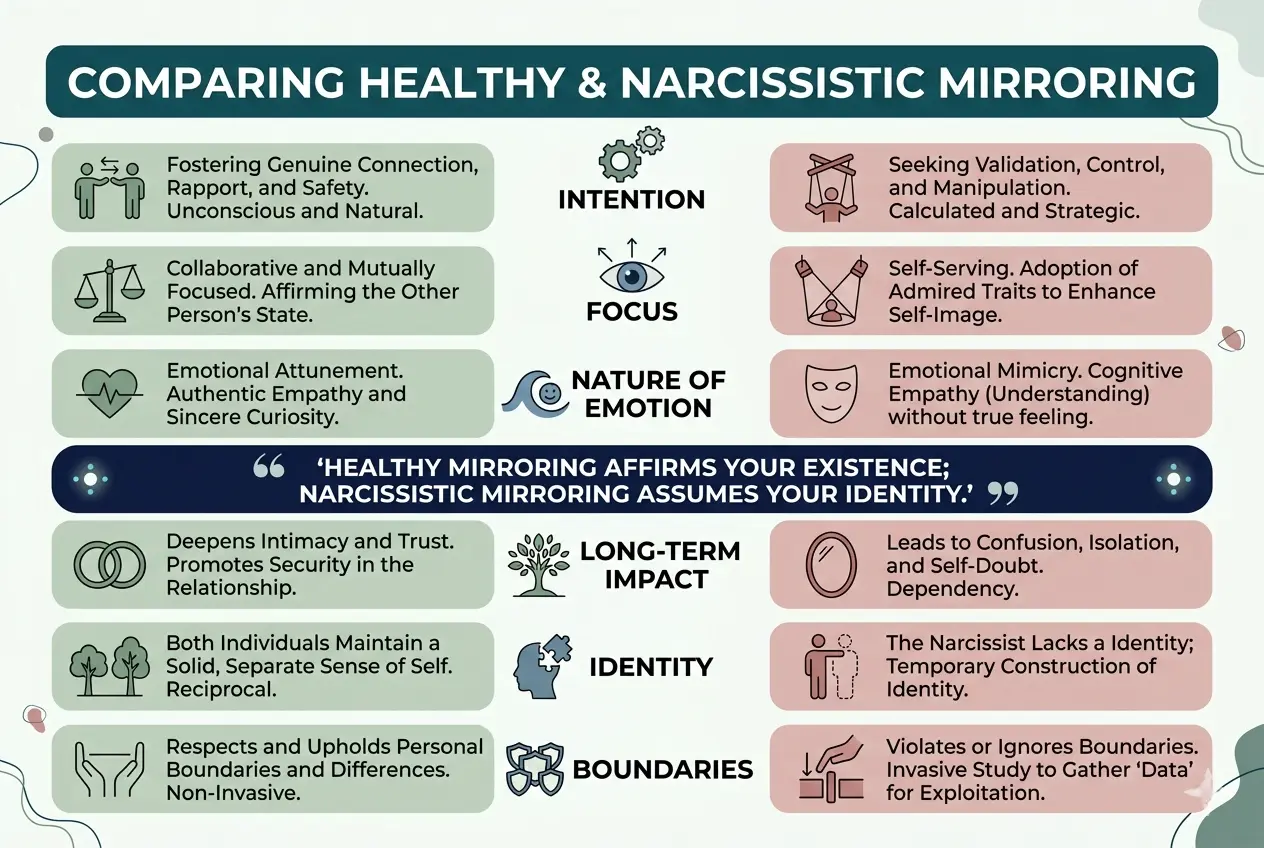
The answer sits in the intent and the direction.
Healthy mirroring, as studied in parent-child attachment research and therapeutic practice, is for the other person. A parent mirrors a baby’s joy to show the child that their emotion is seen and safe.
A therapist mirrors a client’s pain to help them feel less alone in it. The goal is the other person’s sense of being understood.
Narcissistic mirroring is about the narcissist’s goal. The direction is reversed. They are not reflecting your feelings to make you feel whole. They are absorbing your identity to fill their own void and to build leverage.
Psychologist Donald Winnicott described the True Self as the authentic, spontaneous core of a person. His work on object relations proposed that the False Self, by contrast, develops as a protective construction when that authentic self is not safely met.
The narcissist operates almost entirely from their False Self. They cannot offer genuine recognition because they have no stable True Self to recognize you from.
One Psychology Today analysis of narcissistic attraction describes how the mirroring dynamic creates a feedback loop where the target feels seen while the narcissist feels validated. Only one party is gaining anything real.
The table below maps the key differences side by side.
Here is how healthy and narcissistic mirroring differ across the behaviors that matter most to survivors:
| Feature | Healthy Mirroring | Narcissistic Mirroring |
|---|---|---|
| Direction | Reflects your feelings back to you. | Reflects your identity back at you. |
| Intent | Builds your sense of being understood. | Builds trust to gather information for control. |
| Beneficiary | You benefit from the connection. | The narcissist benefits from the manipulation. |
| Long Term Depth | Deepens as your relationship grows. | Fades or turns into a weapon after bonding. |
| Empathy | Requires genuine empathy. | Consists of a calculated performance. |
| Result | Leaves you feeling seen and supported. | Causes confusion, self doubt, and identity loss. |
Key insight: Healthy mirroring validates the other person’s feelings. Narcissistic mirroring harvests the other person’s identity for the mirrorer’s benefit. The acts look similar from the outside. The experience from the inside is entirely different.
You were not wrong to feel seen. Being seen is what the tactic promises. The grief is valid because the need it targeted was real.
What happens when that mirror gets taken away is where the confusion and pain often become hardest to bear.
What Happens When Narcissistic Mirroring Stops?
When narcissistic mirroring stops, the idealization phase ends, and devaluation begins. The narcissist withdraws the reflection, often abruptly, and may begin using your shared information against you.
Many survivors describe this shift as a complete personality change in the person they loved.

One day, you are their everything. Next, you cannot find the person you fell in love with.
This is not because they changed. It is because the mirroring phase had served its purpose. The data was collected. The bond was established. The mask no longer needed to be held in place with the same effort.
The narcissistic abuse cycle moves through idealization, devaluation, and discard. The mirroring belongs entirely to idealization.
When devaluation begins, what was once used to attract you is now used against you. Your dreams become ammunition. Your wounds become weapons.
Here is how the phases typically unfold:
| Phase | Narcissist Behavior | Your Experience |
|---|---|---|
| Idealization | They mirror you and use love bombing to become your ideal person. | You feel seen, loved, and certain this is real. |
| Fracture Point | Mirroring reduces while small criticisms and mood shifts appear. | You feel confused and anxious while trying to get back to the start. |
| Devaluation | They withdraw the reflection and use your personal information to criticize you. | You experience self doubt and walk on eggshells while grieving the person you met. |
| Intermittent Reinforcement | They provide brief returns to mirroring mixed with withdrawal. | You bond deeply and hope the good version returns. |
| Discard or Cycle Reset | They withdraw fully or return to idealization with a new target. | You feel devastated and question your perception of everything. |
Key insight: When mirroring ends and devaluation begins, the narcissist uses the intimate information gathered to weaponize your vulnerabilities, often triggering shame, self-doubt, and loss of identity.
The loss is disorienting at a level that ordinary breakups rarely reach. You are not grieving a person who has left. You are grieving a version of yourself that felt, for the first time, completely known. That is a specific and profound kind of loss.
Many survivors also notice intermittent reinforcement: brief returns to the mirroring behavior, just enough to keep them bonded and hoping.
This is not random. It is the mechanism that deepens a trauma bond, the psychological attachment formed through cycles of reward and withdrawal that keeps you returning for a connection that no longer consistently exists.
A client once told me, “I started dressing differently, changing my opinions, trying to become the person they seemed to want me to be. And I didn’t even notice I was doing it.” That is what losing the mirror does over time. You start trying to become the reflection of yourself.
The cognitive dissonance, holding two contradictory truths at once (“they are terrible” and “but sometimes they are who I fell for”), is a normal response to intermittent reinforcement. Your nervous system is not broken. It is responding exactly as it was conditioned to.
Understanding the cycle is one thing. The deeper question is why this particular kind of loss cuts so much deeper than others.
Why Does Narcissistic Mirroring Hurt So Much?
Narcissistic mirroring hurts so deeply because the connection that is lost was built from your own identity. When the mirror shatters, you grieve not a relationship but a version of yourself that felt fully seen, and the realization that no one was truly there to see you.

This is not ordinary heartbreak. Most breakups leave you grieving a person. This one leaves you grieving the experience of being known.
That is a different wound entirely.
During the mirroring phase, your brain responded with real chemistry. Oxytocin, dopamine, and serotonin flooded in, the same neurochemical pathways activated in genuine, secure bonding.
Your nervous system did not know the difference between a real connection and a constructed one. It felt real because your body treated it as real.
That is why the loss hits at a cellular level. Your nervous system is not overreacting. It is recovering from an actual biochemical bond.
There is also a deeper grief that many survivors struggle to name. It is the grief of the soulless mirror. The narcissist saw you only as raw material.
They knew your wounds, your dreams, your values. But they never actually saw you, the soul behind all of it. You were never witnessed. You were only used.
That realization can feel more devastating than the breakup itself.
Subscribe to Create Higher Vibrations!
Get Inspiration and Practical advice straight to your inbox.
Many survivors fall into a shame loop here. “If the connection was fake, why do I still miss them? Why does it still hurt this much?” The answer is straightforward. Your need to be seen was real. The grief is for that unmet need, not for the person who pretended to meet it.
Key insight: The loss felt after narcissistic mirroring ends is intense because the target grieves the loss of being deeply seen, a need the tactic was designed to exploit.
There is also a spiritual dimension worth naming directly. Many survivors on a conscious path describe a particular kind of soul-level disorientation after narcissistic mirroring ends.
Your inner knowing told you something was wrong long before your mind caught up. The body holds that confusion. That disconnection from your own inner knowing is part of what needs healing.
Two common misconceptions keep survivors stuck in this grief longer than necessary. The first: “They must have loved me because they knew me so well.”
Knowing someone strategically is not the same as loving them. The narcissist studied you. They did not cherish what they found.
The second: “If I could get back to the beginning, it would be okay.” The beginning was a performance built specifically to hook you. It was not a version of the relationship you could return to. It never truly existed.
The pain is real. The relationship, as you experienced it, was not. Both of those things can be true at the same time.
This grief deserves to be taken seriously. And there is a clear path through it.
Discover Your Inner Self. Join Our Self-Mastery Program.
Self-Mastery Coaching gives you the space, tools, and guidance to grow, reflect and discover your values and inner strength.

How Do You Recover After Narcissistic Mirroring?
Recovery from narcissistic mirroring starts with reclaiming what was taken: your sense of self. Healing means learning to see yourself clearly again, without the narcissist’s distorted reflection in the way.
There is no single moment of recovery. There are steps. Each one builds on the last.
Step 1: Name What Happened
The first step is the one you are taking right now. Naming the tactic.
When what happened to you has a name, a pattern, and a psychological explanation, the fog of self-blame begins to lift. You were not foolish. You were targeted. There is a meaningful difference.
Key insight: Naming narcissistic mirroring as a tactic is the first step in recovery, because it separates your identity from the false reflection.
Step 2: Reclaim What Was Yours
Ask yourself this: what did you love before you met them?
Many survivors cannot answer immediately. That absence is information. It shows how completely the mirroring replaced your own reflection.
Start here. Write down ten things that were already yours before the relationship began:
This is not a small exercise. It is the beginning of rebuilding your True Self, the authentic core that exists beneath every role you have ever played.
Step 3: Reconnect With Your Body
Your nervous system carries the imprint of the trauma bond long after the relationship ends. The body does not forget on the same timeline as the mind does.
Practices that help your system begin to regulate include:
Your body knows things your mind is still catching up to. Working with it, not around it, is part of real recovery.
Step 4: Rebuild Trust in Your Own Perception
Part of what narcissistic mirroring disrupts is your trust in your own inner knowing. You sensed something was off. You pushed that sense down. Rebuilding that trust is not a minor side note. It is central to healing.
Notice when your gut signals discomfort. Pause before overriding it. Each small act of listening to yourself is an act of reclamation.
Step 5: Seek Genuine Mirroring
A therapist or trauma-informed coach who understands narcissistic abuse can offer something the relationship never did: consistent, accurate, genuine reflection.
Being truly witnessed by a safe person is itself a powerful part of healing. It rewires the nervous system’s association between intimacy and danger.
Reclaiming your identity after narcissistic abuse is not about returning to who you were before. It is about becoming more fully who you were always meant to be.
You are not rebuilding from nothing. Your identity was always yours. The narcissist borrowed it. You are reclaiming it.
The mirror that matters now is the one inside you.
You Were Never the Problem
The narcissist's mirror was empty. Yours never was.
Your capacity to feel deeply, to want genuine connection, to be known at a soul level, those are not flaws that made you vulnerable. They are the truest parts of who you are.
Narc mirroring targeted your realness. It could not create its own. What felt like love was a reflection of your own light being used to fill someone else's darkness.
Healing from narcissistic abuse begins with understanding what was taken. Reclaiming your identity after narcissistic abuse is where you get it back.
You were always there beneath the borrowed mirror. And you still are.