
The Law of Compensation: What It Means and How to Apply It

Emerson’s version was stranger and more demanding than “give, and you shall receive,” and more useful because of it.
Key Takeaways
What Is the Law of Compensation?
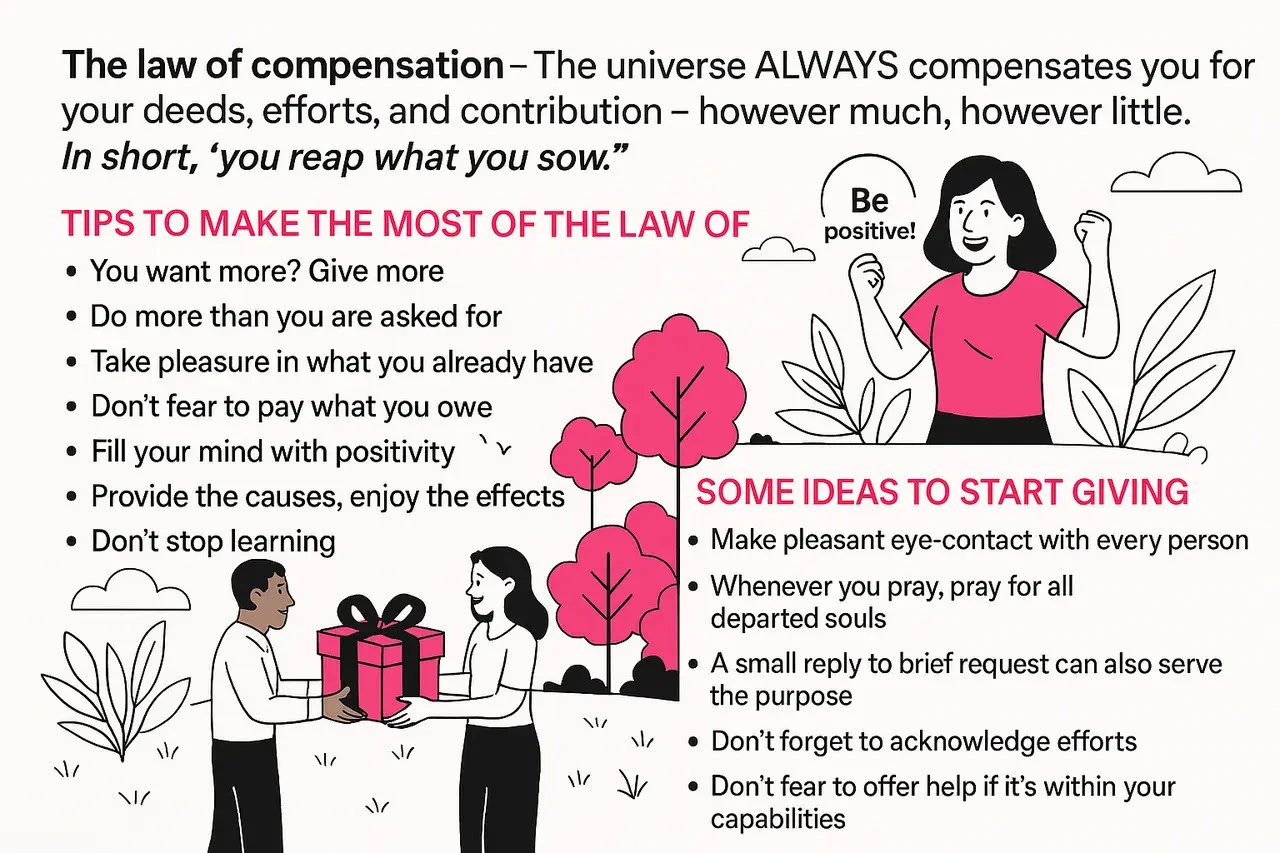
The law of compensation, often summed up as “you get what you give,” is the principle that you receive in proportion to what you give: the value, effort, and intent you put into the world return to you in some form, whether as results, relationships, character, or consequences.
It is one of the most practical ideas in the family of universal laws, because it turns a vague hope (“good things will come”) into a question you can act on today: what am I giving, and what is it costing me?
Below you’ll find where the idea came from, what Emerson meant by it, how it differs from karma and the law of attraction, and how to use it without falling into its most common trap.
Where Does the Law of Compensation Come From?
The phrase belongs to Ralph Waldo Emerson, the American essayist and leader of the Transcendentalist movement. “Compensation” appeared in his Essays: First Series in 1841, the same collection that holds “Self-Reliance” (you can read the full text on Project Gutenberg).
The idea underneath it is much older. “Whatsoever a man soweth, that shall he also reap” (Galatians 6:7) is the reap-what-you-sow version of the same idea, in farming language.
The Hindu and Buddhist teaching of karma, the Stoic view of virtue as its own reward, and folk proverbs about chickens coming home to roost all point in the same direction.
Emerson’s contribution was to treat compensation as a law of nature, as regular as the tides, rather than as a moral lesson.
His reason for writing the essay is the part most summaries leave out. Emerson describes sitting through a sermon on the Last Judgment.
The preacher taught that the wicked prosper in this life while the good suffer, and that the good would be repaid in the next life with the things the wicked enjoyed now.
Emerson found the logic backwards. If heaven’s reward is simply the luxuries the sinners already have, then the preacher secretly believes the sinners chose well.
So Emerson set out to show that the account is settled in this life, continuously, and mostly out of sight.
That origin still shapes how the law is taught. Twentieth-century success writers turned it into a rule about earnings: increase the value of your contribution, and your pay rises to match. Self-improvement teachers such as Brian Tracy still present it that way.
Marianne Williamson took it in a devotional direction in her 2012 book The Law of Divine Compensation, arguing that a mind aligned with love is compensated for material lack. Both readings borrow Emerson’s name. Neither carries the whole of what he said.

What Did Emerson Say About Compensation?
The essay is dense, but four ideas carry it.
Everything comes in pairs. Emerson opens with what he calls polarity: darkness and light, heat and cold, the ebb and flow of water, the heart’s contraction and release.
His summary is blunt: “Every excess causes a defect; every defect an excess.” Strength in one area is paid for with weakness in another.
This is the same pattern the site’s piece on the law of polarity explores, and Emerson treats it as the engine of compensation.
The consequence is inside the act. “Crime and punishment grow out of one stem,” he writes. The liar does not wait for a future penalty; the lie immediately narrows his world, because he now has to manage it. “The thief steals from himself.”
A person who treats others as tools can only relate to people as tools, and that is its own sentence. In Emerson’s words: “Treat men as pawns and ninepins and you shall suffer as well as they.”
Every benefit carries a tax. This is the line modern teachers tend to skip. “Every advantage has its tax,” Emerson says, and “for every benefit which you receive, a tax is levied.”
The promotion costs your evenings. The fame costs your privacy. Money that arrives “without desert or sweat,” he warns, “has no root in me, and the next wind will blow it away.”
His advice follows: “Always pay; for first or last you must pay your entire debt.”
Losses carry hidden gains. Emerson turns the law toward grief. The death of someone close, which seems “nothing but privation,” often “somewhat later assumes the aspect of a guide or genius,” because it ends one chapter of life and forces a new one.
He does not claim that loss is good. He claims it is never only loss.
Then comes the turn that makes the essay spiritual rather than transactional. “The soul is not a compensation, but a life,” Emerson writes. Goodness, in his view, is not a deposit waiting for a return.
“There is no tax on the good of virtue,” because virtue is its own reward from the moment it is practiced.
That is the paradox at the center of the law of compensation. It is most reliable for the person who has stopped giving to get.
How Is the Law of Compensation Different From Cause and Effect, Karma and the Law of Attraction?
These ideas overlap, and many articles use them interchangeably. They are worth separating.
Cause and effect says something follows. Compensation says what follows matches what you gave. Karma adds intention and a spiritual path. Attraction adds the mind.
How Does the Law of Compensation Show Up in Everyday Life?
The law is easiest to see in the parts of life where effort compounds slowly.
Relationships. Attention, patience, and honesty build trust in small increments, and trust is what you draw on when things get hard. The reverse holds too. Criticism and neglect are rarely punished on the day they happen; they show up months later as distance.
Emerson’s “tax” applies here as well: closeness costs vulnerability, and a relationship that asks for no risk rarely gives much depth.
Work and career. People who reliably give more value than their role requires usually end up with more responsibility, trust, and income, though the timing is uneven and the market is not always fair.
The tax is real: more responsibility means more pressure. Seeing that trade clearly helps you decide which advancement you actually want.
Personal growth. Every hour spent learning a skill or facing an uncomfortable truth about yourself returns as capacity. Much of this return comes as ease: the hard conversation you can now have without shaking, the habit that no longer needs willpower.
If you want a method for that kind of self-audit, the self-reflection techniques guide lays out several.
Health. Sleep, movement, and food are compensation in its most literal form. The body keeps an exact account, and it collects with interest. Years of short sleep or no movement rarely cost anything on the day; the bill arrives later, and all at once.
Across all four areas, the pattern is the same: the return tends to be delayed, it arrives in a different currency from the one you spent, and it is almost always proportional.
Does the Law of Compensation Mean People Get What They Deserve?
No, and this is where the idea can be harmful.
Psychologists have studied a closely related belief for more than fifty years. Melvin Lerner called it the belief in a just world: the conviction that people get what they deserve and deserve what they get.
Research summarized by Stroebe and colleagues in PLoS One (2015) notes that this belief helps people feel the world is stable and orderly, and that it can also lead them to blame victims for their misfortune rather than help them.
Read carelessly, the law of compensation becomes the same belief in spiritual language. A child’s illness, a layoff in a recession, abuse, and poverty are not invoices for something the person gave.
Using the law to explain other people’s suffering turns a tool for self-examination into a tool for judgment.
Emerson’s own frame protects against this. He applies the law to the inner account (character, capacity, freedom), not to outcomes that other people and chance control.
His claim about the thief is that the theft shrinks the thief, not that every poor person must have stolen something.
So point the law at yourself, and never at someone else’s pain.
How Do You Apply the Law of Compensation?
Practiced well, the universal law of compensation asks for more honesty than optimism. Five practices come straight from Emerson’s essay.

What Blocks the Law of Compensation?
Most people who say the law “isn’t working” are running into one of three habits, and each one keeps them from seeing or paying the account clearly.
Complaining instead of contributing. Complaining feels like action, but it spends energy without adding anything. A week of noticing every complaint and asking “what could I give here instead?” usually shows how much attention was going nowhere.
Comparing your account with someone else’s. You see another person’s gains, never their tax. Emerson’s whole argument is that the visible half of any life is misleading. The law of relativity makes a related point: comparison changes how your situation feels without changing the situation.
Avoiding risk to avoid loss. Because every gain has a cost, some people stop reaching for anything. But refusing to pay does not cancel the account. A life lived to avoid every tax pays one anyway, in the form of what never grew.
The parts of yourself you’ve learned to hide carry the same cost, which is why shadow work belongs in this conversation.
Subscribe to Create Higher Vibrations!
Get Inspiration and Practical advice straight to your inbox.
What Can You Do With the Law of Compensation This Week?
None of this means you were at fault for what life has handed you. Much of it was set in motion long before you could weigh the cost. But what you give from here is yours to decide, and the account starts moving the moment you do.
Take one area from the everyday-life list above (a relationship, your work, your body) and make a single repayment this week without expecting a return.
Watch what changes in you before anything changes around you. Then read how compensation fits among the other universal laws, starting with polarity and cause and effect.
Emerson thought the account was always balanced, even when it looked unfair. Whether he was right about the universe, he was right about the person doing the giving. The one who gives freely gets the most, precisely because they stopped asking to be paid.