
Limiting Beliefs: What They Are, Common Examples, and How to Change Them

The belief that stops you rarely sounds like a belief. It sounds like a plain fact about who you are.
Key Takeaways
Limiting beliefs are assumptions about yourself, other people, or the world that you accept as true, even though they are holding you back. “I’m not smart enough.” “People always leave.” “Money is hard to come by.” Each one feels like a fact. Each one quietly decides what you will try.
You can’t argue with a belief you never notice. Once you can see one clearly, it starts to look less like the truth and more like an old habit of mind.
What Are Limiting Beliefs?
A limiting belief is a thought you have repeated so often that it no longer feels like a thought. It shapes what you notice, what you attempt, and what you expect to happen. Some people call them self-limiting beliefs, since the limit is set from the inside.
The phrase is popular in coaching and self-help. Therapists use a close cousin. Psychiatrist Aaron Beck, the founder of cognitive therapy, described deep “schemas” about the self, the world, and the future. Cognitive behavioral therapy calls the deepest of these core beliefs.
Core beliefs sit underneath the chatter. The quick thought “I’ll mess this up” is the surface. Below it might sit “I always fail.” Below that, “I’m not good enough.” That last one is the belief doing the real work.
What Are Some Common Limiting Beliefs?
Most of these beliefs fall into a few families. You will probably recognize one or two.
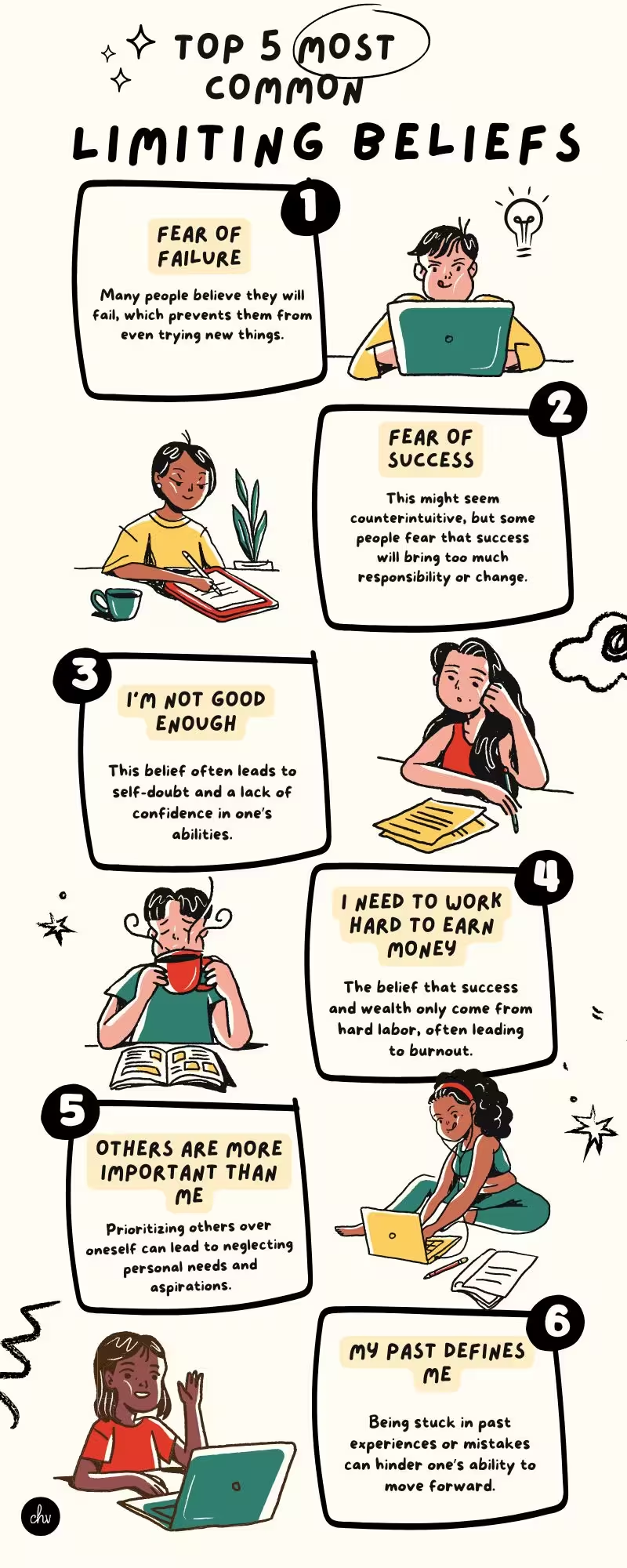
Fear of failure gets most of the attention. Fear of success shows up too. Some people fear that success will bring too much responsibility, change their relationships, or make them a target.
Where Do Limiting Beliefs Come From?
Limiting beliefs are learned. Nobody is born thinking they are unlovable. Beck’s research traced negative schemas to childhood events like the loss of a parent, rejection by peers, bullying, and criticism from teachers or parents.
The common sources look like this:
Many of these beliefs once protected you. “Don’t speak up” kept a child safe in a volatile home. The belief outlived the danger.
Why Do Limiting Beliefs Feel So True?
Limiting beliefs feel true because the mind collects evidence for them. Psychologists call this confirmation bias. In a classic 1998 review, Raymond Nickerson described it as the habit of seeking out and interpreting evidence in ways that favor what we already believe (Nickerson, 1998).
So the belief “People always leave” remembers every breakup. It forgets the friend who stayed for twenty years. The record looks airtight because it was edited.

They also fulfill themselves. If you believe you will fail an interview, you prepare less. You arrive tense. The rejection then confirms the belief. Nobody planned it. The belief steered the whole sequence.
A belief like this is less like a wall and more like a filter. It changes what you see, then points to what you saw as proof.
How Do Limiting Beliefs Affect Your Career and Mental Health?
These beliefs rarely stay in one corner of life. A belief about your worth shows up at work, in love, and in your health.
At work, the best-studied version is impostor syndrome. Psychologists Pauline Clance and Suzanne Imes first described it in 1978. They studied high-achieving women who believed their success was a fluke (Clance and Imes, 1978).
A 2020 review of 62 studies found impostor feelings in men and women, from teenagers to senior professionals. Rates ranged from 9 to 82 percent, depending on how they were measured. The feelings were linked to burnout, lower job satisfaction, and weaker job performance (Bravata et al., 2020).
In relationships, a belief like “I’m too much” can make you hide your needs until resentment builds. “People always leave” can make you leave first.
Mental health takes the deepest hit. Beck’s model of depression puts negative beliefs about the self, the world, and the future at its center.
The same 2020 review found impostor syndrome often travels with depression and anxiety. Low self-worth passes for a mood. It is closer to a lens.
How Do You Identify Your Limiting Beliefs?
They hide in plain sight. These methods bring them to the surface:

The downward arrow comes from cognitive therapy. Psychiatrist David Burns popularized it in his 1980 book Feeling Good. Here is how a chain might run:
The last line is the belief doing the damage. The first line was just an unanswered email.
How Do You Overcome Limiting Beliefs?
You overcome one of these beliefs by weakening its grip, not by shouting it down.
Cognitive behavioral therapy (CBT) works directly on beliefs like these. It is one of the most studied therapies in the world. A 2012 review found 269 meta-analyses of CBT (Hofmann et al., 2012).
These steps borrow from that work:
Therapists call that last step a behavioral experiment. It carries the most weight. A belief formed through experience changes through experience. Your nervous system trusts what happened more than what you told it.
Arnold Schwarzenegger is a useful example. His first film, Hercules in New York, credited him as “Arnold Strong.” His accent was so thick that his lines were dubbed.
Seven Mr. Olympia titles later, he became one of the biggest action stars of the 1980s. Each role was a fresh piece of evidence.
Do Positive Affirmations Help?
Positive affirmations work for some people and backfire for others. Psychologist Joanne Wood and her colleagues tested this in 2009. People with low self-esteem who repeated “I’m a lovable person” felt worse afterward than people who did not (Wood et al., 2009).

People with high self-esteem got only a small lift.
The likely reason is simple. A statement that clashes with what you believe invites the mind to argue back. Each repetition becomes a small debate that the old belief wins.
A different technique has better support. Self-affirmation, in the research sense, means writing about a value that matters to you, such as honesty, family, or curiosity. A 2014 review by Geoffrey Cohen and David Sherman found these brief exercises can reduce defensiveness and help people take in threatening information (Cohen and Sherman, 2014).
Believable statements beat grand ones. “I’m learning to speak up” can land where “I am a confident leader” bounces off.
What Do Limiting Beliefs Have to Do With Manifestation?
In manifestation circles, limiting beliefs are often named as the reason a goal isn’t arriving. The idea is that a hidden belief like “I don’t deserve this” quietly works against what you consciously want.
Part of this matches the psychology. Beliefs shape attention, effort, and the chances you take. Someone who believes money always slips away may avoid asking for a raise. The law of attraction principles describe this pull in spiritual language.
The useful move is the same in both frames. Find the belief, test it, and act against it.
Practices like manifestation journaling can help you spot the belief behind a stuck goal.
For the deeper habit layer, see our guide to subconscious reprogramming. If your thoughts feel like the whole truth, learning to stop identifying with your thoughts adds useful distance.
Subscribe to Create Higher Vibrations!
Get Inspiration and Practical advice straight to your inbox.
How Do You Test a Belief You Can’t Argue Away?
Pick one belief from this page that made you wince. Write it down in its bluntest form.
Then design a test small enough to do in a day. If the belief is “Nobody wants to hear my ideas,” share one idea in one meeting. Write your prediction first. Afterward, write what actually happened.
Keep a page of these results. Over a month, the page becomes a record the old belief never kept. Some tests will confirm your fear. Others will surprise you.
The belief told you it was protecting you from the truth. The test is how you find out what is true.

