
How to Understand Yourself: A Practical Guide to Knowing Who You Are

You have spent your whole life with yourself. That is the reason you are so hard to see.
Key Takeaways
To understand yourself is to see your values, emotions, habits, and motives clearly, including the way you come across to other people. It is a skill you keep practicing through honest reflection, outside feedback, and attention to your own patterns, and it is rarer than most people assume.
Learning how to understand yourself pays off in practical ways. You make decisions with less regret, you react less and choose more, and you stop repeating patterns you never noticed you were running.
What Does It Mean to Understand Yourself?
Understanding yourself means knowing what drives you and why you act the way you do. That covers your core values, your emotional patterns, your strengths and blind spots, and what you want from your life when nobody is watching.
Self-understanding is easy to confuse with two other habits that feel similar from the inside.
Self-knowledge also changes over time. The person you understood at twenty-five is not the person living your life now, which is why the practice never finishes.
Why Is It So Hard to Understand Yourself?
Organizational psychologist Tasha Eurich led a research program of 10 investigations with nearly 5,000 participants. In her 2018 Harvard Business Review summary, she writes that most people believe they are self-aware, yet her team estimated that only 10 to 15 percent actually fit the criteria.
That gap has causes you can name.
Their distinction explains what they called the self-absorption paradox. People who pay close attention to themselves tend to have more accurate self-knowledge and also more distress, because the same score was mixing two different habits.
Eurich’s team found a practical version of this. In their interviews, the highly self-aware people asked “what” far more often than “why.”
“Why did I snap at her?” invites the mind to invent a flattering or damning story. “What was I feeling right before I snapped?” gives you a fact you can work with.

What Are the Two Types of Self-Awareness?
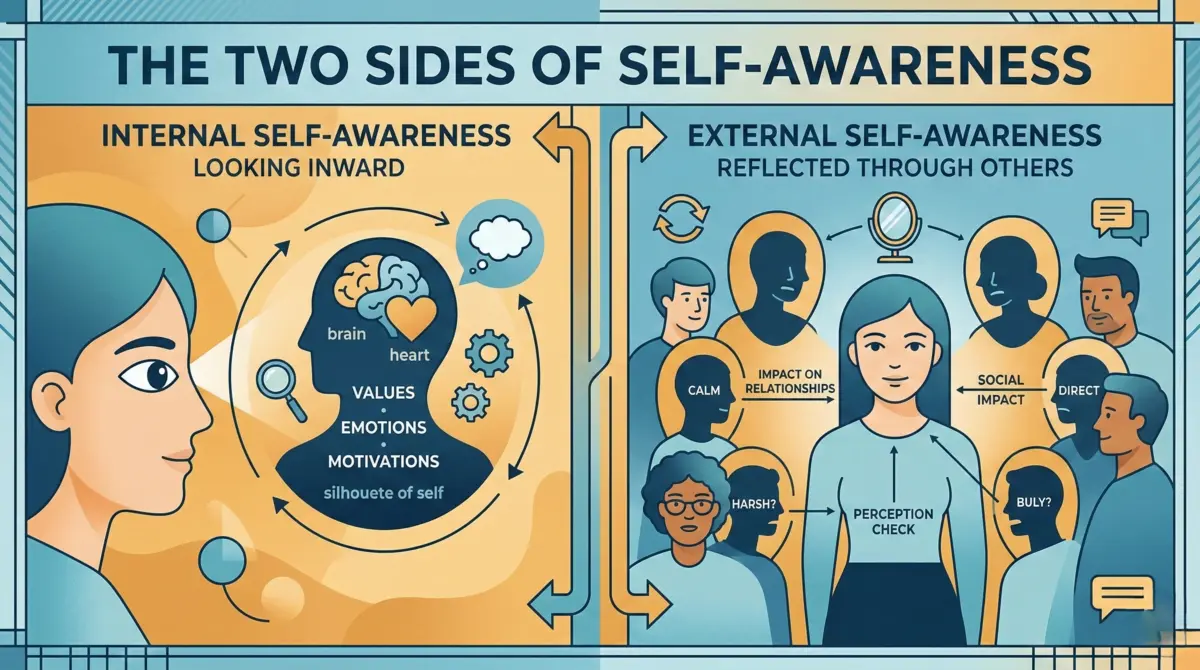
Eurich’s research sorted self-awareness into two categories. Both matter, and most people are stronger in one than the other.
Internal self-awareness is how clearly you see your own values, passions, aspirations, reactions and impact on others. The question behind it is “What drives me?” Eurich reports that it goes with higher job and relationship satisfaction and with lower anxiety, stress and depression.
External self-awareness is how accurately you know the way other people see you, on those same qualities. The question behind it is “How do I come across?” People who have it tend to be better at empathy and at taking another person’s perspective. This outer awareness is also the root of a strong presence.
You might expect the two to travel together. Eurich’s team found virtually no relationship between them.
So a deeply reflective person can still be blind to how they land in a room, and a socially sharp person can have no idea what they want.
The people in her interviews who improved their external self-awareness did it through what she calls “loving critics”: people who have your best interests at heart and will still tell you the truth.
Why Do I Feel Like I Don’t Know Who I Am Anymore?
Your self-concept, the inner picture of who you are, keeps changing across your life. A child builds it from what they can do and who they belong to. By adolescence, other people’s opinions write large parts of it.
Adulthood makes the gap between who you are and who you think you should be harder to ignore. Many people build a defended identity to manage that gap, then spend years maintaining it.
Big transitions break that picture open. A career change, a breakup, a loss, a move, becoming a parent, or an empty house after the children leave can all leave you asking who you are now.
That disorientation is common, and it usually means your old self-picture no longer fits your life. It is an invitation to update the picture, and to look at the parts of yourself you have kept out of view. The article on the shadow self goes further into those hidden parts.
Why Does Understanding Yourself Matter?
The benefits are concrete. Once your core values are clear, choices get faster because you already know what you are protecting.
Recognizing your emotional triggers gives you a small gap between the feeling and the reaction. Working with emotional triggers is one of the quickest ways to feel that gap widen.
When you understand your habits, you can change the ones that cost you. And when you are clear about who you are, you have less to defend, so you listen better and argue less.
What Are the Signs You Don’t Know Yourself Well?
Most people recognize a few of these at some point. None of them means something is wrong with you. Each one points to the place where more self-inquiry will pay off.
Seeing these patterns clearly is the first move. The patterns were set long before you could question them, and now you can.
Subscribe to Create Higher Vibrations!
Get Inspiration and Practical advice straight to your inbox.
How Can You Understand Yourself Better? 9 Practical Steps
If you want to learn more about yourself, these steps work as a sequence or on their own. Start with the one you feel most resistance to, because that resistance is information.
If these steps leave you wanting a clearer sense of identity rather than more data about yourself, the guide on how to find your true self picks up from here.

What Questions Help You Get to Know Yourself?
Use these as journaling prompts or as questions to think over on a walk. There are no correct answers, only accurate ones.
1. Do You Follow Rules or Push Against Them?
Your relationship with authority shows how much autonomy you need. People who resist structure by default often hold independence as a core value, while people who follow rules easily tend to value harmony or security. Each side has its own strengths and costs.
2. Which Stories Do You Keep Returning To?
The films, books, and podcasts you come back to often point at an unmet need. Someone drawn again and again to stories of reinvention may be carrying a real wish for change.
3. What Comes Easily to You That Others Find Hard?
Most people dismiss their natural abilities because they feel effortless. Ease is often a sign of an underlying strength, and it deserves more attention than it gets.
4. Which Flaws Do You Admit, and Which Do You Defend?
The flaws you freely admit are rarely the most useful ones to study. The ones you defend against are. Your defensiveness marks the spot.
5. How Do You Feel About Taking Risks?
Your comfort with uncertainty shapes your choices more than your skill level does. Knowing where you sit lets you predict what you will do under pressure.
6. Which Five Words Describe You Today?
Describe who you are right now, not who you hope to be. Then ask two trusted people for their five words. The distance between their lists and yours is where external self-awareness grows.
7. What Takes Priority for You, Career or Family?
Most people want both. What matters is which one wins when they conflict, because knowing that ahead of time makes hard choices cleaner.
8. Does Competition Energize or Drain You?
Some people sharpen when they compete, and others do their best work in collaboration. Knowing which fits you helps you choose jobs, teams, and friendships that bring out your best.
9. Are You More Reactive or Proactive?
Reactive people are steered by their surroundings and the people around them. Proactive people direct their own attention and energy. Everyone does both, so ask which one runs you in the situations that matter most.
What Does “Know Thyself” Mean?
“Know thyself” was carved at the temple of Apollo at Delphi, and Greek philosophy treated it as the first task of a thoughtful life. In Plato’s Phaedrus, Socrates declines to spend time on myths because, in his words, “I must first know myself, as the Delphian inscription says” (Phaedrus, Jowett translation).
Eastern traditions push the question further. In the Advaita Vedanta taught by Ramana Maharshi, the question “Who am I?” is used in its own way, turned back on the one asking it until the thinker itself is examined.
Psychology asks what your values and patterns are. The contemplative traditions also ask who is doing the noticing. That second question leads into self-realization and into the nature of awareness itself.
How Does Understanding Yourself Help You Understand Others?
Self-knowledge and empathy grow together, and a study shows it.
Researchers led by Anne Böckler gave two groups of adults, 80 and 81 people, a three-month contemplative training in which they learned to identify distinct inner “parts” of their own personality (Böckler et al., 2017, Journal of Cognitive Enhancement).
The more parts a participant learned to identify, the more their theory of mind improved. Theory of mind is the ability to infer what other people are thinking and feeling. The link was strongest for the parts people found unpleasant to look at.

You can see the same effect in daily life. Once you recognize your own triggers, you project them onto others less, and someone with different values stops feeling like a threat.
That clarity also makes it easier to communicate effectively in the relationships that matter to you.
Understanding someone does not require agreeing with them. It means reading people and situations more accurately, so conflict gets smaller before it starts.
Where Should You Start?
Nobody handed you a manual for understanding yourself. The habits you run were installed long before you could inspect them, and none of that is your fault.
Understanding them is now your job, and it starts with one question you can answer today: What did I want before I started worrying about what other people thought?
Write down the first answer that comes, before your mind tidies it up. You have been living with that answer the whole time.
More reads on building self-knowledge live in the self-mastery section.