
How to Overcome Self-Doubt and Overthinking: A Guide to Ruthless Action

It is 2:00 AM. You are staring at the ceiling, completely trapped in a cycle of self-doubt and overthinking while replaying a conversation from three days ago. Your chest feels tight, your energy is entirely drained, and a quiet, persistent voice in your head is whispering that you are completely unequipped to handle what’s coming next.
This is the hidden tax of a hyperactive mind. You aren’t lazy, and you aren’t incapable; you are simply caught in a psychological feedback loop where your brain has turned its analytical machinery against you.
When left unchecked, this mental static doesn’t just make you miserable; it erodes your ability to step into your authentic self, stalling your ambition and replacing decisive momentum with permanent hesitation.
-
The Glitch. Overthinking is a fear-driven defense mechanism. It triggers an amygdala hijack and depletes your emotional bandwidth. It is not preparation.
-
The Cost. Chronic hyper-analysis forces your nervous system into permanent dysregulation. This transforms temporary hesitation into systemic self-doubt.
-
The Fix. You break this loop using a behavioral protocol rooted in neuroplasticity. Use cognitive interception, radical reality testing, present-moment mindfulness, intentional focus shifting, and immediate micro-actions.
What Is the Biological Connection Between Overthinking and Self-Doubt?
To break this loop, you have to understand exactly how your brain glitches. People often treat overthinking and self-doubt as two separate emotional problems, but they actually function as a cause-and-effect loop rooted in neurobiology.
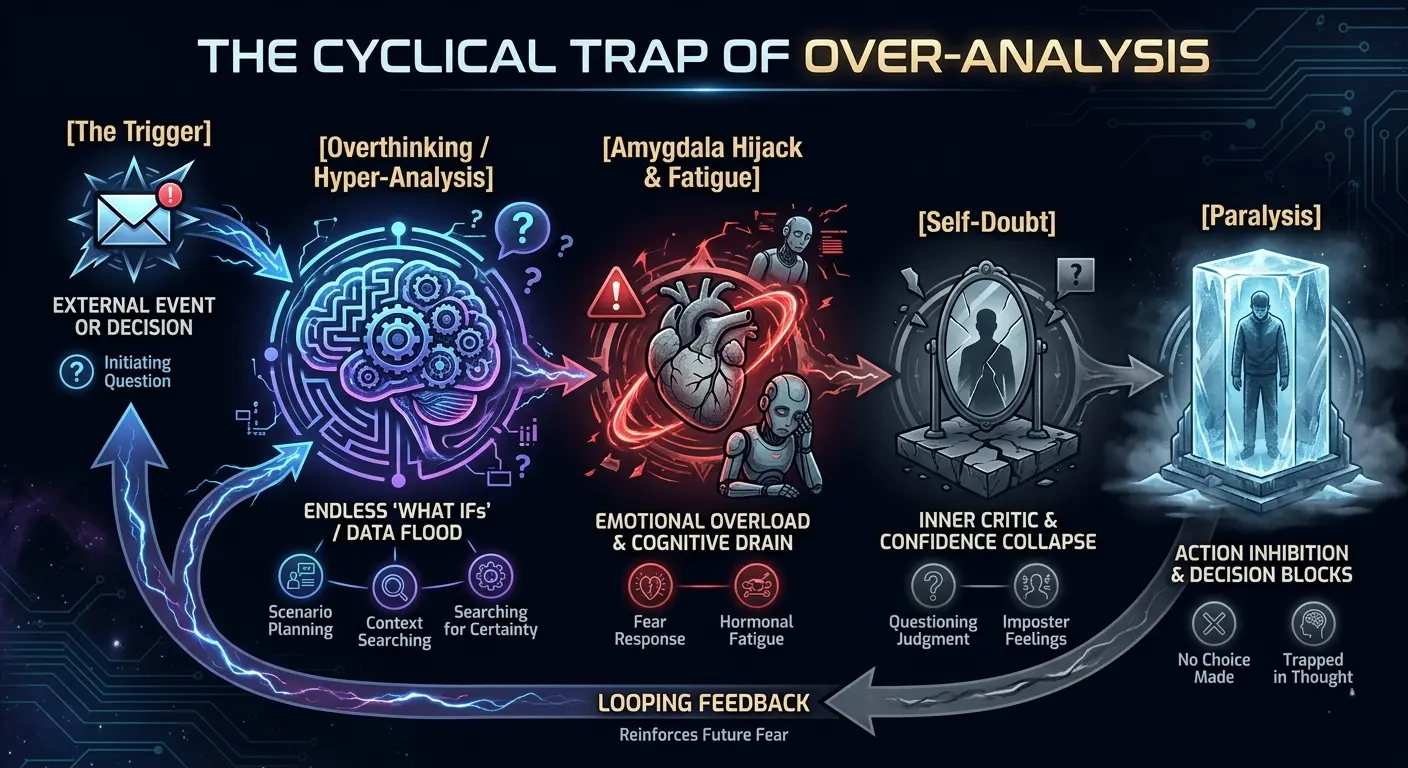
Phase 1: Overthinking (The Cognitive Catalyst)
Overthinking is the obsessive, repetitive habit of over-analyzing past events or over-examining future variables. It masquerades as useful preparation, but it is actually a sophisticated ego defense mechanism rooted in fear.
Your brain falsely believes that if it constructs enough hypothetical scenarios, it can insulate you from failure, rejection, or discomfort.
Phase 2: Self-Doubt (The Somatic Outcome)
When you endlessly loop through hypothetical failures, your nervous system cannot tell the difference between a real threat and an imagined one. Your body experiences a literal amygdala hijack, flooding your system with cortisol and adrenaline.
According to the Mayo Clinic’s research on chronic stress, this prolonged exposure to stress hormones disrupts almost all your body’s natural processes, creating a state of chronic inner tension.
As emotional and physical exhaustion sets in, your subconscious mind reaches a logical conclusion: “If I am this terrified and exhausted just thinking about this, I must not have what it takes to handle it.” This is the exact moment overthinking transforms into self-doubt, the systemic uncertainty regarding your competence, decisions, and inherent value.

Why Does the Brain Default to Negative Patterns and Fear?
Self-doubt is not a personal character defect; it is a miscalibrated evolutionary survival mechanism. The American Psychological Association notes that our brains are naturally wired with an evolutionary negativity bias, meaning we are inherently primed to notice and react to threats more intensely than positive opportunities.
The True Root Causes of a Hesitant Mind
Self-doubt becomes a permanent barrier only when you treat it as an objective fact rather than a temporary emotional weather pattern.
By leveraging neuroplasticity, the brain’s proven ability to reorganize itself by forming new neural pathways, as documented by the National Institutes of Health, you have the power to rewire these pathways and change the forecast.
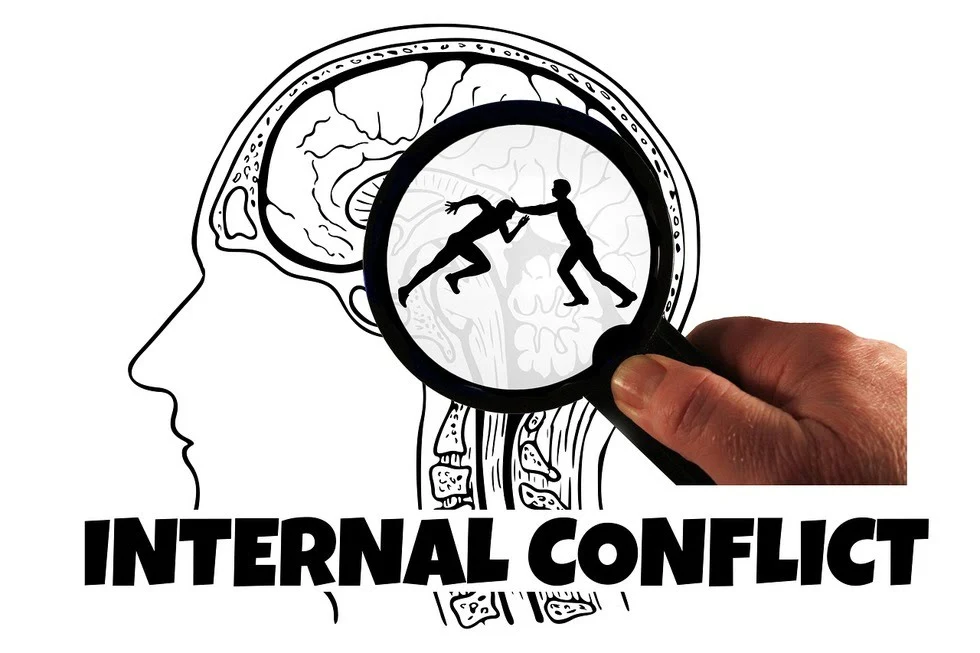
How Do You Stop Overthinking? A 5-Step Mindset Protocol
Overcoming a hyperactive mind requires structured, behavioral intervention rather than just “thinking positive.” Use these five psychological tools to shift from a state of paralysis to a state of execution:
1. Practice Cognitive Interception
You cannot change a habit you aren’t aware of. The moment you catch your mind spinning in circles, mentally step back and observe the thought without judgment.
Use cognitive defusion by labeling it: “I am experiencing the thought that I am unprepared.” This simple shift creates space between your identity and your anxiety. Thoughts are data, not directives.
2. Radical Reality Testing
Challenge the validity of your internal critic using cognitive reframing. Ask yourself: What objective evidence do I have to support this fear? Am I confusing a feeling of discomfort with a fact of inability? More often than not, you will find your fears are entirely baseless projections.
3. Anchor in the Present via Mindfulness
Practicing mindfulness is the deliberate act of anchoring your awareness to the “here and now.” When you are fully immersed in the present moment, your brain lacks the cognitive bandwidth to obsess over the past or project catastrophes into the future. It is the ultimate antidote to mental overwhelm.
4. Intentional Focus Shifting
When an overthinking spiral begins, deliberately pivot your attention to a positive, high-vibrational anchor. This could be a past win, a gratitude list, or a dedicated session of positive visualization techniques to prime your brain for success. Forcing your mind to focus on optimization naturally starves the anxiety loop of its fuel.
5. Execute on a Micro-Action
The most effective way to quiet your mind is to move your body. Action creates clarity; thinking does not. If you are stuck, choose an achievable micro-step that takes less than five minutes and execute it immediately. This breaks the physical stagnation and signals to your nervous system that you are safe.
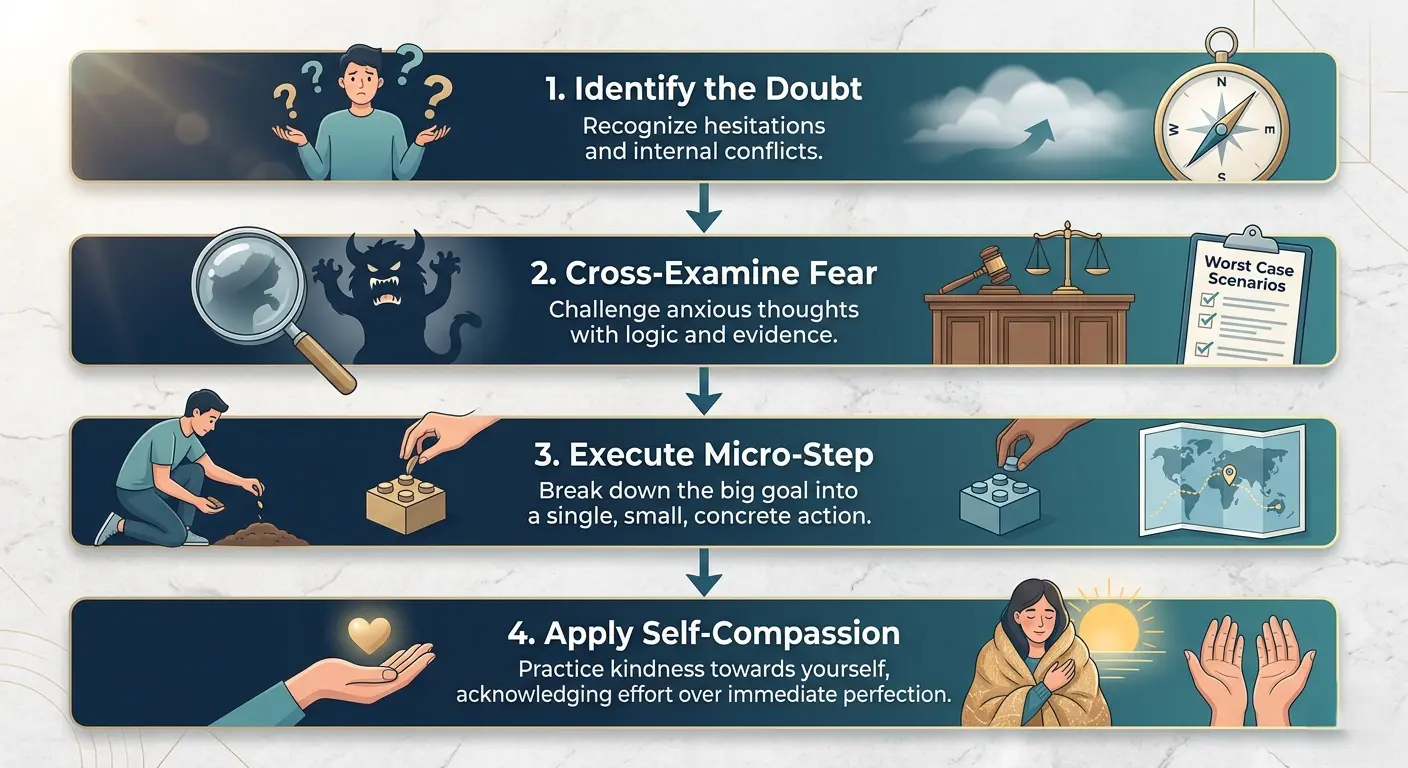
What Are the Most Effective Strategies for Overcoming Self-Doubt?
When self-doubt creeps in, don’t try to aggressively force it away. Instead, manage it using this four-tier emotional regulation framework:
Subscribe to Create Higher Vibrations!
Get Inspiration and Practical advice straight to your inbox.
Final Action
Every great creator, entrepreneur, and leader has had to look their inner critic in the eye and choose action anyway. The difference between those who achieve their goals and those who stay stuck isn’t a lack of doubt; it is a refusal to let doubt steer the ship.
You are the author of your narrative, not the victim of your subconscious wiring. If you want to permanently break the patterns of self-sabotage, quiet the external noise, trust your intuition, and actively build your resilience through daily execution.
If you are ready to accelerate this transformation, integrate deep mindset work into your routine, or work closely with an embodiment coach to realign your energy and actions, the time to begin is now. Turn your insights into impact.