
Quantum Meditation: What It Is, How to Practice It, and What the Science Says
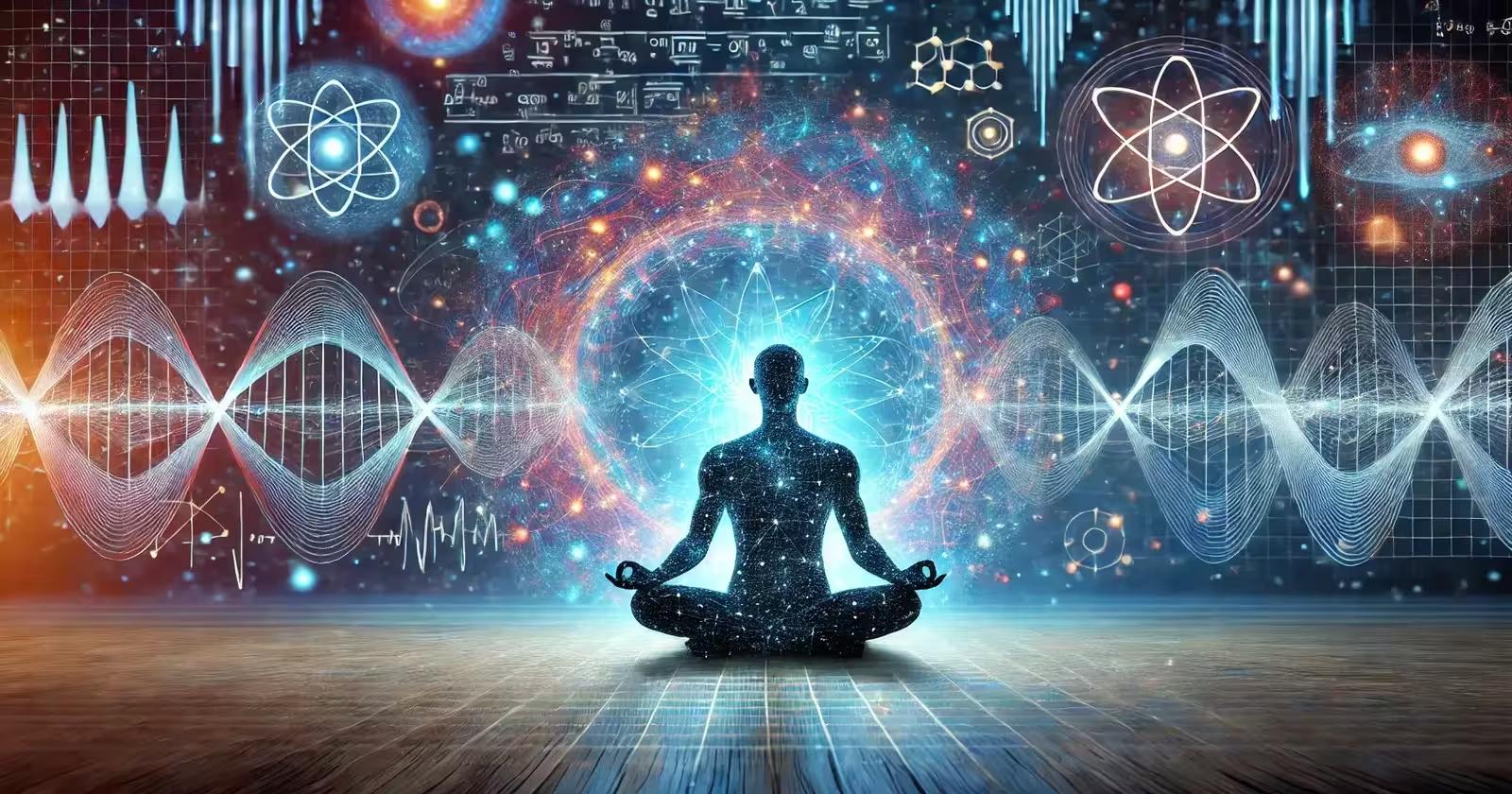
The best-known study of a “quantum” meditation retreat tracked 20 people, had no control group, and counted the teacher as a co-author. Anyone who left a session calmer still felt something real.
Key Takeaways
Quantum meditation is a style of guided meditation that combines deep relaxation, a clear intention, and visualization of a “quantum field” of possibility. Practitioners aim to feel the emotions of a desired future as if it were already happening. Teachers present it as a way to change your life from the inside out.
There is no single quantum meditation method. The term covers many teachers, recordings, and retreats, each with its own script.
What Is Quantum Meditation?
Most versions share one core idea. Everything is made of energy, the story goes. Your thoughts and feelings are energy too. Change your inner state, the teaching says, to change what shows up in your life.
In practice, this style is closer to visualization than to classic meditation. Mindfulness asks you to observe the present. The quantum version asks you to rehearse a future.
Some versions lean toward stress relief. Others are explicitly about manifestation, the belief that focused intention attracts what you want. A related style, “quantum jumping,” has you imagine meeting an ideal version of yourself in a parallel reality.
Where Does the Idea of Quantum Meditation Come From?
The idea grew out of a wider movement called quantum mysticism. It links spiritual ideas to the strange findings of 20th-century physics.
A few landmarks shaped it:
Today, the best-known teacher is Joe Dispenza, whose company runs large meditation retreats. His events draw hundreds of people at a time.
What Does a Quantum Meditation Session Involve?
Sessions vary, but most follow a similar arc. Here is what you are likely to meet in a guided recording or retreat:
Some teachers describe the emotion step as meeting your future self. You imagine the person who already lives the outcome, then try to feel what that person feels.
Many people journal afterward. Some sessions run 10 minutes. Retreat sessions can last an hour or more.
How Do You Practice Quantum Meditation?
You can try a short, grounded version at home. It keeps the useful parts. It needs no special beliefs.

Start with 10 to 15 minutes. Keep sessions short at first, especially if you are new to meditation. For the basics of sitting practice, see our guide on how to meditate.
What Is Quantum Jumping?
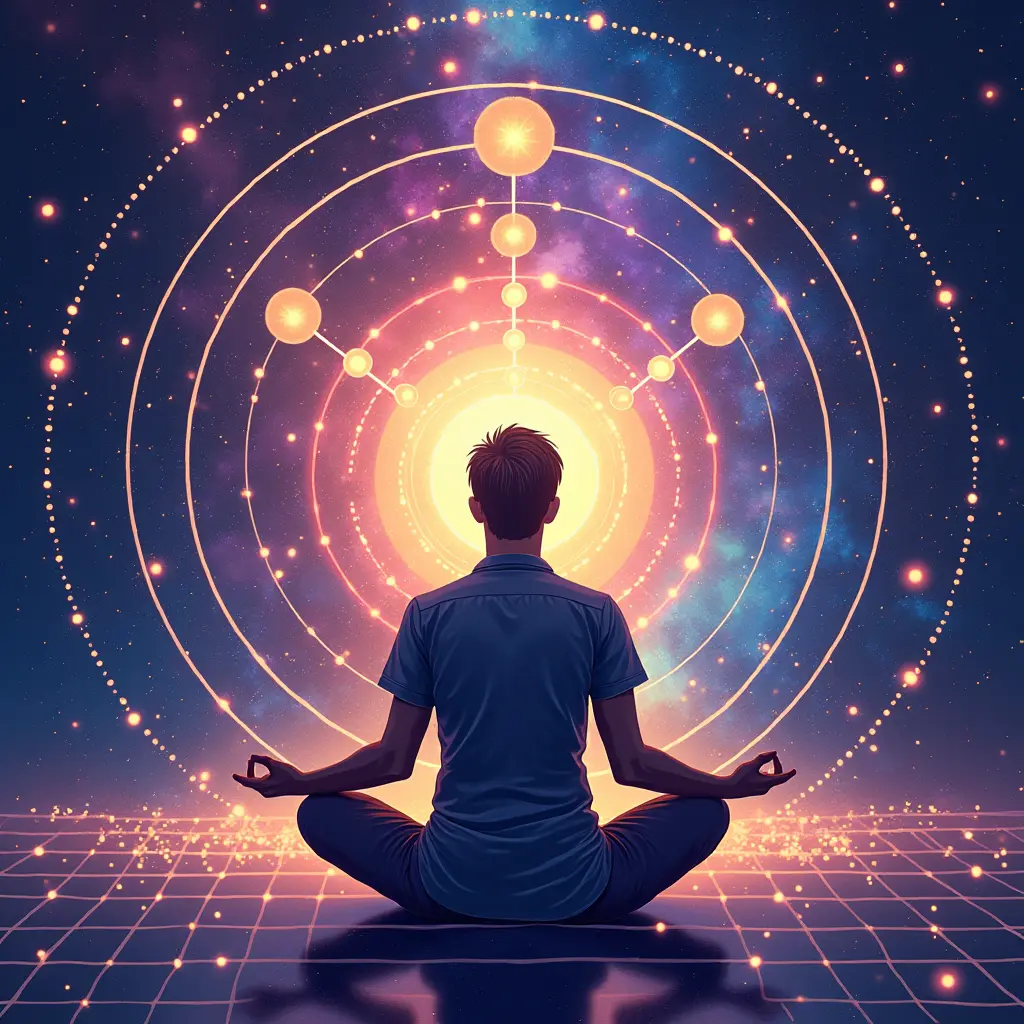
Quantum jumping is a popular offshoot of the practice. In a guided session, you imagine stepping through a portal into a parallel reality. There you meet a version of yourself who already has the skill, calm, or success you want.
You “ask” that self for advice. Then you return, carrying the feeling back with you.
The parallel-universe framing borrows from the many-worlds interpretation of physics. Nothing in that interpretation lets a person visit another branch.
As an imagination exercise, though, picturing your most capable self can be a useful prompt. Treat the answers as your own wisdom, not as messages from elsewhere.
What Is Quantum Spirituality?
Quantum spirituality is the wider belief system that quantum meditation sits inside. It holds that consciousness shapes matter, that everything is connected through a universal field, and that thoughts carry vibrations.
Many of these ideas are much older than quantum physics. Hindu and Buddhist teachings spoke of interconnection long before the 20th century. The newer step was to wrap them in the vocabulary of particles, waves, and fields.
You can hold the spiritual ideas on their own terms. They do not need physics to back them. Our page on quantum healing looks at the same pattern in energy medicine.
Does Quantum Physics Support Manifestation?
No. This is the one place where the name and the science part ways.
In physics, the observer effect means that measuring a tiny particle disturbs it. Measuring means making it interact with a device.
The effect has nothing to do with human attention, wishes, or feelings. The idea that a conscious mind collapses reality is a misreading of how quantum measurement works.
Quantum mechanics experts regard quantum mysticism as pseudoscience. Physicist Murray Gell-Mann coined the phrase “quantum flapdoodle” for this kind of misuse. A summary of that criticism appears in the Wikipedia article on quantum mysticism.
That does not make the practice useless. It means the benefits, where they exist, come from ordinary psychology and physiology. Our page on the quantum mind hypothesis covers the serious scientific debate about quantum effects in the brain.
What Did the Dispenza Retreat Study Find?
The study most often cited for quantum-style meditation was published in Communications Biology in 2025. A University of California San Diego team, including anesthesiologist Hemal Patel, studied a seven-day Dispenza retreat.
The retreat combined meditation, “reconceptualization” of beliefs about the body, and open-label placebo healing rituals. The researchers tested 20 healthy people, chosen at random from 561 attendees. They compared brain scans and blood samples taken before and after.
After the week, the scans showed less connectivity in the default mode network during meditation. That brain system is linked to mind-wandering. Blood samples showed shifts in markers tied to neuroplasticity, metabolism, inflammation, and the body’s own opioids.
The limits matter as much as the findings:
A 2026 correction retitled the paper as “an observational study.” That label is the fairest summary.
What Parts of Quantum Meditation Have Real Support?
Strip away the physics language, and several ingredients have their own evidence.
None of these needs a quantum field to work. They work through attention, emotion, and the nervous system. The guide to the mind-body connection goes further into how that link works.
Is Quantum Meditation Safe?
For most people, short sessions are safe. Long, intense sessions are a different matter.
Online forums include reports of people who stopped quantum-style practice after feeling disoriented, exhausted, or unreal. Research backs up the general risk. A 2017 Brown University study of Western Buddhist meditators catalogued 59 kinds of meditation-related experiences, some of them distressing.
Take extra care in a few cases:
If a session leaves you shaky, open your eyes, feel your feet, and look around the room. Shorter sessions are a sound fix.
Quantum Meditation vs. Mindfulness: What Is the Difference?
The two practices pull attention in opposite directions.
Mindfulness has far more research behind it. Quantum meditation has more in common with the law of attraction and visualization traditions. The mindfulness meditation guide is the better choice if stress relief is your main goal.
Some people do both, a few minutes of plain breath awareness first, then a short rehearsal.
Subscribe to Create Higher Vibrations!
Get Inspiration and Practical advice straight to your inbox.
What Is Left When You Drop the Word “Quantum”?
Quite a lot. A calm body, a clear intention, a vivid rehearsal, and a minute of real gratitude. That is a sound way to start a hard day.
What you lose is the promise that your feelings bend physics. That promise was never the useful part. The useful part was always you, sitting still long enough to decide what matters and to feel ready for it.
Try the seven-step version above tomorrow morning, before you check your phone. If it helps, keep it. If you want the deeper roots of the practice, our hub on what meditation is maps every major style.

