
Living in Fear: Why It Sticks and How to Stop

Fear promises to keep you safe. Somewhere along the way, it started keeping you small.
Key Takeaways
Living in fear means letting worry about what could go wrong make your decisions for you. You avoid risks, stay in your comfort zone and explain it away with good-sounding reasons. Over time, fear stops being a feeling and becomes a way of life.
Most people living in fear don’t call it that. They call it being careful, being realistic or waiting for the right time. Understanding how fear takes hold is the first step in learning how to stop living in fear.
What Does It Mean to Live in Fear?
When fear is in charge, your choices are shaped more by what you want to avoid than by what you want. It is quieter than panic. It looks like the job you never applied for, the conversation you keep putting off and the dream you gave a sensible excuse.
What are the signs you’re living in constant fear?
Fear itself is useful. It is your body’s alarm system for danger. The trouble starts when the alarm keeps ringing in safe situations. Then it no longer protects you. It just limits you.

What Are the Most Common Fears?
Most everyday fears fall into a few familiar groups. See which ones sound like you.
Everyone carries some of these. The question is how much room they get in your decisions.
Is It Fear or Anxiety?
Fear and anxiety feel alike, but they point in different directions. According to the standard psychological definition, summarized on Wikipedia’s anxiety page, fear is the emotional response to a present threat. Anxiety is the anticipation of a future one.
A barking dog on the path triggers fear. Lying awake worrying about next week’s presentation is anxiety. Living in fear usually runs on anxiety. Most of what we fear hasn’t happened, and much of it never will.
Knowing the difference helps. Fear asks, “What do I do right now?” Anxiety asks, “What if?” The steps below work on both.
Why Does Living in Fear Keep You Stuck?
Fear keeps you stuck through a simple loop. Something scares you, so you avoid it. The avoidance brings relief. That relief teaches your brain that avoiding was the right call. Next time, the fear is a little stronger.
Round after round, the comfort zone shrinks. Choices that once felt a bit scary start to feel impossible.
Living this way also wears you down. Constant worry keeps the body on alert. It can leave you tired, tense and short on patience, even when nothing bad is happening.
The good news is that the loop runs both ways. Each time you face a fear and nothing terrible happens, your brain learns something new. That is the principle behind exposure therapy, one of the best-studied treatments for anxiety problems and phobias.
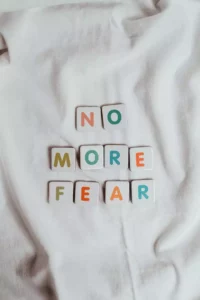
How Do You Stop Living in Fear? 10 Steps That Help
These ten steps build on each other. Start with the first two, then add the rest as you go.
1. Name your fear out loud
Take time to reflect on what scares you. Write it down in one plain sentence. “I’m afraid people will think I’m not good enough.”
Naming a fear does more than you might expect. In a 2007 study, Matthew Lieberman and colleagues found that putting feelings into words lowered activity in the amygdala, the brain’s alarm center. Labeling the emotion calmed the response.
2. Take one small step toward it
Pick the smallest version of the scary thing. If speaking up terrifies you, ask one question in your next meeting. Then do a little more the following week.
Small steps work because they give your brain new evidence. Each one proves the danger was smaller than it felt.
3. Trade excuses for action
Excuses sound reasonable. “I don’t have time.” “It’s not the right moment.” Often they are fear in disguise. When one shows up, ask yourself: “If this excuse weren’t true, what would I do today?” Then do a small piece of it.
4. Turn “I should” into “I will”
“I should” leaves room for fear to win. “I will, on Tuesday at 7 p.m.” gives it less room. Attach a time and place to the thing you have been avoiding.
5. Choose a mindset that grows
A fixed mindset treats every failure as proof of your limits. A growth mindset treats it as practice. Read more about the growth mindset and how it changes your relationship with risk.
6. Let pain teach you
Painful moments often carry the clearest lessons. After a setback, ask what it showed you about your values and your next step. Pain you learn from becomes wisdom rather than a reason to hide.
Try writing three lines after a hard day. What happened? What did it teach me? What will I do differently next time? The questions turn a wound into a map, and they keep one bad day from becoming a reason to stop trying.
7. Practice gratitude
Fear narrows your attention to what could go wrong. Gratitude widens it to what is already right. A short nightly list of good moments shifts that balance. The guide to living in gratitude has more ideas.
8. Expect to fail sometimes
Nobody who does anything worthwhile avoids failure. Plan for it. Decide in advance how you will treat yourself when it happens. Kindness after a setback makes the next attempt far more likely. The page on self-love explains how.
9. Try the 98-year-old test
Imagine yourself at 98, looking back on your life. Which risks do you wish you had taken? Which fears held you back for nothing? Let that older self vote on today’s decision.
10. Come back to the present moment
Most fear lives in an imagined future. The present is usually far more manageable. When worry spins up, feel your feet, take three slow breaths and name what you can see and hear. The power of presence goes deeper into this practice.
Subscribe to Create Higher Vibrations!
Get Inspiration and Practical advice straight to your inbox.
How Do You Stop Living in Fear of the Future?
Fear of the future is anxiety in its purest form. Your mind runs disaster films about events that haven’t happened. The trouble is that your body reacts to the film as if it were real.
Two habits help. First, separate what you can control from what you can’t. Write two lists. Act on the first list today and let the second one wait.
Second, set a daily worry window. Give worry fifteen minutes at a fixed time. When it shows up outside that window, note it and tell yourself it has an appointment later. Many people find the worries shrink once they have a place to go.
What about the fear of what other people think?
This fear keeps many people from living honestly. It helps to remember that most people are busy worrying about what others think of them. They are paying far less attention to you than you imagine.
Start with low-stakes honesty. Share a small opinion you would usually keep to yourself. Notice that the world keeps turning.
What Do Spiritual Traditions Say About Living in Fear?
Nearly every tradition has something to say about fear. Their answers are strikingly similar. Fear shrinks when you rest in something larger than it.
The shared lesson is practical. Love, faith, presence and clear thinking all loosen fear’s grip. You don’t have to fight fear head on. You can make more room for what it pushes out.
When Is Fear More Than Everyday Fear?
Sometimes fear is more than a habit. If it causes panic attacks, stops you from leaving the house or keeps you from work or relationships for weeks at a time, talk to a doctor or a licensed therapist. Anxiety disorders are common and very treatable.
Self-help steps support that care. They don’t replace it.
For the deeper roots of feeling unsafe, the page on feeling safe in the world is a good next read. If self-doubt drives your fear, see overcoming fear and doubt.

What Is the Smallest Brave Thing You Can Do Today?
Fear is loud at the start and quieter every time you walk toward it. You don’t beat it in one big leap. You wear it down in small steps.
Make a fear ladder tonight. Write the thing you fear most at the top of a page. Below it, list five smaller versions, down to one so small it barely scares you.
Tomorrow, do the bottom rung. Next week, the one above it. Keep the page and tick each rung as you go. In a month, look at how far up you’ve climbed.