
Cassiopeia Starseed: Signs, Traits, and Soul Mission
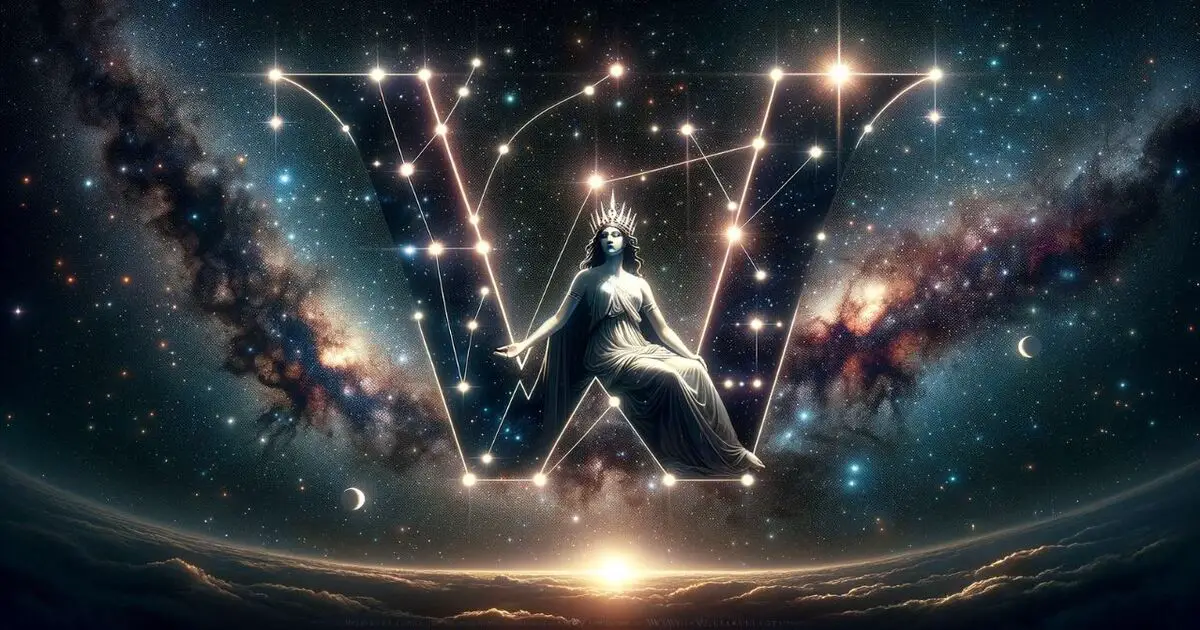
Look up on a clear autumn night, toward the north, and you can find her: five bright stars in a lopsided W, a queen fixed to her throne and turning slowly around the pole.
That is Cassiopeia. People have stared at that shape for thousands of years and told stories about it, and one of those stories is that some of us came from there.
A Cassiopeia starseed is a soul believed to have lived in the Cassiopeia star system before incarnating on Earth, drawn here to communicate, create, and push humanity toward something higher.
That is the definition you came for. Here is the part most starseed articles leave out: this is a spiritual framework, not a finding from an observatory. Nobody has measured a soul leaving a star.
What can be looked at honestly is why the idea lands so hard for a certain kind of person, and what that pull is actually pointing to.
So let’s take the myth seriously without pretending it is physics.
Essential Insights on Cassiopeia Starseeds
What is a Cassiopeia starseed?
A Cassiopeia starseed is understood, within starseed teaching, as an old soul whose origin traces to the Cassiopeia constellation, the W-shaped group of stars fixed in the northern sky.
These souls are described as natural communicators and healers who came to Earth with a job: to move things, to create, and to nudge humanity toward something higher.
The word “starseed” itself is broad. It names any soul thought to have originated in another star system, Arcturus, Sirius, the Pleiades, Andromeda, Cassiopeia, and chosen a human life on purpose.
Cassiopeians are one branch of that larger family, and they are usually cast as the movers, the ones who cannot sit still while something needs changing.
Here is what the framework is really doing. It gives language to a feeling many sensitive people carry from childhood: the sense of being from somewhere else, of never quite fitting the room they were born into.
That feeling is real. Whether it came from a distant star or from being a perceptive child in an ordinary family, the loneliness is the same, and the pull toward meaning is the same.
Signs you might be a Cassiopeia starseed
Most starseed lists hand you twenty flattering traits and let you collect the ones you like. That is not a test. That is a horoscope for your self-image.
So read these differently. Do not ask “is this me?” Ask “is this true, or am I just enjoying being told I’m chosen?” The signs that mean something are the ones that cost you something.

Notice that the honest signs are not superpowers. They are patterns, and most of them have a cost hiding inside the gift. That is the tell of a real trait rather than a flattering one.
If several of these landed, sit with them. Not to confirm your cosmic passport, but to see the shape of how you actually move through the world.
The real Cassiopeia: the constellation behind the myth
Here is where most starseed content goes quiet, because it never bothered to look up. The constellation is genuinely worth knowing, and knowing it makes the symbolism hit harder.
Cassiopeia is one of the 48 constellations catalogued by the astronomer Ptolemy in the 2nd century, and it is circumpolar for much of the northern hemisphere, which means it never sets. It circles the pole star all year, always visible, its five bright stars forming an unmistakable W against the dark.
The region is also home to two deep-sky objects that starseed lore loves for good reason. The Heart Nebula and the neighboring Soul Nebula are vast clouds of glowing gas where new stars are actively being born.
A place named Heart and Soul, where stars are literally made. You do not have to believe in cosmic origins to find that image useful.
The myth, and the lesson hiding in it
In Greek myth, Cassiopeia was a queen who boasted that her beauty, in some tellings, her daughter Andromeda’s, surpassed that of the Nereids, the sea nymphs. The gods do not take kindly to that kind of pride.
Poseidon sent the sea monster Cetus to ravage the coast, and to stop it, Andromeda was chained to a rock as a sacrifice. Perseus saved her.
Cassiopeia was placed in the sky, but not gently: she was set to circle the pole forever, hanging upside down half the year, a public humiliation for her vanity.
Sit with that. The queen’s gift, her radiance, became her downfall the moment it curdled into pride.
That is the paradox every Cassiopeia starseed is asked to hold. The same traits that make you a healer- the sensitivity, the certainty, the drive to be seen doing good- are the exact traits that harden into ego when they go unexamined.
The gift and the trap are the same muscle. The work is not to be more special. The work is to keep the gift from becoming the throne you get stuck on.
The Cassiopeia starseed mission
Cassiopeians are described as being here to shake things loose. Not to sit in a cave radiating peace, but to build, speak, organize, to drag a stuck situation forward by force of will and warmth.
Teachers, artists, healers, the ones who start the organization instead of waiting for someone else to.
If that is you, the mission is not complicated, and it is not comfortable. It is to use the sensitivity without drowning in it. To help without disappearing into the helping. To let yourself be seen without needing the applause to prove you exist.
You came to move things. Start with the thing you have been avoiding in yourself.
If the Cassiopeia label doesn’t quite fit
No starseed exists alone. Cassiopeia sits in the sky right beside Andromeda, and Cassiopeians are described as working closely with other soul groups, so feeling the pull of more than one is normal.
If the compassion and the drive to fix things fit but something still feels off, you may be closer to the Arcturian healers, who share that instinct to repair what is broken, or the Blue Ray empaths, who carry the same sensitivity turned all the way up.
Read across the full starseed family, and the picture usually sharpens.
The point is never the label. The point is the self-knowledge it is pointing you toward.
Are Cassiopeia Starseeds Real?
Starseeds are a spiritual framework, not a scientific claim, and it is worth saying that plainly before going further. Nobody has measured a soul’s stellar origin, and no study ever will. But the psychological terrain the label points at is real and well documented. Psychologist Elaine Aron’s research on sensory-processing sensitivity (Aron & Aron, 1997, Journal of Personality and Social Psychology) describes a genuine, measurable trait: roughly 15 to 20 percent of people process sensory and emotional information more deeply than average, picking up on subtleties others miss and feeling overstimulated faster in loud or chaotic environments. That is not a soul memory. It is a nervous system running a different setting from birth.
Cassiopeia lore describes a queen’s radiance, a pull to be seen, a drive to communicate that outpaces the room’s tolerance for it. Strip the constellation away and what is left is a recognizable pattern: someone whose intensity of feeling and expression was too much for the rooms they grew up in, and who learned, correctly or not, to read that as a flaw rather than a trait. The framework is not proof you came from a star. It is a story that gives a sensitive, expressive nervous system somewhere to belong.
The paradox to leave you with
You may have come from the stars. You may be a perceptive person who has always felt a size too large for the life around you. Both stories can send you to the same place, if you let them: toward using the gift instead of admiring it.
You are already whole exactly as you are. And there is still work in front of you. Hold both. That tension is not a problem to solve. It is the point.