
Amethyst Meaning: Spiritual Meaning, Healing Properties and Uses
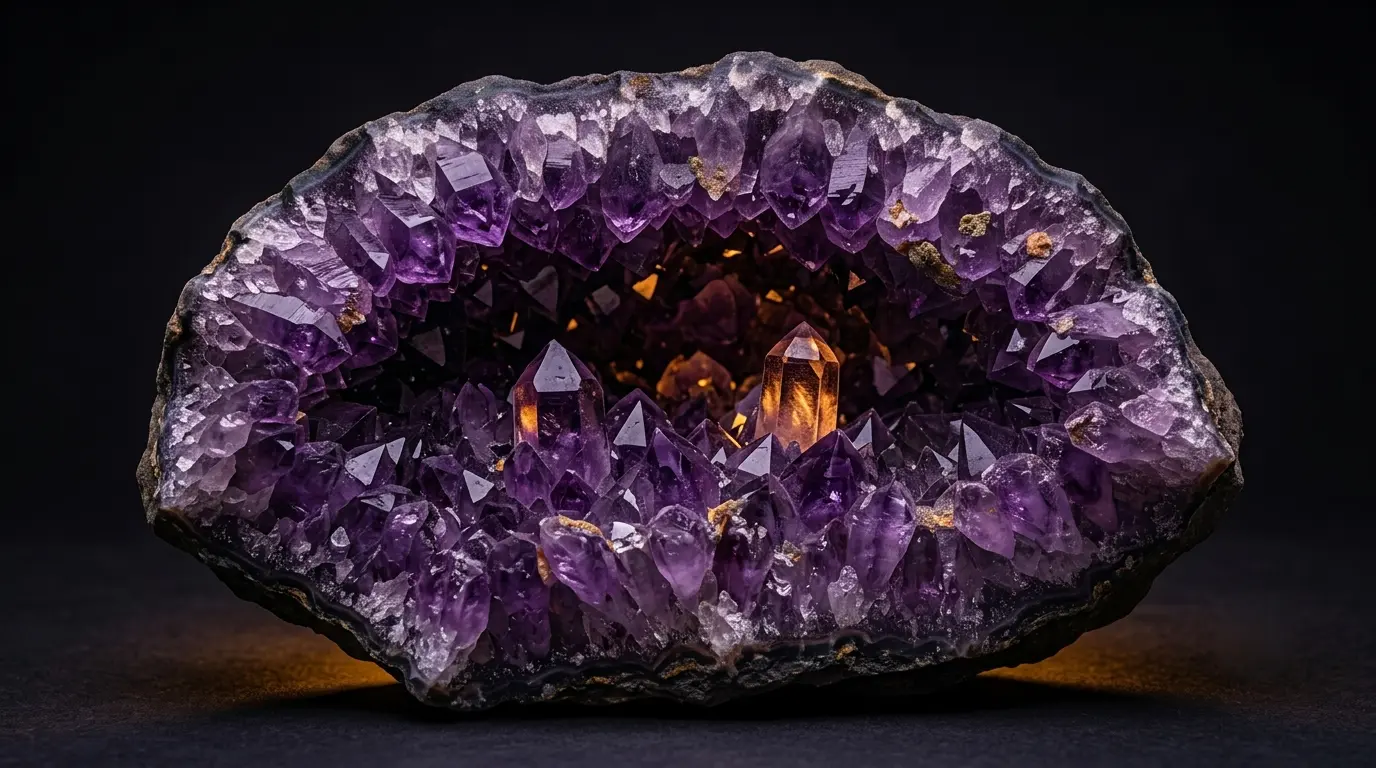
The Greeks named it after the one thing they hoped it would do. People still reach for it to feel clear-headed.
Key Takeaways
Amethyst meaning comes down to a clear, steady mind. The name comes from the Greek amethystos, “not drunk.” The purple quartz has long stood for sobriety, calm, intuition and spiritual protection.
It is often the first crystal people own. It was mine. Knowing where its meaning comes from, how people use it, and what it is made of makes the stone far more useful in your hand.
What Does Amethyst Mean?
Amethyst is the purple variety of quartz, the best-known stone in the quartz family. The literal meaning of amethyst is “not drunk.” The Greek word joins a- (“not”) with methystos (“intoxicated”).
Ancient Greeks linked amethyst with Dionysus, the god of wine. The Romans called him Bacchus.
According to the Gemological Institute of America, the wine-like color led to the belief that wearing amethyst prevented drunkenness. Greeks and Romans carved drinking cups from it. Other legends said it kept the wearer quick-witted in battle and in business.
Over time, that literal promise became a symbolic one. Today amethyst stands for five things.
What Is the Spiritual Meaning of Amethyst?
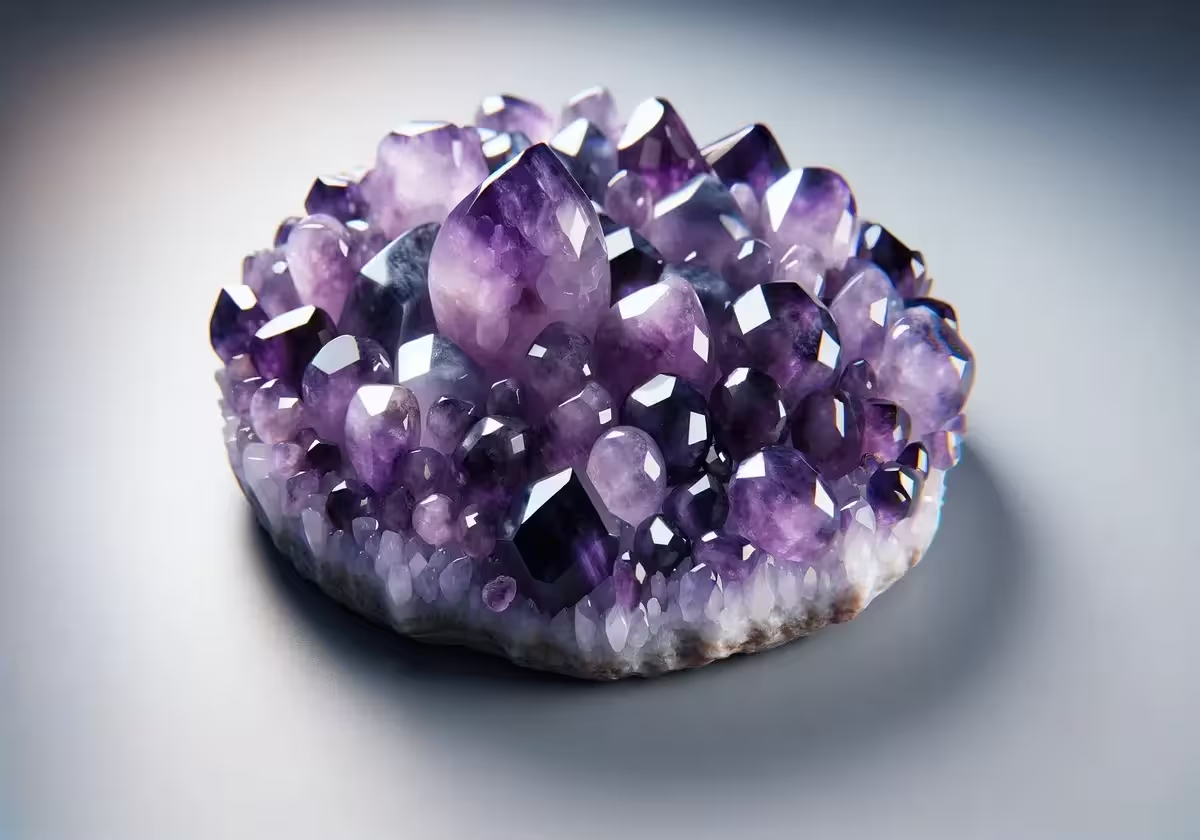
The spiritual meaning of amethyst is awareness without agitation. It is the stone of the calm observer, the part of you that can watch a thought without being carried off by it.
In modern energy work, amethyst belongs to the upper chakras. It is paired with the third eye chakra, the center of intuition and inner sight. It is also linked to the crown chakra, the center associated with spiritual connection.
For that reason, meditators often choose amethyst as their first stone. They use it to quiet mental chatter and settle into stillness.
Many also use it to feel closer to their higher self or their guides. Some use it to develop psychic abilities such as clairvoyance.
Purple itself adds to the meaning. The color has long signaled royalty and devotion, so amethyst carries a sense of dignity. It points to a spirituality that is sober and grounded rather than dreamy.
What Are the Healing Properties and Benefits of Amethyst?
Crystal healing traditions credit amethyst with a steady set of benefits. These are the ones practitioners name most often.
One related question has been tested. No study has tested amethyst itself. A 2025 randomized, controlled study in CNS Spectrums gave 138 adults either rose quartz or a look-alike placebo for 14 days.
Anxiety fell only among people who believed in crystals, whether they held the real stone or the fake one. The calm came from belief and intention. The stone served as the anchor.
That is useful to know. The benefit of amethyst depends on how you use it. A stone you hold with a clear intention every night will do more for you than one gathering dust on a shelf.
What Does Amethyst Protect You Against?
Amethyst ranks among the oldest protection stones. The Greeks trusted it against drunkenness. Later wearers extended that idea to anything that clouds the mind.
In crystal practice, amethyst guards against five threats.
The logic is the same each time. Amethyst guards the clear mind. Whatever threatens your clarity is what amethyst is asked to hold back.
How Do You Use Amethyst?
Amethyst works through small habits repeated daily. These are the most common ways people use it.
Pair each use with an intention. Say what you want it to remind you of, such as “stay calm” or “sleep deeply.” Crystal tradition treats that step as the one that activates the stone.
What Is the Significance of Wearing Amethyst?
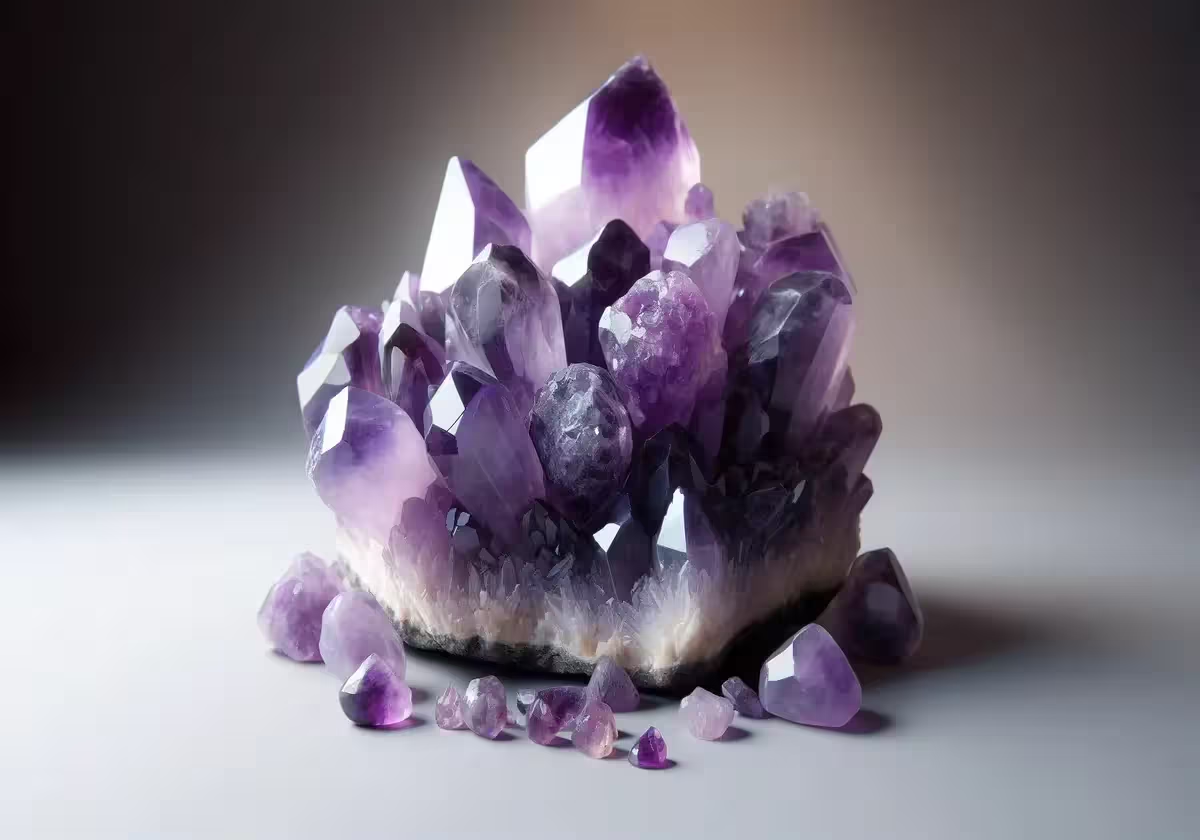
Wearing amethyst jewelry keeps its meaning with you all day. Rings, pendants and bracelets are the most popular choices.
Each form carries a slightly different emphasis in crystal practice.
Amethyst is practical for daily wear. The GIA’s amethyst care guide rates it 7 on the Mohs hardness scale, with good toughness. It suits every jewelry type, including rings, as long as you protect it from hard knocks and scratches.
How Do You Cleanse Amethyst?
For physical cleaning, the GIA recommends warm, soapy water. Ultrasonic cleaners are usually safe. Steam cleaning is not recommended.
The GIA’s care guide also lists three things to avoid.
That last point matters for a common ritual. Skip long hours in direct sunlight. Moonlight is the gentler choice.
Crystal practitioners also cleanse amethyst energetically.
Cleanse a stone you wear daily about once a week. A piece that mostly sits on a shelf needs it far less often.
Why Is Amethyst the February Birthstone?
Amethyst is the birthstone for February. The GIA also lists it as the gem for the 6th and 17th wedding anniversaries.
Its purple is linked to royalty and devotion, which suits a winter month of reflection. Many February gift traditions use amethyst for exactly that reason.
In astrology, amethyst is most often paired with Pisces and Aquarius, the two signs that share February. Pisces is linked to intuition and dreams. Aquarius is linked to vision and independent thought. Both fit amethyst’s focus on a clear, awake mind.
For the animal side of each sign, see the guide to spirit animals by zodiac sign.
What Does Amethyst Mean in the Bible?
Amethyst appears twice in the Bible. In Exodus 28:19, amethyst sits in the third row of the high priest’s breastplate. That breastplate held twelve stones, one for each tribe of Israel.
In Revelation 21:20, amethyst is the twelfth foundation stone of the New Jerusalem. The GIA notes that it became an emblem of the twelve apostles.
Church tradition gave the stone a second life. Bishops have worn amethyst rings for centuries.
In the Anglican church, the episcopal ring is often set with an amethyst. It alludes to Acts 2:15, where Peter tells the crowd at Pentecost that the apostles “are not drunken.”
The old Greek meaning survived inside the church. A stone named “not drunk” became the stone of sober judgment.
Where Does the Myth of Bacchus and Amethyst Come From?
A popular legend says Bacchus pursued a maiden named Amethyste. The goddess Diana turned her into white stone to protect her. Bacchus then poured wine over the stone in remorse, staining it purple.
That story is not ancient. The French poet Rémy Belleau invented it in the 16th century, in a book of poems about precious stones published in 1576.
Classical sources tell a different story. The Greek poet Nonnus, in the Dionysiaca, has the goddess Rhea give Dionysus an amethyst to keep the wine-drinker sane.
Not everyone believed in the stone’s power, either. In the first century, Pliny the Elder called the idea that amethyst prevents drunkenness one of the “falsehoods of the magicians.”
So the famous myth is a Renaissance invention. The link between amethyst and a sober mind is far older.
Why Is Amethyst Purple?
Amethyst is quartz, the same mineral as clear quartz. Its purple comes from two ingredients working together.
The first is iron. Tiny amounts of iron take the place of some silicon atoms in the crystal.
The second is natural radiation from the surrounding rock, acting over long geological time. The radiation changes the iron and creates a “color center,” a defect that absorbs some light and leaves the violet you see.
Heat reverses the process. Heated amethyst turns yellow, orange or brown. Much of the yellow citrine sold today began as heat-treated amethyst.
In Bolivia, nature did both in one stone. The GIA describes ametrine, a crystal that is half purple amethyst and half yellow citrine.
What Are the Different Types of Amethyst?
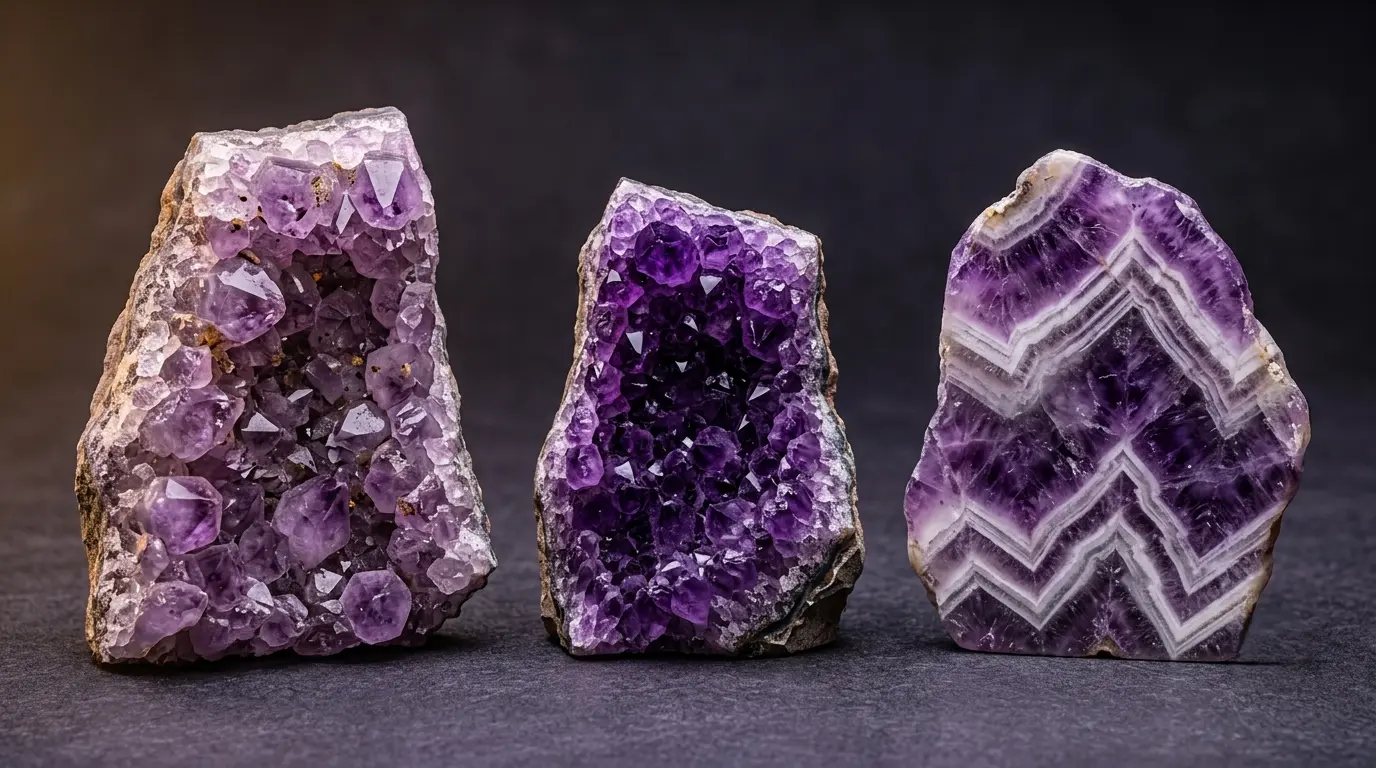
Amethyst ranges widely in shade and pattern. These are the names you will see most often.
According to the GIA, the most valued color is a strong reddish purple with no visible zoning. Brownish tints and uneven color lower the value.
What Is the History of Amethyst?
For most of history, amethyst was a stone of kings and clergy. In the Middle Ages, amethyst was a symbol of royalty and decorated English regalia. It was counted among the cardinal gems, the most valuable stones, next to diamond, ruby, sapphire and emerald.
That changed in the 19th century. According to the GIA, amethyst was as expensive as ruby and emerald until large deposits were found in Brazil. Supply rose. The price fell.
Its royal standing never fully faded. Fine amethysts still appear in the coronation regalia of British royalty. Legend also says St. Valentine wore an amethyst ring carved with the image of Cupid, which ties the stone to faithful love.
Today amethyst ranks among the world’s most popular colored gems. That long history is still part of amethyst meaning. It is precious enough for a crown and affordable enough for a first crystal.
Subscribe to Create Higher Vibrations!
Get Inspiration and Practical advice straight to your inbox.
The Two-Minute Clarity Test
The Greeks named this stone for a single hope: a mind that stays its own. You can put that meaning to work tonight.
Hold your amethyst and ask one question. What am I drunk on right now? It might be worry, scrolling, resentment or a story about someone. Name it in a few words.
Then set the stone down beside you and take ten slow breaths. Notice whether the pull feels weaker. Repeat the test each night for a week.
Amethyst will not do the sobering for you. It gives the question a place to live. For a stone that brings warmth instead of clarity, try rose quartz. To compare other stones, see healing crystals and clear quartz.