
Healthy Masculinity: What It Is, Its Traits, and How to Build It

Strength that can also listen, feel, and ask for help.
Key Takeaways
Healthy masculinity is a way of being a man that keeps strength, courage, and responsibility while making room for emotional expression, connection, and help-seeking. It rejects the idea that a real man must never feel, never ask, never bend. It does not reject being a man.

What Is Healthy Masculinity?
Put simply, it is strength without self-erasure. A grounded man can lead, protect, and provide. He can also admit he is struggling. Crying at a funeral does not shame him. A doctor’s visit happens before a problem becomes a crisis.
The idea is not that men should act more like women. Men are full human beings. The old “tough guy” script asks them to cut off half of themselves. A healthier script asks for the whole man.
What Are the Traits of Healthy Masculinity?
These traits show up again and again in definitions from counselors, researchers, and men’s groups:
These traits make a man more effective, not less masculine.
What Does Healthy Masculinity Look Like in Daily Life?
Examples help more than definitions. Here is what it can look like in an ordinary week:
None of these require a new personality. They require a willingness to be seen. Pick one from the list this week. Notice how people respond. Most men find the reaction warmer than the fear that came before it.
What Is the Difference Between Toxic and Healthy Masculinity?
Toxic masculinity is a narrow set of rules that hurts men. It also hurts the people around them. The healthier version keeps what works but drops what harms. A few contrasts:
Research supports a careful version of this line. A 2017 meta-analysis by Y. Joel Wong pooled 78 samples covering 19,453 people. Conformity to masculine norms was modestly linked to worse mental health. It was more strongly linked to less psychological help-seeking.
The details matter more than the headline. Three norms stood out as harmful across the studies. They were self-reliance, power over women, and the “playboy” norm.
Putting work first did not predict worse mental health. So the goal is not to reject tradition. It is to drop the specific rules that do damage.

Where Did the Term “Toxic Masculinity” Come From?
Many people assume the term began as an attack on men. It did not. The phrase came out of the mythopoetic men’s movement of the 1980s through the 1990s.
Writers in that movement, including Shepherd Bliss, used “toxic” for the pressure on men to be violent, competitive, unfeeling. They contrasted it with a deep masculinity that modern men had lost touch with. Bliss praised the men who fight fires, farm the land, or nurture their families.
So the term began as a call to recover a better masculinity. That is close to what CHV calls the divine masculine.
The debate grew louder in January 2019. New American Psychological Association guidelines had warned about the harms of “traditional masculinity ideology.” Critics called them an attack on men.
What Are the Three P’s of Masculinity?
The three P’s are protect, provide, and procreate. In many cultures, they have long marked the passage into manhood.
Anthropologist David Gilmore explored such cultural tests of manhood in his 1990 book Manhood in the Making. As late as the 20th century, the triple Ps were still widely seen as signs of a man.
A grounded man keeps all three but widens them:
What Are the Four Types of Masculinity?
Sociologist Raewyn Connell’s theory of hegemonic masculinity is the best-known answer. Connell argued that there are many masculinities, ranked against each other in a social order:
A secure man sits outside this ranking. He does not need to win the contest to feel enough.

What Is Positive Masculinity?
Positive masculinity is a counseling approach that starts from men’s strengths instead of their problems. Psychologists Mark Kiselica with Matt Englar-Carlson described it in 2010 as the positive psychology/positive masculinity model.
Their point was simple. Most writing on men had focused on what goes wrong. Therapy works better when it also affirms what is right. Think of loyalty, courage, humor, or the drive to provide.
The two terms overlap almost completely. Positive masculinity puts the spotlight on strengths.
Why Does Healthy Masculinity Matter for Men’s Mental Health?
Men often struggle quietly. In the United States, the suicide rate among males in 2023 was nearly four times higher than among females, according to the National Institute of Mental Health.
The norm of self-reliance plays a part. A man who believes he must handle everything alone is less likely to seek help in time. The Wong meta-analysis found exactly that link between masculine norms and lower help-seeking.
A healthier script turns reaching out into a strength. Talking to a friend, a doctor, or a therapist becomes part of handling life, not proof of failure. If anxiety is part of your picture, our guide to meditation for anxiety is one place to begin.
If you are thinking about suicide, call or text 988 in the United States to reach the Suicide and Crisis Lifeline.

How Does Healthy Masculinity Affect Relationships and Fatherhood?
Emotional openness builds closeness. A partner can only meet the man who shows up. Saying “I’m overwhelmed” instead of withdrawing gives the relationship something real to work with. Our article on emotional intimacy explores how vulnerability builds trust.
Fatherhood shows the effect clearly. A 2008 review of long-term studies examined how father involvement shapes children. Most of the 24 studies found positive effects.
Active, regular involvement predicted better social, behavioral, and psychological outcomes for children. Sons learn what a man is by watching one. When a father names his feelings after a mistake, then apologizes, his son learns that both are allowed.

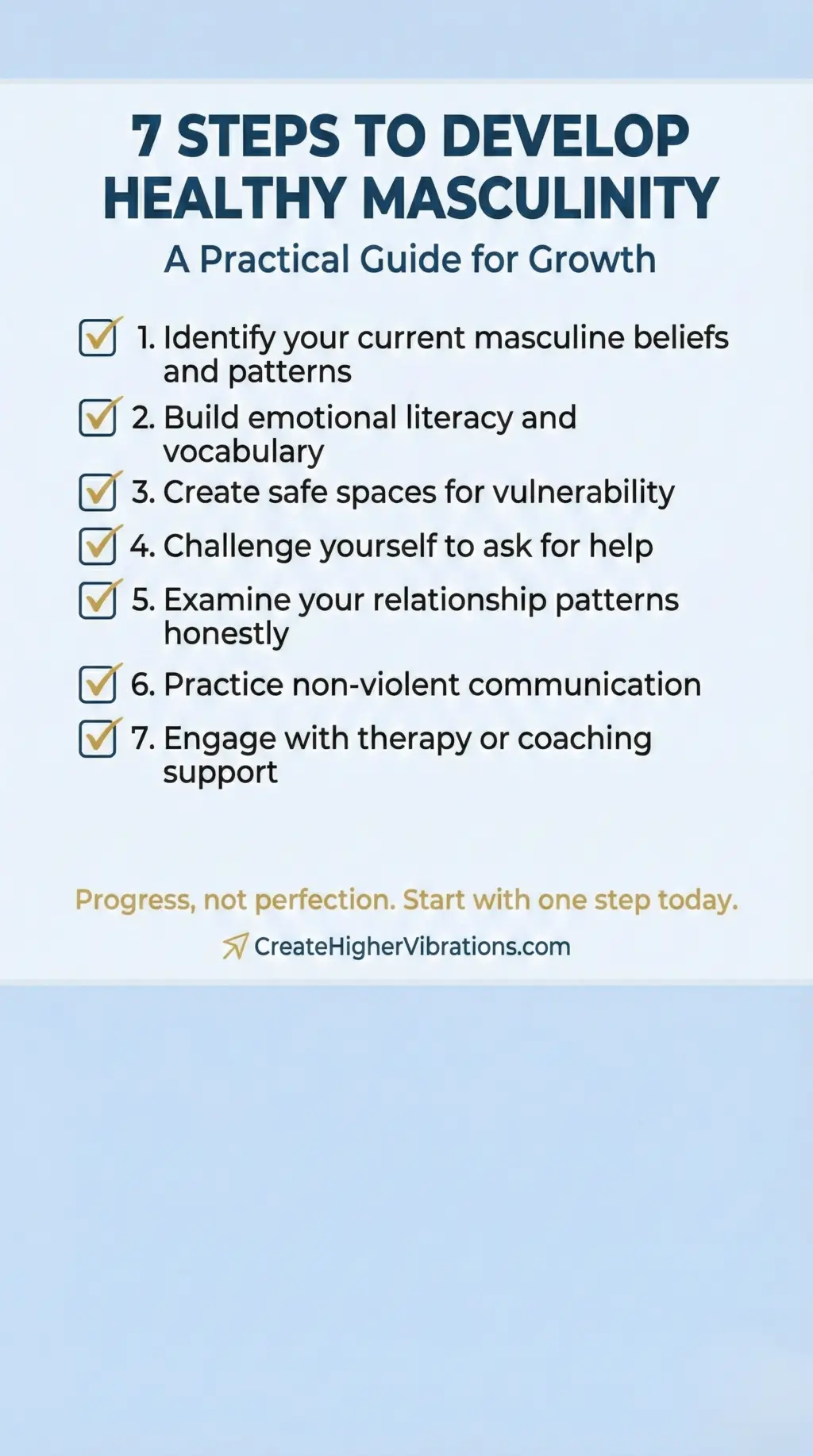
How Can You Develop Healthy Masculinity?
These seven steps build on each other. Start with the first. Move at your own pace.
How Do You Teach Boys Healthy Masculinity?
Boys learn masculinity from the men around them long before anyone explains it. These habits help:

What Gets in the Way of Healthy Masculinity?
Change meets resistance from inside as well as outside. These obstacles are common:
None of these obstacles is permanent. Shame often sits underneath them. Our article on what shame is can help you spot it.
Subscribe to Create Higher Vibrations!
Get Inspiration and Practical advice straight to your inbox.
The Strength That Asks for Help
Here is the paradox at the center of this whole subject. The man who can say “I need help” is often stronger than the man who never does. He has nothing to prove. So he can spend his strength on the people who matter.
That is the masculinity worth passing on. Its raw energy has a name in spiritual writing: the dark masculine. Healthy masculinity is that power, directed with care. Related essays live in our self-mastery collection.

