
Understanding Yourself: A Practical Guide to Knowing Who You Are

Understanding yourself means having a clear, honest picture of your values, emotions, and patterns. Organizational psychologist Tasha Eurich studied thousands of people across seven studies. She found 95% believe they are self-aware, but only 10–15% actually meet the criteria (Insight, 2017).
That gap is the core problem this guide addresses. It is written for anyone who feels disconnected from who they are or who wants to make more deliberate choices. You will leave with a concrete framework, not a vague inspirational nudge.
What Does “Understanding Yourself” Actually Mean?
Understanding yourself is the ongoing process of recognizing your values, emotional patterns, behavioral tendencies, and motivations, including how others perceive you. It is not a fixed state you reach once. It is a practice that builds clarity, confidence, and more intentional choices over time.
Many people confuse self-awareness with self-criticism. They are not the same thing. Self-awareness is neutral observation of patterns; self-criticism is judgment of them.
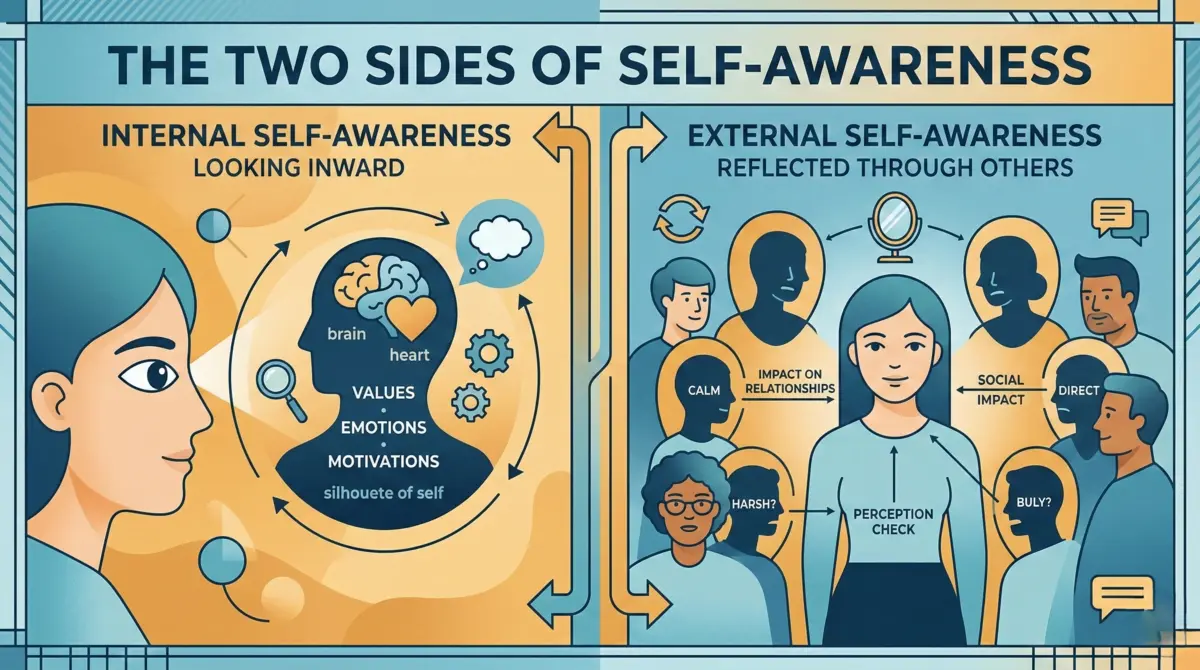
Psychologists separate self-awareness into two distinct types: internal and external. Most people are stronger in one than the other. Both require deliberate development.
- Most people overestimate their self-awareness levels.
- Two types of self-awareness exist. Each type affects your life differently.
- Your self-knowledge improves your ability to understand others.
- Rumination and avoidance block your self-reflection.
- Use personality assessments as starting points. Do not treat these tools as permanent labels.
- Your core values clarify your specific goals.
- Self-awareness reduces your emotional reactivity and improves your decisions.
Why Most People Don’t Know Themselves
The research finding here is precise: 95% of people believe they are self-aware, but only 10–15% actually are (Insight, 2017; HBR, 2018). The gap is not a character flaw. It exists for three specific, identifiable reasons.
The Three Hidden Barriers to Self-Awareness
1. The feel-good effect. The brain filters incoming information to protect self-esteem. This creates blind spots you cannot detect on your own, only outside input reveals them.
2. Outdated self-assumptions. Most people rely on beliefs about themselves that were formed years ago. Those beliefs often no longer reflect who they actually are today.
3. Mistaking rumination for reflection. More self-focus does not always produce more clarity. When introspection cycles without new input, it becomes rumination.
Research published in PMC (2016) found that rumination negatively predicts autonomy and self-acceptance. Insight-based reflection, which moves toward understanding and action, produces the opposite result.
Recognizing these three barriers is itself a form of self-awareness. It is where real progress begins.

What Are the Two Types of Self-Awareness?
Internal Self-Awareness: How You See Yourself
Internal self-awareness is your clarity about your own values, thoughts, and emotional patterns. It answers the question: “What drives me, and why?”
People high in this type set goals that genuinely match who they are. They tend to experience less internal conflict between their choices and their values.
External Self-Awareness: How Others See You
External self-awareness is your accuracy in knowing how others perceive you. It answers: “How do I actually come across?”
People strong in this area build more effective relationships. They experience fewer surprises in conflict because they can anticipate how their behavior lands.
These two types do not automatically go together. Someone can be highly self-reflective and still be blind to how their behavior affects others. The goal is to develop both.
| Type | Core Question | Key Benefit |
|---|---|---|
| Internal self-awareness | What drives me? | Aligned goals, values clarity |
| External self-awareness | How do others see me? | Stronger relationships, fewer blind spots |
How the Sense of Self Develops Over Time
Your self-concept, the internal picture of who you are, evolves across distinct life stages. Knowing where you are in that process helps you use this guide more effectively.
Childhood: The self is defined by direct physical control. What you can touch or move feels like part of you.
Adolescence: Identity expands beyond the body. Traits, social belonging, and others’ opinions begin to shape how you see yourself.
Early adulthood: The gap between who you are and who you feel you should be becomes visible. Psychological defenses often solidify here to manage that friction.
Midlife reflection: Many people discover that the self-concept is not fixed. It shifts with experience, relationships, and changing priorities.
Advanced self-understanding: The self is recognized as a useful construct rather than a permanent, unchanging truth. This awareness frees you from identity stories that no longer serve your current life.
Research on self-concept clarity shows a consistent pattern across studies. People with a clear, stable self-picture report lower anxiety, higher self-esteem, and stronger social relationships (Campbell et al., 1996; PMC, 2023).
Why Self-Awareness Matters in Real Life
Self-awareness has direct, practical effects, not just philosophical ones. When you know your core values, you make decisions faster and with less regret. When you recognize your emotional triggers, you respond to situations rather than react to them.
When you understand your behavioral patterns, you can change the ones that cause problems. People with high self-concept clarity also communicate more honestly. They have less to defend, so they listen better and connect more easily.
One client spent years believing her emotional exhaustion was a personal flaw. Through structured self-reflection, she recognized the pattern: her responses were normal reactions to abnormal treatment.
That single shift, from “something is wrong with me” to “something was wrong in that dynamic,” changed how she set boundaries in every relationship that followed.
What Are the Signs You Don’t Know Yourself Well?
Most people recognize several of these at different points in life. None indicates failure, they show where self-inquiry is most needed.
Seeing these patterns clearly is the starting point. It is not the problem; it is the first move toward a solution.
Subscribe to Create Higher Vibrations!
Get Inspiration and Practical advice straight to your inbox.
How to Understand Yourself Better: 9 Practical Steps
These steps work as a full sequence or as standalone practices. Start with whichever step creates the most internal resistance; that reaction itself is useful information.
- Name your core values. Write down five values and rank them. Then identify a recent decision that conflicted with your top value. That tension reveals your actual priorities more honestly than any list.
- Seek specific, honest feedback. Ask someone you trust: “What is one habit of mine that you think limits me?” Specific questions generate specific, usable answers. Vague questions do not.
- Track your emotional triggers for one week. Note what provoked a strong reaction and what it reminded you of. Patterns emerge faster than most people expect.
- Use a structured personality tool as a starting point. The Big Five (OCEAN model) has the strongest research support. The VIA Character Strengths Survey maps core strengths. CliftonStrengths identifies dominant talent themes. Treat all results as hypotheses to test, not as fixed identities.
- Journal to a specific prompt. Generic journaling often circles. Start with: “When do I feel most like myself, and what is consistently present in those moments?”
- Notice what you repeatedly avoid. Avoidance is directional information. A recurring pattern usually points to a value conflict or an unresolved fear that has not yet been named.
- Observe your patterns without judging them. Self-awareness is descriptive, not evaluative. Name what you see. Resist labeling it good or bad, judgment ends observation.
- Use mindfulness to widen your response window. Mindfulness creates space between a trigger and your reaction. That space is where self-knowledge becomes a practical tool.
- Revisit your self-concept every six months. Reread old journal entries or retake an assessment. Change, or its absence, tells you something important about your current direction.

9 Reflective Questions That Deepen Self-Knowledge
These questions work as journaling prompts or as quiet thinking exercises. There are no correct answers, only honest ones.
1. Do You Follow Rules or Push Back Against Them?
Your relationship with authority reveals your autonomy needs directly. People who resist structure by default often hold strong independence as a core value.
People who follow rules naturally tend to prioritize harmony or security. Neither pattern is superior. Each carries specific strengths and specific costs worth knowing.
2. What Stories Do You Return to Most Often?
Your consistent preferences in film, books, or podcasts often reflect unmet needs or deep interests. Someone repeatedly drawn to stories of reinvention may be processing a real desire for change. Your entertainment preferences are a soft but reliable signal worth reading.
3. What Comes Easily to You That Others Find Hard?
Natural ease is a reliable marker of underlying strength. Most people dismiss their natural abilities because they feel effortless. Effortless does not mean unimportant, it often means foundational to who you are.
4. Which Flaws Do You Recognize, and Which Do You Dismiss?
The flaws you acknowledge are not the most instructive ones. The ones you defend against are. Ask a trusted person: “What is one thing about me that you think holds me back?” That answer is typically more precise than any self-assessment.
5. How Do You Feel About Taking Chances?
Your tolerance for uncertainty shapes behavior more than skill level does. Knowing where you sit on this spectrum helps you anticipate your own choices under pressure. That anticipation is itself a form of self-mastery.
6. What Five Words Describe You Most Accurately Today?
This question is not about your ideal self, it asks who you actually are right now. Ask two trusted people the same question. The gap between their answers and yours reveals more than any single answer alone.
7. What Matters More to You: Career or Family?
This is not an either/or question, it is a priority question. Most people want both. Clarity about which genuinely takes precedence reduces internal conflict. It also produces more honest decision-making in the moments that actually count.
8. Does Competition Energize or Drain You?
Some people sharpen in competitive environments. Others do their best work in collaborative settings. Neither is superior. Knowing which applies to you helps you choose environments that bring out your best consistently.
9. Are You More Reactive or Proactive?
Reactive people are strongly influenced by their environment and those around them. Proactive people direct their own attention and energy more deliberately.
Both tendencies exist in everyone. The useful question is: which one dominates in the situations that matter most to you?
How Understanding Yourself Helps You Understand Others
Self-knowledge and empathy are directly connected, and the connection is measurable, not theoretical.
A study published in the Journal of Cognitive Enhancement found that participants who improved their ability to identify distinct parts of their own personality also showed significant gains in theory of mind: the ability to accurately infer what others are thinking and feeling.
When you know your own emotional triggers, you stop projecting them onto other people. When you know your values, you can engage with someone whose values differ without feeling threatened.
When you can see your own blind spots, you extend more patience to others who share the same ones.
This does not mean you will agree with everyone, or that understanding requires agreement. It means you can read situations and people more accurately, with less friction, than before.
That improvement in relational accuracy reduces conflict at its root rather than managing it after it erupts.
One Last Thought
Most people spend years reacting to life rather than directing it. The gap between those two experiences usually comes down to self-knowledge.
You do not need to have every answer about who you are. You need to stay curious enough to keep asking the right questions.
Start with one: What did I genuinely want before I started worrying what others thought?
That answer belongs to you. It has always belonged to you. Understanding yourself is simply the practice of finding your way back to it.