
What Are Somatic Practices? An Honest Beginner’s Guide
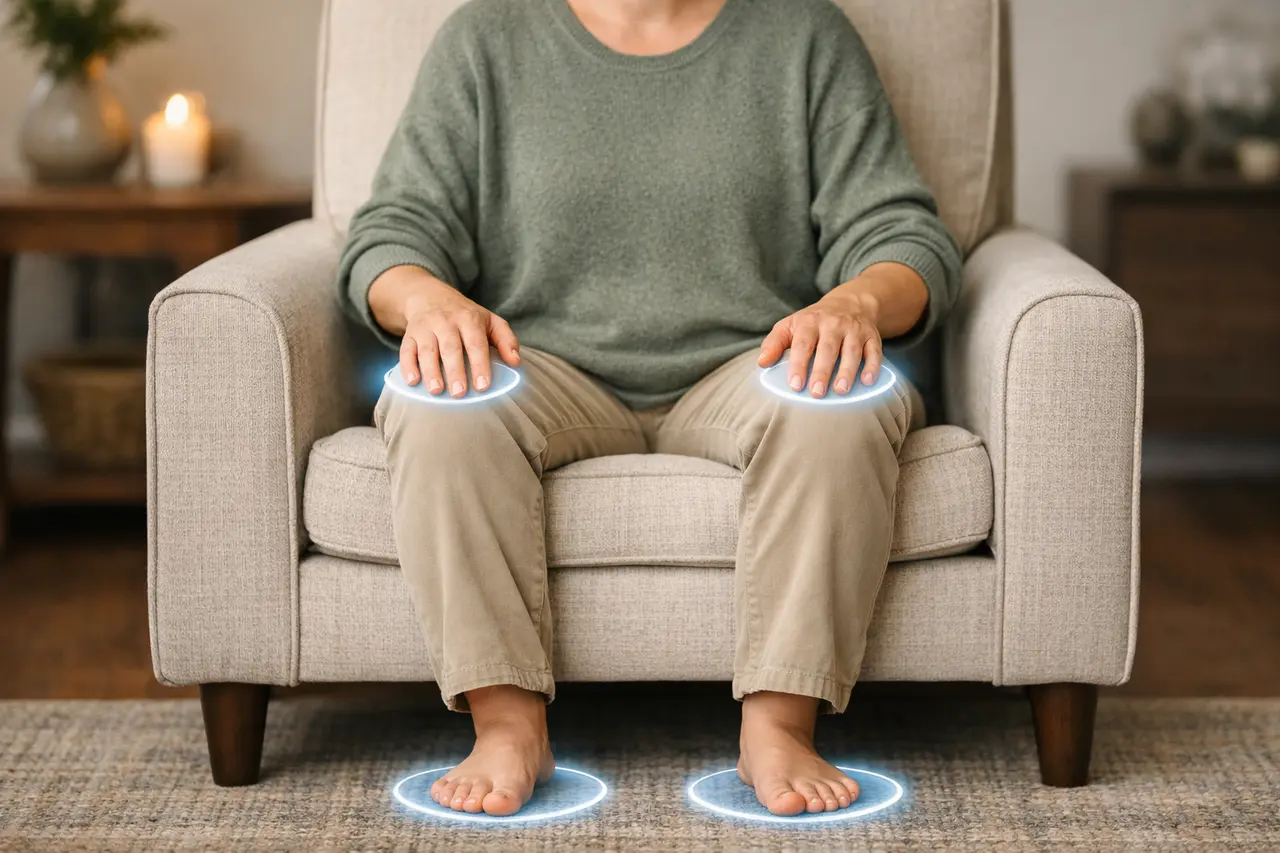
Everyone is talking about getting out of your head and into your body. Almost nobody tells you how thin the evidence still is.
Key Takeaways
Somatic practices are body-based methods for working with stress, anxiety, and trauma responses through physical sensation instead of through analysis and talk.
Where conventional therapy asks what you think about an experience, a somatic approach asks what is happening in your shoulders, your breath, and your gut while you remember it.
If you have spent years understanding your patterns without those patterns changing, this is the specific gap somatic work claims to address. That claim is worth taking seriously. It is also worth checking.
What follows explains what these practices are, what has been measured, where the evidence runs out, and what a beginner can reasonably do with it all.
What Are Somatic Practices?
The word somatic comes from the Greek soma, meaning the body as experienced from the inside rather than observed from outside. Thomas Hanna popularised the term in the 1970s, and Peter Levine’s Somatic Experiencing became its best-known clinical application.
Most somatic methods share a few moves:
None of that requires talking about what happened. For some people, that is the entire appeal, and it is a reasonable one.
What’s the Difference Between Somatic Practices and Somatic Therapy?
Somatic practices are self-directed: breathing, grounding, and body-awareness exercises you do on your own, no training or credential required to try them.
Somatic therapy, most often delivered as Somatic Experiencing, is clinical work led by a therapist certified in the method, typically across a course of sessions.
That distinction matters for reading the research fairly. The randomised trials covered below tested Somatic Experiencing delivered by trained clinicians, not a solo evening routine.
A ten-minute self-guided practice and a course of clinical Somatic Experiencing are related, but they are not the same intervention, and evidence for one does not automatically transfer to the other.
Try the self-directed version freely. If you are working with significant trauma, the clinical version is a different, more supported tool.
Does Somatic Work Actually Help?
There is real evidence here, and there is less of it than the wellness industry implies.
On the encouraging side, Brom and colleagues ran the first randomised controlled trial of Somatic Experiencing for PTSD and found significant improvement against a waitlist control.
A separate randomised trial by Andersen and colleagues tested Somatic Experiencing added to physiotherapy for patients with chronic low back pain and co-occurring post-traumatic stress symptoms, and found benefit over physiotherapy alone.
Two positive randomised trials on serious clinical populations are nothing. Most wellness practices have none.
Now the part that usually gets left out. Kuhfuß and colleagues published a scoping review of the entire Somatic Experiencing literature in 2021. Out of 83 articles screened, 16 met inclusion criteria: ten quantitative studies and six qualitative.
Of those ten quantitative studies, only two were randomised controlled trials. The authors flagged small samples, missing control groups, high attrition, and 24 different outcome instruments across the studies, which makes results hard to compare at all.
Their conclusion was direct: the current evidence base is weak and does not yet fully accomplish the high standards for clinical effectiveness research.
So the honest position is this. Somatic work is plausible, is widely practised, has early trial support, and it has not yet been tested to the standard we would demand of a medication. Holding all four of those at once is more useful than picking whichever one suits you.
Is Trauma Really Stored in the Body?
This sentence is the whole field, and it deserves more care than it usually gets.
Something real sits underneath it. Threat responses are physiological. Heart rate, muscle tone, breathing, and hormonal cascades all change under stress, and in people with chronic trauma symptoms, those changes can persist long after the danger. That much is not controversial.
The trouble is the word stored. It suggests a memory sitting in your tissue like a file in a drawer, waiting to be retrieved and released. That is a metaphor, not a finding.
Your muscles do not hold episodes. What persists is a pattern of activation, maintained by a nervous system that has not registered the threat as over.
The distinction matters practically. If trauma were stored like a file, the goal would be discharge, one big release, and many somatic products are sold on precisely that promise.
If it is a maintained pattern, the goal is repetition. Small, consistent, unremarkable practice that gradually teaches the system a new default.
The second is far less dramatic. It is also much closer to what the research describes.
What Does a Somatic Practice Actually Look Like?
Unglamorous, mostly. Here is a beginner sequence that requires nothing and takes about ten minutes.
Do the sequence daily for two weeks before deciding anything. One session tells you almost nothing.
Notice what is absent from that list: no purchase, no practitioner, no course. If a somatic approach cannot survive being free, it was never the practice that was working.
How Do Daily Rhythms Support Your Nervous System?
Your nervous system works in cycles. It shifts between activation and rest many times a day. Somatic practice tends to stick when it follows a steady rhythm instead of rare, intense sessions.
Breath is the easiest rhythm to work with. A 2018 systematic review of slow breathing, under 10 breaths a minute, found that it increases heart rate variability. Higher heart rate variability is a marker of a more flexible nervous system.

A simple daily rhythm might look like this:
Keep it small and repeatable. A steady five minutes is easier to keep than an occasional hour.
Who Should Be Careful With This?
Somatic work is low-risk for most people, but low-risk is not no-risk, and this caution is skipped almost everywhere.
Turning attention toward body sensation can intensify distress rather than settle it, particularly for people with significant trauma histories, dissociation, or panic responses.
If a practice reliably makes you feel worse, more numb, or further away from yourself, that is a signal to stop and work with a trained trauma therapist rather than to push harder.
Somatic practices are not a treatment for PTSD, and they are not a substitute for care. In the trials described above, Somatic Experiencing was delivered by trained clinicians, and in one case alongside physiotherapy.
A ten-minute routine from an article is a starting point, not a protocol.
Where This Leaves You
You did not imagine the gap. Understanding your patterns really does fail to change them, and being told to think differently about a body that will not settle is its own quiet frustration. That is a real experience, and somatic work is a reasonable response to it.
What it is not is proven. Two good trials and fourteen weaker studies is an honest beginning, not a foundation, and anyone presenting it as settled science is telling you something they do not know.
You can still work with it. Do the ten minutes. Do it daily for two weeks, watch one thing, and let your nervous system return the verdict rather than a sales page.
The body has been giving you information the whole time. The practice is not making it speak. The practice is learning to stop talking over it.