
Shadow Work After Narcissistic Abuse: A Complete Guide to Reclaiming What Was Hidden

After the relationship ended, you expected to feel free. Instead, you found yourself carrying new voices. An inner critic that sounds exactly like them. An anger you never had before. A version of yourself you do not recognize.
Shadow work after narcissistic abuse is the process of identifying and integrating the hidden psychological patterns that formed during your relationship with a narcissistic partner. These are not character flaws.
They are survival adaptations, the parts of you that learned to anticipate their moods, suppress your own needs, and monitor for danger. Shadow work helps you reclaim these parts and transform them from invisible prisons into conscious choices.
If you are here, you have likely done the obvious work. You left. You set boundaries. You started therapy. And still, something inside feels unresolved. That something is not a failure of your healing. It is the next layer.
By the end of this article, you will understand why narcissistic abuse creates specific shadow aspects that generic shadow work does not address, what those aspects look and feel like, and a structured protocol you can begin today to integrate them.
- Specific Shadow Aspects. Narcissistic abuse creates shadow aspects such as the fawn response, the inner critic, and suppressed anger. Generic shadow work does not address these traits.
- Survival Adaptations. These shadow traits represent survival adaptations rather than character flaws.
- Four-Phase Protocol. A structured four-phase shadow work protocol exists for survivors of narcissistic abuse. You witness, name, integrate, and reclaim your power.
- System Integration. Shadow work integrates your nervous system with your mind. This process adds a spiritual dimension to your recovery.
What Is Shadow Work, and Why Is It So Important After Narcissistic Abuse?
Shadow work is the process of identifying and integrating the hidden parts of yourself that developed as survival strategies during difficult experiences.
After narcissistic abuse, these hidden parts include the fawn response, the inner critic, and suppressed rage. Standard shadow work practices help, but they often miss the specific patterns that NPD abuse creates.
The shadow originates with Carl Jung, who described it as the parts of ourselves we have repressed or denied.
After narcissistic abuse, the shadow becomes especially dense because the relationship systematically required you to suppress fundamental aspects of who you are: your anger, your needs, your intuitions, your identity.
Shadow work brings those parts back into the light where you can choose what to keep and what to release. To understand how the shadow Self relates to narcissistic abuse recovery, see our guide to the shadow self and embracing your dark side.
Why Does Narcissistic Abuse Create Unique Shadow Aspects?
Narcissistic abuse creates specific shadow aspects because the relationship systematically trains you to suppress parts of yourself that the abuser found threatening while amplifying parts that served them.
Over time, these suppressed parts become your shadow: hidden, disowned, and operating outside conscious awareness.

One of the most painful dynamics is projection. The abuser projects their own disowned qualities onto you. You become the “angry one,” the “crazy one,” the “selfish one,” not because you are, but because they cannot face those parts of themselves. Over time, you internalize these projections.
Cognitive dissonance keeps these shadow aspects hidden. Your brain cannot hold “this person loved me” and “this person was destroying me” simultaneously.
So it resolves the contradiction by blaming you. Your shadow aspects were formed in a specific relational context. That context has ended. The parts that kept you safe in the relationship are no longer needed in the same way.
For help with the boundary dismantling that made this possible, see our guide to setting boundaries after narcissistic trauma.
1. The Inner Critic That Sounds Like Your Abuser
One of the most disorienting aspects of post-NPD abuse recovery is hearing your abuser’s voice in your own head. This is called identification with the aggressor.
Your brain learned that anticipating and internalizing the abuser’s criticism was safer than being surprised by it. The inner critic shows up as perfectionism, self-blame, anticipating rejection, and a constant sense of never being enough.
As Bessel van der Kolk explains, trauma is stored in the body and the nervous system, not just in memory. The inner critic is not only a thought pattern.
It is a physiological state: tight chest, shallow breath, scanning for danger. Shadow work addresses it at this level, not just through thinking differently.
2. The Fawn Response as a Shadow Trait
The fawn response, identified by Pete Walker, is the survival strategy of automatically prioritizing someone else’s needs and emotions over your own.
In narcissistic relationships, fawning becomes so habitual that it stops being a strategy and starts being an identity.
After the relationship ends, the fawn response remains, showing up as people-pleasing, inability to identify your own needs, and loss of a sense of self outside of relationships.
In shadow work, the fawn pattern is treated not as a personality flaw but as a protective part that needs to be witnessed and thanked. For a detailed breakdown, see our guide to the fawn response and why it keeps you stuck.
3. Suppressed Anger and the Shadow of Rage
Many narcissistic abuse survivors are surprised to discover intense anger after the relationship ends. During the relationship, expressing anger was unsafe.
So it went underground, becoming part of the shadow. After the relationship ends, this suppressed anger surfaces, sometimes as rage, sometimes as bitterness, sometimes as an inability to feel anything at all.
This is not you becoming a bitter person; it is years of unexpressed emotion finally seeking release.
Pete Walker notes that suppressed anger is one of the most common shadow aspects in CPTSD survivors, and that witnessing this anger without acting on it destructively is a core skill of recovery.
Shadow work handles repressed resentment not through harmful outbursts but by creating room for it to be present. You can Journal from the viewpoint of your rage. Engage in physical movement that channels strength.
Verbally articulate the truths you were unable to voice while in the relationship. These techniques permit shadow anger to find full expression and eventually reach a state of integration.
A Shadow Work Protocol for NPD Abuse Survivors
Shadow work for NPD abuse survivors is not the same as generic shadow work. It requires a structured approach that addresses the specific aspects the abuse created.
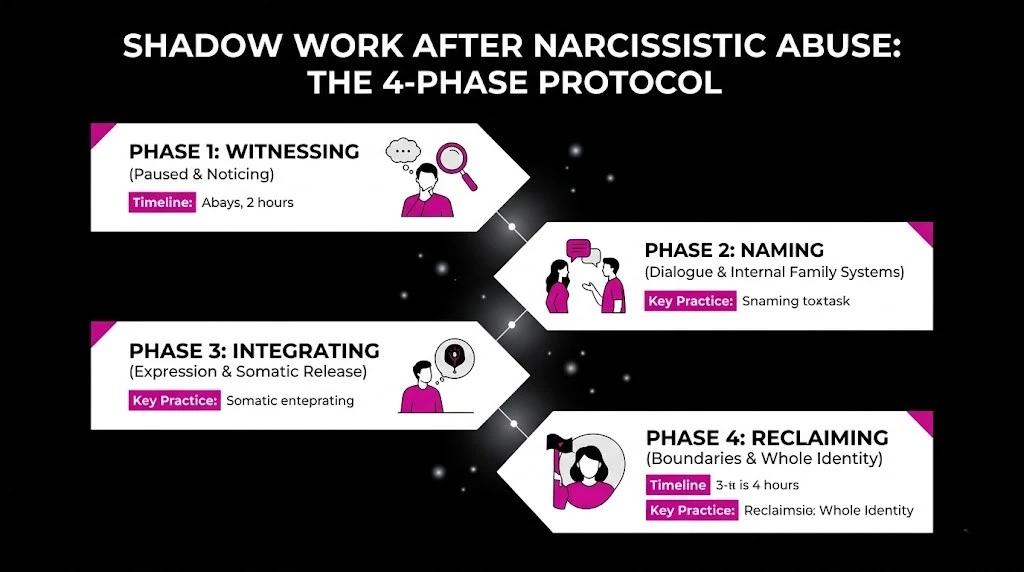
This protocol moves through four phases: witnessing, naming, integrating, and reclaiming. Each phase builds on the one before. There is no shortcut, but there is a path.
| Phase | What It Feels Like | Key Practice | Timeline |
|---|---|---|---|
| Witnessing | You notice shadow patterns without judgment. | Body scan and journaling. Ask “When did I first learn to make myself small?” | Weeks 1 to 3 |
| Naming | You identify the specific shadow trait. | Dialogue with the part. Ask “What were you protecting me from?” | Weeks 3 to 6 |
| Integrating | You allow the shadow aspect to speak. | Practice expressive writing and somatic release. | Weeks 6 to 16 |
| Reclaiming | You reclaim energy the shadow used. | Practice boundaries, rebuild identity, and make new choices. | Months 4 plus |
Caption: The four phases of shadow work after narcissistic abuse. Progress is non-linear.
Phase 1: Witnessing. Learning to notice when a shadow pattern is active is the foundational practice. Most survivors have spent years overriding their body’s signals.
Witnessing means pausing and asking: what part of me is running right now? Just notice. Do not try to change anything yet.
Phase 2: Naming. Once you can witness the pattern, you begin to name it. This is where Internal Family Systems (IFS) language becomes helpful. Instead of “I am a people-pleaser,” you say “a part of me learned to people-please to stay safe.”
This creates space between you and the shadow aspect.
Phase 3: Integrating. Integration means allowing the shadow aspect to have a voice. Writing a letter from your anger to your abuser (that you never send). Saying out loud the things you could never say. Allowing yourself to cry. The goal is not catharsis. It is witnessing.
Phase 4: Reclaiming. Over time, the shadow aspects release their grip. The energy they were using becomes available for new choices. You begin to set boundaries from self-respect. You begin to identify your own needs as necessary. You rebuild an identity that is yours.
Discover Your Inner Self. Join Our Self-Mastery Program.
Self-Mastery Coaching gives you the space, tools, and guidance to grow, reflect, and discover your values and inner strength.

The Spiritual Dimension: Freeze, Shadow, and Awakening
Many spiritual traditions describe a dark night, a winter, or a period of stillness that precedes transformation.
The shadow aspects created by narcissistic abuse can be understood through this lens: not as a malfunction, but as a necessary ascent before a descent.
The shadow contains the parts of yourself that the abuse forced underground. Integrating them is not just psychological healing. It is spiritual emergence.
Carl Jung wrote: “One does not become enlightened by imagining figures of light, but by making the darkness conscious.”
The shadow aspects you are carrying contain suppressed strengths. Your anger holds boundary energy.
Your sensitivity holds intuition. Your people-pleasing holds a capacity for attunement that can be redirected toward yourself.
For more on the spiritual dimension of stillness, see our guide to the dark night of the soul.

What to Do Starting Today
Start with one practice. Do it consistently for two weeks. Shadow work is measured in millimeters, not miles.
Practice 1: Three check-ins per day. Pause for thirty seconds. Ask yourself: what part of me is running right now? Just notice. Name it if you can.
Practice 2: Dialogue with the inner critic. When you notice the critical voice, ask: who does this voice belong to, me or them? Write down what the voice says. Then write a response from your adult self.
Practice 3: One expressive writing session per week. Write from the perspective of your shadow. Let the angry part speak. Let the fawn part speak. Do not edit. Let it be heard.
Seek professional support if in crisis or stalled in CPTSD recovery. Consult a trauma-informed therapist (IFS/Somatic Experiencing); shadow work complements but doesn’t replace professional care.
Conclusion
The shadow aspects you are carrying are not evidence that the abuse broke you. They are evidence that you survived it. The fawn response kept you safe when fighting was impossible.
The inner critic tried to protect you from further harm. The suppressed anger held boundaries you could not express at the time.
These parts served you. Now, shadow work helps you thank them for their service and gently retire them from duty. You are not becoming someone new. You are reclaiming who you were before the relationship taught you to disappear.
If you want to go deeper, our guide to the fawn response offers a detailed breakdown of this specific shadow trait. And if you are beginning your recovery journey, our guide to reclaiming your identity after narcissistic abuse is the right starting point.