
Is It Anxiety, or Is Your Nervous System Stuck? How to Tell the Difference

You’re sitting in a parking lot. Nothing happened. No argument, no bad news, no trigger you can name. But your chest is tight, your jaw is clenched, and your thumb is picking at the cuticle on your index finger until it bleeds.
You don’t feel anxious. You don’t feel anything you could put into words. Your body is just running.
If you’ve been told you have anxiety and the usual tools haven’t worked, the thought journals, the CBT reframes, the “have you tried meditation?”, there’s a reason.
Your nervous system isn’t a mindset problem. It’s a physiological problem. And it has a completely different set of instructions.
By the end of this article, you’ll understand exactly what’s happening inside your body, why standard anxiety advice hasn’t worked, and what to do instead.
Is Nervous System Dysregulation Real, or Just Wellness Hype?
Nervous system dysregulation is a real physiological condition in which chronic stress or trauma causes the autonomic nervous system to become stuck in survival mode.
Research from Harvard Medical School confirms that repeated activation of the stress response damages blood vessels, disrupts cortisol regulation, and produces measurable physical symptoms, not just feelings.
Your autonomic nervous system runs the show behind the scenes. Heart rate, breathing, digestion, and temperature govern everything you don’t consciously control. It has two branches that work like a gas pedal and a brake.
If you’ve read our polyvagal theory overview, you already have a head start on this next part.
The sympathetic nervous system is the gas pedal. It triggers your fight-or-flight response, flooding your body with adrenaline and cortisol so you can respond to danger.
The parasympathetic nervous system is the brake. It promotes rest, digestion, and recovery after the threat passes.
In a healthy system, these two branches dance. You activate when needed, then settle back down. But in a dysregulated system, the gas pedal gets stuck.
Your body stays in high alert even when there’s no danger. Or, and this is the part most articles miss, the brake can get stuck too, leaving you numb, exhausted, and shut down.
Here’s what actually happens inside your body when this goes on too long. The stress response begins in a part of your brain called the amygdala. When it perceives danger, it sends a distress signal to the hypothalamus, which acts like a command center.
The hypothalamus activates your sympathetic nervous system, which tells your adrenal glands to pump epinephrine into your bloodstream. Your heart races. Your breathing speeds up. Your senses sharpen.
Then the HPA axis kicks in, your stress hormone cascade. The hypothalamus releases CRH, the pituitary releases ACTH, and the adrenals release cortisol.
This is the system designed to keep you alive during a crisis. The problem? When it stays activated for weeks, months, or years, it starts doing damage.
Researchers call this accumulated wear-and-tear allostatic load. Chronic cortisol elevation damages blood vessels, promotes artery-clogging deposits, increases appetite, and stores unused nutrients as fat. It suppresses immune function. It disrupts sleep.
It literally changes brain structure in ways that deepen anxiety and depression. This is why you can feel physically ill from stress that “isn’t even real.”
Now, the wellness industry has absolutely oversimplified this. As the Birchwood Clinic points out, “regulating your nervous system” has become a buzzword that ignores how complex and individual this process actually is.
You can’t breathe your way out of a system that was rewired by years of trauma. But that doesn’t mean the underlying science is wrong. It means the Instagram version is incomplete.

What Nervous System Dysregulation and Anxiety Actually Have in Common
Nervous system dysregulation and anxiety are not the same thing, but they share a root system. Both involve an overactive threat response. Both produce physical symptoms that feel disproportionate to the situation.
And both can be driven by the same underlying mechanism: a body that learned to stay on high alert and never got the signal that it was safe to stand down.
The overlap is why so many people get treated for anxiety when the real issue is physiological. You feel your heart race, so you assume you’re anxious.
You assume you’re anxious, so you try to think your way out of it. But if the racing heart started in your nervous system, not your thoughts, then thought-level tools will only ever address the surface.
Here’s what connects them at the mechanism level:
The key difference is the entry point. Anxiety often starts in cognition, a worry spiral that cascades into the body. Dysregulation often starts in the body, a threat response that cascades into anxious thoughts.
If your anxiety doesn’t respond to cognitive tools, it’s worth asking which direction yours runs.
Discover Your Inner Self. Join Our Self-Mastery Program.
Self-Mastery Coaching gives you the space, tools, and guidance to grow, reflect, and discover your values and inner strength.

Is It Anxiety, or Is Your Nervous System Stuck in Survival Mode?
Anxiety is primarily a cognitive experience, including excessive worry, racing thoughts, and fear. Nervous system dysregulation is the physiological state underneath it: a body stuck in fight-or-flight or shutdown.
You can have anxiety without full dysregulation, but chronic dysregulation almost always produces anxiety as a symptom. The difference matters because it determines which tools actually work.
Here’s a framework that changes everything. In polyvagal theory, your nervous system has a window of tolerance, a zone of arousal where you can function, think clearly, and respond to life without either flooding or shutting down.
When you’re inside this window, you feel present. You can handle stress and recover.
Dysregulation means you’ve left the window. And you can leave it in two directions.
Hyperarousal is above the window. This is the state most people recognize as anxiety. Your system is flooded with stress hormones. You feel panic, rage, insomnia, muscle tension, and a racing heart that won’t slow down.
Your thoughts spiral. You can’t sit still. Everything feels like a threat. This is the sympathetic nervous system locked in the “on” position.
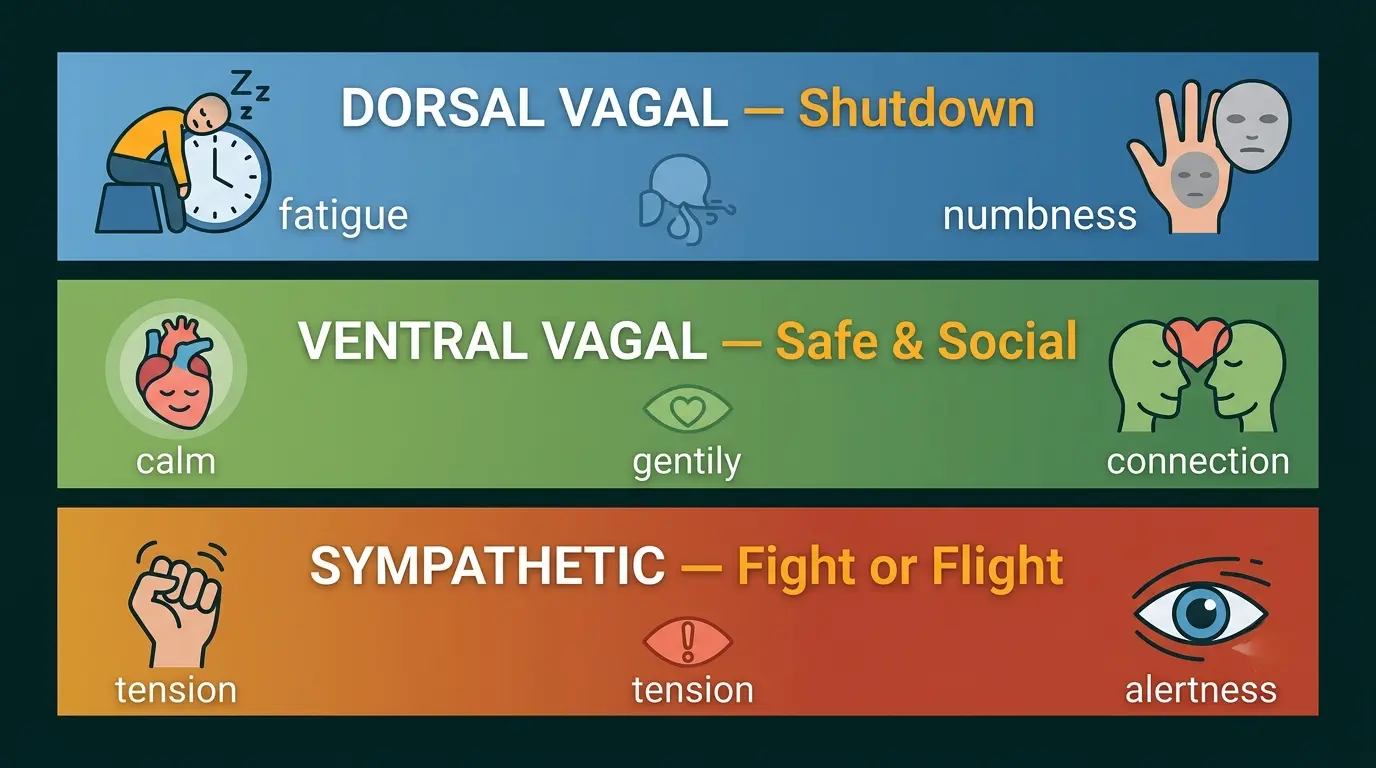
Hypoarousal is below the window. This is the one nobody talks about. Your system hasn’t calmed down; it’s collapsed. This is the dorsal vagal state, where the parasympathetic system overcorrects and shuts everything down.
You feel numb, disconnected, exhausted beyond words. You might lie on the couch for hours, unable to move. You might dissociate during conversations. You might feel nothing at all, which is somehow worse than feeling too much.
I know what this state feels like from the inside. There was a point where I needed to board a plane back to the U.S., back to a legal system that had spent years treating me as the threat while the actual threat filed her twentieth police report. I knew I needed to go.
My mind had the ticket, the gate number, the plan. My body had a different answer. It shut down completely at the airport. I missed the flight. Not because I chose to.
Because my nervous system had correctly catalogued what waited on the other side of that departure gate as more dangerous than standing still in Singapore.
That is not a weakness. That is your ancient survival architecture doing its job with ruthless efficiency, in the wrong decade.
This is the part clinicians sometimes miss. Dorsal vagal shutdown does not look like panic. It looks like nothing. It looks like a person sitting quietly who cannot explain why they cannot move.
From the outside, it reads as laziness, avoidance, and giving up. From the inside, it is the body pulling the emergency brake because the gas pedal stopped working. Your system is not broken.
It is doing exactly what evolution designed it to do when fight or flight have both failed. The problem is not the response. The problem is that the danger that trained it is gone, and nobody sent the memo to your brain stem.
This distinction matters because the tools for each direction are opposite. Breathing exercises and calming techniques help hyperarousal, but they can make hypoarousal worse.
If you’re already shut down, asking your body to “relax” is like asking a passed-out person to meditate. People in a dorsal vagal state need gentle activation, movement, temperature change, social connection, not more stillness.
So which direction does your system lean? If you’re not sure, here’s your diagnostic tool:
HYPERAROUSAL: Your system is flooding
Your sympathetic nervous system is locked in the “on” position. Everything feels like a threat.
Your parasympathetic system overcorrected and pulled the emergency brake. You haven’t calmed down, you’ve shut down.
Most people lean in one direction, though some swing between both. Knowing which one you’re dealing with right now tells you which tool to reach for first.
If you recognize yourself in the hypoarousal column, our fawn response article explores why shutdown happens and how it connects to people-pleasing patterns.

Why Doesn’t CBT Work When Your Nervous System Is the Problem?
Cognitive Behavioral Therapy works on thought patterns. But the stress response begins in the amygdala and triggers the hypothalamus before your visual cortex has even finished processing what’s happening.
When anxiety is driven by a nervous system that’s reacting below the level of conscious thought, no amount of reframing will reach the source.
Here’s the timeline Harvard researchers mapped out. When you encounter a threat, or something your brain interprets as a threat, your eyes and ears send information to the amygdala.
The amygdala interprets it and instantly signals the hypothalamus. The hypothalamus activates your sympathetic nervous system. Adrenaline floods your bloodstream. Your heart pounds, your muscles tense, your breathing accelerates.
All of this happens in milliseconds. Before you’ve consciously registered what you’re looking at. Before you’ve had a single “thought” about it.
As Harvard Health documents, “the wiring is so efficient that the amygdala and hypothalamus start this cascade even before the brain’s visual centers have had a chance to fully process what is happening.”
That’s why you can jump out of the path of an oncoming car before you think about what you’re doing.
This is also why you can know, intellectually, that you’re safe, and still feel terrified. Your conscious mind is the last one to get the memo.
The threat response has already fired. The cortisol is already in your bloodstream. Your body is already braced for impact.
CBT asks you to identify and reframe the thoughts that produce anxiety. And that works when the thoughts are the source.
But when the source is a nervous system that’s firing below cognition, you’re trying to edit a document that’s already been printed and mailed. The thought isn’t causing the anxiety. The anxiety is causing the thought.
This isn’t a failure on your part. It’s not that you didn’t try hard enough or think positively enough. It’s that you were using a top-down tool for a bottom-up problem.
You need an approach that speaks the language your nervous system actually understands: sensation, movement, breath, temperature, rhythm. Not logic.
Subscribe to Create Higher Vibrations!
Get Inspiration and Practical advice straight to your inbox.
What Happens When Your Nervous System Stays Stuck for Months or Years?
Chronic nervous system dysregulation doesn’t stay in your head. It cascades through your entire body, especially your gut. The enteric nervous system contains 500 million neurons and communicates with the brain primarily through the vagus nerve.
When stress diverts blood away from digestion and cortisol disrupts gut bacteria, the result is IBS, bloating, nausea, and a microbiome that literally produces more anxiety.
Your gut has its own nervous system. The enteric nervous system is a web of 500 million neurons lining your digestive tract, more than in your spinal cord. It’s sometimes called your “second brain,” but that undersells it.
Your gut brain and your head brain are in constant conversation, and the primary channel between them is the vagus nerve. If you want to understand this nerve in more depth, our vagus nerve article breaks down its anatomy and function.
Here’s the part that changes how you think about your stomach problems. About 80% of the vagus nerve’s fibers are sensory; they send information FROM your body TO your brain, not the other way around.
Your gut is telling your brain how to feel far more than your brain is directing your gut.
When your nervous system is stuck in survival mode, blood gets diverted away from digestion and toward your large muscles, because your body thinks it needs to run or fight.
Chronic reduction in digestive blood flow means food sits longer, enzymes don’t secrete properly, and the gut lining becomes more permeable. This is why anxiety and IBS so often show up in the same person.
Meanwhile, cortisol is doing its own damage. It increases appetite, your body is trying to replenish energy it thinks it just burned escaping a predator. It stores unused nutrients as fat, particularly around the midsection.
It disrupts the gut microbiome, reducing beneficial bacteria and allowing inflammatory species to thrive. Those inflammatory bacteria produce metabolites that cross the blood-brain barrier and deepen anxiety.
It’s a loop. Stress damages the gut. The damaged gut sends distress signals to the brain. The brain interprets those signals as a threat and keeps the stress response active, Round and round.
This is why you can’t supplement or diet your way out of a gut problem that’s being driven by a nervous system problem. The food isn’t the root cause.
The alarm system is. If you’re working on somatic healing, addressing the gut-brain axis is a critical piece of the recovery puzzle.
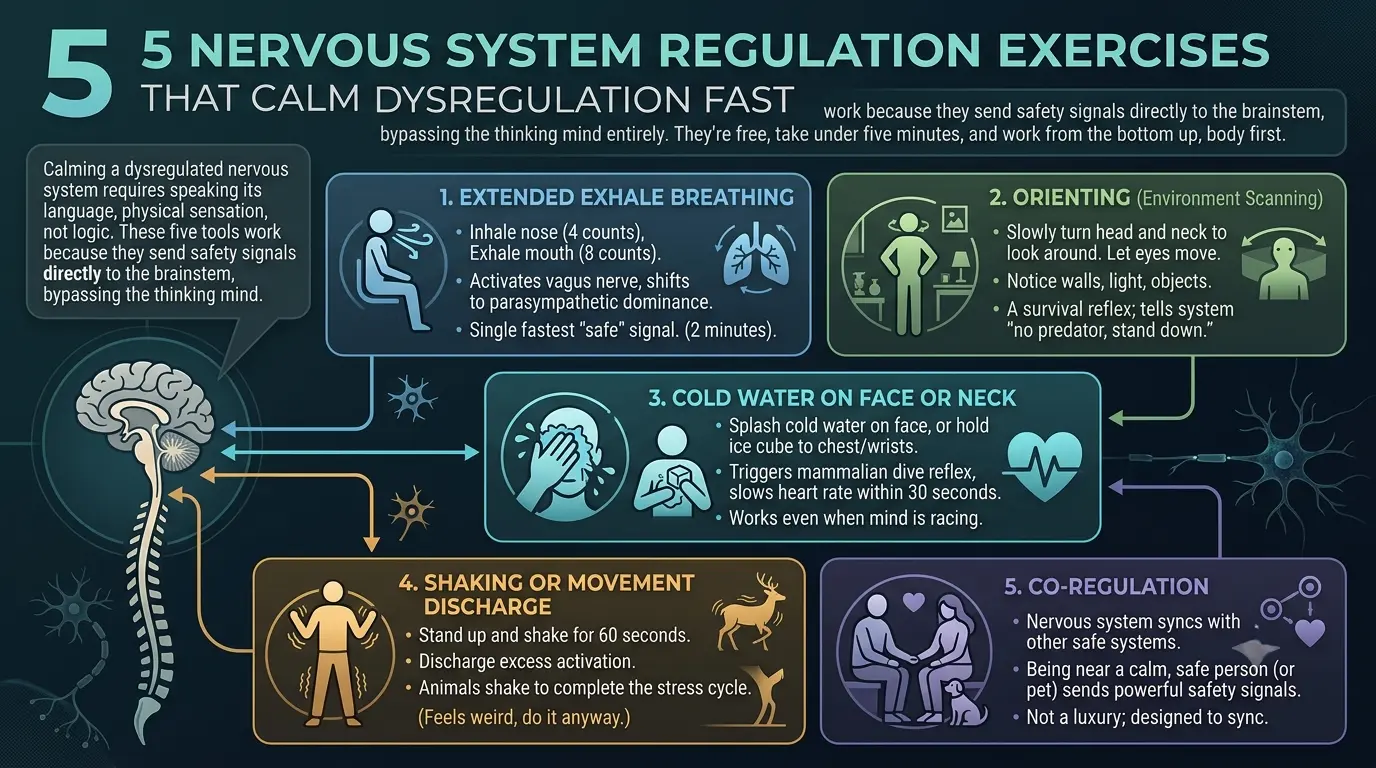
5 Nervous System Regulation Exercises That Calm Dysregulation Fast
Calming a dysregulated nervous system requires speaking its language, physical sensation, not logic. These five tools work because they send safety signals directly to the brainstem, bypassing the thinking mind entirely.
They’re free, they take under five minutes, and they start working the first time you try them.
These aren’t wellness fluff. Each one is grounded in how your nervous system actually processes safety. They work from the bottom up, body first, mind second.
1. Extended Exhale Breathing
Inhale through your nose for 4 counts. Exhale through your mouth for 8 counts. The extended exhale activates your vagus nerve and shifts your system toward parasympathetic dominance.
This is the single fastest way to signal “safe” to your brainstem. Do it for two minutes. If your mind wanders, that’s fine. The breath is doing the work whether you’re paying attention or not.
2. Orienting (Environment Scanning)
Stand or sit where you are. Slowly turn your head and neck to look around your space. Let your eyes move. Notice the walls, the light, the objects. This isn’t a mindfulness exercise; it’s a survival reflex.
When animals escape a threat, they orient to their environment to confirm that the danger is past. Your orienting reflex tells your nervous system: no predator here. You can stand down.
3. Cold Water on Face or Neck
Splash cold water on your face, hold an ice cube to your chest, or run cold water over your wrists. This triggers the mammalian dive reflex, an ancient physiological response that slows your heart rate within 30 seconds.
It works even when your mind is still racing because it’s a brainstem-level reflex, no cognition required.
4. Shaking or Movement Discharge
Animals shake after a threat passes. Literally. Watch a deer after it escapes a predator; it shakes for about 60 seconds, then goes back to grazing. This completes the stress cycle.
You can do the same. Stand up and shake your hands, arms, and legs for 60 seconds. It feels weird. Do it anyway. You’re discharging the excess activation your body has been holding.
5. Co-Regulation
Your nervous system is designed to sync with other nervous systems. Being near a calm, safe person, or even a pet, sends powerful safety signals to your brainstem. This is called co-regulation, and it’s not a luxury.
It’s a biological need. If you’re dysregulated, don’t isolate. Sit next to someone steady. Their calm is contagious at a physiological level.
Why Your Nervous System And Anxiety Can’t Find Its Way Back (And What Changes That)
If you grew up around chronic unpredictability, a volatile parent, an abusive partner, an unsafe home, your nervous system adapted by staying on high alert.
An intermittent threat is MORE dysregulating than a consistent threat because your system can never complete the stress cycle. The adaptation that kept you alive then is the thing keeping you stuck now.
Here’s what nobody tells you about healing: your nervous system isn’t broken. It’s doing exactly what it was designed to do. It adapted to an environment that was genuinely unsafe, and it built a survival response that worked. You’re still here because of it.
The problem is that the environment changed, but the adaptation didn’t. The threat is gone, but the alarm is still running.
And if the threat was intermittent, sometimes there, sometimes not, like in a narcissistic relationship, your system never got the chance to complete the stress cycle. It stayed braced for the next hit that might or might not come.
This is why survivors of narcissistic abuse often have the most stubborn, treatment-resistant anxiety. It’s not that they’re doing something wrong.
It’s that their nervous system was shaped by unpredictability, and unpredictability is the hardest pattern to recover from. Our trauma bonding article goes deeper into why intermittent reinforcement is so physiologically damaging.
Some people land in a dorsal vagal shutdown state, the system’s last resort when fight or flight both fail. If you’ve ever felt like you can’t feel anything, like you’re watching your life through a window, like you’re moving through water, that’s dorsal vagal collapse.
It’s not depression, though it looks like it. It’s your nervous system pulling the emergency brake because the gas pedal wasn’t working. Vishnu’s CPTSD symptoms article maps how this shutdown shows up in daily life.
Recovery from this state looks different than recovery from hyperarousal. You don’t need to calm down. You need to wake up gently. Temperature change. Social contact. Small movements. Tiny moments of activation that remind your system it’s safe to be alive again.
Healing isn’t about never getting triggered. It’s about a faster recovery time. The trigger might always come. But the difference between a dysregulated system and a healing one lies in how long it takes to return to baseline. Minutes instead of days. Hours instead of weeks.

Your nervous system isn’t broken. It’s doing exactly what it was designed to do: protect you. The problem isn’t the alarm. The problem is that the alarm is still ringing in an empty room.
You don’t need to fix your thinking. You need to teach your body, slowly and repeatedly, that the danger has passed. One breath. One orienting glance. One shake of the hands. That’s where it starts.
The next time your chest tightens for no reason, don’t ask why. Put your hand on your sternum, breathe out longer than you breathed in, and wait. Your body already knows what to do. It just needs you to stop talking long enough to listen.