
Signs You Are the Family Scapegoat (And It’s Not What You Think)

You know the feeling before you know the thought. Chest tightens in the car on the way there. You rehearsed an apology for something you have not done yet.
Your voice rises half an octave when you defend yourself; you notice your voice rising, and now you are watching yourself from outside your body while still inside it.
This is not anxiety in the general sense. This is a specific, conditioned response to entering a space where the rules were written without you, and the penalty for doing something wrong was never made explicit. You had to learn it through your nervous system.
Being the family scapegoat means you were systematically assigned blame, shame, and responsibility for the family’s dysfunction. Not because you were broken, but because the system needed somewhere to put pressure it refused to face.
The signs are not only psychological: your nervous system adapted structurally to chronic threat, creating patterns that persist long after you leave the family behind. The same perceptiveness that got you targeted is the faculty that will get you out.
By the end of this, you will understand why your body reacts the way it does, why the role chose you, and how the thing that made you dangerous to them becomes the foundation of your own clarity.
The family scapegoat does not represent the broken member. You acted as the truth teller in a system built on denial. Your nervous system paid the price. This framework maps the somatic and psychological and spiritual dimensions of the scapegoat role. You learn why your body reacts this way. You discover why the role chose you. The deep perception making you a target now functions as your compass.
What Does It Mean to Be the Family Scapegoat?
Being the family scapegoat is not only being blamed more than others.
It is a systematic, often lifelong role assignment where one family member becomes the emotional release valve for the entire system: absorbing projection, hosting shame that belongs to others, and being punished for naming reality.
It is not a personality trait. It is a structural position that your nervous system has adapted to.
Here is the distinction that most articles blur. The identified patient, a term from Virginia Satir’s family therapy work, is the family member who carries visible symptoms.
The one acting out, struggling in school, or showing signs of distress the family can point to. The scapegoat is different. The scapegoat may be the healthiest person in the system. They carry invisible blame so the family can maintain its self-image.
The IP holds the family’s dysfunction visibly. The scapegoat holds it invisibly through projection.
This matters clinically because the healing paths differ. An identified patient may need symptom treatment. A scapegoat needs identity reclamation.
If you have spent years in therapy treating yourself as the problem when you were the designated problem-holder, you have been aiming at the wrong target.
Murray Bowen’s family systems theory explains why this role exists at all. Families operate as emotional units, and like any system, they seek stability. That stability is called family homeostasis.
When pressure builds (marital dysfunction, unprocessed grief, a parent’s unresolved trauma), the system must release it somewhere. One member gets elected.
Rebecca Mandeville’s clinical work on Family Scapegoating Abuse (FSA) formalizes this: it is not occasional unfairness. It is systemic, identity-level psychological abuse that produces specific neuro-relational injury distinct from general family dysfunction.
For the full structural picture, read our guide to the narcissistic family system.
The scapegoat’s function is the truth-teller function. In a family that runs on denial, the person who names reality becomes the threat. You did not get the role because you were the most broken.
You got it because you were the one who could not or would not pretend. That clarity, the very thing that isolated you, is genuine perceptual capacity. It got turned against you before you had the power to use it consciously.
Before we look at the signs, understand this: the scapegoat role is not who you are. It is what was done to you. And the body kept the score long before you had words for any of it.
The term scapegoat originates from a ritual described in Leviticus 16. A community sent a goat into the wilderness to carry its sins. This ancient mechanism serves a specific function. The group designates one target to carry unacknowledged pain. You experience a dynamic predating modern psychology by millennia.
Source Center for Action and Contemplation
What Are the Signs You Are the Family Scapegoat?
The signs go beyond being blamed. You notice a pattern: your feelings are pathologized, your achievements minimized, your mistakes magnified. You apologize before anyone has accused you.
Your body reacts before your mind does (chest tightness, voice changes, the urge to shrink). And you see the family system clearly in ways others seem blind to. That clarity is what made you the target.
The signs fall into four clusters. Most articles give you the first one and stop. The other three are where the real information lives.
The Relational Signs
These are the interpersonal patterns everyone in the role recognizes.
The Somatic Signs
This is where the scapegoat role lives physically, and where most articles have nothing to say.
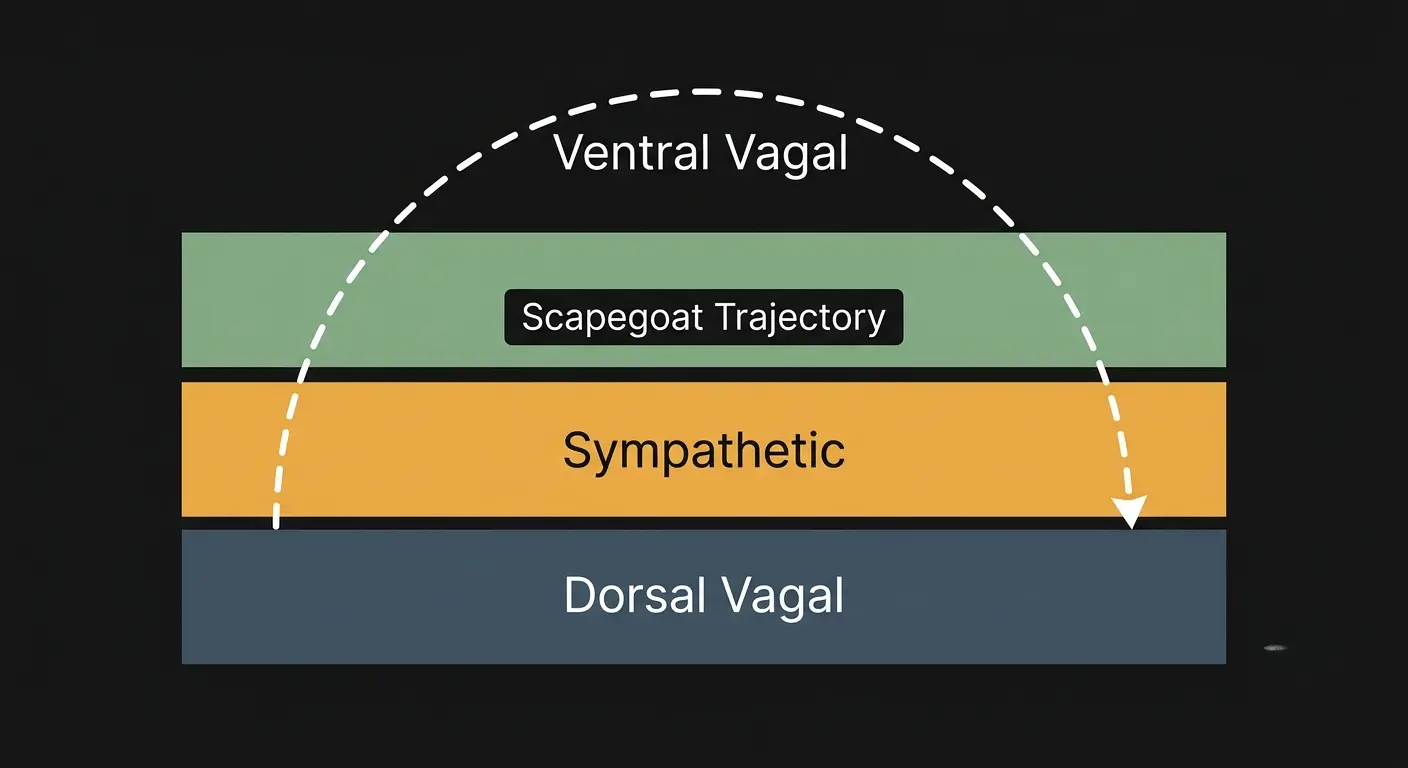
Your body learned the role before your mind had language for it. Before family gatherings, your chest tightens. Your voice modulates upward when you defend yourself, a physiological submission signal your nervous system learned was the safest option.
You feel the urge to apologize before anyone has accused you, because your body has learned that pre-emptive surrender sometimes reduces the incoming damage.
These are not personality quirks. They are conditioned autonomic responses.
Stephen Porges’ polyvagal theory explains the mechanism: your neuroception (the nervous system’s unconscious threat detection) was calibrated in an environment where threat was constant, unpredictable, and came from the people you depended on for survival.
It now over-fires in safe contexts because it was trained on data that said safety never lasts.
The fawn response, from Pete Walker’s 4F trauma typology, becomes your default social strategy. The fight was never safe. These are your caregivers. Flight was not an option. You were a child. So your nervous system learned to appease, to pre-empt, to shrink.
This is not a weakness. It is a sophisticated survival adaptation that kept you alive in an environment where direct resistance would have made things worse.
If you notice your nervous system overreacting in safe situations, the signs of nervous system dysregulation article maps out the full picture.
Researchers Vogel and Bell identified the family scapegoat role in 1960. They studied families experiencing severe dysfunction. Parents used one child to release emotional pressure. The symptoms of the child distracted parents from deep marital problems. Professionals document this exact pattern for over sixty years.
Source ScienceDirect
The Identity Signs
The deepest wound is pre-verbal. Many scapegoats describe a sense of fundamental wrongness that predates any specific memory. “I have always felt like I was the mistake. Not that I made mistakes, but that I AM the mistake.”
This is toxic shame as John Bradshaw defined it: not “I did something bad” but “I am bad.” And here is the mechanism most articles never explain. Toxic shame and healthy guilt activate completely different neural circuitry.
Shame triggers the anterior cingulate cortex (the brain’s self-referential processing center) and corresponds to dorsal vagal shutdown in the nervous system. The body collapses.
The mind attacks the self. Healthy guilt activates the prefrontal cortex (the brain’s repair-seeking and behavioral correction center) and corresponds to ventral vagal engagement. The body stays online. The mind looks for solutions.
Scapegoats live in shame, not guilt. Standard self-esteem advice (affirmations, cognitive reframing) cannot reach a dorsal vagal state. You cannot talk your way out of a nervous system configuration.
This is why “believe in yourself” has never worked for you. The problem is not your beliefs. It is your autonomic baseline.
The Perceptual Signs
You see patterns other family members deny. You track emotional shifts in the room before anyone speaks. You can predict how a conversation will go because you have mapped the family script.
This hypervigilance is often framed as pathology: “you are too sensitive,” “you overthink everything.” But it is trained perception. Your nervous system learned to read threat because threat was everywhere, and the same hardware that reads threat reads truth.
You developed genuine perceptual intelligence through an environment that required it.
| Sign Cluster | What It Looks Like | Nervous System Mechanism |
|---|---|---|
| Relational | You receive blame for speaking the truth. They hold you to unequal standards. They pathologize your emotions. | Your neuroception expects punishment for authenticity. |
| Somatic | You feel chest tightness before gatherings. You modulate your voice. You apologize preemptively. | You experience dorsal vagal activation. Your nervous system uses the fawn response as a default social strategy. |
| Identity | You believe you represent the mistake. You confuse shame with guilt. | Your anterior cingulate attacks your sense of self. You experience dorsal vagal collapse as an identity state. |
| Perceptual | You recognize patterns instantly. You track emotions constantly. You see systemic clarity others miss. | Your hypervigilance functions as trained perception. Your neuroception operates at a heightened level. |
One of the earliest academic observations of this pattern came from Vogel and Bell in 1960. They identified the scapegoat child as an “emotional release valve” whose visible struggles distracted from deeper marital dysfunction.
The mechanism has been documented for over sixty years. You are not imagining it.
Why Do Families Choose a Scapegoat?
You were not chosen because you were broken. You were chosen because you were the one who could not or would not pretend. Scapegoats tend to be the most perceptive, honest, or emotionally reactive members of the system.
In a family that runs on denial, the person who names reality becomes the threat. Sometimes it begins before you have words.
The selection is not random. Several factors converge.
Temperament plays a role. Elaine Aron’s research on sensory processing sensitivity identifies a trait present in roughly 15 to 20 percent of the population: deeper processing of stimuli, stronger emotional reactivity, greater awareness of subtleties.
A highly sensitive child in a dysfunctional family is like a smoke detector in a burning building. They register the fire while everyone else is adjusting to the heat.
That perceptiveness makes them the canary. And the canary does not cause the gas. It notices first.
Circumstances matter too. You may resemble a parent someone resents. You may have arrived during a crisis (a marriage under strain, a financial collapse, a death that was never grieved).
The family system, already overloaded, routes its unprocessed pressure toward the newest or most visible member. Birth order can contribute, but it is not determinative. What matters is whether you became the most convenient container.
Sometimes the role begins before language. Maternal projection, attunement failure, and a parent’s unresolved attachment patterns. These can assign the scapegoat role to an infant who has no way to refuse it.
The mother looks at the child and sees not the child, but her own unprocessed material. The child’s nervous system registers the misattunement long before the mind can name it. This is why many scapegoats describe the wound as “older than memory.” It is.
The common thread: the scapegoat is the system’s pressure valve. Not because they deserve it. Because the system needs one, and they were the most available. By temperament, by timing, by the threat their perceptiveness posed to the family’s shared story.
Those who have lived this role often experience a particular kind of loneliness. The recognition that even the people who were supposed to protect you were, in their own way, using you.
That isolation is real. And it is also the beginning of something the family never intended.

The Scapegoat and the Golden Child: Two Sides of the Same Control System
The golden child and scapegoat are not opposites. They are both prisoners in the same system. The golden child is role-locked into performance and enmeshment.
The scapegoat is role-locked into blame and exile; the split functions to prevent sibling bonding, which would threaten parental control. Neither role is freedom.
Most articles describe the golden child as “the favored one” and leave it there. That framing is incomplete in a way that harms both siblings. The golden child is not free.
They are trapped in conditional love. Their worth depends on continued performance, continued compliance, and continued reflection of the parent’s desired self-image.
They cannot individuate without shattering their entire identity, because their identity was built to serve someone else’s.
The split between the two roles is a control mechanism. If the scapegoat and golden child compared notes, if they sat down and said “what was your experience of this family?”, the entire system would be exposed.
So the system ensures they never do. The golden child is trained to see the scapegoat as the problem. The scapegoat is conditioned to resent the golden child for having it easier.
The energy stays horizontal, between siblings, instead of vertical, toward the parents who designed the arrangement.
Here is the paradox: the scapegoat often has more freedom than the golden child. The scapegoat has already been rejected, which means they have less to lose by becoming themselves.
The golden child is still inside the machine, still earning love through performance, still unable to ask “what do I want?” because the question has never been permitted.
Some readers experienced both roles at different times. Role oscillation (being the golden child one year and the scapegoat the next) is more common than clinical literature acknowledges.
It creates a specific kind of identity fragmentation. You never knew which version of you the family would see today. That unpredictability prevented you from developing a stable self-concept because the mirror the family held up kept changing shape.
If this was your experience, the confusion itself is evidence. No child can integrate an identity when the reflection keeps flipping.
| Dimension | Scapegoat | Golden Child |
|---|---|---|
| Role Assignment | You act as the designated blame holder. You function as the emotional release valve. | You act as the designated performer. You carry the self image of the parent. |
| Family Treatment | They punish you for the truth. They hold you to impossible standards. They pathologize your reactions. | They reward you for compliance. They protect you from consequences. They idealize your actions. |
| Independence Level | You gain more freedom. Rejection forces your separation from the system. | You possess less freedom. Enmeshment prevents your individuation. |
| Identity Outcome | Blame fragments your identity. You rebuild yourself outside the system. | Performance fragments your identity. You discover yourself beneath the assigned role. |
What the Scapegoat Role Does to Your Nervous System
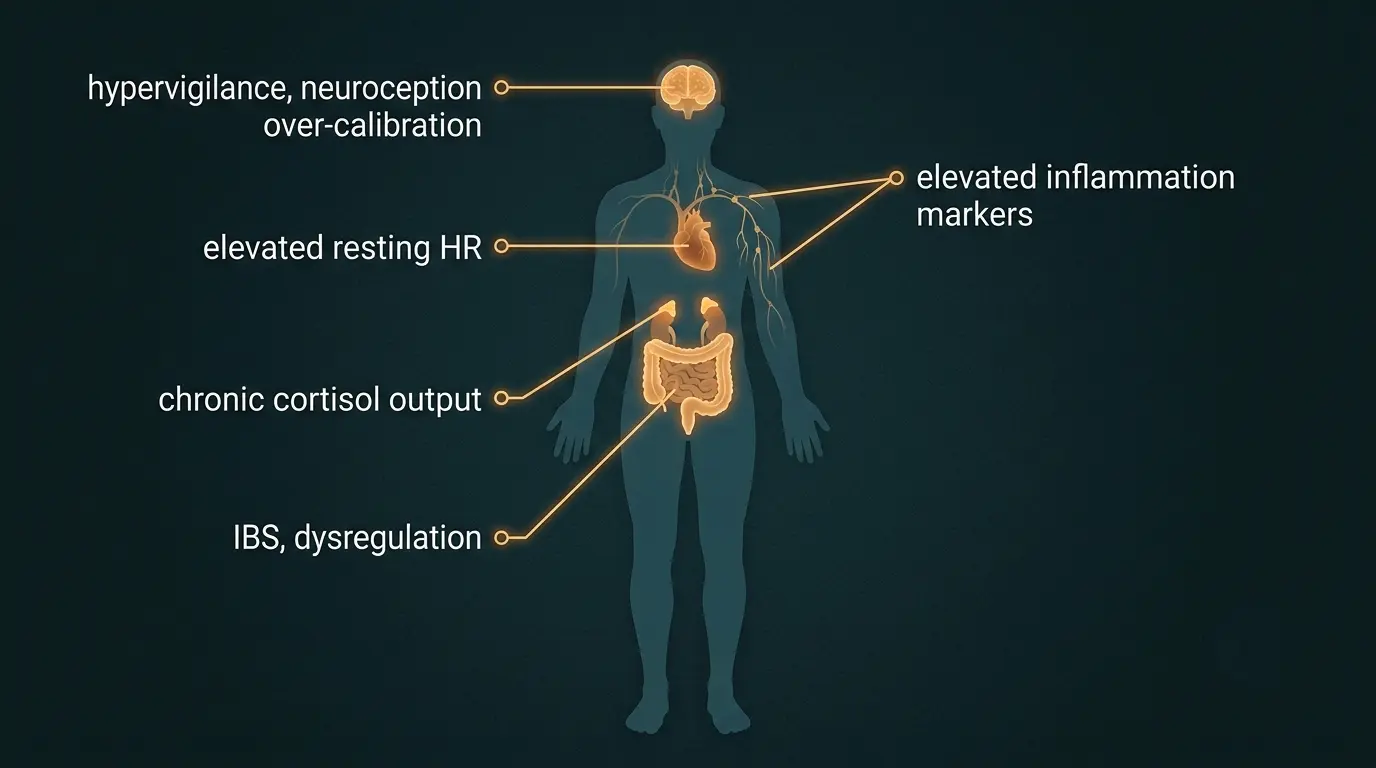
The scapegoat role not only changes how you think. It rewires how your body processes threat. Repeated exposure to family hostility trains your neuroception to detect danger everywhere.
Your nervous system defaults to dorsal vagal shutdown or fawn response because fight or flight were never safe options in a system you could not leave. The body adapted to survive, and the adaptation became your baseline.
Porges’ polyvagal theory maps three autonomic states. The ventral vagal complex is the safe-and-social system: you feel connected, present, capable of rest and digestion.
The sympathetic nervous system is mobilized (fight-or-flight, the body preparing for action). The dorsal vagal complex is the oldest pathway, the shutdown system: collapse, dissociation, the body playing dead because neither fight nor flight is possible.
For a deeper look at the freeze mechanism, read how the freeze state response works.
A healthy nervous system moves fluidly between these states in response to genuine changes in the environment. Threat appears, you mobilize. Threat passes, you return to ventral vagal safety. The scapegoat’s nervous system loses this flexibility.
Chronic, unpredictable threat from caregivers you depend on trains the system to skip mobilization and go straight to dorsal vagal collapse. Why? Because fighting back against a parent was punished. Fleeing was impossible. You were eight.
So the nervous system learned the only safe option was to disappear, to appease, to collapse.
This produces a specific profile:
This is why talk therapy alone often fails scapegoats. You can cognitively understand that you are safe now. Your body does not believe it.
The nervous system learned its lessons at a level words cannot reach directly. Healing has to include the body. The connection between trauma and nervous system health is explained further in C-PTSD and nervous system dysregulation.
Discover Your Inner Self. Join Our Self-Mastery Program.
Self-Mastery Coaching gives you the space, tools, and guidance to grow, reflect, and discover your values and inner strength.

Toxic Shame vs. Healthy Guilt: The Neurobiological Difference
Toxic shame says, “I am bad.” Healthy guilt says, “I made a mistake.” They activate completely different nervous system states. Shame triggers dorsal vagal collapse and anterior cingulate self-referential processing.
Guilt activates ventral vagal engagement and prefrontal repair-seeking behavior. Scapegoats live in shame, and standard self-esteem advice cannot reach a dorsal vagal state.
Bradshaw’s framework on toxic shame identified this distinction decades ago, but the neurobiological mechanism is what makes it actionable.
The anterior cingulate cortex, when activated by shame, turns attention inward. Not in a productive self-reflection mode.
It turns inward to attack. The brain treats the self as the problem to be solved. Simultaneously, the dorsal vagal system initiates collapse: heart rate slows, breathing shallows, muscle tone drops, cognition narrows.
The body is preparing to disappear because the self has been identified as the threat.
Healthy guilt activates an entirely different pathway. The prefrontal cortex engages (the part of the brain that plans, corrects, and repairs).
The ventral vagal system stays online, keeping you connected to others and capable of action. The thought is “I did something wrong, and I can fix it.” The body remains resourced enough to fix it.
Scapegoats rarely experience healthy guilt. The family system trained them to experience shame, because a child who feels “I made a mistake” might correct the behavior and move on.
A child who feels “I am the mistake” stays controllable. Shame is a more efficient compliance mechanism than guilt. Guilt leaves room for agency. Shame closes the door.
| Dimension | Toxic Shame | Healthy Guilt |
|---|---|---|
| Core Belief | You believe you represent a bad person. | You believe you made a mistake. |
| Brain Region | Your anterior cingulate drives self attack. | Your prefrontal cortex drives repair seeking behavior. |
| Nervous System State | You experience dorsal vagal shutdown. You collapse and dissociate. | You maintain ventral vagal engagement. You feel connected and capable. |
| Behavioral Output | You hide. You shrink. You punish yourself. | You seek repair. You make corrections. You take relational accountability. |
| Healing Approach | You use somatic regulation first. Cognitive reframing fails to reach shutdown states. | You use cognitive and behavioral methods. Your body already operates online. |
A small, honest pause here. At some point, you have to notice the sheer administrative effort your family puts into making you the problem. The unspoken agreements. The coordinated eye-rolls.
The way everyone seemed to have received a memo you never got. A memo titled “Why Everything Is Their Fault.” That is a lot of organizational energy directed at one person.
You were the family’s full-time employee, except the job was “Be Wrong” and the benefits package was trauma. You are allowed to find that absurd. It is absurd.
The Scapegoat’s Hidden Gift: Systemic Perception as Spiritual Faculty
If this section triggers resistance, that resistance is correct data. Sit with it before reading further. Moving from allostatic load and toxic shame into “gift” territory too quickly can feel like a betrayal of what you just acknowledged.
The section below does not minimize the pain. It names something additional, not something instead.
The scapegoat sees what others cannot. Hypervigilance, pattern recognition, emotional tracking, systemic awareness. These survival adaptations are genuine perceptual faculties.
When the threat is removed through healing and boundaries, they do not disappear. They become available as gifts: discernment, energetic literacy, predictive intelligence. You developed skills no one else in the family has.
This is not toxic positivity. The pain was real. The injury was real. The years of being told you were the problem while being the only one who could see the problem.
That does damage. Nothing in this section minimizes that. What it does is name something true that the victim narrative alone cannot hold: you developed genuine capacities through the fire, and those capacities are yours now.
The anthropologist René Girard spent his career studying the scapegoat mechanism across cultures, the way communities resolve internal tension by expelling a designated victim.
The insight that matters here: the scapegoat occupies a unique perceptual position. Because they have been forced outside the collective, they can see it.
Most people are inside the story their group tells about itself. The scapegoat has been ejected from that story. That ejection grants a perspective no insider can access.
In Jungian terms, the scapegoat carries the family’s collective shadow. All the disowned shame, rage, failure, and fear the system refuses to acknowledge. That is the wound. But the person who carries the shadow also develops the capacity to perceive it.
You learned to track what others deny. You can feel the emotional currents in a room before anyone speaks. You see the pattern behind the individual incidents. These are not trauma symptoms.
They are trained faculty. Hypervigilance is a perception tuned to threat. Remove the threat, and that same perceptual hardware becomes discernment.
Awakening traditions cultivate these capacities deliberately. Meditation trains you to observe thoughts without identifying with them. Contemplative practice develops systemic awareness: seeing the whole rather than being caught in the part.
The scapegoat developed versions of these capacities not through choice but through necessity. The isolation that hurt you also separated you from the collective denial. That separation is the definition of awakening: waking up from the shared dream.
This is not spiritual bypassing. Spiritual bypassing would say, “Your pain was a gift, so you should be grateful.” That is garbage. The pain was pain. The gift is not the pain.
The gift is the perceptual faculty that developed alongside it, and that faculty is real whether or not you choose to name it spiritually.
What matters is this: the same perceptiveness that made you dangerous to a dysfunctional family is the perceptiveness that lets you move through the world with clarity most people never develop.
You are not broken. You are calibrated differently. And once you stop using that calibration to scan for threats, you can start using it to see what is true.
Subscribe to Create Higher Vibrations!
Get Inspiration and Practical advice straight to your inbox.
How Do You Heal From Being the Family Scapegoat?
Healing requires two things most advice misses. First, your nervous system has been structurally adapted to threat. Somatic work is not optional; it is the foundation.
Second, you must reclaim the identity the family overwrote. This does not require their acknowledgment. Most scapegoats heal without the family ever revising the story. The perceptiveness that got you targeted becomes your compass.
The path moves through three phases. They overlap. You will cycle through them, not complete them once.
Phase 1: Nervous System Regulation
Cognitive insight cannot reach a body running on dorsal vagal shutdown. Before you can meaningfully engage with “who am I apart from the role,” your nervous system needs to learn that safety is possible. This is not a metaphor. It is neurobiological.
Somatic approaches that address the autonomic baseline directly:
Phase 2: Identity Reclamation
Once your nervous system has enough ventral vagal capacity to stay present during self-inquiry, the identity work becomes possible. The family gave you a script: who you are, what you are worth, what you are allowed to want.
That script was never yours. Reclamation means separating who you were told you were from who you are.
This does not require family acknowledgment. Most scapegoats heal without anyone in the family ever revising the narrative. Waiting for them to see you clearly is waiting for a system that depends on not seeing you.
The work is internal: notice when you are running a family-authored belief, name it as theirs, and choose your own. This sounds simple. It is not. The beliefs were installed before you had the cognitive equipment to question them.
Phase 3: Perceptual Gift Integration
This is where the trajectory bends upward. The same perceptiveness that made you a target, once liberated from the threat context, becomes available for conscious use.
You do not heal “back to normal.” You heal in capacities most people do not have.
Your systemic awareness (the ability to read a room, sense dynamics, see patterns) becomes discernment. Your emotional tracking becomes energetic literacy.
Your hypervigilance, recalibrated, becomes a capacity to notice what matters while filtering what does not. These are not consolation prizes. They are genuine faculties.
The scapegoat who heals does not become “like everyone else.” That was never the goal. The goal is to own what you are.
Whether you cut contact with your family depends on one question: is contact with them still actively dysregulating your nervous system? If yes, distance is not punishment.
It is autonomic self-defense. If no (if you have developed enough somatic capacity to stay regulated in their presence), limited contact with strong boundaries is possible.
There is no universal answer. The nervous system decides. For guidance on post-healing relationships, read Conscious Relationships After Trauma.

The light this morning hit the ridgeline differently. You have been here before. This vantage point, looking back at terrain you crossed. But you could not see it then.
You were inside it. The patterns, the pressure systems, the way every road in that place led back to the same tired verdict about who you were. From the outside, the whole geography makes sense.
You were not lost in there because you were broken. You were lost because the map they gave you was drawn to keep them comfortable, not to get you out. You found your way anyway. Not through their acknowledgment.
Through your own nervous system, slowly learn that safety is real. Through your own clarity, the very thing they punished is now the thing you steer by. You were not the family’s problem. You were its wake-up call. And you are the one who woke up.