
How Narcissistic Abuse Rewires Your Autonomic Nervous System

You left the relationship. Maybe six months ago. Maybe two years. But your body is still running the program.
A text from an unknown number. A tone of voice too much like theirs. A genuinely kind partner, and your chest still tightens anyway. You tell yourself it is over. Your nervous system did not get that memo.
This is not a character flaw. This is your autonomic nervous system doing exactly what it was trained to do during months or years of unpredictable threat.
The system that learned to survive can learn to settle. But it needs a different kind of instruction than your thinking brain can provide.
This is what narcissistic abuse does to the autonomic nervous system, and the specific practices that help rewire it.
- Somatic Reprogramming. Narcissistic abuse inflicts physical trauma on your autonomic nervous system. This trauma traps you in permanent survival states long after physical separation.
- The Traumatizing Trio. Three distinct physiological mechanisms drive systemic dysregulation. These include chronic unpredictability, thwarted defensive responses, and a total loss of relational co-regulation.
- State Dependent Healing. True recovery requires physical somatic interventions including breathwork, sensation tracking, and movement. Cognitive understanding alone fails to reset your dysregulated nervous system.
- The Baseline Objective. Healing does not mean the absolute elimination of stress. You restore your autonomic flexibility instead. This means rebuilding your physiological capacity to seamlessly cycle back to a safe baseline.
What Is the Autonomic Nervous System, and Why Does Narcissistic Abuse Target It?
The autonomic nervous system (ANS) is the body’s unconscious control center for survival. Narcissistic abuse targets the ANS by weaponizing chronic unpredictability, forcing the survivor into an indefinite state of hypervigilance that disrupts the HPA axis and prevents the body from returning to a safe baseline.
The ANS regulates vital involuntary functions, including:

When subjected to narcissistic abuse, this system undergoes a process of trauma-induced physical reprogramming.
A partner who shifts without warning between warmth and cruelty forces your autonomic system into permanent partial alert. You are never fully activated.
You are never fully at rest. You exist in the in-between: bracing, scanning, waiting.
This sustained partial activation is extraordinarily expensive. Over months and years, it changes the chemistry of your stress response system.
The hypothalamic-pituitary-adrenal axis (HPA axis) stops cycling naturally between activation and recovery. It gets stuck running too hot (anxiety, hypervigilance, insomnia) or too flat.
This disruption causes real, measurable physiological consequences: exhaustion that sleep cannot fix, profound emotional numbness, and the distinct feeling of watching your own life from behind glass.
The Three Autonomic States of Survival
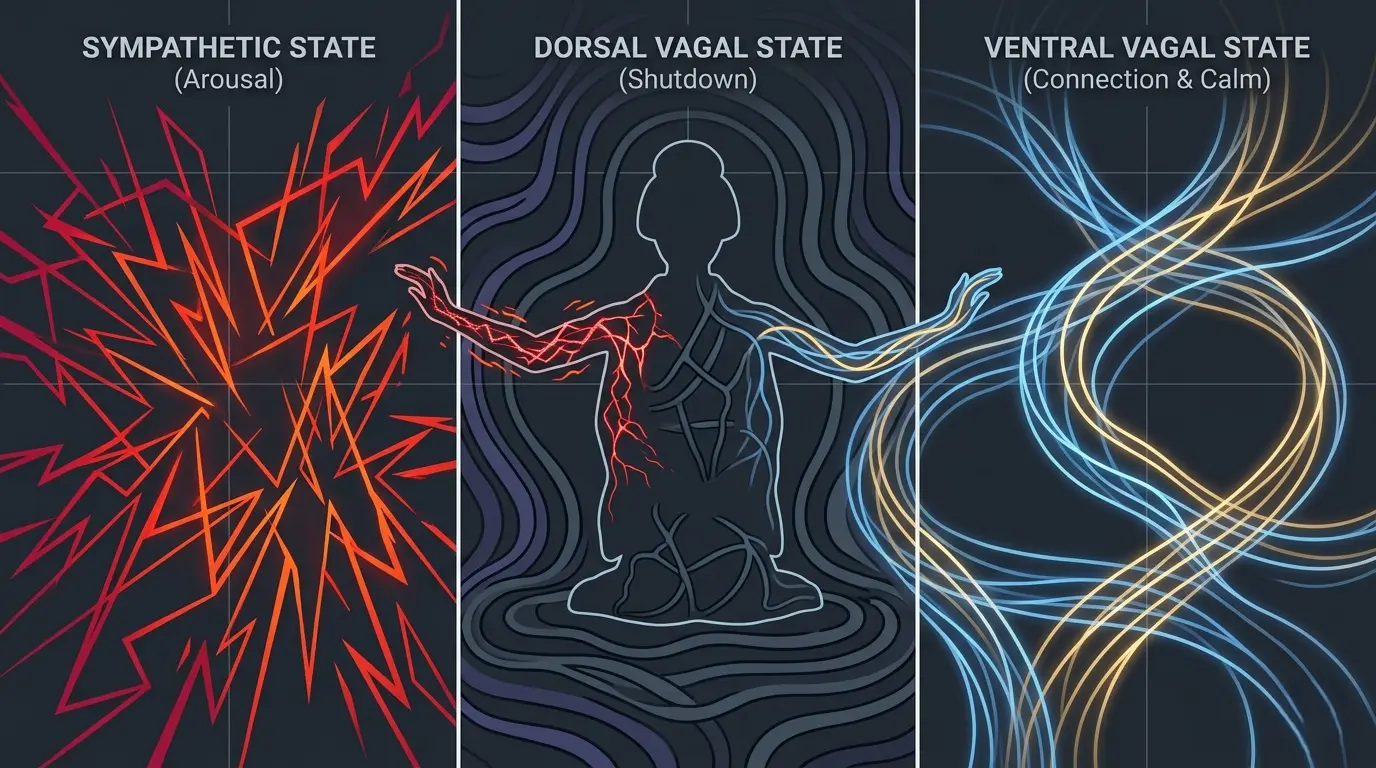
To navigate recovery, you must understand the three distinct states of the nervous system. Chronic stress disrupts the baseline-recovery cycle, trapping survivors in the lower two survival states:
| Autonomic State | What It Is | What It Feels Like After Abuse |
|---|---|---|
| Ventral Vagal (Safe) | You engage socially. You feel calm connection. You rest and digest. | You experience brief windows of ease interrupted by sudden anxiety. This state is the hardest for you to access. |
| Sympathetic (Fight or Flight) | You mobilize for action. You stay alert. | You notice a racing heart, muscle tension, hypervigilance, and insomnia. This feels like anxiety but operates as a survival state. |
| Dorsal Vagal (Freeze) | You shut down to conserve energy. You protect yourself through disconnection. | You feel exhaustion rest does not fix. You experience numbness and dissociation. You feel outside your own life. |
The Three Mechanisms: How Narcissistic Abuse Rewires Your Nervous System
Each mechanism requires a slightly different recovery approach. Generic self-care addresses none of them.
Mechanism 1: Chronic Unpredictability
A healthy nervous system relies on predictable safety cues to settle. You learn that kindness can become cruelty without warning.
That the person who said “I love you” at breakfast can treat you like an enemy by dinner. That your own judgment cannot be trusted.
What this looks like: You cannot fully relax in objectively safe situations. You scan faces, voices, and text phrasing. You grip your thigh under the table during meetings without noticing. The threat is gone. The scanning is not.
Over time, the system loses its ability to move fluidly between states. It gets locked, either chronically activated or shut down, with only brief, unstable access to the ventral vagal baseline where genuine rest happens.
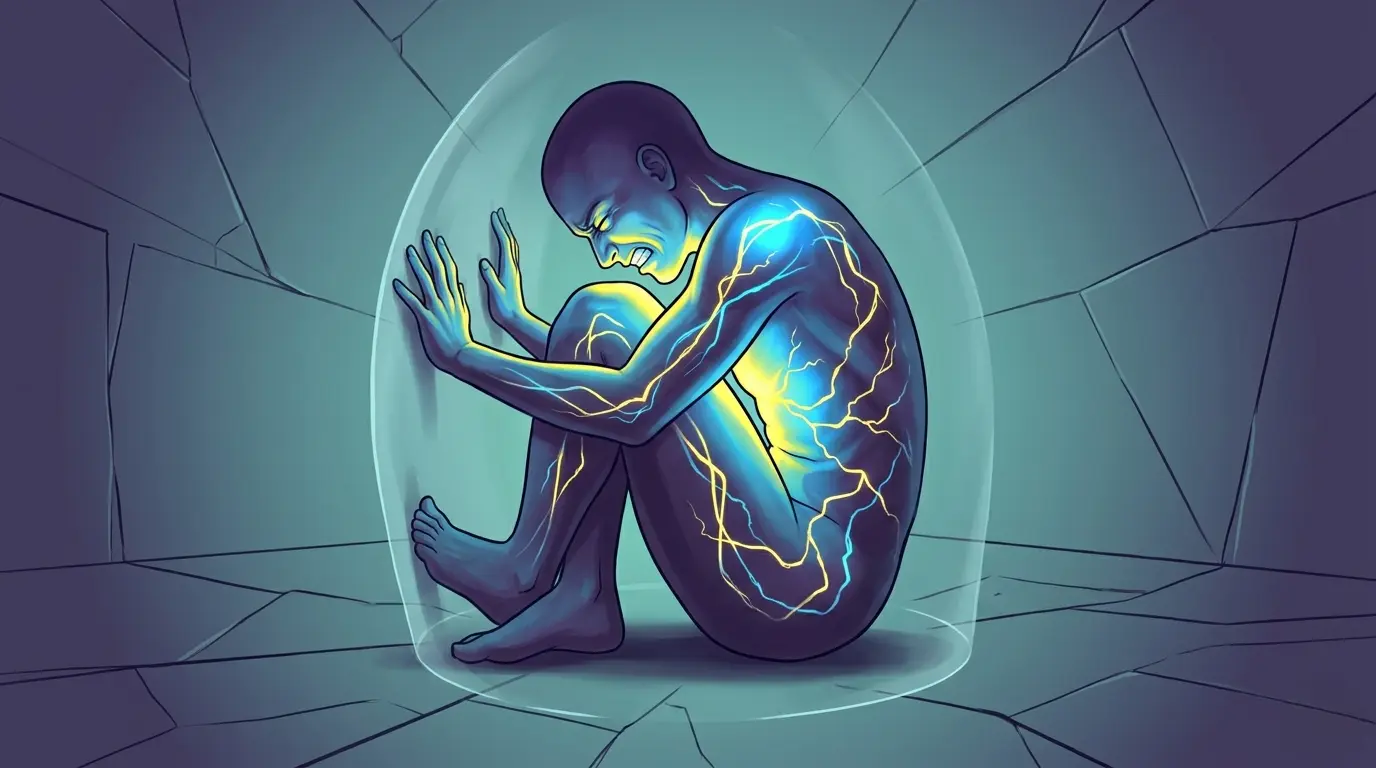
Mechanism 2: Suppressed Defensive Responses
In a typical threat scenario, the sympathetic nervous system mobilizes the body to fight or flee. Once the defensive action is completed, stress hormones drop, and the system naturally returns to homeostasis.
In a narcissistic relationship, executing these natural self-protective boundaries results in immediate punishment or retaliation.
To survive, your nervous system is forced to suppress this mobilization energy. It does not dissipate; instead, it becomes trapped within the body as chronic allostatic load (the cumulative wear and tear of stress on tissues).
Mechanism 3: The Destruction of Co-Regulation
Your nervous system is not designed to regulate itself alone. We regulate partly through attunement with other regulated nervous systems. The calm presence of a safe person is not a luxury. It is a physiological necessity.
In a narcissistic relationship, the primary relational resource is not reliably regulated. Over the years, the survivor loses access to one of the core mechanisms through which human nervous systems naturally recover from stress.
What this looks like after the relationship: Feeling alone despite a social calendar. Being around people and still feeling dysregulated. Afraid of connection but starving for it. “Putting yourself out there” feels physiologically threatening.

How to Tell Which State You Are In Right Now
Different states require different interventions. Using the wrong one makes you feel worse.
Sympathetic Activation (Your System Running Hot)
Physical signs: elevated resting heart rate, muscle tension, shallow breathing, heightened startle response, digestive disruption, compulsive need to move.
Emotional signs: free-floating anxiety, irritability disproportionate to the trigger, racing worst-case-scenario thoughts, difficulty receiving comfort.
In your life: Waking at 3 a.m. with a racing heart. Cannot watch a phone-free movie. Snapping at someone you love without knowing why.
Dorsal Vagal Shutdown (Your System Gone Flat)
Physical signs: exhaustion that does not respond to sleep, heaviness, numbness or tingling, feeling cold, dissociation.
Emotional signs: emotional flatness, difficulty accessing pleasure, knowing you “should” care without feeling it, distance from physically close people.
In your life: Sleeping nine hours and waking exhausted. Sitting on the couch unable to start simple tasks. A friend tells a sad story, and you feel nothing.
The key insight: Most survivors cycle between these two states. Highly activated during demands, collapsing into flat exhaustion in the spaces between. Neither state is the ventral vagal baseline where human flourishing happens.
Ventral Vagal Access (Where Healing Occurs)
Breathing is easy. Muscles are relaxed but not collapsed. You can feel pleasure in small things. You can receive comfort from another person. Quiet moments feel peaceful, not threatening.
| Your State | First Response | Daily Practice |
|---|---|---|
| Sympathetic (Hot) | You practice extended exhale breathing for five minutes. | You engage in breathwork before checking your phone, cold exposure, and vigorous movement. |
| Dorsal Vagal (Flat) | You practice orienting, seek warmth, and use gentle movement. | You practice trauma-informed yoga, take slow walks, and seek safe, quiet contact. |
| Cycling Between Both | You use three-state journaling. | You attend body-based therapy, practice co-regulation, and maintain consistent routines. |
What Actually Helps: State-Specific Practices
For Sympathetic Activation
Extended exhale breathing (4 counts in, 6 to 8 counts out) directly stimulates the vagus nerve. Research shows measurable heart rate variability improvements in five minutes. This is a physiological intervention, not a relaxation technique.
Cold water on the face activates the dive reflex, producing a rapid parasympathetic response. Thirty seconds to two minutes is enough.
Vigorous movement that discharges energy: running, swimming, boxing. The goal is to complete the sympathetic activation cycle that your body was forced to suppress.
For Dorsal Vagal Shutdown
Not intense exercise. That asks too much of a depleted system. Slow stretching, gentle yoga, slow walking. The goal is to reintroduce small amounts of activation without overwhelming.
Orienting: slowly turning your head to look around. This activates the social engagement system and signals that your surroundings are safe. Notice one thing in each direction.
Warmth: warm bath, blanket, drink. The dorsal vagal state often includes feeling cold. Gentle warmth signals safety without demanding energy your system does not have.
For Ventral Vagal Recovery
Safe relational connection. Time with people whose regulated presence genuinely settles you. Not stimulating socializing. Warm, safe, predictable contact. One genuinely safe connection is high-yield nervous system medicine.
Nature exposure. Twenty to forty minutes, two to three times weekly, produces measurable effects on autonomic regulation. Parks qualify. You need trees and sky, not a forest.
Trauma-informed yoga. Research from the Trauma Center at JRI documents its effectiveness for trauma recovery. It builds interoceptive awareness, the capacity to sense your own internal states, which narcissistic abuse profoundly disrupts.
Discover Your Inner Self. Join Our Self-Mastery Program.
Self-Mastery Coaching gives you the space, tools, and guidance to grow, reflect, and discover your values and inner strength.

Why Healing Feels Worse Before It Feels Better
When you stop doing, stop producing, stop managing your internal state through momentum, suppressed material starts surfacing. This is not the practice making things worse. The practice is making space for what needs to be felt.
You may feel more anxious before, less. Cry without knowing why. Feel angry for the first time in years. This is not regression. It is your nervous system finally feeling safe enough to process what it had to store to survive.
Deb Dana describes the goal as restoring “autonomic flexibility.” The ability to move between states and return to baseline with increasing reliability. Not the elimination of stress. The restoration of the capacity to come back.
Subscribe to Create Higher Vibrations!
Get Inspiration and Practical advice straight to your inbox.
An Honest Timeline
Three months of consistent practice. That is when most survivors notice a meaningful reduction in acute symptoms: better sleep, less baseline tension, less reactive startle. More fundamental changes in the autonomic baseline take longer. Often a year or more.
Duration of the relationship, severity of abuse, concurrent stressors, and quality of therapeutic support all affect the timeline. What research is detailed in this work that produces real physiological change? The changes are permanent once established.
Working with a body-based clinician provides the relational co-regulation and professionally guided titration that make deeper nervous system work possible. Self-directed practices help. They work best alongside clinical support.
final Thought
Your nervous system adapted to survive an environment that required constant vigilance, suppressed self-protection, and the loss of safe co-regulation. It did exactly what it was designed to do.
The practices that restore regulation are not complicated. Extended exhale breathing. Slow movement. Safe relational contact. Time in nature, body-based therapy.
The challenge is not understanding them. The challenge is doing them consistently in a nervous system that has learned to associate slowing down with danger.
Start with one practice. Five minutes. Before you check your phone. Before momentum takes over. Your nervous system does not need you to understand the theory. It needs you to give it a different experience until the new pattern becomes the default.
You are not broken. You are adapted. And adaptation can go both ways.