
Does Meditation Help With Anger? A Guide to Meditation for Anger
Put your anger into words and your brain’s alarm center quiets down. Researchers watched it happen in a brain scanner in 2007.
Key Takeaways
Does meditation help with anger? Yes. Regular mindfulness practice lowers how often anger flares and how hot it burns.
Meditation for anger works in two ways. In the moment, it slows the body’s fight response. Over weeks, it trains you to notice anger early, before it turns into words you regret.
Anger is not the enemy. It is a signal that something feels unfair, unsafe, or out of your control. Meditation does not delete that signal. It gives you a gap between the signal and what you do with it.
Does Meditation Help With Anger?
The strongest answer comes from a 2025 meta-analysis in Clinical Psychology Review. O’Dean and colleagues pooled 118 studies on mindfulness with anger and aggression.
People with higher everyday mindfulness reported less anger. In experiments, mindfulness programs produced lower anger and lower aggression than control groups. The program effects were medium in size.
The review also found a weak spot. Studies comparing meditation with doing nothing showed bigger effects than studies with an active comparison. Some of the gain comes from simply doing something structured.
A smaller Japanese study by Hirano and Yukawa (2013) shows how quickly practice can matter. People meditated for five to ten minutes a day for one week.
Those who kept going on their own afterward showed less anger rumination, the habit of replaying an angry episode. The drop still held four weeks later.
What Happens in Your Body When Anger Rises?
Anger is part of the body’s defense cascade, the chain of automatic responses to threat. Anger belongs to the fight branch. It readies you to push back against whatever feels like a threat.
That response fires for a rude email the same way it fires for real danger. You feel it in the body first:
The earlier you catch these signs, the easier anger is to work with. A clenched jaw is easier to soften than a shouted sentence is to take back. Every practice below trains that early noticing.
What Is the Fastest Meditation When You Are Angry Right Now?
Breathing is the fastest meditation for anger because you can do it anywhere, eyes open, mid-conversation. The key is a slow pace with a long exhale.
Box Breathing
7-11 Breathing
Breathe in while you count to seven. Breathe out slowly to eleven. The long exhale is the point. Repeat until your shoulders drop.
A 2023 systematic review by Bentley and colleagues looked at 58 studies of breathing practices for stress. The practices that worked avoided fast-only breathing. They also ran at least five minutes and were repeated over time.
So use a few slow breaths to get through the moment. Then build a daily breathing session of five minutes or more. The resonant breathing guide explains a slow pace you can practice daily.
How Do You Do a Body Scan for Anger?
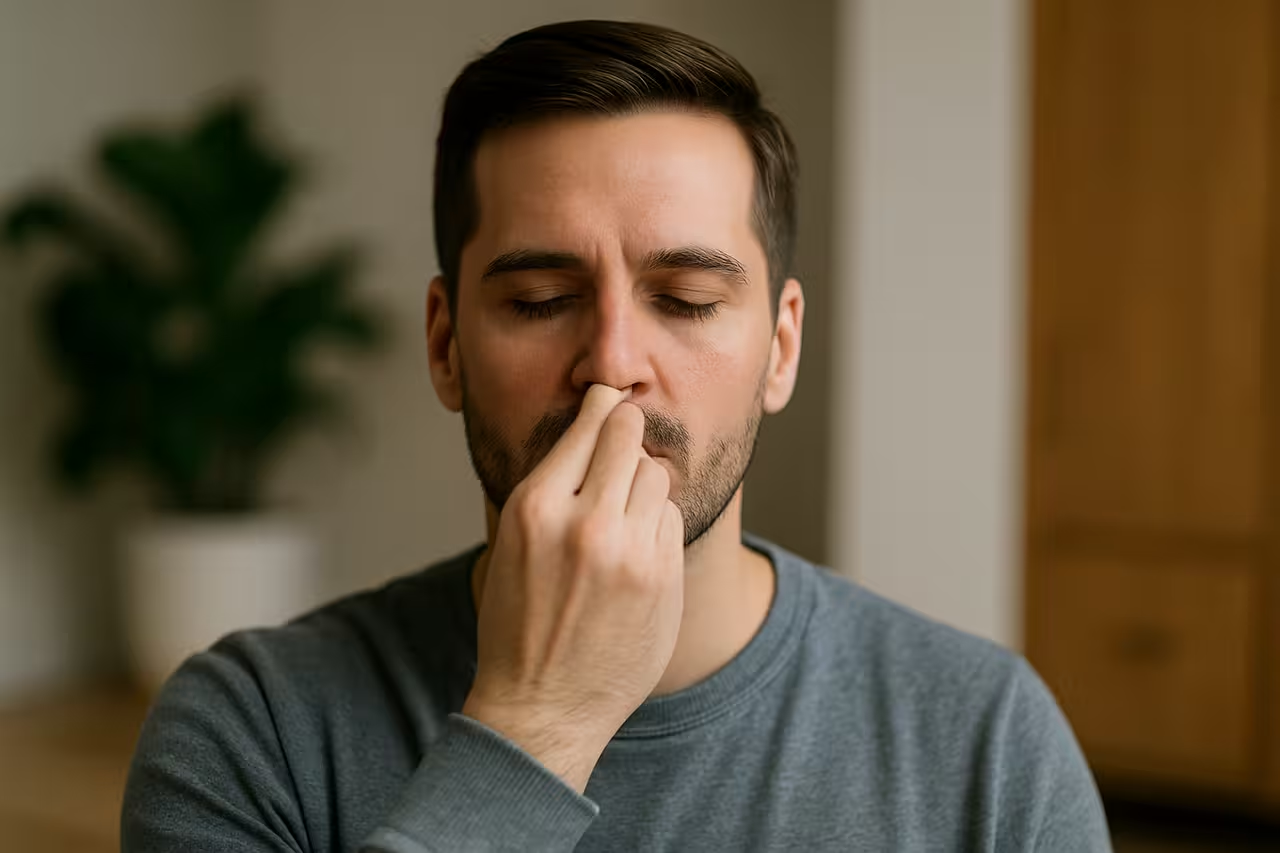
A body scan finds where anger is lodged in the body and softens it one area at a time. It works best when you have five quiet minutes, after the first spike has passed.
You do not have to fix anything. Feeling the sensation without judgment, and without feeding the story, is the practice.
Why Does Naming Your Anger Calm It Down?
Naming an emotion turns down its volume. Psychologists call this affect labeling.
In a 2007 brain imaging study led by Matthew Lieberman, people viewed emotional images. When they put the feeling into words, activity in the amygdala dropped.
The amygdala is a brain region involved in alarm responses. A region in the prefrontal cortex became more active instead.
To use labeling, say silently, “This is anger.” Or, “Anger is here.” Skip the story about who caused it. Name the feeling, then return to the breath and the present moment.
Labeling works because it moves you from inside the feeling to beside it. You stop being the anger for a moment. You become the one noticing it. The guide to overcoming emotional triggers builds on the same skill.
Can Loving-Kindness Meditation Soften Resentment?
Loving-kindness meditation, called metta in Buddhism, works on the anger that lingers after the moment passes. It suits resentment toward a specific person.
Start with yourself, then widen the circle:
The last step can feel false at first. That is expected. You are not excusing what happened. You are loosening the grip the anger has on you. The full practice appears in the guide to loving-kindness meditation.
What Does Buddhism Teach About Anger?
Buddhist teachers have worked on anger for centuries. Three teachings stand out.
Shantideva and Patience
Around 700 CE, Shantideva, a Buddhist monk at Nalanda in India, composed the Bodhicaryavatara, often translated as A Guide to the Bodhisattva’s Way of Life. Its sixth chapter, on patient endurance, strongly criticizes anger. The Dalai Lama and Robert Thurman have both written modern commentaries on it.
Thich Nhat Hanh’s Anger
The Vietnamese Zen teacher Thich Nhat Hanh devoted a whole book to the subject. Anger: Wisdom for Cooling the Flames appeared in 2001. It applies the mindfulness practices of his tradition to anger in daily life and relationships.
Lama Rod Owens and SNOELL
Lama Rod Owens, a teacher of Tibetan Buddhism, shared a six-step practice with NPR’s Life Kit in 2021. He calls it SNOELL:
Owens does not claim the practice made him less angry. He describes a different relationship with anger, one where he chooses what to do with it.

Can Meditation Make Anger Worse?
Sometimes, yes. Meditation turns attention inward. For some people, that brings up feelings they had kept at a distance, including anger.
A 2021 study by Willoughby Britton and colleagues interviewed 96 people after an eight-week course of mindfulness-based cognitive therapy. In their findings, 83% reported at least one side effect from meditation.
Lasting bad effects showed up in 6% to 14%. Those were linked to signs of hyperarousal and dissociation.
The authors found these rates similar to other psychological treatments. Meditation is not risky for most people. It is still a real practice with real effects, and some of them are uncomfortable.
If agitation keeps building during practice, shorten the sessions. Keep your eyes open. Switch to walking meditation. If the agitation lasts, talk to a qualified teacher. A therapist is another good option.
Which Meditation Is Best for Anger?
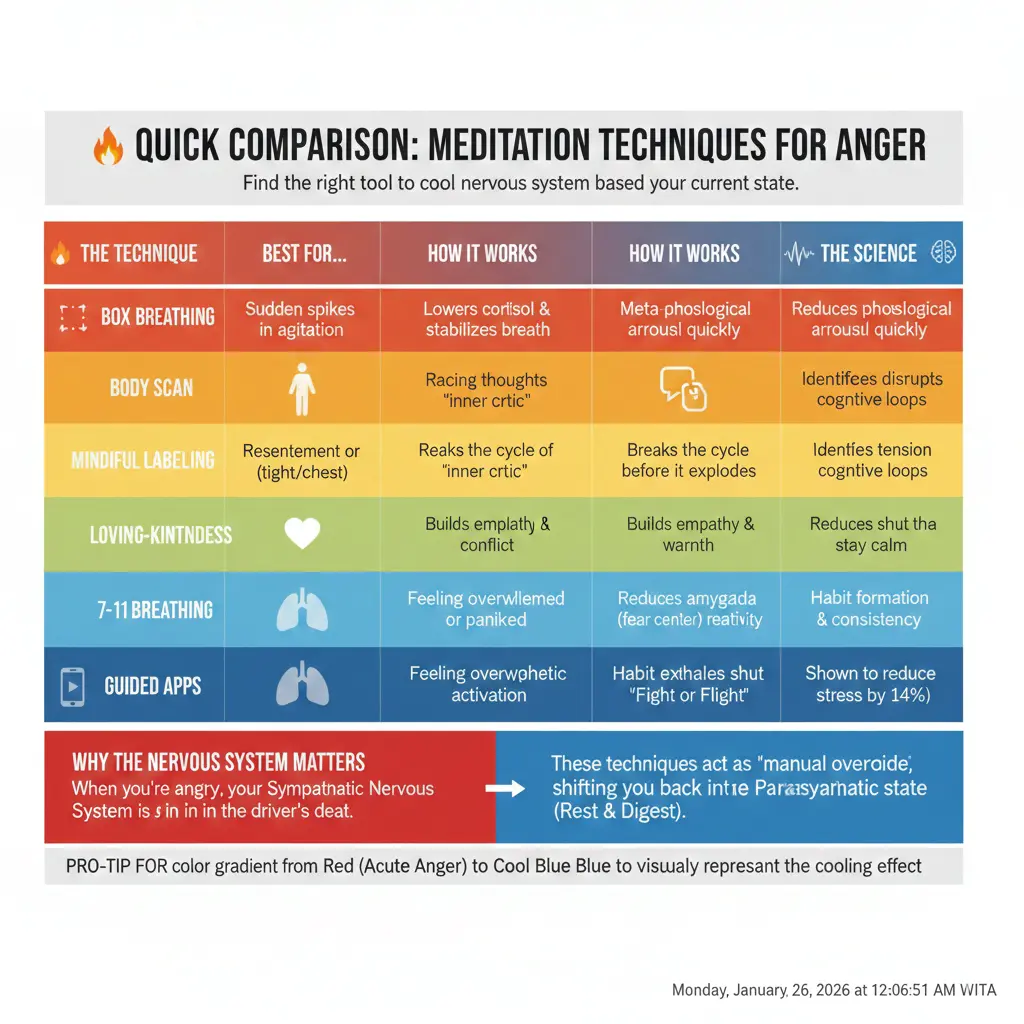
The best meditation for anger depends on what kind of anger you are dealing with. Match the tool to the moment:
Most anger management programs teach more than one of these. Start with the one that fits your most common kind of anger.
How Do You Build a Daily Anger Meditation Practice?
Short and steady beats long and rare. Ten minutes a day is enough to start.
Tracking shows patterns. You may find your jaw tightens before every meeting. You may find your breathing speeds up after an hour on social media. Patterns tell you where to step in earlier.
Some weeks will feel like nothing is changing. That is normal. If anxiety rides along with your anger, the guide to meditation for anxiety adds tools for that side.
When Is Anger More Than Meditation Can Handle?
Meditation helps everyday anger. Anger issues that run deeper need more support. Talk to a doctor or a licensed therapist if any of these sound familiar:
Therapy for anger is widely available, often built on cognitive behavioral methods. Meditation pairs well with it.
If you might hurt yourself or someone else, call 911. In the US, you can also text 988 to reach the Suicide and Crisis Lifeline.
For more on handling strong emotions day to day, see emotional regulation. For the basics of sitting practice, start with what meditation is and mindfulness meditation.
Subscribe to Create Higher Vibrations!
Get Inspiration and Practical advice straight to your inbox.
How Do You Rehearse the First Ten Seconds?
Anger moves fast. The first ten seconds decide most of what happens next.
Pick your move now, while you are calm. One long exhale. Three silent words: “This is anger.” Feet pressed into the floor.
Practice that sequence once today, with no anger at all. When the real moment comes, your body will already know the way.

