
Narcissistic Abuse Syndrome: What It Is, What It Does to Your Brain, and How to Recalibrate

You check your phone before you check yourself. Not for messages. For permission. You already know what you feel. You do not trust it yet.
You are not broken. You were up against a dynamic designed to make you feel exactly this way. And the fact that you are here, reading this, means part of you already knows that.
Narcissistic abuse syndrome is the cluster of trauma symptoms (hypervigilance, self-doubt, identity erosion, and emotional flashbacks) that develop after prolonged exposure to someone with narcissistic traits.
It is not a formal diagnosis, but it is a real, recognizable pattern of neurobiological harm that affects every area of a survivor’s life.
By the end of this, you will understand exactly why your body is still doing what it is doing. And that it is not your fault.
Is Narcissistic Abuse Syndrome Real?
Narcissistic abuse syndrome is not a formal diagnosis in the DSM-5. But it describes a real, recognizable cluster of trauma symptoms that result from prolonged exposure to someone with narcissistic traits.
The pattern is well-documented in trauma research and increasingly recognized by clinicians who specialize in relational trauma and coercive control.
The term “syndrome” comes from the Greek. It means “to run together.” A syndrome is a package: symptoms that travel as a cluster. In this case, hypervigilance, self-doubt, emotional flashbacks, identity erosion, and a persistent sense that something is wrong even in safe situations.
Here is what matters. The lack of a formal diagnosis does not mean it is not real. It means the diagnostic manual has not caught up with the research.
Brain research on narcissism confirms that people with narcissistic traits show measurable differences in how they process social pain and rejection. The abuse is not imaginary. The harm is not imaginary.
Key distinctions:
If you have been Googling “am I going crazy” at 2 AM, you are not alone. And you are not crazy. You are injured. There is a difference.

What Are the Core Symptoms of Narcissistic Abuse Syndrome?
The symptoms of narcissistic abuse syndrome often mimic those of other mental health conditions. That is part of what makes it so confusing. You might think you have generalized anxiety.
Or depression. Or a personality disorder. You might have been told that by professionals who did not ask the right questions.
The difference is the pattern. These symptoms travel together. They emerge from a specific type of relational injury.
The core symptoms include:
What Happens in Your Brain and Body During Narcissistic Abuse?
Narcissistic abuse syndrome is not primarily a psychological problem. It is a nervous system injury. The symptoms you experience are the predictable neurobiological consequences of being bonded to someone whose affection was unpredictable.
Here is what is happening under the hood.
The Amygdala Hijack:
Your amygdala is your threat-detection center. After prolonged narcissistic abuse, it becomes enlarged and hyper-reactive. It fires danger signals when there is no danger.
A neutral facial expression becomes a threat. Silence becomes a countdown to an explosion. Your amygdala is not broken. It is doing exactly what it was trained to do.
The Hippocampus Shrinks:
Research shows that prolonged trauma can reduce hippocampal volume by up to 12%. The hippocampus helps you distinguish past danger from present safety.
When it shrinks, you lose that distinction. Every room feels like the room it happened in. Every person feels like the person who did it.
HPA Axis Dysregulation:
Your HPA axis controls your stress hormones. After narcissistic abuse, it gets stuck in the “on” position. Cortisol floods your system even when you are safe. This is why you feel wired and tired at the same time.
This is why you cannot sleep even when you are exhausted. Your body is marinating in stress chemistry that it cannot clear.
Intermittent Reinforcement and Dopamine:
This is the mechanism most people miss. The abuser’s affection did not arrive on a schedule. It arrived randomly, between periods of coldness, criticism, or silence.
This pattern, called intermittent reinforcement, creates addiction-like dopamine surges identical to those seen in substance dependency. Your brain learned to crave the relief of kindness after the pain of withdrawal. That is not love. That is neurochemistry.
Oxytocin and Trauma Bonding:
Every time the abuser showed affection, your brain released oxytocin, the bonding hormone. This deepened your attachment even as the overall dynamic became more harmful.
Oxytocin does not care about your well-being. It cares about bonding. It bonded you to the person who hurt you. That is not a character flaw. That is a neurochemical reality.
Allostatic Load:
Chronic stress creates allostatic load, the wear and tear on the body from being in survival mode for too long. This is why survivors experience gastrointestinal problems, cardiovascular issues, immune dysfunction, and chronic pain.
The body was not designed to live in fight-or-flight indefinitely. Something had to give.
Why You Still Feel Attracted to Them: The Neuroscience of Trauma Bonding
Trauma bonding occurs because the abuser’s unpredictable cycles of affection and withdrawal create an addiction-like neural response. This is not a metaphor. The same pathways activated by opioid addiction are activated by trauma bonds.
Here is how it works.
Reward Prediction Error:
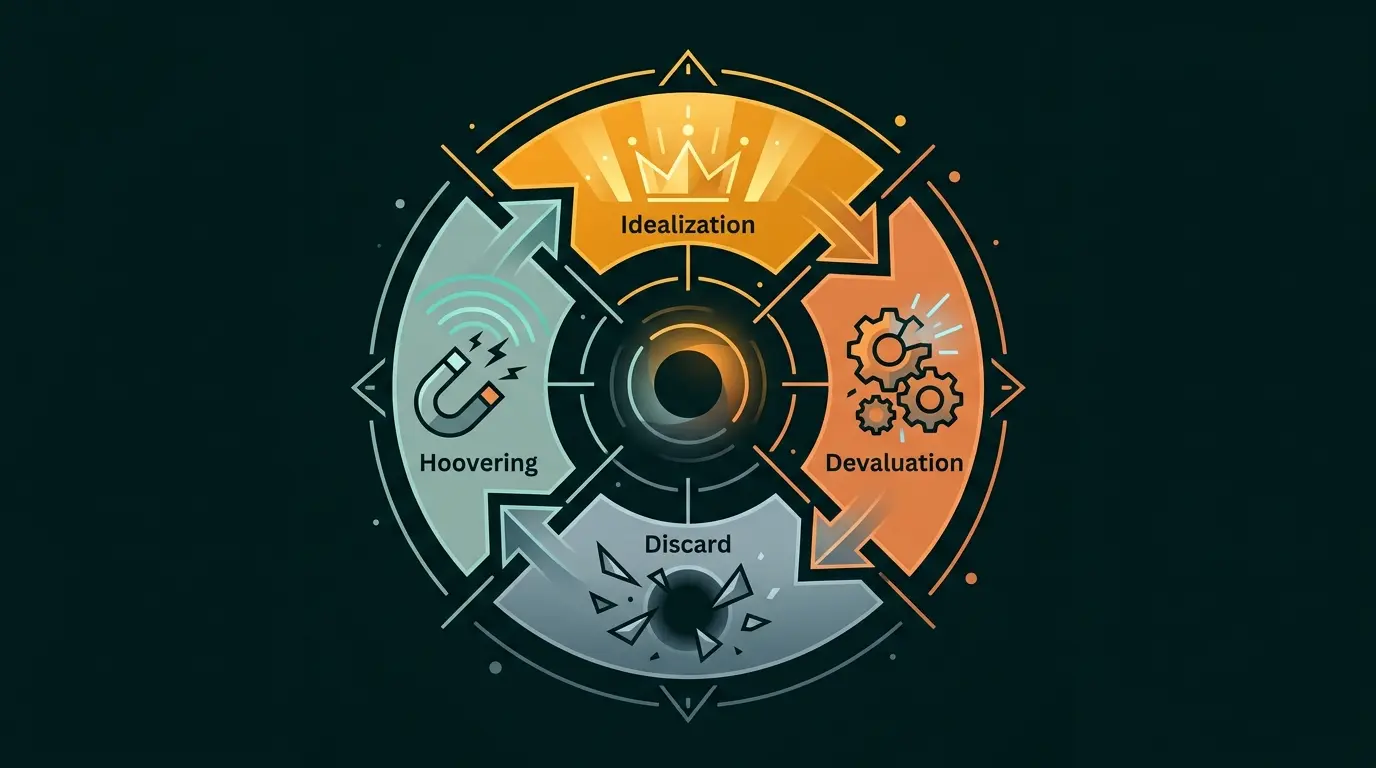
Your brain is a prediction machine. It learns patterns. When affection arrives at random intervals (which is exactly what happens in the idealization-devaluation cycle), your brain cannot predict the reward.
This unpredictability triggers larger dopamine surges than consistent reward would. You are not bonding with the person. You are bonding to the uncertainty.
Why Calm Feels Boring:
Your nervous system was trained on chaos. Intensity became the baseline. When someone treats you with consistent kindness, your nervous system does not read it as safety.
It reads it as an absence. In the absence of threat, yes. But also the absence of the familiar. And the familiar, even when it is harmful, feels like home.
This is why you might feel more alive in a chaotic relationship than in a stable one. It is not because you are broken. It is because your calibration is off.
The Addiction Model:
Research on trauma bonding shows that the neurochemical profile mirrors substance addiction: dopamine-driven craving, withdrawal-like distress during separation, and tolerance (needing more of the “good” to feel okay).
This is why “just stop thinking about them” is neurologically equivalent to “just stop using.” The pathways are real. They persist after the relationship ends.
Why You Cannot Think Your Way Out:
Your prefrontal cortex, the rational part of your brain, is offline when your amygdala is firing. You can know intellectually that this person was harmful and still feel physically bonded to them.
That is not a failure of logic. It is a hierarchy of brain function. The survival system always wins. You cannot out-think your nervous system. You have to speak the language.
The Identity Problem: Why You Do Not Recognize Yourself
Narcissistic abuse systematically erodes your internal “yes” signal, the felt sense of what is true, wanted, and yours. Survivors lose not just confidence. They lose the ability to know what they actually feel.
This is the part nobody talks about.
How Identity Erosion Happens:
In a healthy relationship, your feelings are mirrored back to you. Someone notices you are sad. Someone asks what you want. Your internal experience is validated.
You learn: my feelings are real. My preferences matter. My yes means yes.
In a narcissistic dynamic, your feelings are overwritten. You are sad. You are told you are too sensitive. You want something. You are told you are being selfish.
You express a need. You are told you are demanding. Over time, you stop expressing. Then you stop feeling. Then you stop knowing.
The Performance of Self:
Many survivors describe feeling like a different person in the relationship than they were outside it. At work, you were competent. At home, you were a ghost. With friends, you were funny.
With them, you were silent. You learned to perform a version of yourself that would not trigger their rage. The problem: you cannot perform forever. Eventually, you forget which version is real.
Loss of Interoception:
Interoception is your ability to sense your own body’s internal signals (hunger, fatigue, desire, discomfort). It is the foundation of self-awareness. After narcissistic abuse, many survivors report feeling disconnected from their bodies.
You eat because it is mealtime, not because you are hungry. You stay because it is expected, not because you want to. Your body is a vehicle, not a home.
Why “Just Be Yourself” Is Useless Advice Here:
You cannot be yourself if you don’t know who you are anymore. That is not a failure. That is the injury. Recovery is not about returning to some authentic self you remember.
It is about building a new self from the ground up, one informed by what happened but not defined by it.
But They Never Hit Me: The Covert Abuse Pattern
Not all narcissistic abuse involves yelling, name-calling, or obvious cruelty. Covert abuse uses withdrawal, quiet contempt, emotional absence, and passive control. It leaves the survivor with no “evidence” and a constant question: was it really abuse?
Yes. It was.
What Covert Abuse Looks Like:
Why It Is Harder to Identify:
Overt abuse leaves marks. Covert abuse leaves confusion. When someone hits you, everyone understands it is wrong. When someone slowly erases you over a decade, even you might not name it as abuse. The lack of visible harm is the harm.

The “They Were Nice Sometimes” Trap:
Every covert abuser has moments of kindness. That is not evidence that the abuse did not happen. That is the mechanism that makes it work. The kindness is the hook.
The withdrawal is the line. The cycle repeats. And each time, you think: maybe I am the problem. Maybe I am too sensitive. Maybe I am making it up.
You are not making it up.
Emotional Absence as Control:
Most people think of abuse as something that is done to you. But abuse can also be something that is withheld. Emotional presence. Validation. Interest. Curiosity about your inner world.
When these are used as currency (given when you comply, removed when you assert), the damage is identical to active harm. Your nervous system does not distinguish between attack and abandonment. Both are registered as threats.
Why You Keep Attracting the Same Pattern
Survivors often re-enter similar relationships because their nervous system has been recalibrated to read intensity as love and calm as danger. The fawn response becomes a fixed relational strategy. The internal compass points toward familiar dynamics.
This is not a character flaw. It is a calibration error.
The Relational Template:
Your early relationships created a template for what love feels like. If love meant unpredictability (warmth one day, coldness the next), then that is what your nervous system recognizes as “right.”
When someone stable enters your life, they do not trigger the familiar cascade of stress hormones. They feel flat. Boring. Wrong. Not because they are wrong for you. Because they are unfamiliar.
Why Calm Feels Dangerous:
Your body learned that calm precedes the storm. Peace was never peace. It was the pause before the explosion. So when genuine peace arrives, someone consistent and someone safe, your body does not relax.
It waits. It scans for the threat that must be coming. And if no threat comes, it might create one. Not consciously. But your nervous system will destabilize a stable situation to return to its baseline.
The Fawn Response as Fixed Strategy:
The fawn response (people-pleasing to reduce threat) is the least recognized survival strategy. And the hardest to unlearn. It worked in the abusive dynamic. It does not work in a healthy one.
But your nervous system does not update automatically. It keeps using the old playbook. You find yourself performing compliance even when there is no threat. You find yourself erasing your needs even when someone is asking you to share them.
Re-Victimization Is Not Your Fault:
Many survivors blame themselves for entering a second or third similar relationship. “Why do I keep attracting narcissists?” You are not attracting them.
Your nervous system is recognizing them. And it is reading them as “home.” That is not a failure of judgment. It is a learned response that can be unlearned.
Neuroception and Safety Detection:
Polyvagal theory calls it neuroception, your nervous system’s ability to detect safety or danger outside conscious awareness. After narcissistic abuse, your neuroception is miscalibrated. It reads danger where there is safety.
It reads safety where there is danger. Recovery requires recalibrating this system. Not through insight. Through repeated experience.
How to Recalibrate Your Nervous System After Narcissistic Abuse
Recovery is not about thinking differently. It is about teaching your body that the present is not the past. This requires somatic approaches that target the nervous system directly. Not just cognitive reframing.
Here is what actually works.
Why Talk Therapy Alone Often Fails:
Your prefrontal cortex, the part of your brain that does the talking, is the last to know what your body is feeling. Talk therapy operates from the top down. It engages your rational mind.
But trauma lives in the body. Your amygdala does not speak English. It speaks sensation. You cannot talk your nervous system out of a survival response. You have to show it.
Somatic Approaches That Work:
Rebuilding Interoception:
Your ability to sense your own internal states (hunger, fatigue, desire, discomfort) is the foundation of self-trust. After narcissistic abuse, this capacity is damaged.
Rebuilding it starts small. Before you eat, ask: ” Am I hungry? Before you agree, ask: Do I want to? Before you stay, ask: Do I feel safe? The answers may be unclear at first. That is normal. The practice is the point.

The Window of Tolerance:
Dr. Dan Siegel coined the term. It is the zone of arousal where you can function effectively, not too activated and not too shut down. After narcissistic abuse, your window narrows.
Small triggers push you into hyperarousal (anxiety, panic, rage) or hypoarousal (numbness, dissociation, shutdown). Recovery means widening the window. Not by avoiding triggers. By learning to stay present through them.
Why Healing Is Not Linear:
You will have good days and bad days. You will feel like you have healed and then wake up in a full emotional flashback. This is not failure. This is how nervous system recalibration works.
The old pathways do not disappear. They get quieter. New pathways get stronger. But the old ones are still there, and they will activate under stress. That is okay.
When to Seek Professional Support:
If you are experiencing suicidal thoughts, self-harm, severe dissociation, or inability to function in daily life, please reach out to a trauma-informed therapist. This article is educational, not a replacement for professional care. You deserve support.
The Difference Between Narcissistic Abuse Recovery and General Trauma Recovery
Narcissistic abuse requires specific recovery approaches because it uniquely combines identity erosion, cognitive dissonance, and intermittent reinforcement. Generic trauma work often misses the “who am I?” question that survivors carry.
Why C-PTSD Frameworks Are Close but Not Complete:
Complex PTSD, resulting from prolonged and repeated trauma, captures much of what survivors experience. Emotional dysregulation. Negative self-concept. Interpersonal difficulties.
But it does not fully address the specific mechanism of narcissistic abuse: the systematic overwriting of your internal reality by someone whose reality was the only one allowed.
The Identity Question vs. the Safety Question:
Most trauma recovery focuses on safety. “Are you safe now?” For narcissistic abuse survivors, safety is necessary but insufficient.
The deeper question is: “Who am I now?” You may be physically safe and still feel like a stranger to yourself. Recovery must address both.
What Specific Recovery Looks Like:
The Role of Psychoeducation:
Understanding the neuroscience does not heal the wound. But it removes the shame. When you learn that your brain was structurally altered by a predictable mechanism, the frame changes.
You are not weak. You are not crazy. You are not “too sensitive.” You are a human nervous system that was pushed beyond its design limits. And nervous systems can be recalibrated.
Discover Your Inner Self. Join Our Self-Mastery Program.
Self-Mastery Coaching gives you the space, tools, and guidance to grow, reflect, and discover your values and inner strength.

How to Trust Yourself Again
Self-trust returns through small, repeated experiences of honoring your own feelings and acting on them. It is built in micro-moments. Not grand declarations.
Small Yes’s:
Start with low-stakes decisions. What do you want for lunch? Not what you should have. Not what is convenient. What do you actually want?
Then choose it. Notice how it feels. That feeling, the one where you know what you want and act on it, is self-trust being rebuilt.
The Feelings Inventory:
Three times a day, pause and ask: What am I feeling right now? Name it. Do not judge it. Do not fix it. Just name it. “I feel anxious.” “I feel tired.” “I feel angry.”
This simple practice rebuilds the connection between your conscious mind and your emotional experience.
Boundary Practice:
Start with boundaries that cost you nothing. “No, I do not want that drink.” “No, I cannot stay late tonight.” “No, I disagree with that.” Each time you say no, and the world does not end, your internal yes-signal gets a little stronger.
Why Journaling Works Differently Here:
Do not journal to process. Journal to record. Write down what you felt, what you wanted, and what you chose. Over time, you will see that your feelings are consistent.
That your wants are valid. That your choices, even the ones you second-guessed, were reasonable. This creates an external record that your self-doubt cannot overwrite.
The “Check Before You Ask” Practice:
Before you ask someone else what you should do, ask yourself first. Write down your answer. Then, if you still want external input, ask.
But notice: most of the time, you already knew. You did not trust that you knew.
Subscribe to Create Higher Vibrations!
Get Inspiration and Practical advice straight to your inbox.
You Are Not Going Back to Who You Were
You will not return to the person you were before the abuse. That person is gone. And that is not a tragedy.
It is a graduation.
You are not the same person who walked into that relationship. You are someone who walked through a decade of psychological warfare and came out the other side still capable of reading sentences like this one.
Still capable of wanting something better. Still capable of asking: Is this real, or am I just on autopilot?
That question, the one you are asking right now, is the answer. It is the internal yes-signal coming back online. Quiet. Uncertain. Yours.
The work ahead is not about healing. You are not a wound. The work is about becoming someone who carries what happened without being crushed by it.
Someone who can feel anger without being consumed by it. Someone who can want without being ashamed of wanting.
Someone who checks themselves before they check their phone.
You are already doing that. Right now. Reading this, looking for something real.
You found it. It was you.