
Raven Symbolism: Meaning in Myth, Dreams and the Spirit World

Most birds sing about the day. The raven talks about what the day hides.
Key Takeaways
Raven symbolism centers on transformation, wisdom and the space between worlds. The raven is read as a messenger from the unseen, a keeper of secrets, a guide through dark times.
The raven’s spiritual meaning shifts by culture. It can be a creator, a trickster, a helper or a warning.
Few animals carry as much story. The raven appears in the Bible, in Norse myth, in Pacific Northwest creation stories, even in one of the most famous poems in English. Each adds a layer to what a raven means when one crosses your path.
What Do Ravens Symbolize?
Six meanings run through most raven lore.
The common thread is change. Where the raven appears, something is shifting, whether you asked for it or not. The symbolism hub sets the raven beside the other winged messengers.

What Does It Mean When You See a Raven?
Seeing a raven usually points to change, insight, or a message you have not yet heard. The details help narrow it down.
A repeated raven deserves a note in a journal. Write down where you were. Note what you were thinking. Over time, the pattern tends to point to the part of your life in flux.
Are Ravens Good or Bad Omens?
Ravens are both, depending on who is telling the story.
The dark reading is familiar. Ravens feed on carrion. They gathered on old battlefields. In Edgar Allan Poe’s 1845 poem “The Raven,” a black bird perches above a grieving man’s door and answers every hope with “Nevermore.”
The ravens at the Tower of London carry a famous warning too. Legend says the Crown will fall if they leave, so at least six are kept there. According to the Wikipedia history of the Tower ravens, the Tower’s own historian suspects the legend is Victorian rather than ancient.
The bright reading is just as old. In the Bible, ravens feed a prophet in the wilderness. In a Tlingit story, Raven brings daylight to a dark world. In Lakota teaching, the raven helps holy men see their visions clearly.
So a raven is not a curse. It is a sign that something is ending or being revealed. How that feels depends on whether you are ready for it.
What Do Ravens Symbolize in the Bible?
Ravens appear in 11 verses of the King James Bible. They carry three main meanings: God’s care, the unclean, and the unsettled.
God’s provision
The best-known raven story is Elijah’s. In 1 Kings 17, God sends the prophet to hide by the brook Cherith. There, “the ravens brought him bread and flesh in the morning, and bread and flesh in the evening.”
Jesus uses ravens to make the same point. In Luke 12:24 he says, “Consider the ravens: for they neither sow nor reap.” God feeds them anyway, he adds. People matter far more.
Job 38:41 pictures God feeding young ravens when they cry. Psalm 147:9 repeats the image.
For Christians, a raven can therefore mean provision in a hard season. Help may come from an unlikely source.
Unclean and wild
The Law of Moses lists the raven among birds not to be eaten, in Leviticus 11:15 and Deuteronomy 14:14. In Isaiah 34:11, ravens settle in a land left in ruins. Here the raven stands for wildness, even desolation.
The raven and the dove
In Genesis 8, Noah opens the ark’s window and sends out a raven first. It flies “to and fro, until the waters were dried up.” Only then does he send the dove, which returns with an olive leaf.
Readers have long contrasted the two birds. The dove comes back with a sign of peace. The raven keeps moving over the water. For many, the raven stands for the restless search. The dove stands for the answer that follows.
What Do Ravens Mean in Norse Mythology?
In Norse myth, the god Odin keeps two ravens, Huginn and Muninn. Their names mean Thought and Memory. Each day they fly over the world. Each evening they return to tell him what they saw.
The Poetic Edda poem Grímnismál gives Odin a striking worry about them. In Henry Adams Bellows’s 1923 translation, available on the Internet Archive, Odin says: “For Hugin I fear lest he come not home, / But for Munin my care is more.”
The god of wisdom fears losing memory more than thought. That line gives Norse raven symbolism its edge. Knowledge matters. Forgetting where you came from costs more.
What Does the Raven Mean in Celtic Myth?
In Welsh, the name Brân is usually translated as crow or raven. It belongs to Bran the Blessed, a giant king in the Second Branch of the Mabinogi, Branwen ferch Llŷr.
Bran is fatally wounded in a war in Ireland. He tells his men to cut off his head and carry it home. According to the Wikipedia summary of the tale, they bury it on the White Hill of London, facing France, to guard Britain against invasion.
The White Hill is thought to be where the Tower of London now stands. Modern writers have tried to tie the Tower’s ravens to Bran’s buried head. It makes a fitting story, whatever its real age.
Irish myth gives the raven to war. The goddess Badb, one of three war goddesses called the Morrígna, often took the form of a screaming raven or crow over the battlefield. The guide to crow symbolism covers the Morrígan herself.
In Celtic lore, then, the raven guards the land and announces fate. It is a protector as much as an omen.
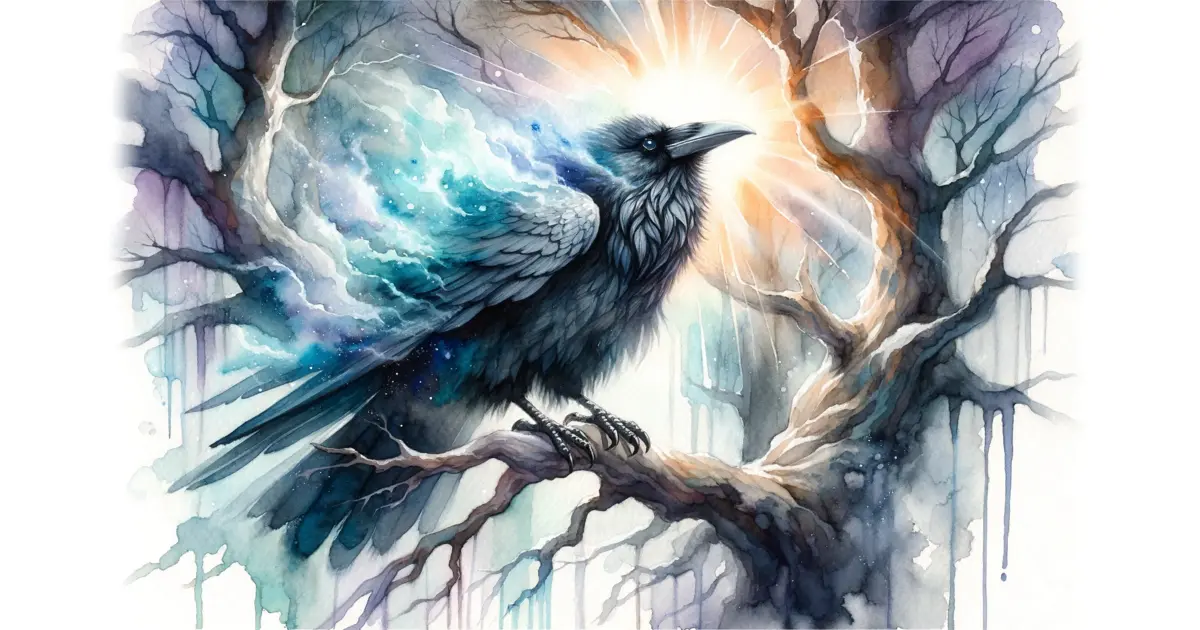
What Does the Raven Mean in Native American Traditions?
Raven stories differ widely between nations. Two are well documented.
Tlingit: Raven brings the daylight
On the Northwest Coast, Raven is a creator and a trickster at once. In 1909, John R. Swanton published Tlingit Myths and Texts, which you can read on the Internet Archive.
In one telling, the world is dark because a rich man keeps the sun, moon and stars in boxes. Raven is reborn as the man’s grandson. The baby cries and cries until his grandfather hands him each box in turn.
Raven lets the moon go into the sky. Then he gets the box of daylight. When a group of fishermen mocks him, he opens it, and daylight breaks over the world. Startled people flee into the sea or the forest. They become animals.
In this tradition, the raven is a hero and troublemaker at once. It brings the world what it needs, often for selfish reasons.
Lakota: the raven and clear vision
The Aktá Lakota Museum describes the raven, kȟaŋǧí tȟáŋka, as a creature of change and transformation. It notes that medicine men and holy men honored the raven and called on it in ritual so their visions could become clear.
That fits the raven’s wider meaning. It helps you see what is hard to see.

What Is the Meaning of a White Raven?
White ravens exist, but they are rare. In myth, the white raven has its own story.
In Ovid’s Metamorphoses, Apollo sets a white raven to watch over his lover, Coronis. The bird reports that she has been unfaithful. In his anger, Apollo scorches the messenger black.
The tale is often read as a warning about carrying hard news. White raven meaning in modern symbolism leans toward purity, a rare message, or a new start.
What Is the Difference Between a Raven and a Crow?
Ravens and crows are close relatives. Both are black. They are still easy to tell apart once you know what to look for.
These details come from the Wikipedia summary of the common raven. Symbolically, the two birds overlap but lean differently. The raven leans toward myth, prophecy, transformation. The crow leans toward everyday messages. The guide to crow meaning covers the crow in full.
How Smart Are Ravens?
The raven’s reputation for wisdom has a basis in its behavior. Ravens solve problems that stump most animals.
In a 2017 study in the journal Science, Can Kabadayi and Mathias Osvath found that ravens rival great apes at flexible planning. The birds chose tools, even trading tokens they would only need later.
Other experiments show ravens pulling up a string bit by bit to reach food, without trial and error. Myth gave the raven secret knowledge. Science suggests the raven really does think ahead.
What Does the Raven Mean as a Spirit Animal?
As a spirit animal, the raven belongs to people who are comfortable with mystery. They notice what others miss. They often live through big changes. They come out wiser.
A raven guide asks hard questions. What are you refusing to look at? What story about yourself has outlived its use? It also brings a gift. The raven helps you find meaning in dark stretches instead of only enduring them.
If the raven keeps appearing to you, the guide to finding your spirit animal explains how to read a repeating animal. For the raven’s gentler counterpart, see the meaning of the red cardinal, a bird of comfort rather than mystery.
What Does It Mean to Dream of a Raven?
A raven in a dream usually signals change or a message from your deeper mind.
Write the dream down on waking. Note where you were in the dream. Note how you felt. A raven dream that returns often points to the same unfinished business.
Why Is the Raven Linked to the Dark Night of the Soul?
Many people meet the raven during a hard spiritual season. Old beliefs fall away. The ground feels unsteady. Nothing seems to work the way it used to.
That season is often called the dark night of the soul. The raven suits it well. It is at home in the dark. It feeds on what has ended. It carries messages from places we cannot see.
As a symbol, the raven says the dark is not empty. Something is being prepared in it. The signs of spiritual awakening often begin in exactly this place.
What Odin Feared to Lose
Go back to Odin on his high seat. Every morning he sends out his two ravens. Every evening he waits for them to come home. He can live without some of his thinking, he admits. Losing his memory frightens him more.
That is a strange confession from a god of wisdom. It is also the raven’s quietest lesson. Thinking runs ahead to the next problem. Memory holds who you were, what you survived, what you promised.
The next time a raven lands nearby, ask a different question. Instead of wondering what is coming, ask what you are in danger of forgetting. Then write it down before the bird flies off.

