
What Is DARVO? How to Recognize and Respond to This Manipulation Tactic

You are standing in your kitchen. You just told them, calmly and clearly, that what they said hurt you. Now they are crying. Not because they are sorry. Because you said it out loud.
“I can’t believe you would attack me like this.”
Suddenly you are the villain in a story you did not write. You open your mouth to respond, but the words feel wrong before they leave. The ground is not where it was thirty seconds ago.
What just happened has a name: DARVO. It is one of the most disorienting manipulation tactics a person can experience. The reason is not complexity. It works on a level most people do not see coming.
By the end of this article, you will understand why DARVO makes you doubt yourself. You will know what is happening in your nervous system when it occurs. And you will have a way to respond without losing your grip on what is real.
DARVO operates as a manipulation pattern. The abuser denies their actions. They attack you for speaking up. They claim they are the real victim. This tactic succeeds because it exploits a specific vulnerability in your nervous system. It does not succeed because you act weak. Once you understand the mechanism, you recognize it in real time.
What Does DARVO Stand For?
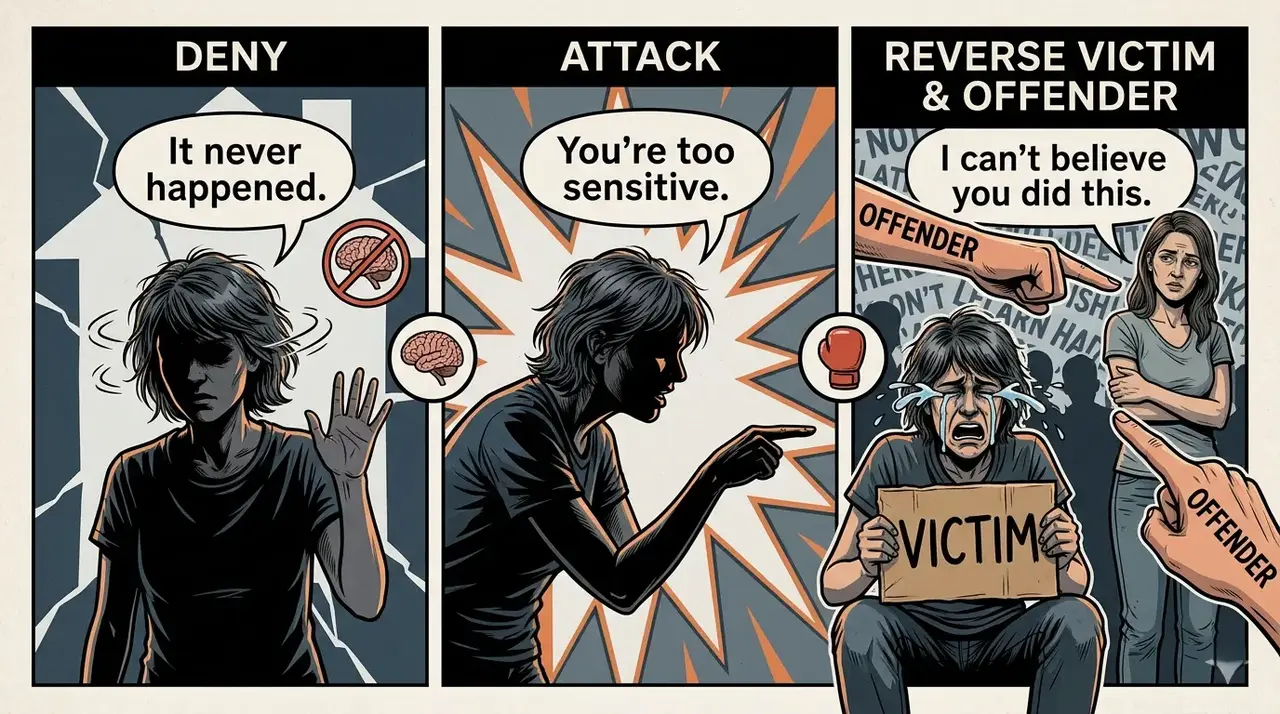
DARVO stands for Deny, Attack, Reverse Victim and Offender. Coined by psychologist Jennifer Freyd in 1997, it describes the pattern perpetrators follow when confronted. They flatly deny it happened. They attack the person who raised the issue. Then they reverse the roles, claiming they are the true victim and the person who spoke up is the aggressor. (Freyd, 1997)
DARVO is a structured narrative reversal designed to do one thing: make you stop trusting your own perception.
The term emerged from Freyd’s research into betrayal trauma theory. Her work examined what happens when someone you depend on for safety becomes your source of danger.
She kept observing the same pattern. When abusers were held accountable, they did not respond with defensiveness. They responded with a three-phase counterattack that silenced the person who spoke up.

The research since then has been striking. A 2017 study found that 72% of perpetrators used DARVO when confronted about wrongdoing. (2017 study) This is not rare. DARVO is the default response of someone who would rather dismantle your reality than take responsibility.
What makes DARVO different from simple lying is the third phase. A liar denies. Someone using DARVO denies, attacks, and then positions themselves as the wounded party.
They do not just avoid accountability. They recast you as the person who needs to be held accountable.
That is what makes it so disorienting. You came into the conversation knowing what happened. You are leaving it wondering if you are the problem.
Why Does DARVO Make Me Doubt Myself?
DARVO works because it exploits betrayal trauma. When someone you depend on for safety is also your source of danger, your brain encodes their version of reality to preserve the attachment bond. This is not a character flaw. It is a survival mechanism.
Here is what is happening inside you.
Your brain has a system called the default mode network. It handles self-referential processing. It is the part of your mind that knows what you experienced, what you felt, what is real to you. Under normal circumstances, it is stable.
But when someone you are attached to denies your reality with total conviction, your attachment system fires.
The part of your brain that needs the bond to survive starts overriding the part that knows what happened. Freyd called this adaptive blindness.
Your nervous system literally dampens your own perceptual signals. The alternative, losing the relationship, feels like death.
This is not weakness. A human nervous system is doing what it was designed to do. The problem is that the person you depend on is the one distorting your reality. And your brain, trying to survive, chooses their version over yours.
The polyvagal system adds another layer. During the Attack phase, your sympathetic nervous system fires. Your heart rate spikes. Your thoughts race.
You are trying to defend yourself while managing a full survival response. If the attack continues, your system may shift into dorsal vagal shutdown.
The freeze state. You go quiet. You stop fighting. You agree to things you do not believe because your body decided silence is safer than arguing.
There is also what Freyd and Veldhuis called betrayal blindness. The longer the pattern continues, the more your nervous system learns that speaking out triggers danger.
So you stop speaking. You begin to doubt not just this incident but your entire capacity to perceive reality.
The real damage of DARVO is not the single confrontation. It is the slow erosion of your ability to trust yourself.
In my work with survivors, the most common thing I hear is not “they hurt me.” It is “I do not trust my own mind anymore.”
Losing self-trust after narcissistic abuse is not a sign that something is wrong with you. Something was done to you, repeatedly, by someone who needed you to doubt yourself.
A 2020 study proves education defeats DARVO. Researchers taught participants about the tactics beforehand. These educated participants rated perpetrators as less believable. Knowing the pattern breaks the manipulation.
Source 2020 Study
What Are the 3 Steps of DARVO?
DARVO unfolds in three stages. First, the perpetrator denies the behavior happened. Second, they attack the person who confronted them. Third, they reverse the roles, claiming they are the real victim.
The three phases are sequential. Each one sets up the next. Understanding the progression means you can anticipate what is coming.
| Phase | What It Looks Like | What They Want You to Feel |
|---|---|---|
| Deny | “It never happened.” “You are making this up.” They speak with total conviction even with evidence directly in front of them. | You feel doubtful. You question your own memory. |
| Attack | “You are too sensitive.” “Nobody talks to you.” They target your character instead of the issue. They bring up past mistakes as evidence you are unstable. | You feel defensive. You justify your personality instead of naming their behavior. |
| Reverse | “I do not believe you said this to me.” They cry. They become the wounded party. You stand there holding the original complaint while they receive sympathy. | You feel guilty. You feel wrong. You feel like the bad guy. |
The Attack phase deserves attention because it is what people are least prepared for. The real attack is more strategic than calling you “crazy.” They bring up your past mistakes.
They question your mental health. They tell mutual friends you have been acting strange. They build a case file against your credibility. This is how a narcissistic smear campaign works. The goal is not to win the argument. The goal is to make sure no one believes you.
The Attack phase also sets up the reversal. When the role flip happens, there is a ready-made audience with reasons to doubt you. DARVO is not just a one-on-one manipulation.
It recruits bystanders. Sometimes the audience is friends and family. Sometimes it is a flying monkey network the abuser has already primed.
Researchers document DARVO in workplace bullying. They observe it during medical malpractice cases. The pattern appears in university Title IX processes. Government communications also show this exact manipulation.
Source Wikipedia DARVO and Harsey and Freyd The Hill 2025
How Does DARVO Affect Your Mental Health?
Exposure to DARVO is directly linked to increased self-blame, anxiety, depression, and trauma symptoms. The more someone uses DARVO on you, the more likely you are to blame yourself for what they did.
A 2017 study found that higher DARVO exposure during confrontation was associated with increased self-blame. This was true regardless of how many apologies the perpetrator offered. The damage was in the tactic itself.
A 2023 study showed that DARVO changed how observers rated victims and perpetrators. Even when the facts were identical, victims were seen as less believable and perpetrators as less responsible.
DARVO does not just confuse you. It changes how everyone else sees you.

The long-term effects of repeated DARVO exposure are well-documented, and they go far beyond feeling upset after a difficult conversation.
A 2026 study introduced the DARVO Short Form (DARVO-SF) measurement tool and linked DARVO exposure to trauma symptoms.
DARVO exposure was highest in confrontations about emotional and psychological mistreatment, the exact contexts where harm is hardest to prove, and victims are least likely to be believed.
Discover Your Inner Self. Join Our Self-Mastery Program.
Self-Mastery Coaching gives you the space, tools, and guidance to grow, reflect, and discover your values and inner strength.

Can DARVO Happen in Courts, Workplaces, and Institutions?
Institutional DARVO occurs when the systems designed to protect you become the mechanism of your re-victimization. Abusers file defamation lawsuits, weaponize HR departments, and exploit Title IX processes. All of it is DARVO packaged in institutional language.
Institutional DARVO takes several forms:
Freyd calls this institutional betrayal: when institutions you turn to for protection become complicit in your silencing. DARVO at the systems level. And it sends a message to every survivor watching: even the systems will be used against you.
Abusers file defamation lawsuits against victims. Experts define this action as legal DARVO. The lawsuit completely denies the abuse. The filing attacks your credibility. It positions the abuser as the harmed party.
Source Harsey and Freyd 2022 Journal of Trauma and Dissociation
How Do I Respond to DARVO?
The most effective response is to know what is happening before it happens. Expect the denial. Expect the attack. Expect the reversal. State your facts once, briefly, and disengage.
The single most powerful thing you can do is learn the pattern before you are in it. Once you know the three phases, you can feel them coming. That does not make it painless. But it makes it legible. And legibility is the first step out of confusion.
The Attack phase works because it gives you something to defend against. Every time you explain yourself, offering context, producing evidence, clarifying what you meant, you hand them another opening.
More words. More material. More things to distort and throw back. So name what happened. Be specific. Be brief. Then stop.
Here is what that sounds like in practice:
This is called the broken-record technique. You are not trying to win the argument. You are staying anchored in your own experience while someone actively tries to pull you out of it. It works precisely because it refuses to engage with the distortion.
Documentation matters, too. Keep a record, not for court, but because DARVO’s real target is your internal record.
When someone denies your reality repeatedly, your own memory starts to fracture. A written log with dates and exact quotes becomes a lifeline back to your perceptions. This is not paranoia. It is self-preservation.
You also need people who are not the abuser. Trusted friends, a therapist, a support group. DARVO isolates.
It works best when you are alone with the perpetrator’s narrative, and no one else is reflecting what they have seen. When you doubt yourself, these witnesses can tell you what actually happened.

Know when to leave the conversation. If your nervous system has gone into freeze, silent, dissociating, unable to form words, step away. “I am not continuing this.” Your nervous system is protecting you.
And understand that knowing about DARVO does not automatically undo the damage. If you have been DARVO’d repeatedly, your nervous system learned that speaking out triggers danger.
Unlearning that requires somatic work and rebuilding epistemic self-trust, the ability to believe your own eyes and ears again.
This is the part of healing from narcissistic abuse that most people do not talk about, because the problem lives in the nervous system, not in thinking.
Is DARVO the Same as Gaslighting?
No. Gaslighting is a specific tactic of making someone doubt their reality. DARVO is a broader pattern that uses gaslighting as one component. DARVO adds the Attack and Reverse phases. Those are what make it effective at recruiting third parties.
Gaslighting is a gradual wearing down. You are told your memory is incorrect next, that you are too emotional then, that your peers are anxious about you.
Eventually, you lose faith in your own perceptions. The harm remains hidden inside. To better grasp the distinction, what is gaslighting provides a more detailed explanation.
DARVO is a swift counterattack. It happens in a single confrontation. The damage is social. The Attack phase creates an audience.
The Reverse phase makes that audience take sides. By the time it is over, you are not just doubting yourself. People around you doubt you too.
Projection is another related concept. Someone attributes their own unacceptable feelings to you. “I am not angry, you are the angry one.”
Projection can be a component of DARVO, but it is not the full pattern. You can read more about psychological projection and how it relates to DARVO.
| Concept | Definition | Core Mechanism | What Makes It Effective |
|---|---|---|---|
| DARVO | Deny Attack Reverse Victim and Offender. | They reverse the narrative completely. | It manipulates you and third party observers. |
| Gaslighting | They make you doubt your reality. | They repeatedly deny your perceptions. | It destroys your internal trust over time. |
| Projection | They assign their feelings to you. | They force the blame onto you. | It confuses you. It forces your attention away from them. |
If you are being gaslit, the priority is rebuilding internal self-trust. If you are being DARVO’d, the priority is staying anchored in your experience while someone flips the script.
And documenting what happened so you have an external record when your internal one starts to fracture.
Subscribe to Create Higher Vibrations!
Get Inspiration and Practical advice straight to your inbox.
Conclusion
You did not imagine it. You were not too sensitive. You were not the problem.
The vertigo you felt, the ground shifting mid-sentence, becoming the villain while they cried, that was not a sign you were wrong. You were up against something designed to make you feel exactly that way.
DARVO exploits the deepest wiring in your nervous system. Your brain will choose the abuser’s version of reality over losing the bond. Your body will freeze when the attack comes.
Your voice will go quiet when you learn that speaking triggers danger. None of that is failure. Any human system would respond the same way under sustained assault.
But once you see the pattern, you cannot unsee it. The confusion still comes. Now it has a name. And a thing with a name is a thing you can respond to.
Healing begins with reclaiming your own perceptions. Not because your perceptions are always perfect. Because they are yours, and they are the only ground you have to stand on.
Start there.