
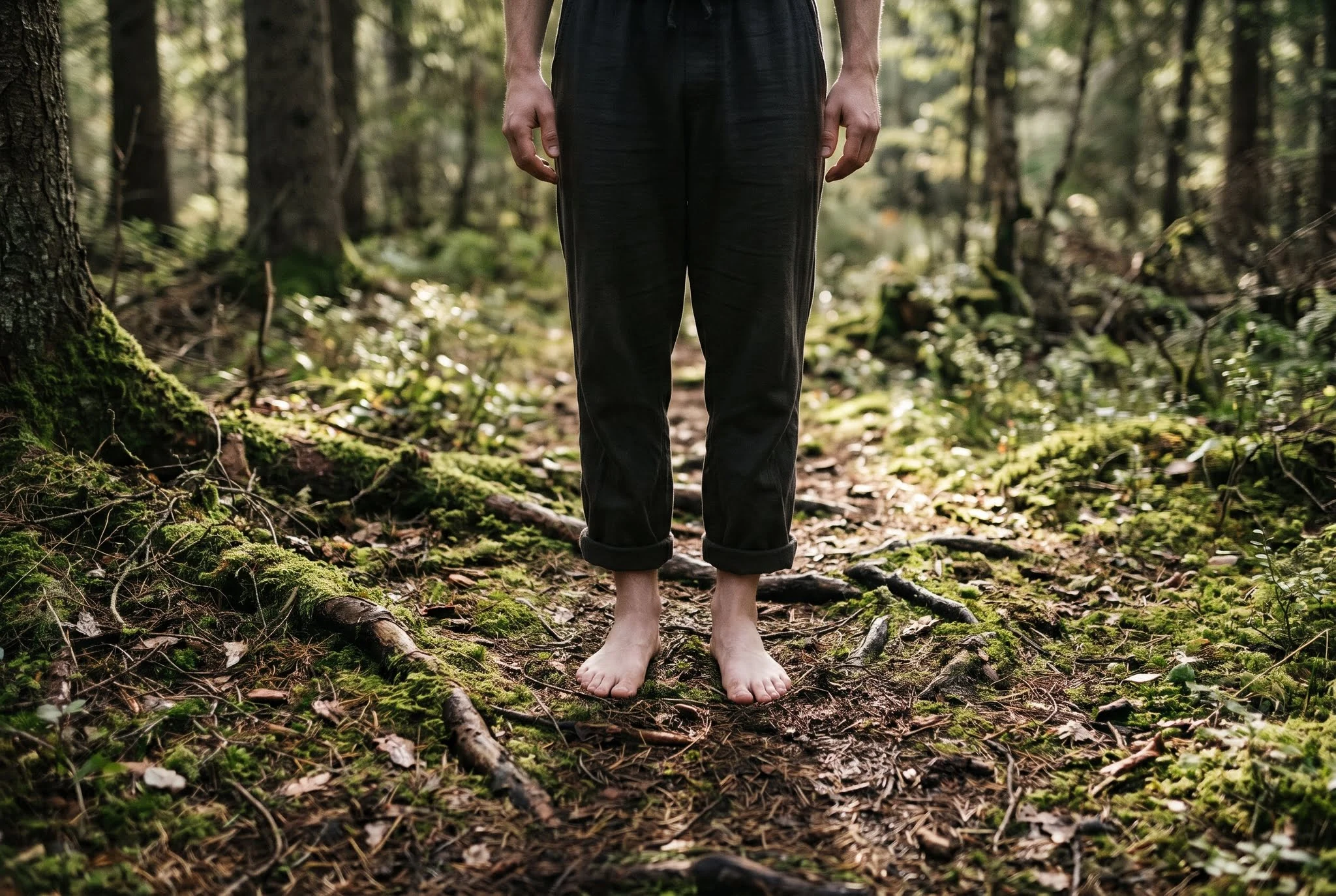
You can meditate for an hour and still float out of the room afterward. Part of you hasn't come back yet.
Key Takeaways
- Somatic grounding brings attention back into the body. Weight, contact, and the five senses anchor you in the present moment.
- Spiritual practice can leave you ungrounded. Long meditation, energy work, and awakening experiences often pull attention upward.
- The simplest tools work fastest. Pressing your feet down, naming what's in view, and slowing the breath take under a minute.
- Earthing is a separate claim. Its research is small. The main review came from people tied to the company funding it.
Somatic grounding is the practice of bringing your attention back into your body through physical sensation. You feel your weight, the surface under you, and what your senses are taking in. The word somatic means "of the body." The anchor is sensation, not a thought.
People reach for grounding when they feel scattered, anxious, and a little unreal. Therapists use it to settle a stressed nervous system.
Spiritual practitioners reach for it for another reason too. Practices that open awareness upward can leave the body behind. Somatic grounding brings it back.
What Is Somatic Grounding?
Grounding gets used in three ways:
- Somatic grounding. You come back to the present through body sensation, like weight, pressure, temperature, and breath.
- Sensory grounding. You orient through the five senses, noticing what you can see, hear, and touch around you.
- Earthing. You make direct skin contact with the ground, on the theory that the earth's charge affects the body.
Somatic grounding mostly blends the first two. It's quick and needs no equipment. It works in a meeting as easily as on a meditation cushion.
Here's a familiar version. A long phone call ends. Your mind keeps replaying it anyway.
So you stand up and press both feet into the floor. The boards feel cool under your heels. Thirty seconds later, the call has loosened its grip a little.
The Johns Hopkins Office of Well-Being describes grounding in nearly those terms. Its somatic sessions release body weight through the feet into the floor. That contact re-establishes a conscious sense of grounding and centering.
Why Do Spiritual People Feel Ungrounded?
Many spiritual practices point attention upward. Long meditation, breathwork, visualization, Reiki, and prayer can all leave you light-headed. Some people feel like they've half left their body.
Common signs of being ungrounded include:
- Feeling spacey or dreamy for hours after practice
- Clumsiness, like dropping things or bumping into doorframes
- Trouble finishing ordinary tasks, like paying a bill or cooking dinner
- Strong sensitivity to noise, crowds, and bright light
Spiritual awakening can stretch this out for weeks. Our guide to spiritual fatigue during an awakening covers that longer version. So does the page on kundalini awakening, where energy rising through the spine can leave people restless and unanchored.
The chakra system gives the experience a map. Grounding belongs to the root chakra, Muladhara, at the base of the spine. It's linked with safety, stability, and belonging in the body.
When attention lives mostly in the upper chakras, the root is said to go quiet. Practitioners then feel unsafe, scattered, or unable to land.
You don't have to accept the chakra map to recognize the feeling. Anyone who has stood up after a two-hour sit knows it.
How Do You Ground Yourself Through the Body?
Most somatic grounding techniques take under a minute. Start with whichever one fits where you are.
In my own Reiki sessions, the work starts with grounding. I settle my weight into my feet. My attention drops into my belly before my hands move at all.
- Press your feet down. Sit with both feet flat. Push them gently into the ground for a few breaths. Notice the pressure in your heels.
- Feel your weight. Notice where your body meets the chair under you. Let it hold you for a while.
- Lengthen the out-breath. Breathe in normally. Let the exhale run a little longer than the inhale. Repeat that five or six times.
- Use your hands. Press your palms together firmly. A cool glass of water in your hands works too.
- Move low and slow. Stamp your feet a few times. A minute of loose somatic shaking also helps before settling.
- Step outside. Feel the air temperature, the ground under your shoes, and the sounds around you. Time in nature counts double.

The best-known sensory method is 5-4-3-2-1. The University of Rochester Medical Center lays it out in five steps:
5
See
Name five objects in view.
4
Touch
Notice four textures within reach.
3
Hear
Pick out three sounds.
2
Smell
Find two scents in the air.
1
Taste
Notice one taste in your mouth.
For a longer practice, sit for ten minutes with attention on the body's weight and breath. That's the ground floor of somatic meditation.
Is Earthing the Same as Somatic Grounding?
Earthing is a narrower claim. It says direct skin contact with the earth transfers electrons from the ground into the body. Conductive mats wired to the ground are said to do the same indoors. Proponents say that contact improves sleep.
The best-known review is a 2012 paper in the Journal of Environmental and Public Health. It describes reported benefits like better sleep and reduced pain.
Its disclosure section also matters. Three of the authors were independent contractors for the company sponsoring earthing research. They also owned shares in it.
That doesn't make the findings false. It does mean the evidence is early, small, and mostly produced by people with a stake in it.
Somatic grounding doesn't depend on any of that. Walking barefoot on grass is still a lovely way to feel your feet. The ground is cool, uneven, and alive with small sensations. You just don't need to believe in electron transfer to get that part.
When Does Grounding Not Work?
Grounding isn't always calming. Sometimes turning toward the body makes things feel worse.
That can happen for a few reasons:
- The body holds something heavy. Attention on the chest can bring up grief, fear, and old memories.
- You've been numb for a while. Feeling nothing, then suddenly feeling everything, can be a shock.
- The technique doesn't match the state. Someone who feels frozen may need movement before stillness.
When grounding backfires, make it smaller. Keep your eyes open. Name objects in the room instead of sensations inside you. Try movement, like walking or stamping, before sitting still.
If grounding regularly brings up panic, flashbacks, or the feeling of leaving your body, work with a therapist trained in trauma. Our beginner's guide to somatic practices explains what that kind of support looks like.
What Does a Grounded Spiritual Life Look Like?
It looks a lot less mystical than the ungrounded version.
You meditate, then make lunch without burning it. You finish a Reiki session. You can still drive home safely.
Big feelings still come. The phone still gets answered.
Being grounded doesn't close you off from expanded states. It gives them somewhere to land. The insight from your practice can then show up in how you live.
Try this
After your next meditation or energy session, don't jump straight back into your day. Stand up and press both heels down for ten breaths. Name five colors in the room. Then drink a glass of water slowly.
Grounding is a habit, not a single fix. A minute after every practice adds up faster than one long session once a month. For the bigger picture of spirit and body as partners, read about embodied spirituality.