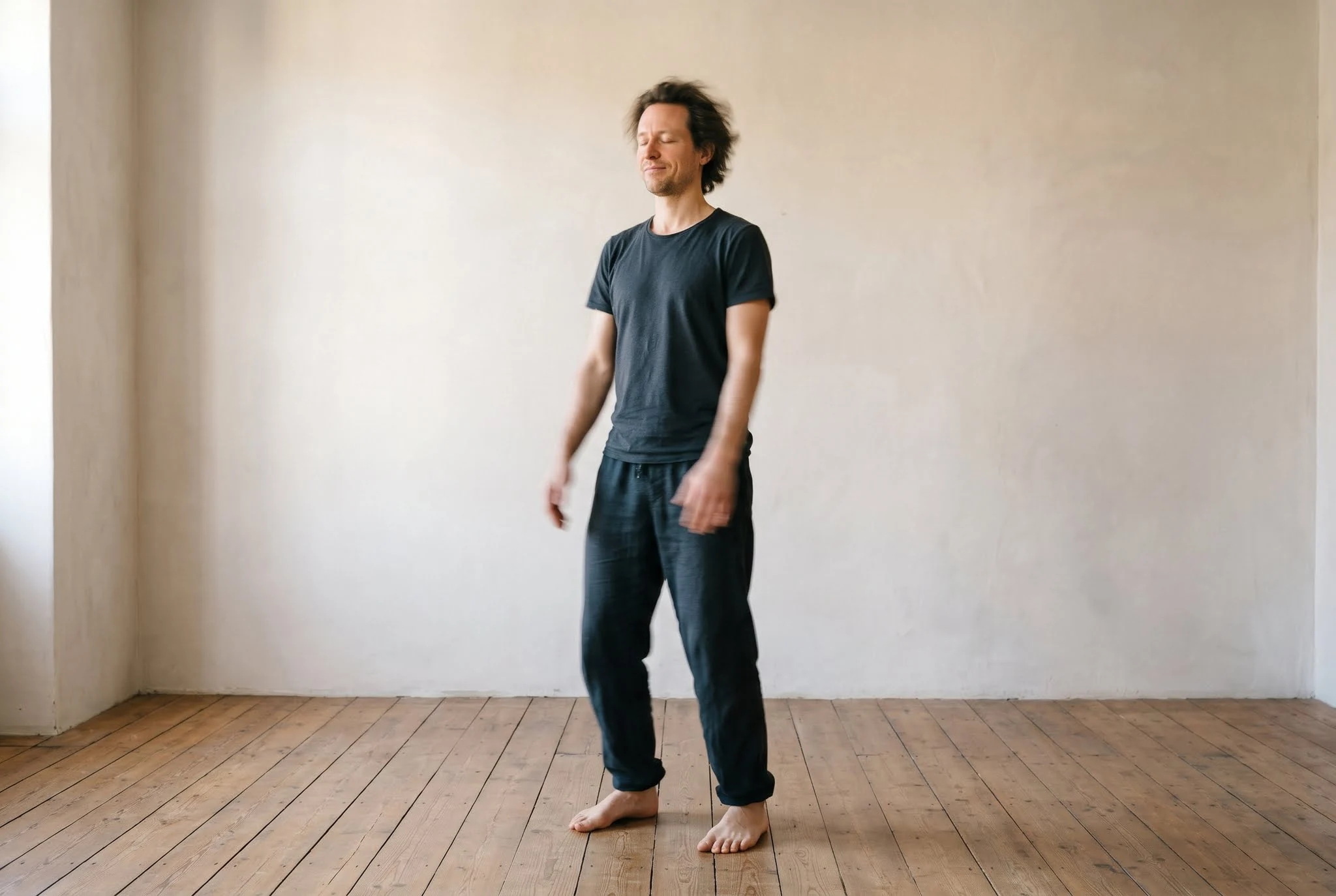
A Christian sect was nicknamed for trembling in worship. Two centuries later, Osho opened an evening meditation with fifteen minutes of shaking.
Key Takeaways
- Somatic shaking means letting the body tremble on purpose. Most people start with a minute or two of loose shaking through the hands, arms, and legs.
- Shaking has a long spiritual history. It shows up in Osho's Kundalini Meditation, the worship of the early Shakers, and Kalahari Bushman healing dances.
- The research is early. A 2026 review of 22 studies on tremor exercises found promise, but the study designs weren't consistently rigorous.
- Some people should skip it. Seizures, injuries, joint problems, panic disorder, and a history of severe trauma all call for caution.
Somatic shaking is the practice of letting your body tremble on purpose for a few minutes, usually standing, with the joints loose. The shaking can start in the hands and spread through the arms, legs, and torso. People use it to shed muscle tension. It also brings them back into their bodies.
It looks a little silly. That's part of its charm. It may also be part of why it works for the people who keep doing it. You can't keep up a stiff, controlled image of yourself while your knees are bouncing.
What Is Somatic Shaking?
Somatic shaking covers a spread of practices. At the gentle end is the quick shake-out, the same flick of the hands you'd use to get water off them. At the stronger end are full-body tremors that run for fifteen minutes.
Two kinds of shaking get mixed together under the name:
- Shaking you do. You choose the movement yourself, bouncing through the knees and loosening the arms.
- Shaking that happens. You set up a posture and let a tremor start by itself. Tension and trauma releasing exercises (TRE) work this way, tiring certain muscles until they begin to quiver.
Somatic shaking took off on social media as a stress hack. Everyday Health described the trend as fast, uncoordinated movement like jumping, arm flailing, and foot stomping. That's one version. Older traditions treat shaking as a doorway into something larger than stress relief.
The word somatic only means "of the body." So somatic shaking is body shaking, done with attention. The attention is what turns a jiggle into a practice.
Why Do Animals Shake After Danger?
Watch a dog after a scare. It plants its feet and shakes from nose to tail, then trots off as if nothing happened. That image sits underneath most of what's written about somatic shaking.
Peter Levine, who developed Somatic Experiencing, built a model of trauma around that observation. According to Somatic Experiencing International, Levine noticed that wild animals live under constant threat of death. Even so, they show no signs of trauma stuck in their systems.
In his account, the key lies in the freeze response. An animal that can't fight or flee goes still, like playing dead. That freeze is meant to run its course. The energy mobilized for fight or flight then gets discharged through shakes and trembling.
Levine's model says that trouble starts once the freeze never completes. The charge stays in the body. From the body's point of view, the threat hasn't ended. Somatic Experiencing works to let that stored energy finish moving.
People tend to cut the tremble short. Some of us are embarrassed by it. Others were taught to hold still and act fine. Shaking practices give the body permission to do what a dog does without asking anybody.
Where Does Shaking Show Up in Spiritual Practice?
Long before TikTok, shaking belonged to worship, healing, and meditation. Three traditions show how far back the idea runs.
Osho's Kundalini Meditation
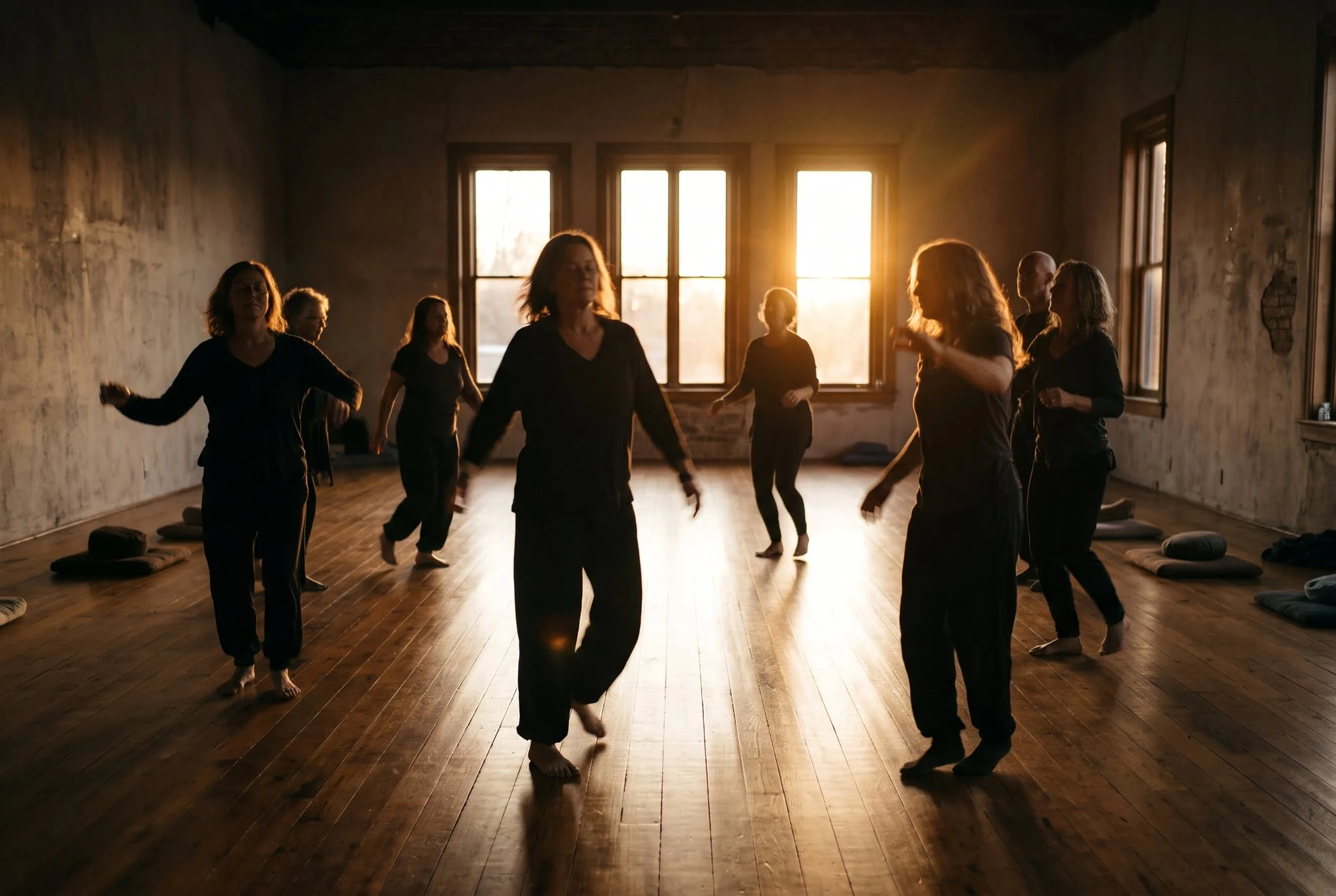
Osho's Kundalini Meditation lasts one hour. It's best done at sunset or late afternoon. It has four stages of fifteen minutes each.
1
Shake
Let the whole body shake, with energy moving up from the feet.
2
Dance
Dance any way you feel and let the body move as it wishes.
3
Witness
Sit or stand still with eyes closed, watching what happens inside and out.
4
Rest
Lie down with eyes closed and stay still until the gong.
Osho's instruction for the first stage is to "allow the shaking" and not to do it. Forced shaking, he warned, turns into a physical exercise that stays on the surface. The aim is a point where there's no shaker left, only shaking.
I do this meditation myself. It aligns me with my body. It also allows me to center my nervous system.
The Shaking Quakers
The Shakers split from mainstream Quakerism in England in 1747. Their worship included shakings of the body and motions of the head and arms. That's how they came to be called the "Shaking Quakers," later shortened to Shakers.
Kalahari Bushman Healers
Among the Kalahari Bushmen of southern Africa, healers tremble during their healing dances. Bradford Keeney, who wrote about his initiation into their tradition, called this kind of ecstatic movement "shaking medicine." The phrase became the title of his 2007 book.
Shaking may also stir the energy some traditions call kundalini. Our guide to kundalini awakening covers what that rising can feel like.
How Do You Do Somatic Shaking, and for How Long?
Start with one to three minutes. You can work up to Osho's fifteen once the shorter version feels easy.
Stand with your feet about hip-width apart. Keep your knees soft. Hold a chair if your balance is shaky.
- Begin with the hands. Shake them loosely, like flicking off water, for about fifteen seconds.
- Let the arms join. Keep the shoulders loose. Let the elbows flop.
- Bounce through the knees. Small, easy bounces send the movement up through the hips and belly.
- Add the legs one at a time. Loosen one leg, then the other. Seated, try quick foot taps instead.
- Let the jaw and face go. Unclench the teeth. A sigh may slip out, which is fine.
- Stop and stand still. Feel the tingling in your hands and legs for at least a minute. Notice your breath settle.
A Honolulu therapist told TIME that the stillness after the movement is the more important part. Osho's structure says the same thing in its own way. Three of his four stages are about what follows the shaking.
Don't chase a big release. Some days the shaking feels mechanical, and nothing seems to happen.
Other days a tremor takes over and runs by itself. Both are normal.
Does Somatic Shaking Work?
The honest answer is that research is thin, though it isn't zero. Most studies look at TRE, the version where tremors start by themselves after a few tiring postures.
A 2026 scoping review in Occupational Therapy in Health Care gathered 22 studies on TRE. Most involved people exposed to stress or trauma. The authors saw possible benefits for mood, anxiety-related sleep problems, and thinking. They also noted that study designs weren't consistently rigorous.
A small 2018 trial gave 18 people with restless legs syndrome either tremor exercises or a discussion group for six weeks. Both groups improved by about the same amount. That result is a fair reminder that attention and company help people too.
The quick social media shake-out has less behind it. Gail Saltz, MD, told Everyday Health that no studies support rapid shaking for mood or anxiety.
So treat somatic shaking as a body practice with early, mixed evidence. It doesn't cure anything. Plenty of people still find it eases muscle tension and sharpens body awareness.
Who Should Skip Somatic Shaking?
Shaking is gentle for most bodies. It's still movement, though, and it can stir up strong feelings. Everyday Health lists the people who should be cautious:
- Anyone with a history of severe trauma or post-traumatic stress
- People dealing with injuries and joint problems
- Anyone who has seizures
- People with panic disorder, bipolar disorder, or psychosis
Pregnancy, recent surgery, and dizziness are good reasons to ask a doctor first, too. Stop right away if you feel faint, feel pain, or lose track of where you are.
Trauma deserves a special word. Shaking can bring old fear up faster than you can handle it alone. A practice that shook loose something you can't put back down needs a trained somatic therapist, not more shaking.
Working with someone who tracks your responses keeps the pace slow enough to be safe. Our beginner's guide to somatic practices explains what that kind of help looks like.
What Is Left When the Shaking Stops?
Here's the paradox inside the practice. You shake so that you can be still. The movement is loud, but the point of it is the quiet that comes after.
Osho put three quiet stages after one loud one for a reason. Stillness is easier to find once the body has had its say. Many of us try to sit calmly while our muscles are still braced for a fight that ended years ago.
Nobody else can shake for you. Only you can find out what your body does with a few minutes of permission.
Try this
Tomorrow morning, stand up before you check your phone. Shake your hands for fifteen seconds, then let the shaking spread to your arms and knees for one more minute. Stand completely still for sixty seconds afterward. Count how many places in your body still tingle.
Once the shaking feels familiar, try sitting still right after it. Somatic meditation picks up exactly where the trembling leaves off.