
Somatic Exercises for PTSD: A Body-Based Healing Guide

Somatic exercises for PTSD are body-based practices that release trauma stored in the nervous system through breath, movement, and body awareness, shifting the autonomic state from threat to safety. They are gentle, evidence-informed, and safe to begin at home.
Your body has been holding something your mind never got to finish. After trauma, the nervous system locks into a survival loop. Not because you are broken. Because your body never received the signal that it was safe to let go.
You may have spent years trying to think your way through the pain. You talked about it. You journaled it. You meditated on the memories. And yet something still felt stuck.
That is not a failure of will or intelligence. It is simply how trauma works. It bypasses the thinking brain and settles in the body, in your muscles, in your breath, in the way your shoulders brace before anyone has even said a word.
Somatic exercises meet trauma exactly where it lives.
- Your body holds trauma as a physical pattern inside your nervous system. You release these physical patterns through somatic exercises.
- You practice somatic exercises safely at home without a therapist. You build an effective daily routine using these gentle movements.
- Polyvagal theory proves the effectiveness of these movements. You target specific nervous system states with different exercises. You choose the correct physical tool when you understand your current biological state.
- Somatic work functions as a spiritual practice for survivors of narcissistic abuse and childhood trauma. You reconnect your mind with your physical body through these methods.
What Are Somatic Exercises for PTSD?
Somatic exercises for PTSD are body-based practices that help the nervous system release stored trauma. Unlike talk therapy, they work bottom-up, engaging physical sensation first so the brain can follow.
Research on Somatic Experiencing shows meaningful PTSD symptom reductions after structured practice.
The word “somatic” comes from the Greek soma, meaning body. In healing work, it simply means that the body is your starting point. Not the last stop, but the first.
Most traditional therapy is “top-down.” You talk about an experience. A therapist helps you reframe it. Ideally, the feelings shift. That works for many things. But trauma is different.
Key insight: Trauma is encoded in sensorimotor memory, the body’s implicit record of what happened, not in the verbal, narrative part of the brain.
This sits at the heart of Dr. Bessel van der Kolk’s foundational research. In The Body Keeps the Score, he documents how trauma bypasses language centers and lodges in physical memory.
The body is not a passive bystander to what the mind experiences. It is an active participant in both the wound and the healing.
Somatic exercises are not the same as regular exercise. A run focuses on output: pace, distance, performance. Somatic practice turns attention inward. The question is not “how hard am I working?” The question is “what do I feel right now, and where do I feel it?”
That internal awareness is called interoception (your body’s ability to sense its own internal state). Trauma often shuts it down. You may feel numb, disconnected, or simply unaware of what your body is doing from moment to moment. Somatic exercises rebuild that capacity, gradually and safely.
Key insight: Somatic exercises work as standalone practices but are most effective when combined with professional trauma support.
These are practices, not clinical treatments. Many are completely safe to begin on your own today. That said, if your symptoms are severe or complex, working with a trained somatic therapist alongside self-practice is the wiser path.
As someone who has worked with trauma survivors, the most consistent thing I hear after a person tries their first somatic practice is: “I didn’t realize how much I was holding.” The body always knows. We just need to learn how to listen.
The body is not the obstacle to healing. It is the way through.
Knowing that, the next question matters: why does trauma settle in the body at all, and what is actually happening there?

Why Does Trauma Live in the Body?
Trauma lives in the body because the survival response (fight, flight, or freeze) is a full-body event managed by the autonomic nervous system, not the thinking brain.
When a threat passes, but the nervous system never gets a “safe” signal, that activation stays locked in muscles, breath patterns, and posture.
Think of it this way. Imagine you are almost in a car accident. Your heart races. Your muscles brace. Your breath stops. Then the car swerves and the danger passes. Slowly, your shoulders drop, your heart settles, and your body exhales. That is a complete stress cycle.
Now imagine that car accident never fully ended, at least not in your body’s perception. That is what chronic trauma does. The threat has passed. But the nervous system never received the update.
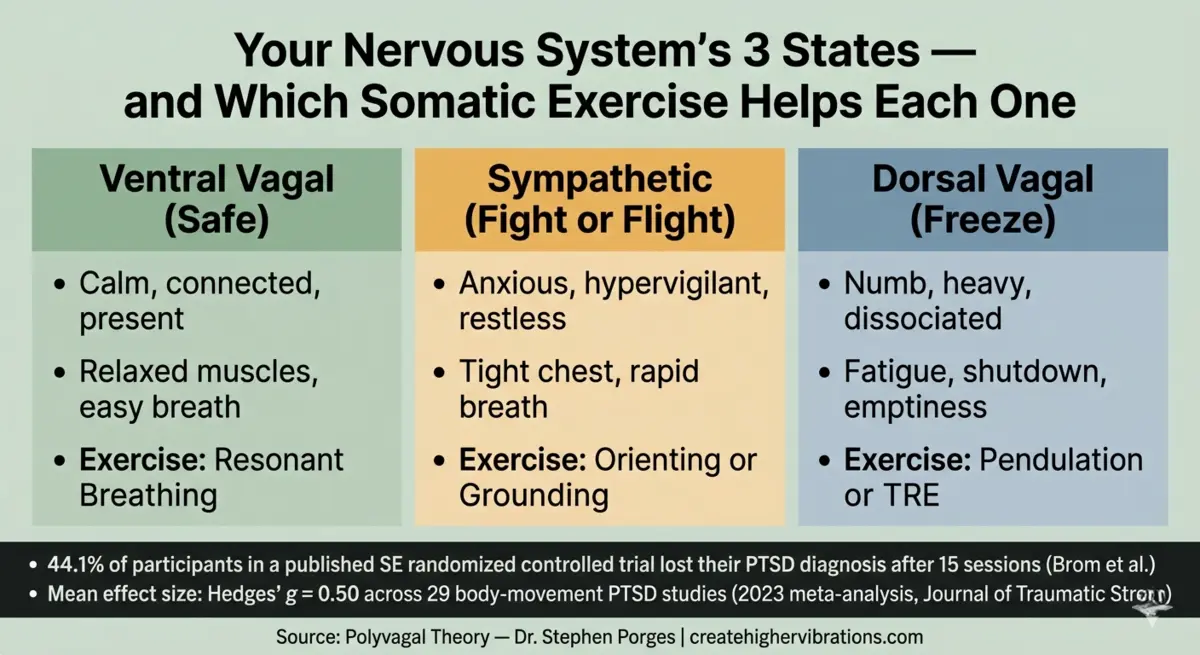
Dr. Stephen Porges, a neuroscientist who developed Polyvagal Theory, explains why this happens. His research shows the autonomic nervous system does not simply toggle between calm and stressed. It operates across three distinct states.
Each has its own physiology, emotional tone, and set of behaviors. Recognising your current state tells you exactly which somatic exercise to use. For a full breakdown of this model, see nervous system healing.
The table below shows each autonomic state, its key signs, and what somatic work aims to do:
| Nervous System State | Physical Signs | Emotional Signs | Somatic Exercise Goal |
|---|---|---|---|
| Ventral Vagal Safe State | You experience relaxed muscles and easy breath. | You feel calm, connected, and present. | You maintain and deepen your current state. |
| Sympathetic Fight or Flight State | You experience a tight chest, rapid breath, and restlessness. | You feel anxiety, hypervigilance, and irritability. | You discharge energy and ground yourself. |
| Dorsal Vagal Freeze State | You experience numbness, heaviness, and fatigue. | You feel dissociation, hopelessness, and emptiness. | You gently activate your nervous system and orient your body. |
Table: The three autonomic nervous system states from Polyvagal Theory, mapped to physical and emotional signs and the corresponding somatic exercise goal.
When trauma occurs, the nervous system fires a massive survival response. Adrenaline floods the body. Muscles brace. Breath shortens. This is healthy and correct in the moment.
The problem comes when the threat passes, but the activation does not discharge. It stays locked in the tissues.
Over time, that locked energy becomes the chronic symptoms of PTSD: hypervigilance, emotional flooding, startle responses, or their opposite, numbness, disconnection, and collapse.
Dr. Peter Levine, founder of Somatic Experiencing, observed something worth noting in animals. After escaping a predator, animals shake and tremble to discharge survival energy.
That trembling is the nervous system completing its own stress cycle. Humans suppress that response. We are taught to hold it together. And so the cycle stays open.
Key insight: Polyvagal Theory identifies three autonomic states (ventral vagal, sympathetic, and dorsal vagal), and different somatic exercises are designed to help the body move between them safely.
Here is something worth sitting with. In many spiritual traditions, the body holds vibrational imprints of every unprocessed experience.
What neuroscience calls “implicit memory stored in the nervous system,” ancient wisdom calls “stored energy in the physical and energetic body.” The language is different. The observation is the same.
I worked with a client who had done years of therapy and understood her trauma thoroughly. She could describe every dynamic of the abusive relationship she had left. But her body still braced every time someone raised their voice. Talk therapy had taken her as far as it could. Somatic work took her the rest of the way.
Your body is not misbehaving. It is remembering. And somatic exercises give it a way to let go finally.
Knowing why trauma lives in the body makes what the research shows much easier to trust.

What Does Research Say About Somatic Exercises for PTSD?
Dr. Peter Levine’s Somatic Experiencing model has been tested in a published randomized controlled trial with 63 participants who met full DSM criteria for PTSD.
After 15 weekly SE sessions, PTSD symptom severity dropped with large effect sizes (Cohen’s d = 0.94 to 1.26). Depression scores followed with similar effect sizes. Notably, 44.1% of participants lost their PTSD diagnosis entirely. These are not small results.
A separate 2018 study in Frontiers in Neuroscience examined clinicians completing a three-year SE training program. It found significant reductions in anxiety and somatization symptoms (p < 0.001 for both), alongside improved quality of life.
The research signals that SE builds regulation capacity across populations, not just in formal patient settings.
The research base extends beyond SE alone. A 2023 updated meta-analysis of body-and-movement-oriented interventions for PTSD analyzed 29 studies and found a mean Hedges’ g effect size of 0.50 for PTSD symptom reduction across yoga, breathwork, body scan, and related practices.
The researchers noted high participant satisfaction and no reported harms across all included studies. BMOIs are now considered a clinically valuable addition to the PTSD treatment landscape.
The HeartMath Institute, a nonprofit research organization, has published findings showing that slow, rhythmic breathing (around five to six breaths per minute) shifts the heart rhythm into a measurably coherent pattern.
This directly influences the brain and nervous system, reducing cortisol and creating a physiological state associated with calm and emotional regulation.
A separate pilot study published in Alternative Therapies in Health and Medicine found that cardiac coherence was significantly lower in combat veterans with PTSD compared to controls, connecting heart rhythm regulation directly to trauma recovery outcomes.
Key insight: Research on Somatic Experiencing includes randomized controlled trials showing significant PTSD symptom reduction, placing it among the more rigorously studied body-based trauma therapies.
One thing deserves honest framing. Somatic research typically involves smaller sample sizes than large pharmaceutical trials. The evidence base is growing, but not complete.
What those smaller studies consistently show is worth sitting with: large effect sizes, high participant satisfaction, and zero reported harms across every study included in the 2023 meta-analysis.
In clinical research, consistent replication across 29 independent studies with strong effect sizes carries real weight, even without thousands of participants.
These practices work best alongside professional trauma care, not instead of it. That is not a hedge. It is how evidence-based integrative healing is designed to function. The body does not heal through a single method. It heals through layered, consistent support over time.
Key insight: Timeline for results: research suggests nervous system shifts can begin within weeks of consistent somatic practice, while deeper therapeutic benefit typically develops over months.
When I first read the SE research, what struck me most was not the data. It was the recognition that body workers and energy healers had been observing these same outcomes for decades before clinical trials caught up.
The science validates what the body has always known. That understanding sets you up perfectly for what comes next: the exercises themselves, and exactly how to use them.
Discover Your Inner Self. Join Our Self-Mastery Program.
Self-Mastery Coaching gives you the space, tools, and guidance to grow, reflect and discover your values and inner strength.

The 7 Best Somatic Exercises for PTSD (With Step-by-Step Instructions)
The most evidence-informed somatic exercises for PTSD include grounding, orienting, diaphragmatic breathing, pendulation, body scan, TRE, and the butterfly hug. Each targets a different aspect of nervous system dysregulation and can be practiced safely at home in 10 to 20 minutes.
Before you begin, one important note. You do not need to do all seven. Start with one. Pick the exercise that matches where your nervous system is right now. The table below will help.
Use this guide to match your current state to the right exercise:
| Exercise | Ideal Application | Nervous System Target | Time Needed |
|---|---|---|---|
| Grounding | You apply this for dissociation and freeze states. | You activate your dorsal vagal system. | 5 minutes |
| Orienting | You apply this for hypervigilance. | You activate your ventral vagal system. | 3 minutes |
| Diaphragmatic Breathing | You apply this for anxiety and racing thoughts. | You shift your sympathetic system to your ventral system. | 5 to 10 minutes |
| Body Scan | You apply this for numbness and disconnection. | You rebuild your interoception. | 10 to 20 minutes |
| Pendulation | You apply this for overwhelm and emotional flooding. | You discharge energy through titrated somatic experiencing. | 5 to 10 minutes |
| Trauma Release Exercises | You apply this for chronic tension and freeze states. | You achieve neurogenic discharge. | 15 to 20 minutes |
| Butterfly Hug | You apply this for flashbacks and acute distress. | You soothe your nervous system through bilateral stimulation. | 2 to 5 minutes |
Table: Seven somatic exercises for PTSD mapped to nervous system states, best use cases, and approximate practice time.
1. Grounding (For Freeze and Dissociation)
Grounding anchors you to the present moment through physical sensation. It is the first exercise to reach for when you feel numb, spacey, or disconnected from your body.
From a Polyvagal perspective, this practice gently activates the ventral vagal state from dorsal shutdown. From an energetic perspective, grounding is also a root chakra practice: restoring the felt sense of safety and physical presence that trauma disrupts.
2. Orienting (For Hypervigilance)
Orienting is the act of slowly scanning your environment to send a “safe now” signal to the nervous system. It is one of the most overlooked tools in trauma recovery.
Dr. Peter Levine describes orienting as the natural behavior of a regulated nervous system. Predators scan fast. Safe animals scan slowly. When you move slowly, your nervous system listens.
This exercise directly stimulates ventral vagal activation by having the body confirm, in real time, that the environment is safe.
3. Diaphragmatic Breathing / Resonant Breathing (For Anxiety)
Slow, deep belly breathing activates the vagus nerve (the long nerve running from the brain stem into the chest and abdomen that regulates calm) and pulls the nervous system out of sympathetic overdrive within minutes.
For deeper regulation, try resonant breathing: five to six full breath cycles per minute. This is the rate HeartMath Institute research links to heart-brain coherence and measurable stress reduction. For a full audio-guided version, see resonant breathing.
4. Body Scan (For Numbness and Disconnection)
A body scan rebuilds interoception (your ability to feel what is happening inside your body), a capacity that trauma often shuts down.
There is no right way to feel during a body scan. Numbness is not failure. It is information.
5. Pendulation (For Overwhelm and Flooding)
Pendulation is a core Somatic Experiencing technique. It moves your attention between a place in the body that holds discomfort and a place that feels neutral or at ease.
It works by training the nervous system to build tolerance gradually, rather than pushing through distress all at once. This is called titration in SE practice.
Pendulation was the practice that changed everything for many of the clients I work with. It taught them that safety was not somewhere out there. It was already in their body, right alongside the pain.
6. TRE (Tension and Trauma Releasing Exercises) (For Chronic Body Tension)
TRE, developed by Dr. David Berceli, uses gentle leg fatigue to trigger the body’s natural neurogenic tremoring response, the shaking your nervous system uses to discharge stored survival energy.
Important: TRE can be intense for those with complex trauma. Begin with shorter sessions of five minutes and build slowly.
7. The Butterfly Hug (For Flashbacks and Acute Distress)
The butterfly hug is a bilateral stimulation technique (a practice that alternately activates the left and right hemispheres of the brain) used in EMDR-adjacent work to self-soothe the nervous system quickly during acute distress.
This technique draws from the EMDR framework developed by Dr. Francine Shapiro. The bilateral movement gently processes activated distress without requiring words or a therapist present.
Each of these seven exercises is a door. You only need to open one to begin.
Now that you have the tools, the next question is how to build them into your actual life without overwhelming yourself.
How to Build a Daily Somatic Practice Without Getting Overwhelmed
A sustainable somatic practice for PTSD starts with just 10 minutes, three times a week. Pick one exercise and do it consistently before adding more. The goal is not performance. It is present.
The biggest mistake people make is trying to do everything at once. They read a guide like this, feel inspired, and attempt four exercises on day one. By day three, it feels like another thing they failed at. Start smaller than you think you need to.
Here is a simple three-week build:
Two things you may notice. First, some days you will feel nothing. That is a nervous system response, not failure. Second, some days you may feel too much. If you feel flooded, destabilized, or worse after practice, reduce the duration. Do not stop entirely. Just do less.
Pairing somatic exercises with journaling and emotional regulation practices deepens the results. If you want structured guidance, working with a trauma-informed coach can help you design a practice tailored to your specific history and needs.
Key insight: A sustainable somatic practice starts with one exercise, practiced consistently three times per week, before adding more.
Permit yourself to be imperfect. Five minutes and a timer. That is a complete beginning.
The body heals in repetition, not intensity.
Subscribe to Create Higher Vibrations!
Get Inspiration and Practical advice straight to your inbox.
Can Somatic Exercises Help Narcissistic Abuse Survivors Specifically?
Yes. Narcissistic abuse creates a specific type of complex trauma (C-PTSD) marked by hypervigilance, freeze responses, and a profound loss of felt safety in the body.
Somatic exercises directly address these patterns by rebuilding the nervous system’s capacity to distinguish threat from safety.
Standard PTSD often follows a single traumatic event. Complex PTSD (C-PTSD) develops from prolonged, repeated trauma within a relationship, the kind that comes from months or years of narcissistic abuse.
The nervous system does not just respond to one threat. It rewires itself to expect a threat everywhere, all the time.
The physical symptoms of narcissistic abuse make this clear: chronic fatigue, digestive issues, persistent muscle tension, and immune disruption are all somatic manifestations of a nervous system locked in survival mode. These are not “just stress.” They are the body’s honest record of what happened.
Many narcissistic abuse survivors also experience dissociation, the nervous system’s way of leaving a body that no longer feels safe to inhabit. Grounding and orienting exercises are specifically designed to reverse that pattern.
They teach the body, step by step, that the present moment is different from what came before.
Somatic exercises also support the crucial work of rebuilding boundaries. Boundaries are not just thoughts or decisions. They live in the body. In the breath that shortens when someone crosses a line. In the shoulders that brace.
Learning to feel that somatic “no” is part of healing from narcissistic abuse in a lasting way.
From a spiritual perspective, narcissistic abuse is also an energetic violation. The repeated devaluation, manipulation, and control shrink a person’s sense of self until they no longer feel anchored in their own body.
Somatic exercises are a form of energetic reclamation: a way of calling your life force back into your own physical presence.
The body remembers who you were before the abuse. Somatic practice helps you find your way back.

The Spiritual Dimension: Somatic Healing as a Return to Embodied Consciousness
From a spiritual perspective, somatic healing is not just about regulating the nervous system. It is about reclaiming the body as the home of the soul.
Many trauma survivors describe somatic work as the moment their spiritual awakening became real, because they could finally feel it.
Most spiritual practice asks you to rise above the body. To transcend. To reach for something higher.
That is valuable. But there is a shadow side. When healing stays only in the realm of thought and spirit, without anchoring in the physical body, it can become what is called spiritual bypassing (using spiritual ideas to avoid fully processing pain). For more on this pattern, see spiritual bypassing.
The body is not a lower frequency to overcome. It is the vessel through which higher-self connection becomes embodied rather than conceptual.
In energy anatomy, the exercises in this guide map directly to specific energy centers. Grounding and TRE work at the root chakra, the center governing physical safety and presence.
Pendulation and breathwork open the sacral chakra, the center of feeling, flow, and creative life force. Rebuilding these centers is not separate from nervous system healing. It is the same process, described in a different language.
Key insight: Spiritual trauma survivors describe somatic healing as the physical gateway through which spiritual awakening becomes embodied rather than purely intellectual.
When the nervous system regulates, the body’s vibrational frequency rises. Not as a metaphor. As a lived experience of ease, presence, and aliveness that was not accessible when survival mode was running the show.
The first time my body truly relaxed in a somatic session, I felt something I can only describe as coming back to myself after a very long time away. That is what this work is really for.
If you want to reclaim your identity after trauma, the body is where that reclamation becomes real.
The soul needs a regulated nervous system to come home to.
When Somatic Exercises Are Not Enough: When to Seek Professional Support
Somatic exercises are powerful self-care tools, but they are not a substitute for professional trauma therapy. If you regularly feel destabilized, re-traumatized, or unable to complete even short practices, working with a trained somatic therapist is the right next step.
Knowing when to get professional support is not a failure. It is self-awareness. Watch for these signs:
If any of these feel familiar, these professional somatic modalities are worth exploring:
Key insight: Caution: if somatic practice consistently causes destabilization or worsening symptoms, working with a trained somatic therapist is the appropriate step, not pushing through alone.
Working with a trauma-informed coach or a somatic practitioner does not mean you are too broken to heal on your own. It means you are wise enough to know when support accelerates the process.
You do not have to hold this alone.
Your Body Has Been Waiting for This
The body is not the obstacle to healing. It is the doorway.
Every somatic exercise in this guide is a small act of trust between you and a nervous system that kept you alive when it had to. Now it is ready to learn something new. It is ready to learn that the threat has passed, that the present moment is safe, and that you are allowed to arrive here fully.
Start with one exercise today. Five minutes. A quiet room. That is enough.
When you are ready to go deeper, explore somatic bodywork therapy and the mind-body connection for the next layer of this work.
You are not starting over. You are coming home.