
Root Chakra Healing: Practices That Ground You in Daily Life

The root chakra is about one question. Do you feel safe enough to stand where you are?
Key Takeaways
Root chakra healing is the practice of restoring a sense of safety, stability, and belonging through grounding, breathwork, movement, meditation, and affirmations. It targets Muladhara, the first chakra, which sits at the base of the spine. It works best in small daily doses.
What Does Root Chakra Healing Mean?
The Sanskrit name Muladhara means “root of existence.” It is the first of seven main chakras, or energy centers, in Hindu tantra. Its symbol is a red lotus with four petals and a yellow square at the center. Its element is earth, so the earth element runs through the practices below.
The tradition places the root chakra near the base of the spine. It is called the seat of kundalini, the coiled energy that yogic systems describe as sleeping there.
The seed sound is laṃ. Yogic systems stress steadying this chakra first, because every other center rests on it.
In daily life, the root chakra stands for survival needs. Food, shelter, money, health, belonging: all of them belong to it. When those feel secure, you tend to feel present. When they do not, you feel on edge.
Healing here means teaching your body that it is safe. Our guide to the root chakra covers what the chakra is. This page covers what to do about it.
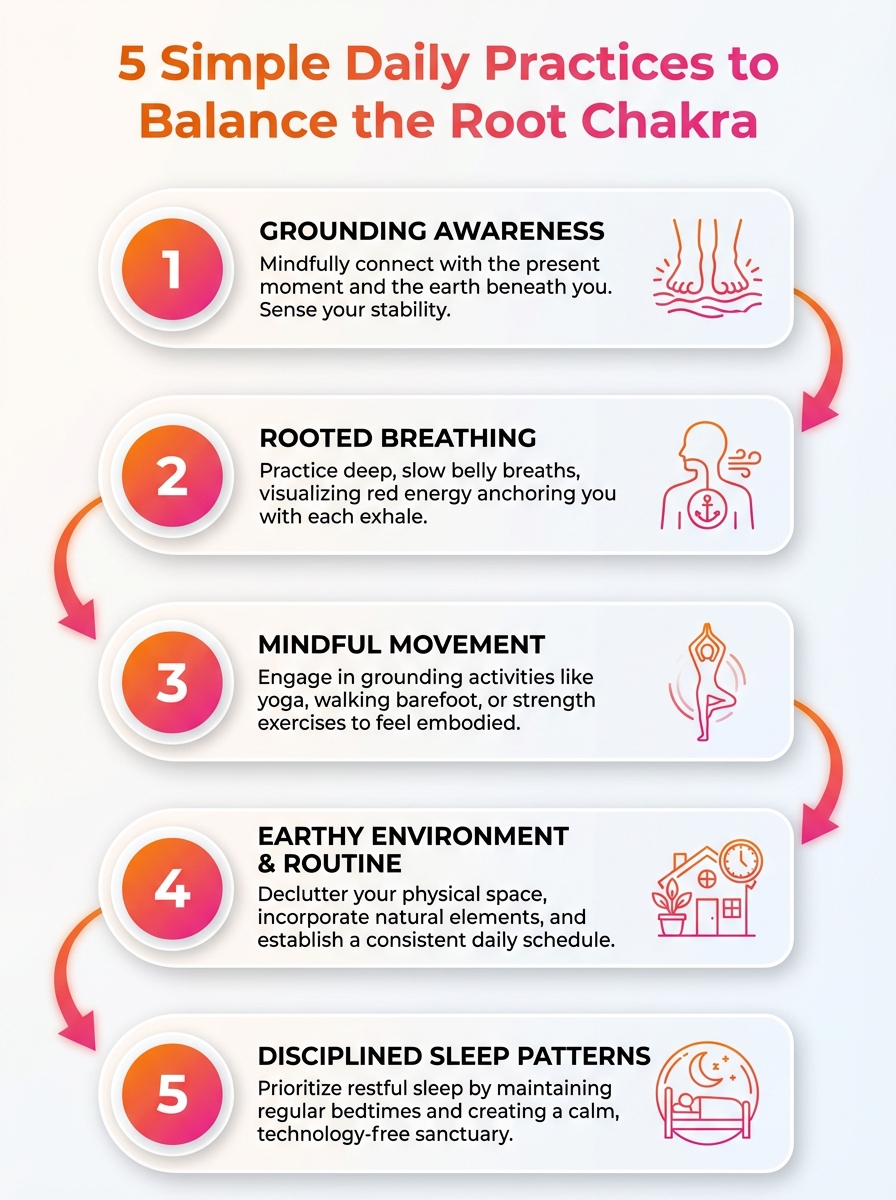
Discover five simple daily practices to balance the root chakra and cultivate grounding, safety, and vitality in daily life.
Does Root Chakra Healing Work?
Be clear about what is being claimed. No scan has found a chakra. The system is a spiritual map. Research does not test whether it exists.
Research does test the practices the map points to. Three findings stand out.
A systematic review of slow breathing, under ten breaths a minute, found increased heart rate variability and shifts in brain activity. Higher heart rate variability reflects a calmer nervous system.
A small pilot with 13 clinicians tested three exercises. Grounding, deep breathing, and body scans all shifted heart rate variability toward relaxation. Subjective stress scores fell from 44.6 to 27.2 after the one-day session. The study was small and had no control group.
A randomized trial of 107 adults tested online conscious connected breathwork. Six weekly sessions cut anxiety scores by about 10.6 points, against 1.9 in the waitlist control group. That is a different technique from the ones below. It shows that guided breathing can reduce anxiety.
So the practices are worth doing. The energy framing is your choice.
How Do You Know Your Root Chakra Needs Attention?
A blocked root chakra shows up in the body and mind, according to tradition. Common signs include the following:
These signs also have ordinary causes. Persistent pain, panic or low mood deserve a medical or mental health check. Our guide on how to identify blocked chakras goes further into the signs.
How Do You Ground Yourself?
Grounding is the fastest place to start. It uses attention to your body’s contact with the earth.
These take under two minutes each. Try them on a commute or before a meeting. Reach for one when your mind spins.

Which Breathing Practices Help the Root Chakra?
Fast, shallow breathing signals threat, even when nothing is wrong. Slow breathing tells the body the threat has passed. Practice these patterns when you are calm first. That way, they are ready when you are not.
Our guide to resonant breathing covers a related pace of about six breaths a minute.
How Do You Do a Root Chakra Meditation?
Root chakra meditation combines slow breathing with an image of stability. Sit with your spine tall. Keep your feet on the floor. A chair works well.
Follow these steps for about ten minutes:
Our guide to mantra meditation has more on using a repeated sound. If sitting still makes you restless, walk slowly instead. Feel each heel and toe meet the ground.
Ten minutes is plenty. Longer sessions are not better for a beginner. Regular ones are.
Which Yoga Poses Support the Root Chakra?
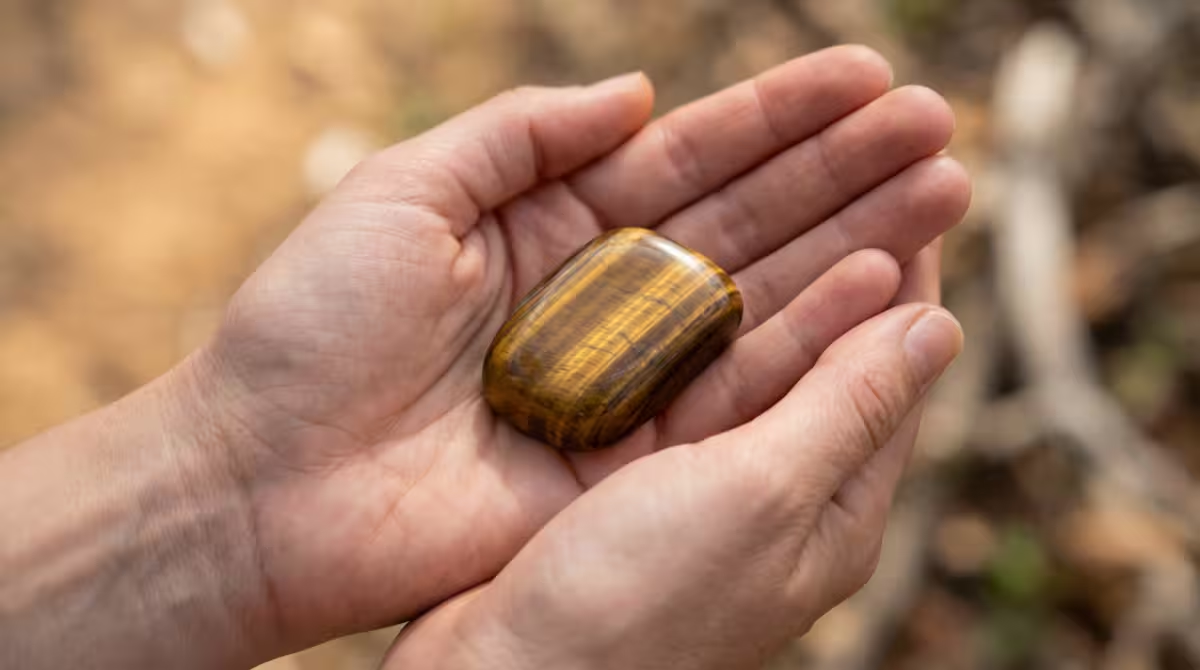
Root chakra yoga uses postures that load the feet, legs, and hips. The classic modern set is Mountain Pose, Warrior I and II, Chair Pose, Malasana (the yogi squat, also called garland pose), Tree Pose and Standing Forward Bend. Child’s Pose and Corpse Pose add rest.
Traditional kundalini sources name other postures. The Muladhara entry lists Garudasana, Shashankasana, Balasana and Siddhasana, plus the practice of Mula Bandha, a gentle lift of the pelvic floor.
A 10-minute sequence is enough. Hold each pose for five slow breaths. Slow, low-load styles such as yin yoga also suit the root, since they ask you to stay put.
What Are Good Root Chakra Affirmations?
Affirmations work best when you pair them with breath and body awareness. Say one quietly for two to five minutes during grounding or breathwork.
Choose one and stay with it for a week. Use it at transitions, such as starting work, commuting, or getting ready for bed.
Can Stones, Foods and Routine Help?
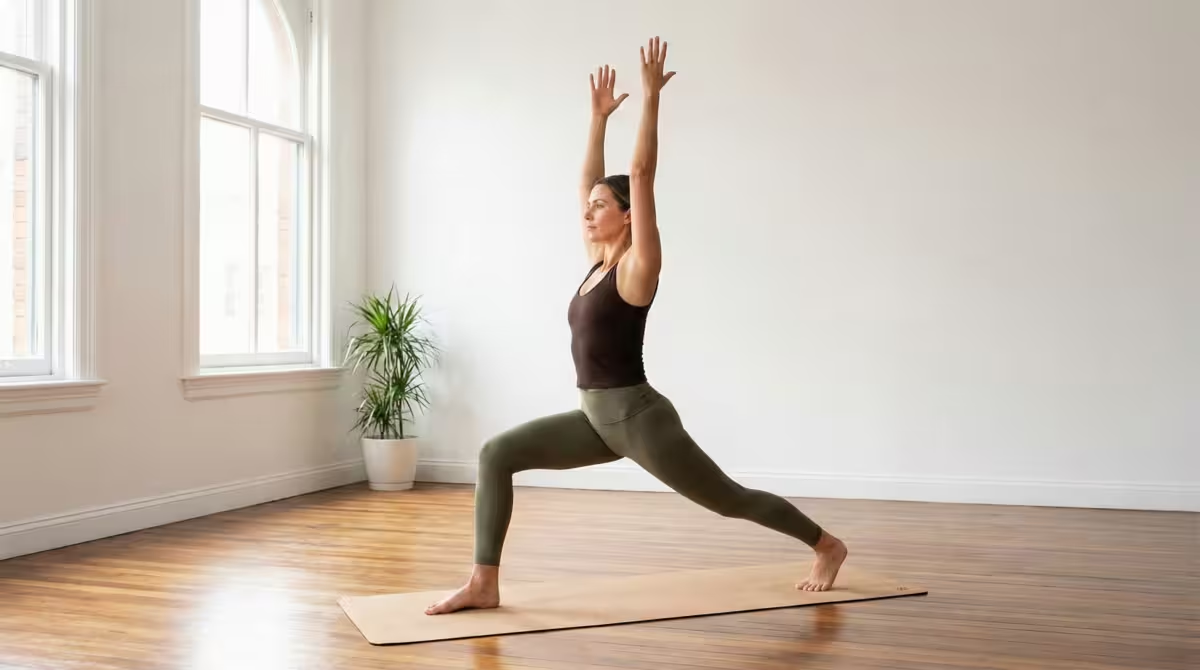
Many people use tangible cues. A stone in the pocket reminds you to pause and breathe. It does the same job as a knot in a handkerchief.
Tiger’s eye is popular for courage and grounded confidence. Red jasper, hematite, and black tourmaline also appear on common lists. Treat any stone as a cue, not a cure.
Which Foods and Routines Support the Root Chakra?
Root chakra foods are earthy ones. Traditional lists name beets, carrots, potatoes, and other root vegetables, plus red foods such as apples and radishes.
Regularity matters more than the menu. Eat at steady times. Sleep and wake at steady times. Build a short morning ritual and a short evening ritual that you repeat daily.
Predictability tells the body that it is safe. That is the core of the root chakra.
Why Does Daily Practice Beat Big Rituals?
The nervous system learns through repetition. A five-minute practice done every day teaches more than a two-hour retreat done once a year.
Big rituals are hard to keep. Small ones fit into a commute or a lunch break. Pick one grounding practice and one breathing practice. Do them at the same time each day for two weeks.
You are not aiming for perfection. You are aiming for predictability and kindness toward your body.
What Trauma Is Stored in the Root Chakra?
Tradition ties the root chakra to early safety. A childhood with insecurity, neglect, sudden loss, or fear of scarcity is said to leave this center unsteady.
The modern version of that idea is closer to nervous system science. Early threat can leave the body quick to alarm and slow to settle. That is a body pattern, not a stored object.
Grounding and slow breathing help with everyday alarm. They are not a trauma treatment. Deep fear, flashbacks, or long-standing panic call for a trauma-informed therapist. Somatic practices can sit alongside therapy, not replace it.
What Does It Feel Like When the Root Chakra Opens?
People who practice regularly describe a quieter body. Common reports include steadier breathing, less money worry, easier sleep, and a feeling of being at home in their own skin.
Some people also feel emotions rise. Tears, tiredness, or a wave of old fear can appear as the body lets its guard. This is common with any deep relaxation practice. Go slowly, shorten sessions, and stop if it feels like too much.
A strong root does not mean no fear. It means fear passes through without taking over the day.
How Does the Root Chakra Support the Other Chakras?
The seven chakras are taught from the bottom up. The root gives the base for the sacral chakra and its emotional flow. It steadies the heart chakra, where opening can feel overwhelming without a safe base.
Grounding also helps you tell intuition from anxiety when you work with the third eye chakra. Pair upper-chakra practices with something physical, such as a walk.
Subscribe to Create Higher Vibrations!
Get Inspiration and Practical advice straight to your inbox.
A 10-Minute Root Sequence to Try Tonight
Set a timer and run the full sequence once.
Do it again tomorrow. The effect is in the repetition. A body learns safety the way it learns anything else. It returns to it.

