
What Is the Narcissistic Discard? And Why Does It Hurt So Much?

You wake up on a Tuesday morning and reach for your phone the way you have every morning for eighteen months, no good-morning text. You tell yourself he’s probably in a meeting.
By Thursday, the silence has a texture to it, not empty, but deliberate. You check your sent messages. Delivered. Read. Nothing. It feels less like a breakup and more like you have been edited out of someone’s story while you were still living in it.
If you’re reading this, you probably already know something was off long before the ending came. You don’t need anyone to tell you this wasn’t a normal breakup.
You need someone to explain why it landed so differently, and why “it’s not about you” hasn’t stopped the 3 a.m. spiral.
The narcissistic discard is the abrupt, often total ending of a relationship by someone with significant narcissistic traits. It typically follows a period of intense idealization and gradual devaluation.
Unlike a mutual breakup, it comes without warning, without remorse, and often with a replacement already in place. It feels different from a normal breakup because it is: the collapse of a connection built on their projection, not on who you actually are.
By the time you finish reading this, you will have a framework for why the discard happened, why it hit so hard, and why the path forward requires understanding both your nervous system and your grief, not one instead of the other.
The narcissistic discard operates differently than a normal breakup. The abuser built the relationship on a false projection. They never loved your true self. The collapse destroys this illusion. Your nervous system learned to rely on unpredictable rewards. This conditioning makes the sudden withdrawal feel like a survival threat. You experience physical withdrawal symptoms. Healing demands cognitive clarity and somatic repair. You bear no fault for the abuse. Your body requires profound safety to recover. Intellectual understanding fails to heal the physical trauma.
What exactly is the narcissistic discard?
The narcissistic discard is the sudden, unilateral ending of a relationship by someone with significant narcissistic traits.
It follows a predictable cycle (idealization, devaluation, then erasure) and is characterized by its totality: blocking, silence, and the absence of any acknowledgment that something real existed. It is not a breakup.
It is a deletion.
The recognizable pattern in narcissistic relationships in which an initial phase of intense idealization (often called love-bombing) gives way to progressive devaluation: criticism, withdrawal, contempt, triangulation.
This is followed by the discard: an abrupt, often total ending of the relationship. This is the final phase of the narcissistic abuse cycle.
The cycle may repeat, with the narcissistic person returning after the discard (the “hoover”) before cycling through idealization and devaluation again.
What distinguishes the narcissistic discard from an ordinary breakup is the combination of three things:
The discard is not about your inadequacy. It is about a relational incapacity they carry, a developmental wound in their ability to sustain genuine intimacy, to experience others as full subjects, to tolerate the ordinariness that inevitably enters every real relationship.
Behavioral psychology defines the extinction burst. Your mind temporarily escalates its efforts to restore a lost reward pattern. You experience this as obsessive checking. You monitor social media constantly after a discard. Your brain operates normally. Your nervous system performs exactly what it learned. It seeks the missing reinforcement.
Source Simply Psychology
Why do narcissists discard people? And why does it feel so different from a normal breakup?
Narcissists discard people not because the person has become useless, but because they have become too real.
When you started having your own needs, questioning their narrative, or failing to mirror their idealized self-image, you stopped functioning as what they need: a perfect source of admiration with no demands.
If you recognize this pattern, you may have experienced trauma bonding, the specific attachment that forms under unpredictable reward patterns.

To understand this, you need a basic picture of how narcissistic psychology works at its core. Otto Kernberg’s object relations framework describes narcissistic personality organization as a fundamental impairment in the capacity to experience other people as full, separate subjects with their own interior lives.
Others tend to be experienced not as people but as objects: sources of something needed.
Heinz Kohut described the narcissistic person’s internal sense of worth as fundamentally fragile and dependent on ongoing “mirroring” from others to remain coherent.
Narcissistic supply is the external validation, admiration, attention, and reflected specialness they require to maintain a stable sense of self. When that mirroring is no longer available, the psychological structure begins to destabilize.
Here is what that looks like practically. Most people have an internal battery that recharges through rest, reflection, and genuine connection.
Someone with significant narcissistic traits has a battery with a broken charging port. It can only charge externally, and only through specific input types.
When you were new, idealized, and admiring, you were a perfect charger. When you became a full, complex human being with your own needs and limits, you stopped working as one. That is not about your worth. That is their wiring.
The discard feels different from a normal breakup because of what the relationship did to your nervous system before it ended.
The narcissist begins emotionally detaching weeks or months before the discard event. The discard is not a sudden decision. It is the final visible act of a process the survivor was never allowed to witness.
By the time the actual ending arrives, the narcissist has already grieved the relationship (in their own way), secured or begun securing a replacement, and psychologically reframed you as the problem.
You are entirely operating on different timelines. You are just beginning to process what has already ended for them.
This is where the specific harm lives. The hot-cold cycle of narcissistic relationships (the alternation of warmth and coldness, idealization and devaluation) creates intermittent reinforcement: the pattern where rewards are delivered unpredictably.
Bessel van der Kolk documents extensively how intermittent reinforcement in relational contexts produces a stress-bonding effect that deepens attachment in ways that predictable, stable relationships don’t.
Your brain responds to unpredictable rewards with elevated dopamine sensitivity, becoming more attentive and more reactive to the relationship over time, not less.
Attachment rupture, the loss of someone your nervous system encoded as a safety figure, activates the same neurological alarm systems as physical danger.
This is not a metaphor. John Bowlby’s attachment theory establishes that the attachment system is one of the most biologically fundamental systems in the human organism.
We are literally wired to form attachments, to track attachment figures, and to experience their loss as a threat to survival.
So when they discard you, your brain does not register “break up.” It registers “abandonment by a survival figure.” That is why the 3 a.m. heart racing will not stop.
That is why you cannot stop replaying everything, looking for the variable you missed. Your threat-detection system is still running, still scanning for the return signal that means safety, because the training did not stop when they left.

This is also why the extinction burst takes hold. When a reward pattern suddenly stops, the brain surges with attempts to restore it: the obsessive checking of their social media, the drafting and deleting of messages you will not send, the asking mutual friends if they have mentioned you.
This is not pathetic. It is neurological. Your brain is doing exactly what a brain trained by intermittent reinforcement does when reinforcement stops: it tries harder, assuming the pattern will return.
Experiencing this does not mean you are weak or addicted. It means your nervous system was conditioned by a pattern designed (consciously or not) to create exactly this response.
A narcissist discards you not because you became less valuable, but because you became too real.
When you started having your own needs, questioning their narrative, or failing to mirror their idealized self-image, you stopped functioning as what they need: a perfect source of admiration with no demands of your own.
The discard is triggered by their inability to tolerate being known as an ordinary human being. It is about their psychological limitations, not your worth.
Psychoanalyst Heinz Kohut described the narcissistic person’s internal sense of worth as fundamentally dependent on ongoing mirroring from others. They experience relationships as fuel for a fragile self-structure rather than authentic connections. You were not in a relationship with a person. You were in a relationship with someone’s survival mechanism.
What actually happens in the weeks and months after the discard?
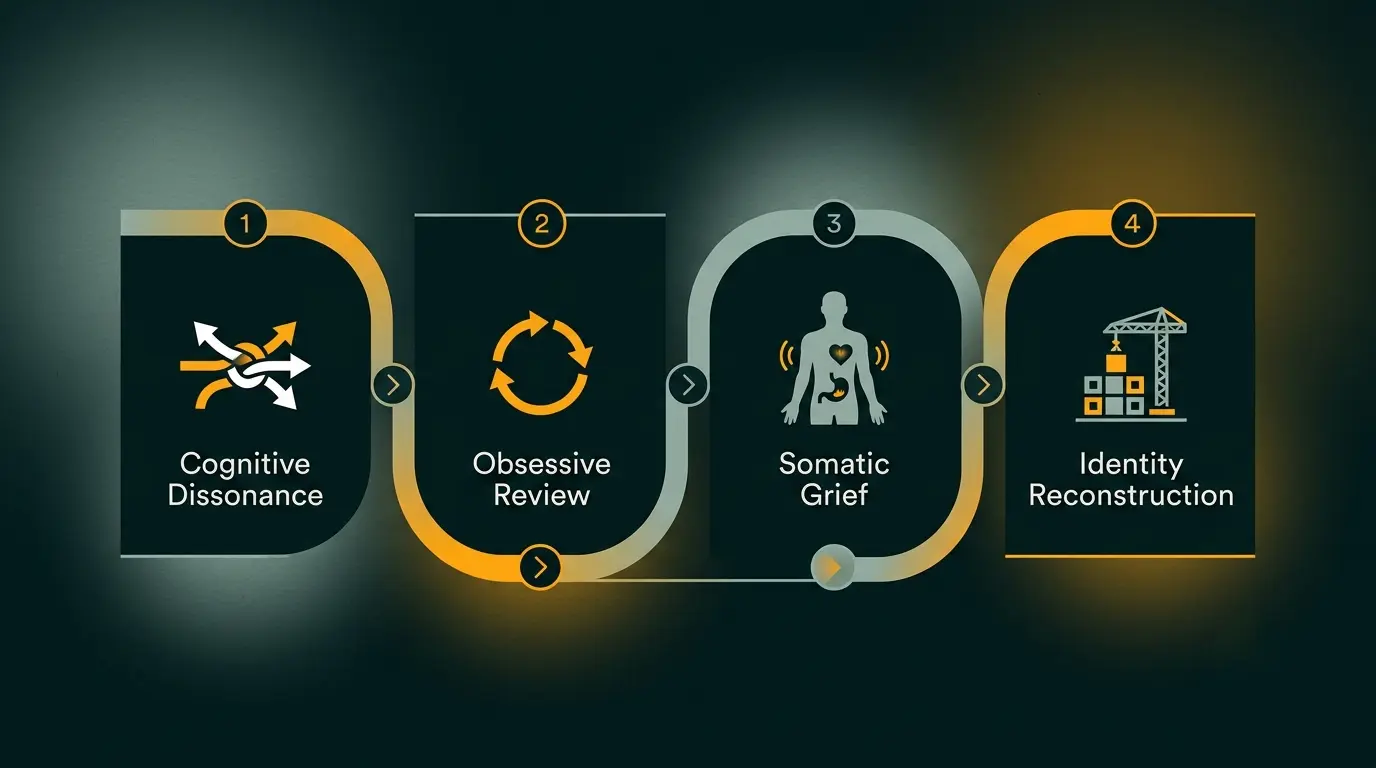
The discard is not a single event. It is a psychological process that survivors move through in recognizable stages. Understanding these phases does not make the pain go away, but it does make it normal. It removes the “why am I not better yet?” shame that keeps you stuck.
| What It Looks Like | What Is Happening Neurologically | What Helps | |
|---|---|---|---|
| Cognitive Dissonance | You hold two contradictory realities simultaneously. You know the relationship ended. You fail to make the ending make sense. | Your brain attempts to reconcile incompatible data. The person who loved you became the person who erased you. | Name the experience. This feeling does not represent confusion. Your brain processes the event normally. |
| Obsessive Review | You replay every interaction. You look for the missing variable. You draft messages you never send. | Your extinction burst operates at full force. Your dopamine system attempts to restore the previous reward pattern. | No contact functions as medicine instead of punishment. This boundary allows your dopamine system to recalibrate. |
| Somatic Grief | Your body processes the pain your mind avoided. You experience chest tightness. You suffer sleep disruption. Your appetite changes. | Your body encoded the attachment below conscious awareness. Your nervous system now releases the stored pain. | You must practice somatic work. Use breathwork and physical grounding. Talk therapy alone fails to resolve this phase. |
| Identity Reconstruction | You question your identity. You attempt to separate yourself from their narrative about you. | You built your identity inside the attachment relationship. You must rebuild your internal self-concept independently. | You must rebuild your internal trust. You learn to trust your own perception again. |
If you are in week 3 and wondering why you are still in the obsessive review phase, your brain is doing exactly what it was designed to do.
The intermittent reinforcement of the hot-cold cycle trained a nervous system, and a nervous system does not recalibrate in three weeks.
It takes the time it takes. You may be experiencing nervous system dysregulation. Your body is still running the threat-detection program.
Some readers will be months past the discard and wondering if they are “behind.” You are not behind. There is no timeline. The body heals on its own schedule. Understanding that is not passive. It is the foundation of actually healing.
Was any of it real? Understanding the both/and of narcissistic relationships
This is the question that survivors return to more than any other. And the answer is genuinely both/and.
Yes, the connection you felt was real. Neurologically, emotionally, genuinely yours. Your somatic markers (the body-level encoding of emotional experience that Damasio’s research identifies) formed under conditions of intense intermittent reinforcement.
That is not fake love. That is a nervous system doing exactly what nervous systems do when exposed to unpredictable rewards from an attachment figure.
And simultaneously, the narcissist’s experience of the relationship was fundamentally different from yours. Kohut’s framework is essential here: the narcissistic person’s internal sense of worth is fundamentally dependent on ongoing mirroring.
They were attached to the mirror you held up, not to the person holding it. You weren’t in a standard relationship where someone simply failed to love you properly; you were dealing with someone incapable of seeing you as a human being, interacting instead with the function you served.
This reframes the good memories. They are not lies. Your experience of those moments was genuine, but the narcissist’s internal experience was fundamentally different.
They were experiencing the mirror, not the person holding it. Both things are true at the same time.
This also explains why the discard is so devastating. It is not just the loss of a relationship. It is the betrayal trauma documented by Judith Herman, MD, in Trauma and Recovery.
Violations of attachment relationships carry a particular kind of damage precisely because they contradict the core human need to believe that those we love are safe.
The betrayal is compounded by the fact that it was not an accident. It was the expression of a relational pattern you were never told you were entering.
Here is the part nobody tells you: the narcissist probably felt relief when they discarded you. Not because you were a burden, but because maintaining the facade with someone who was starting to see them clearly is exhausting.
You became too real, and being real around someone who has built their entire psychology around not being seen is threatening. The discard was their escape from the discomfort of being known.
That stings. It is also clarifying. If they felt relief, the discard was never about your value. It was about their limitations.
Psychologist Dorothy Tennov coined the term limerence. It describes an involuntary emotional attachment formed under intermittent reinforcement. It differs completely from love. Limerence creates obsessive thinking and emotional dependency through a hot and cold cycle. You must understand this difference to recover.
Source Love and Limerence The Experience of Being in Love
Punishment or strategy? Not all discards work the same way
Here is something most articles on this topic do not address: not all discards function the same way, and understanding which type you experienced changes the recovery path.
Why does this distinction matter? Because survivors of punitive discards tend to blame themselves: “If I hadn’t pushed back, they wouldn’t have left.” And survivors of strategic discards tend to blame themselves: “If I had been more interesting, they wouldn’t have found someone else.”
Both forms of self-blame are wrong. A punitive discard says something about your autonomy. You did something they could not tolerate: you existed as a person with your own will.
A strategic discard says something about their boredom. You became predictable to someone who requires novelty to feel alive. Neither says anything about your worth.
And here is the part that is difficult but necessary: the narcissist’s internal state after the discard is often relief, ego boost, and sometimes (in punitive cases) satisfaction.
They feel free of the burden of performing for someone who was starting to see through it. They feel validated by the new target. And if the discard was punitive, they feel the satisfaction of having punished someone who dared to challenge them.
This is devastating to read. It is also clarifying in a way that “it’s not about you” alone cannot be. If they felt relief, the discard was about their psychological needs, not your value.
You were not discarded because you were insufficient. You were discarded because you were too much: too real, too perceptive, too autonomous, for someone who could only relate to projections.
Discover Your Inner Self. Join Our Self-Mastery Program.
Self-Mastery Coaching gives you the space, tools, and guidance to grow, reflect, and discover your values and inner strength.

Why does nobody else see it? The cultural gaslighting of narcissistic abuse
One of the most painful parts of the aftermath is discovering that the person who hurt you in private is charming, generous, and even vulnerable in public. This is not a coincidence. It is structural.
Narcissistic traits (confidence, charisma, apparent certainty, the ability to command attention) are rewarded by culture.
The same traits that make someone a compelling presence in a boardroom or at a dinner party overlap significantly with narcissistic personality organization.
This is not accidental. It is the predictable outcome of a social structure that selects for the appearance of power over the reality of character.
When a capable, accomplished person discloses that they were in a narcissistic relationship, they are frequently met with disbelief: “But they seemed so nice. How did you not see it?”
This response reveals a cultural assumption that competence confers immunity from relational harm. It does not. In fact, empathetic, loyal, capable people are often specifically attractive to narcissistic partners precisely because of those qualities.
The public charm / private cruelty split is not a failure of your judgment. It is a feature of how narcissistic abuse operates. The narcissist’s public persona is their most effective tool.
It protects them from accountability, isolates you from support, and makes you doubt your own experience. When you try to explain what happened, you are not just telling your story.
You are asking someone to believe something that contradicts the social evidence they have already accepted.
This is the cultural gaslighting dimension: the system that rewards narcissistic traits also systematically disbelieves those who are harmed by them.
Understanding this does not make the social fallout less painful. But it removes its power to confirm their version of the story as truth. You are not crazy. You are not alone in this. The system was never designed with your flourishing as the priority.
Oregon State University researchers published a study in 2020. They found narcissists do not learn from mistakes. The abuser does not believe they make errors. Their brain shows a reduced neural response to mistakes. The pattern producing your discard will remain the same. The abuser requires intensive therapeutic work to alter this behavior. You will experience the exact same cycle if you return. The abuser will provide a shorter idealization phase the second time.
Source Oregon State University Research 2020
How do I actually heal from a narcissistic discard?
Healing from a narcissistic discard requires two simultaneous tracks. Most people only get one.
Track one: cognitive work. Your brain needs clarity about what happened. This was not your fault. The relationship was built on their projection, not your actual self.
The discard was triggered by your increasing realness, not your decreasing utility.
Understanding the (Kernberg’s object relations, Kohut’s self psychology, Herman’s betrayal trauma) mechanism gives you a framework that replaces self-blame with accuracy.
Track two: somatic work. Your body needs safety and time. The intermittent reinforcement of the hot-cold cycle trained your nervous system to stay hypervigilant, and the discard triggers a withdrawal response similar to breaking an addiction.
Talk therapy alone is insufficient because the trauma lives in the body, not just the mind.
The body keeps the score, as van der Kolk documents: if the memory of trauma is encoded in the viscera, in heartbreaking and gut-wrenching emotions, in autoimmune disorders and skeletal/muscular problems, then healing must also live in the body.
Practically, this means three things:
Healing from a narcissistic discard requires both cognitive understanding and nervous system repair. Your brain needs clarity. This was not your fault, and the relationship was built on their projection, not your actual self.
But your body needs safety and time. The intermittent reinforcement of the hot-cold cycle trained your nervous system to stay hypervigilant, and the discard triggers a withdrawal response similar to breaking an addiction.
The path forward is no contact (to let your nervous system recalibrate), somatic work (because the trauma lives in the body, not just the mind), and rebuilding your sense of self independent of their narrative about you.

Will they come back? What you need to know about hoovering
They often do come back. This is not because they changed, realized what they lost, or genuinely miss you. It is because they need something: attention, control, an ego boost, or a safety net while the new supply source is still being secured.
Hoovering is the predictable pattern of reappearance after a discard: the breadcrumbs, the sudden reappearance, the “I’ve changed” narrative, the request to “talk” that somehow becomes an invitation back in.
It feels like relief. It feels like an answer. It is neither. It is the cycle attempting to restart. Understanding hoovering and how to hold boundaries is essential for not being pulled back into a cycle that will end the same way.
The data is this: most people who return after a discard experience the same cycle, often with a shorter idealization phase the second time.
The pattern that produced the discard does not change without significant, sustained therapeutic work on the narcissistic person’s part. That work is rare. The pattern is not.
How to hold the boundary in real-time: recognize the hoover for what it is before you respond. Ask yourself: “If this person had genuinely changed, what would they be doing right now?”
The answer is: giving you space, respecting your boundary, and doing their own work, not reaching out to pull you back into a cycle that ended with you being erased.
Subscribe to Create Higher Vibrations!
Get Inspiration and Practical advice straight to your inbox.
The discard was someone else’s architecture. The rebuilding is yours.
That hand is still yours. Still capable of holding something new. Still capable of reaching for something real, not the phantom of who you thought they were, but the solid ground of who you are becoming.
You were real in that relationship. The love you felt was genuinely yours. And the fact that they could not hold it does not mean it was never meant to exist. It means they were not capable of what you are. That is their limitation. Not yours.
This content is educational and not a substitute for professional mental health support. If you are in crisis or experiencing thoughts of self-harm, please contact the 988 Suicide and Crisis Lifeline by calling or texting 988.