
Signs of Nervous System Dysregulation: What Your Body Is Trying to Tell You

You’re sitting in a meeting, or lying in bed. Or standing in a grocery store, staring at a shelf of pasta sauce like it holds an answer you can’t quite reach.
Something feels off. Not dangerous. Not wrong, exactly. off.
Your chest is tight. Your thoughts are fast. You can’t name what changed, but your body noticed before you did. Your shoulders crept up, and you’re only realizing now.
Your breath has been shallow since you woke up. You’ve checked your phone fourteen times. It’s 9:47 in the morning.
That’s not weakness. That’s your nervous system running a program it wrote when the stakes were higher than they are now.
Nervous system dysregulation is when your body’s stress response gets stuck in protective mode. It stays locked in high-alert or complete shutdown even when there’s no real danger.
The signs include:
Your nervous system stays trapped in survival mode long after the threat leaves. You experience physical tension and emotional numbness. You battle brain fog. You feel wired and exhausted simultaneously. These symptoms do not represent character flaws. Your body simply runs an outdated survival program. You possess the ability to retrain your nervous system. You will learn to recognize dysregulation. You will discover the practices bringing real relief.
What Is Nervous System Dysregulation?
Nervous system dysregulation occurs when your autonomic nervous system gets stuck in a protective pattern. Instead of flexibly moving between activation and recovery, it stays locked in hypervigilance or shutdown, interpreting safe situations as threatening based on experience.
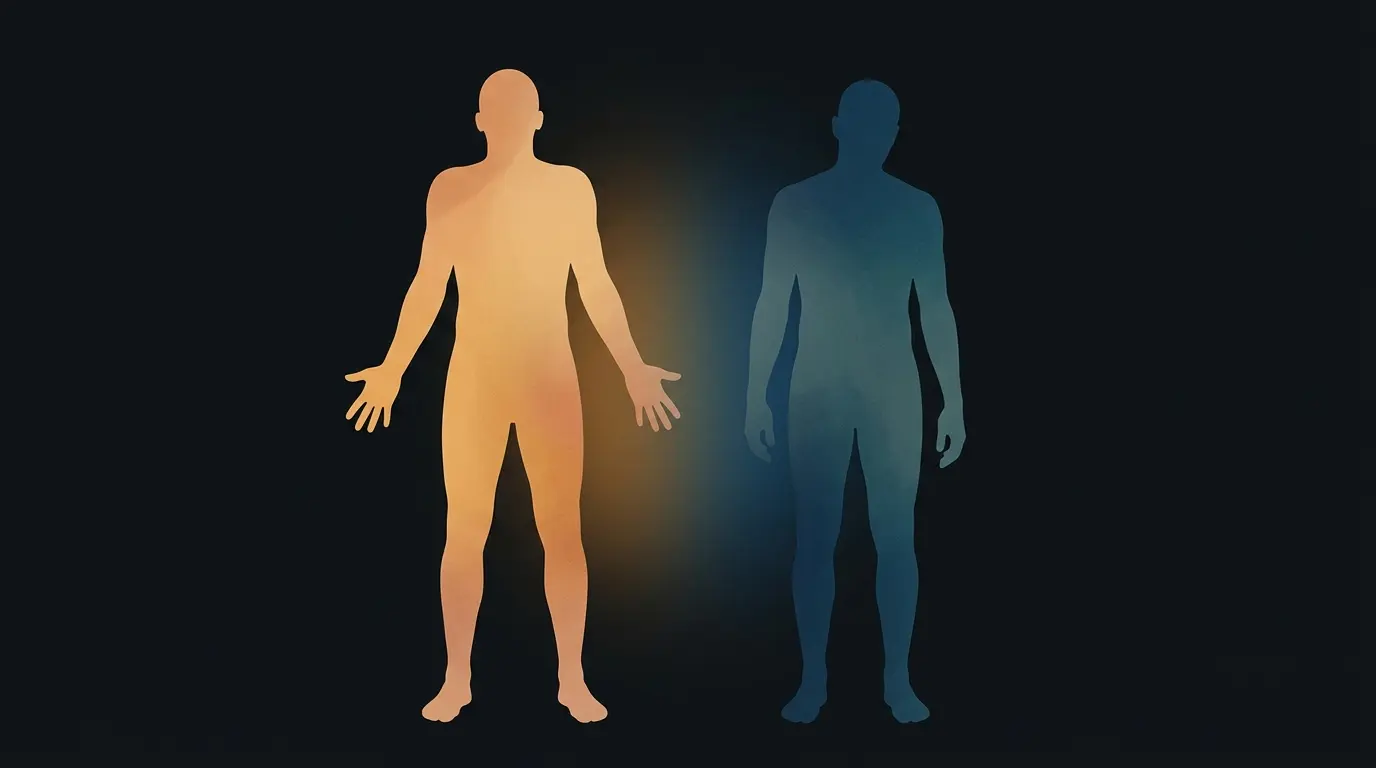
Your autonomic nervous system has three states, not two.
Ventral vagal. You feel calm, curious, and connected. Your voice is warm. Your face is relaxed. This is where creativity and real learning happen. It’s also the state that’s hardest to access after chronic threat.
Sympathetic. Your body mobilizes. Heart rate rises. Digestion slows. Attention narrows to the perceived danger. This is the territory of anxiety and hypervigilance. Built for action, not rest.
Dorsal vagal. This is the oldest survival mechanism. When a threat feels inescapable, your system pulls you into collapse: numbness, dissociation, profound fatigue, often mistaken for depression.
It’s neither. It’s last-resort survival. Our guide to dorsal vagal freeze explores what shutdown looks like in more depth and why it happens.
This system is designed to move fluidly between all three states. Dysregulation happens when it gets stuck.
The Threat Scanner Running Below Your Awareness
Neuroception is the term neuroscientist Stephen Porges coined for your nervous system’s unconscious, continuous scan for safety and danger.
It operates below conscious awareness. It reads cues from your environment, from people around you, from the tone of a voice. Before you form a single thought about a situation, your nervous system has already cast a vote.
That’s why you can feel uneasy around someone without any logical reason to distrust them. It’s not that you’re irrational. Your body is running a protection program written long before your rational mind was online.
Your Window of Tolerance
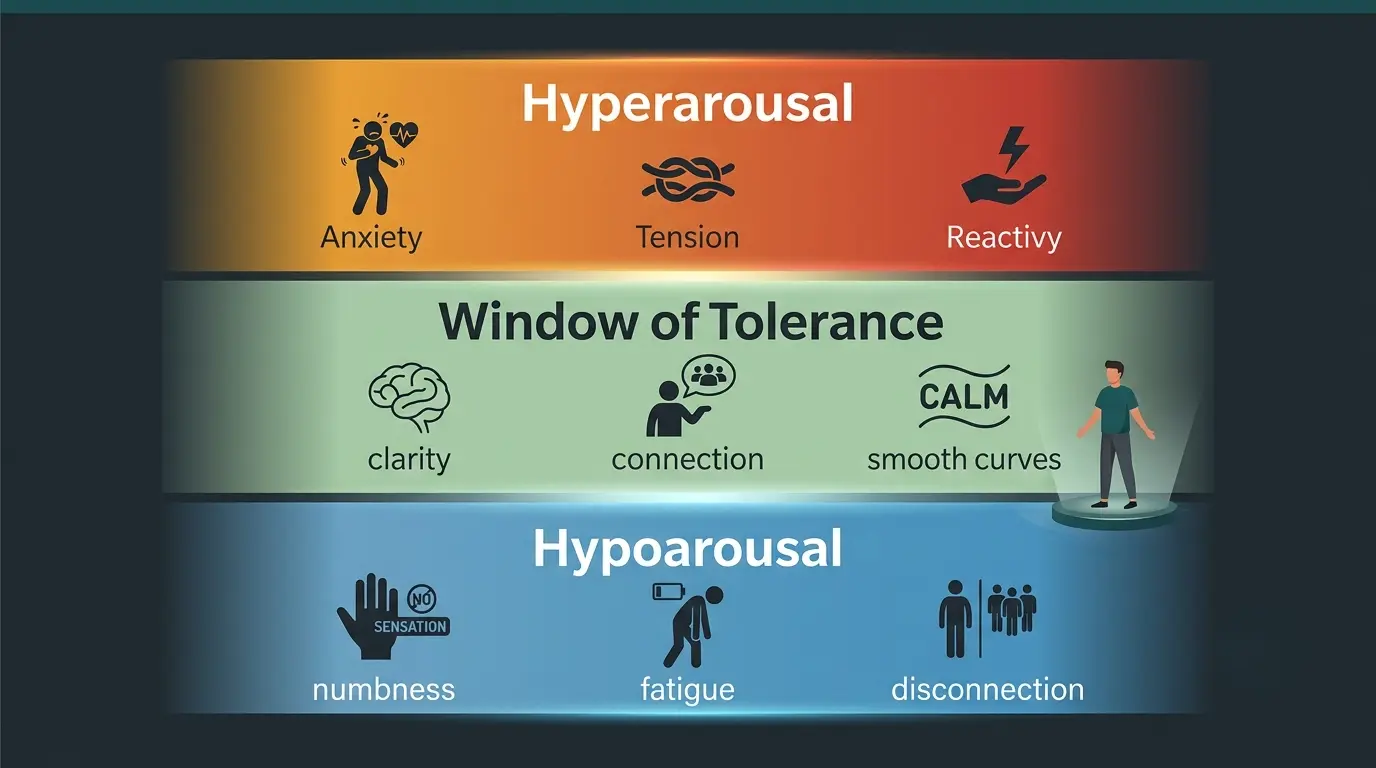
Your window of tolerance is the zone where you can handle stress without flooding or collapsing. Inside it, you can feel intense emotions, think clearly, and stay connected to the people around you.
Outside it, you’re either hyperaroused (reactive, overwhelmed, unable to settle) or hypoaroused (numb, disconnected, unable to engage).
When your nervous system has been shaped by chronic stress or trauma, that window gets narrower. Things that wouldn’t have bothered you before now push you over the edge.
Or you stop feeling anything at all. If you want to understand the three states and how they map to your daily experience, our guide to polyvagal theory walks through the full framework.
The Cumulative Cost
Allostatic load is the cumulative wear and tear on your body from staying in survival mode too long. It’s not feeling stressed.
It involves high cortisol, disrupted sleep, suppressed immunity, and chronic inflammation. The body keeps the score, and the bill comes due, not as punishment, but as physiology.
Why Your Nervous System Won’t “Calm Down”
Understanding that you’re dysregulated doesn’t fix it. Your nervous system doesn’t respond to logic. It responds to somatic evidence of safety.
You can know, intellectually, that you’re safe and still feel your heart racing. The body needs a different kind of proof than the mind can provide.
This is why understanding your autonomic nervous system matters more than understanding your thoughts. Your nervous system makes micro-adjustments 200 to 500 milliseconds before your conscious mind catches up.
By the time you’re aware of feeling tense, your body has been bracing for threat for half a second. You can’t think your way out of a response that started before you were thinking.
Telling a dysregulated nervous system to calm down is like telling a smoke alarm to stop beeping as the house is still on fire. The alarm isn’t the problem.
It’s doing exactly what it was designed to do. Your nervous system isn’t malfunctioning. It’s responding to a threat assessment written through experience, not the present moment.
The system isn’t broken. It’s running a program written for a threat that may no longer exist.
Quiet Dysregulation: When You Look Fine
There’s a version of dysregulation nobody talks about because it doesn’t look like what people expect. You have a job. A clean kitchen. Maybe a therapist. You show up. You perform. You’re reliable. Inside, your system runs emergency protocols 24/7.
You can be the person everyone leans on and still feel like you’re holding your breath all day. Functioning is not the same as regulated. High-functioning dysregulation is still dysregulation.
And it’s exhausting in a way that sleep doesn’t touch, because the exhaustion isn’t from doing too much. It’s from your system never getting to stop scanning for the next threat.
Productivity as a Trauma Response
Some of the most dysregulated people you’ll meet are also the most productive. They say yes to everything. They’re the first to volunteer and the last to leave.
From the outside, it looks like ambition. From the inside, it sounds like this: if I stop moving, something bad will happen. If I slow down, I’ll have to feel what I’ve been outrunning.
Productivity can be a trauma response. Staying busy keeps the nervous system occupied so it doesn’t have to process what it’s been storing. The work isn’t the problem. The work is the solution your nervous system found to a problem it couldn’t solve any other way.
The Signs of Nervous System Dysregulation
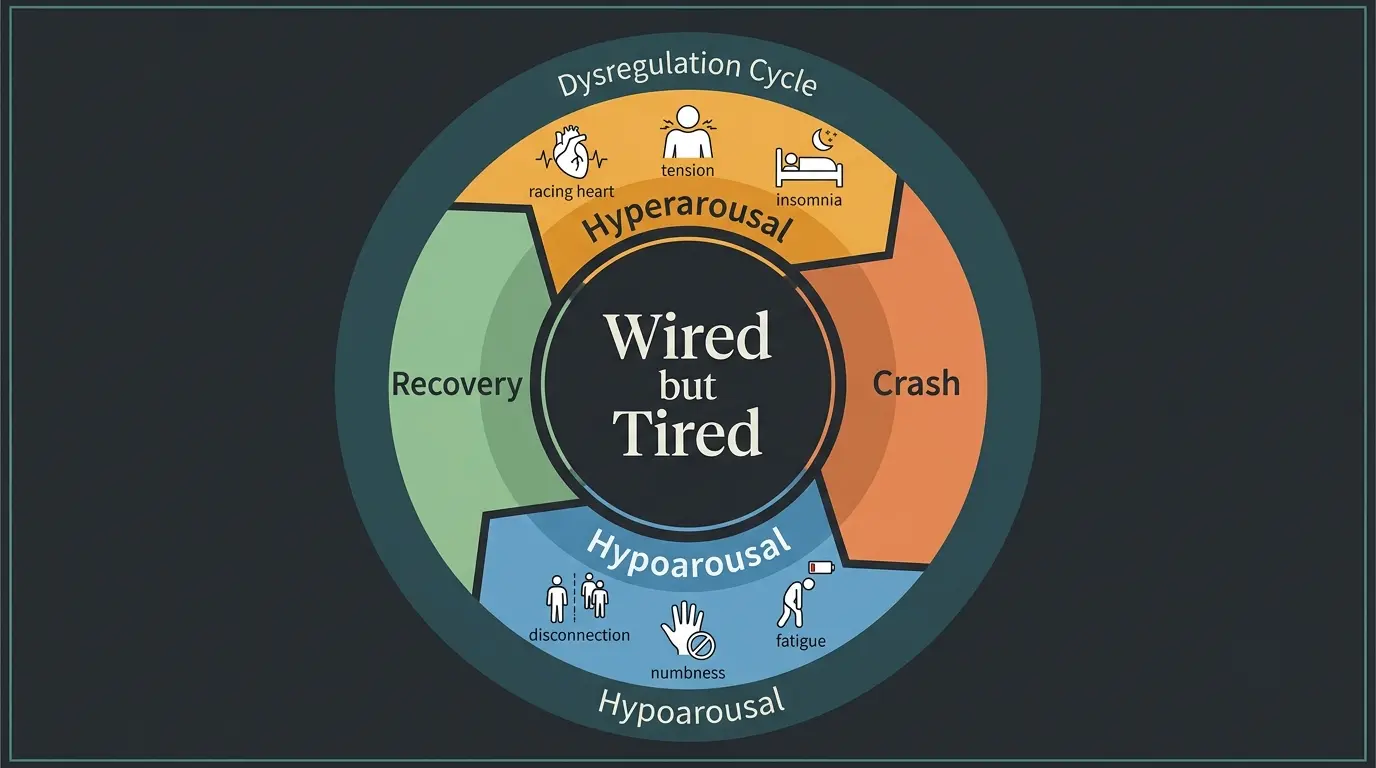
Dysregulation shows up as two primary patterns: hyperarousal (your system stuck in overdrive) and hypoarousal (your system stuck in shutdown). Most people cycle between both.
The signs aren’t “feeling stressed.” They’re specific, physical, and often confusing because they don’t match what’s happening in your life.
Hyperarousal Signs (Your System Running Hot)
Your sympathetic nervous system is activated and won’t turn off. Your body is mobilizing for a threat that isn’t here.
Physical signs include:
Emotional signs include:
Behavioral signs include:
Hypoarousal Signs (Your System Gone Flat)
Your dorsal vagal system has pulled the emergency brake. Your body is conserving energy by shutting down non-essential functions. You’re not lazy. You’re in survival mode.
Physical signs include:
Emotional signs include:
Behavioral signs include:
Discover Your Inner Self. Join Our Self-Mastery Program.
Self-Mastery Coaching gives you the space, tools, and guidance to grow, reflect, and discover your values and inner strength.

The Cycle: Why You Feel Both at Once
Here’s what makes dysregulation so confusing: most people don’t stay in one state. They cycle. You spend three days wired, racing thoughts, can’t sleep, snapping at everyone, then you crash.
Nine hours of sleep and you wake up exhausted. You can’t remember the last time you felt anything. Then, slowly, the energy returns. Not good energy. Jagged. And the cycle restarts.
Wired but tired is the hallmark. Your sympathetic system activates as your body burns out simultaneously. You’re exhausted but can’t settle. Restless but depleted. Your body and mind are operating on different frequencies.
The 3 am mind race is another pattern. You hold it together all day: work, people, responsibilities. Then the distractions stop. The house is quiet. Your nervous system finally has space to process everything it held during the day.
That’s not insomnia. That’s delayed processing. Your body waited until it felt safe enough to start.
| Dimension | Hyperarousal (Hot) | Hypoarousal (Flat) |
|---|---|---|
| Energy | You feel jagged. You feel restless. | You feel heavy. You feel depleted. |
| Emotions | You feel anxious. You feel irritable. | You feel numb. You feel flat. You feel distant. |
| Body | Your muscles tense. Your heart races. | Your body feels exhausted. You feel cold. You feel heavy. |
| Thoughts | Your thoughts race. You imagine the worst outcomes. | Your mind feels foggy. Your thoughts slow down. You go blank. |
| Sleep | You struggle to fall asleep. | You struggle to wake up. |
| Social | You react quickly. You stay on edge. | You withdraw from others. You disconnect. |
Caption: Hyperarousal and hypoarousal are two sides of the same dysregulation cycle. Most people swing between both.
What Causes Nervous System Dysregulation?
Dysregulation is caused by prolonged exposure to stress or trauma that overwhelms your system’s ability to return to baseline. Common causes include chronic stress, childhood adversity, relational trauma, burnout, and prolonged uncertainty.
Your nervous system learns from these experiences and can get stuck running programs that once kept you safe.
The Training That Writes the Program
Your nervous system is a learning system, and every experience teaches it something. If you grew up where danger was unpredictable, where love and harm came from the same person, your system learned to stay on guard. You scanned for mood shifts to stay safe.
That learning isn’t a choice. It’s neuroplasticity adapting to the environment. The system doesn’t automatically update when the environment changes. It keeps running the old program until given consistent evidence that a new one is needed.
“Little t” Trauma and “Big T” Trauma
Not all trauma looks like what you’d expect. Big T trauma (assault, accidents, natural disasters) is what most people think of.
But little t trauma (emotional neglect, an unavailable parent, years of criticism or dismissal) rewires the nervous system as thoroughly.
The nervous system doesn’t grade trauma on a curve. For a child, emotional unpredictability from a caregiver is a survival threat, and the system adapts accordingly.
Subscribe to Create Higher Vibrations!
Get Inspiration and Practical advice straight to your inbox.
Why Intermittent Stress Is More Damaging Than Constant Stress
Research on stress physiology shows that unpredictable stress is more damaging than constant stress. When stress is constant, the system can adapt.
When it’s intermittent, sometimes safe, sometimes dangerous, with no pattern to predict, the system stays in permanent partial activation. It can never fully relax because the next threat could come at any time.
This is why people from chaotic environments often struggle more than people from consistently difficult ones. The unpredictability writes the deepest programs.
Why Your System Can’t Tell Past from Present
Your nervous system responds to the present based on patterns from the past. It doesn’t have a calendar. It doesn’t know the relationship ended or that you moved out.
It knows that a certain tone of voice, a certain facial expression, a certain quality of silence once preceded danger. And it responds accordingly.
This isn’t a flaw. It’s a feature. The system is protecting you. It’s working with outdated information.
What Happens If This Goes Unaddressed
Chronic dysregulation doesn’t stay in the nervous system. Over time, sustained survival-mode activation disrupts immune function, digestive health, hormonal balance, and cellular repair.
The inflammation-stress loop can seed chronic health conditions. This isn’t alarmist. It’s the documented physiology of allostatic load.
The HPA Axis and Cortisol Disruption
The hypothalamic-pituitary-adrenal (HPA) axis is your body’s central stress response system. When it’s working properly, it releases cortisol in response to threat and cycles back to baseline.
When you’re chronically dysregulated, this system gets stuck. It either runs too hot with high cortisol, anxiety, and insomnia, or it flattens out into exhaustion, brain fog, and immune dysfunction. Both patterns have measurable consequences.
Immune Suppression and Inflammation
Chronic stress suppresses immune function while simultaneously increasing inflammatory cytokine production.
This paradox of weakened immunity paired with chronic inflammation is one of the primary mechanisms through which dysregulation seeds long-term health conditions.
Research on stress and immunity links sustained allostatic load to increased risk of autoimmune conditions, chronic pain, cardiovascular disease, and depression.
The Gut-Brain Axis
Your gut contains approximately 100 million neurons and communicates directly with your brain via the vagus nerve. This is why digestive issues (IBS, nausea, constipation, stomach churn) are among the most common signs of dysregulation.
The gut is often the first system to show the cost of chronic survival mode.
Cellular Aging
Chronic stress accelerates cellular aging through telomere shortening. Research published in PNAS found that chronic psychological stress is associated with shorter telomere length and lower telomerase activity, markers of accelerated aging at the cellular level.
The body keeps the score. The bill comes due, not as punishment, but as biology.
Chronic psychological stress accelerates cellular aging. Research shows your perceived stress directly impacts your telomere length. Telomeres cap your DNA and determine cell longevity. Staying stuck in survival mode causes measurable biological wear at the cellular level.
Source Proceedings of the National Academy of Sciences
Can a Dysregulated Nervous System Heal?
Yes. The nervous system has neuroplasticity, and the same capacity that allowed it to adapt to threat now allows it to adapt to safety. Healing doesn’t mean eliminating stress.
It means restoring autonomic flexibility: the ability to gear up when needed and return to baseline with increasing reliability. This takes consistent, body-based practice over weeks to months, not cognitive understanding.
What Healing Looks Like
Healing doesn’t mean you never feel anxious again. It means anxiety doesn’t hijack your entire day. You can feel angry without it turning into a four-hour spiral. It means receiving comfort from someone who loves you without your system treating it as a threat.
The goal is autonomic flexibility, the ability to move between states and return to baseline with increasing reliability. Not the elimination of stress. The restoration of the capacity to come back.
If you’re looking for specific practices that help, our guide to nervous system regulation techniques covers breathwork, somatic exercises, and vagal toning in detail.
The Three Ingredients
Safety cues. Your nervous system needs consistent, repeated evidence that it’s safe to stand down. Not intellectual evidence, somatic evidence.
The feeling of your feet on the floor. The sound of a warm voice. The experience of exhaling and having nothing bad happen.
Repetition. One good experience doesn’t rewrite a program built over years. It takes hundreds of small, consistent signals of safety to teach the nervous system a new baseline. This isn’t a failure of willpower. It’s the pace of neuroplastic change.
Co-regulation. You cannot fully regulate on your own, as your nervous system evolved within relationships and heals most deeply through them. The calm presence of a safe person is a biological necessity, not a luxury.
Research on co-regulation confirms that human connection is not separate from nervous system healing. It’s a core part of it.
Why Healing Feels Worse Before It Feels Better
When you stop running, stop producing, stop managing your internal state through momentum, and suppressed material starts surfacing. This isn’t the practice making things worse.
The practice is making space for what needs to be felt. This isn’t regression. It’s your nervous system finally feeling safe enough to process what it had to store to survive.
You may feel more anxious before you feel less. Cry without knowing why. Feel angry for the first time in years. This is processing. Not regression.
An Honest Timeline
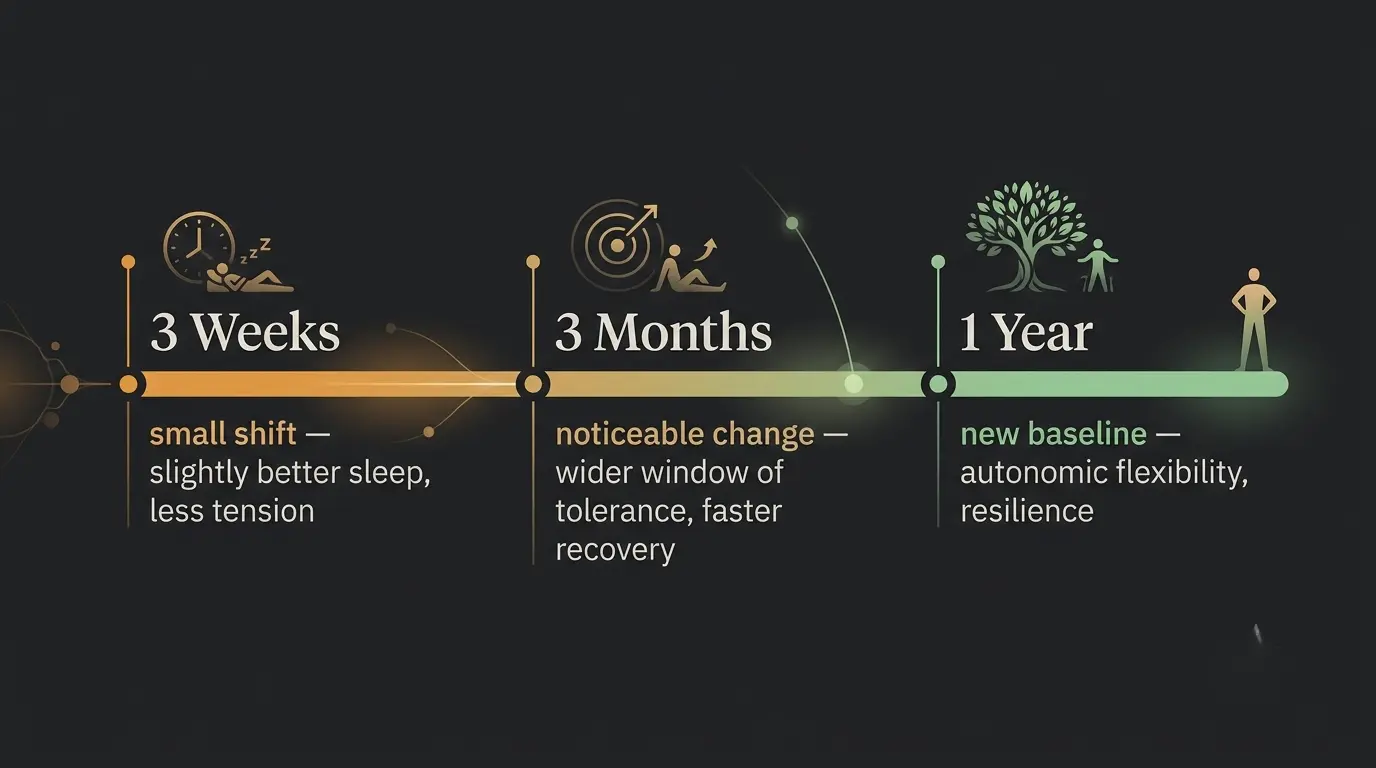
Three weeks of consistent practice is when most people notice the first subtle shifts. Sleep improves, tension eases, and recovery speeds up.
Three months is when the changes become more noticeable. The window of tolerance widens. You start handling things that would have previously pushed you into flooding or collapse.
One year is when a new baseline starts to feel normal, not perfect. Not invulnerable. But genuinely different. The system has learned a new default.
These are averages. Your timeline depends on how deep the training was, how consistent your practice is, and what support you have. The changes are real. They’re also gradual. Both things are true.
When Should You Seek Professional Help?
Seek help when dysregulation interferes with your ability to work, sleep, maintain relationships, or take care of yourself. If you’re stuck in panic, shutdown, or rapid cycling, get help.
If self-directed practices aren’t working after several weeks, a trauma-informed therapist can provide what self-help can’t.
Signs You’ve Moved Beyond Self-Help Territory
Not all therapy addresses the nervous system. Talk therapy that focuses exclusively on changing thoughts often falls short because the problem isn’t cognitive.
It’s physiological. Look for practitioners trained in somatic experiencing, EMDR, polyvagal-informed therapy, or sensorimotor psychotherapy. These modalities work directly with the body’s nervous system, not with the story of what happened.
A regulated therapist is part of the treatment. You’re not talking about safety. You’re experiencing co-regulation in real time. Somatic practices 101 can help you understand what body-based healing looks like before you commit to working with a practitioner.
Your gut contains 100 million neurons. It communicates directly with your brain through the vagus nerve. Digestive issues function as common signs of nervous system dysregulation. Your gut serves as the first system to show the physical cost.
Source Johns Hopkins Medicine
The Role of Medication
Medication isn’t a failure. If your system is too dysregulated to sleep, eat, or do body-based work, medication can provide stability. It addresses symptoms and makes the deeper work accessible.
SSRIs and SNRIs have demonstrated efficacy for PTSD and anxiety symptoms. Medication addresses symptoms. It doesn’t replace body-based work. But it can make that work accessible.
Your Nervous System Is Not the Enemy
There’s a moment, maybe it’s coming, maybe it already happened, and you didn’t notice. Your exhale gets longer than your inhale. Your shoulders drop without you telling them to.
When you’re standing in a grocery store and realize you’re not scanning for threats. You’re buying pasta sauce. And your body, for the first time in a long time, is not preparing for anything.
It’s here
That’s not the absence of stress. That’s the presence of something your nervous system has been looking for since before you had words for it. Safety. Not as a concept. As a felt experience in your body.
Your body remembers how to find it. It needs you to stop telling it to calm down and start showing it what calm feels like. One slow breath. One moment of orienting to the room around you.
One conversation with someone whose presence settles your system. These aren’t small things. They’re the evidence your nervous system is waiting for.
You are not broken. You are adapted. And adaptation can go both ways.
This article is for educational purposes only and does not replace professional therapeutic support. If you are experiencing severe trauma symptoms, please seek care from a qualified somatic therapist or mental health professional.