
Narcissistic Abuse Patterns: What They Are and How to Break Free

You kept telling yourself it was not that bad, that they were just stressed. That the good moments meant the real them was still in there. And every time, the cycle proved you wrong.
Narcissistic abuse does not announce itself. It arrives as the most intense connection you have ever felt. Then it becomes the most confusing pattern you have never been able to escape.
If you are here, you already know something was wrong. What you may not have is a clear map of what actually happened, why it kept happening, and why it felt so impossible to leave.
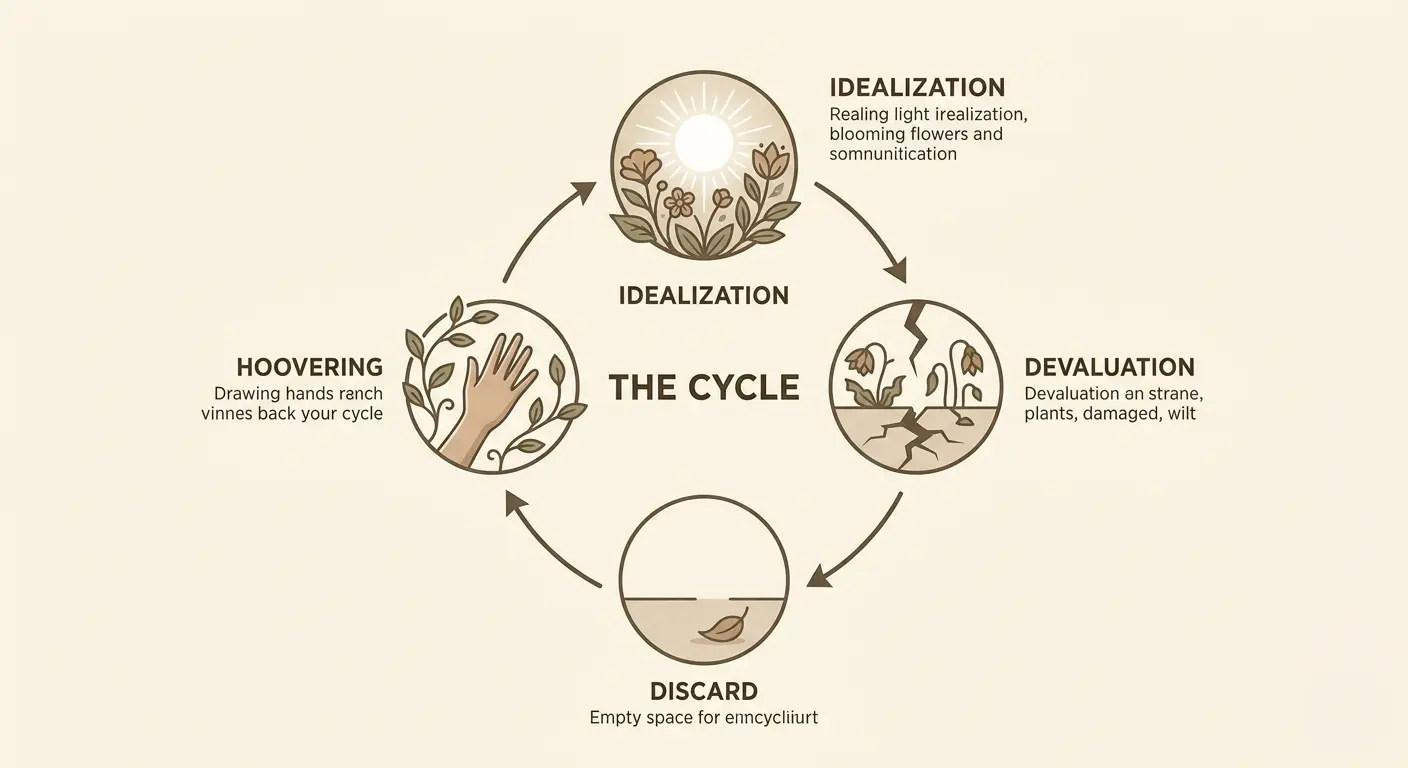
Narcissistic abuse patterns are a predictable sequence of manipulation tactics used by people with narcissistic traits to gain and maintain control over another person. The pattern typically follows a cycle: idealization, devaluation, discard, and hoovering.
Each phase activates specific psychological and neurological responses in the victim, particularly trauma bonding and the fawn response, which make the pattern feel impossible to break even when the victim recognizes what is happening.
By the end of this article, you will have a clear understanding of how narcissistic abuse patterns work, why they are so effective on the human brain and nervous system, and a framework you can use to recognize these patterns in your own experience.
- Predictable Abuse Cycle. Narcissistic abuse follows a predictable pattern of idealization, devaluation, discard, and hoovering.
- Neurological Responses. Each phase activates specific neurological responses in your body, particularly trauma bonding and your fawn response.
- Intermittent Reinforcement. These patterns work because they exploit your brain’s reward system through unpredictable schedules of validation.
- Fawn Response. Your fawn response (placing your abuser’s needs above your own to stay safe) represents a biological survival strategy rather than a character flaw.
- True Recovery. Breaking free from the cycle requires clear awareness of your past experiences while actively repairing your internal nervous system.
What Are the Patterns of Narcissistic Abuse?
Narcissistic abuse patterns are a predictable sequence of manipulation tactics that follow a consistent cycle: idealization, devaluation, discard, and hoovering.
Each phase serves a specific purpose for the abuser: gaining control, maintaining power, and ensuring the victim remains emotionally bonded even when the relationship ends.
The pattern works because it exploits the brain’s reward system, attachment needs, and survival responses in ways that are difficult to recognize from the inside.
This is not a relationship that went wrong. It is a system of control that followed a script. Understanding that script is the first step toward breaking free from it.
The four phases repeat throughout the relationship, often hundreds of times. Each cycle deepens the emotional bond the victim feels toward their abuser, even as the abuse intensifies.
This is the part that confuses survivors most. The bond gets stronger the worse the treatment becomes.

The entire process is fueled by intermittent reinforcement. This is the very same psychological phenomenon that makes gambling on slot machines so compulsive.
When positive and negative feedback are given at random, the brain develops an intense fixation on obtaining the reward and finds it impossible to quit.
In the context of a narcissistic relationship, the “reward” is the reappearance of the affectionate, caring partner from the early days. The mind stays trapped in this loop because it can never predict when that version of the person will show up again.
Intermittent reinforcement creates the strongest behavioral conditioning of any psychological mechanism. Research from behavioral psychology shows unpredictable reward schedules create responses significantly harder to extinguish than consistent ones. This is why the narcissistic abuse cycle feels so much like an addiction. To your nervous system, it is one.
How Does the Narcissistic Abuse Cycle Work?
The narcissistic abuse cycle has four distinct phases that repeat throughout the relationship. During idealization, the abuser creates an intense emotional bond through love-bombing and mirroring.
During devaluation, they systematically undermine the victim’s self-worth through criticism, gaslighting, and intermittent cruelty. During discard, they withdraw or end the relationship, only to return during hoovering with renewed affection that restarts the cycle.
| Phase | What Happens | Why It Works |
|---|---|---|
| Idealization | Love-bombing, mirroring, future-faking, and intense connection | Activates dopamine and oxytocin. This creates emotional dependency before your patterns begin. |
| Devaluation | Gaslighting, projection, intermittent cruelty, and the silent treatment | Creates cognitive dissonance. You try harder to regain the good version of your partner while your trauma bond deepens. |
| Discard | Sudden withdrawal, replacement, and blame-shifting | Triggers dorsal vagal shutdown. You experience deep grief matching none of your relationship logic. |
| Hoovering | Apologies, claims of changing, and manufactured crises | Reactivates your trauma bond. Your nervous system stays wired to the cycle. |
Why Do Victims Stay in Narcissistic Abuse Patterns?
Victims stay because of traumatic bonding, a neurological attachment formed when intermittent reward and punishment create an addictive emotional bond.
It is not weakness. It is the brain’s response to a specific type of psychological conditioning. Your nervous system becomes wired to the cycle, making it feel physically impossible to leave even when you know intellectually that you should.
Cognitive dissonance is one mechanism that keeps victims trapped. This is the psychological tension of holding two contradictory beliefs simultaneously.
“They love me” and “They are hurting me.” Your brain tries to resolve this by rationalizing their behavior, minimizing the abuse, or blaming yourself.
According to research by Dutton and Painter, traumatic bonds are strongest when there is a power imbalance combined with intermittent abuse. This means the worst relationships in terms of bonding are not the ones that are constantly cruel.
They are the ones where cruelty is unpredictable. Your nervous system wires itself to the unpredictability.
The Fawn Response
The fawn response is a trauma survival strategy where you automatically place the needs, emotions, and safety of the person threatening you above your own.
In narcissistic relationships, fawning develops as a learned strategy to prevent abuse by becoming whatever the abuser needs. It feels like empathy, people-pleasing, or being kind, but it is actually a survival response that can become a prison.
According to Pete Walker, a licensed psychotherapist and trauma specialist, the fawn response is one of four trauma survival strategies alongside fight, flight, and freeze.
Walker notes that fawning is the most common response that goes unrecognized because it looks like being a good, empathetic person.
In narcissistic relationships, fawning shows up as hypervigilance to the abuser’s moods, abandoning your own needs to keep the peace, defending the abuser to others, and losing track of who you are outside the relationship. You become a mirror, reflecting what the abuser wants to see.
What makes the fawn response so difficult to break is that it feels like who you are. You might think you are just a caring person.
But caring in a healthy relationship looks different from fawning in an abusive one. Healthy caring has boundaries. Fawning abandons them.
As someone who has worked with many survivors of narcissistic abuse, I want to name this clearly. If you have spent years making yourself small to keep someone else calm, that was not weakness.
That was a biological survival strategy that kept you alive in the environment you were in. The problem was never your strategy; the problem was that the environment didn’t change, causing you to rely on a survival tool long after it stopped keeping you safe.
Discover Your Inner Self. Join Our Self-Mastery Program.
Self-Mastery Coaching gives you the space, tools, and guidance to grow, reflect, and discover your values and inner strength.

What to Do When You Recognize the Patterns
Name the pattern. Writing down what happened and mapping it to the phases described here is itself a repatterning act.
When the cycle lives only in your body and emotions, it feels chaotic and confusing. When you can see it on paper as a predictable sequence, it begins to lose its power.
Understand that your responses were survival strategies, not character flaws. You did not stay because you were weak. You stayed because your nervous system was bonded to the cycle.
You did not lose yourself because you were naive. You lost yourself because the pattern systematically dismantled your boundaries.
Set boundaries. This might mean the gray rock technique (becoming emotionally uninteresting to the abuser), limited contact if complete separation is not possible, or full no contact if your situation allows it. The right boundary depends on your circumstances.
Begin nervous system work. The fawn response and trauma bond live in your body, not just your mind. Talk therapy helps. But for many survivors, body-based approaches make the difference.
This might include somatic experiencing, trauma-informed yoga, or breathwork that helps your nervous system learn that the danger has passed.
Seek support from someone who understands narcissistic abuse specifically. Not all therapy is equipped for this. Look for a therapist who specializes in narcissistic abuse recovery, complex PTSD, or relational trauma.
Subscribe to Create Higher Vibrations!
Get Inspiration and Practical advice straight to your inbox.
Narcissistic Abuse Patterns in Your Relationship: A Self-Check
If you are wondering if your relationship followed a narcissistic abuse pattern, this checklist is not a diagnostic tool. But it can help you see your experience more clearly. If several of these points feel familiar, your experience may match the pattern described throughout this guide.
If you recognized yourself in several of these points, that is important information. It does not mean you were weak.
It means the pattern worked on you the way it is designed to work. The fawn response, trauma bonding, and intermittent reinforcement are powerful psychological forces. Recognizing them is the beginning of unwiring them.
Conclusion
Recognizing these narcissistic abuse patterns in your own life is a profound and courageous first step. It is not a small feat.
These manipulation tactics are specifically designed to remain invisible from the inside, forcing you to question your own reality instead of questioning the behavior of the person harming you.
While understanding the four-phase cycle doesn’t automatically undo the past, it restores something the abuse systematically tried to steal: your clarity.
Knowing that your responses, whether it was freezing, fawning, or staying, were biological survival strategies rather than character flaws is where true recovery begins.
However, breaking free from a trauma bond and repairing an overworked nervous system is a gradual process that requires targeted support. You do not have to navigate the path to healing alone.
Take Your Next Steps: Ready to begin rewiring your nervous system and establishing firm boundaries? Read our practical roadmap on healing relational trauma after narcissistic abuse.
Go Deeper into it: To better understand the neurological grip of these relationships, explore our comprehensive guide on trauma bonding and how to break it.
This article is for educational purposes and is not a substitute for professional mental health treatment. If you are in crisis, please reach out to the 988 Suicide and Crisis Lifeline by calling or texting 988.