
Dorsal Vagal Freeze Symptoms: How to Recognize the Signs Your Nervous System Is Shut Down

What if the reason you feel so heavy, numb, and stuck is not that something is wrong with you, but that your body is in survival mode?
You have been told you are depressed. Lazy. Unmotivated. But something does not fit. The fatigue does not lift with rest. The numbness does not respond to medication.
The fog does not clear with caffeine or willpower. You feel like you are watching your own life from behind glass, unable to reach through and touch anything real.
This is not depression. This is not laziness. This may be a dorsal vagal freeze, and recognizing the symptoms is the first step toward coming back.
What Is Dorsal Vagal Freeze?
The dorsal vagal freeze state is a nervous system reaction governed by the vagus nerve’s most primitive division.
Rooted in the foundational polyvagal theory, this occurs when the brainstem senses an inescapable threat and initiates a total-body conservation mode.
This is not a character flaw. It is not depression. It is not laziness. It is your autonomic nervous system doing exactly what it was designed to do when fight-or-flight is not possible.
The problem is that most people in a freeze do not know they are in it. They think they are broken.
They pursue treatments for depression or chronic fatigue when the real issue is nervous system dysregulation. Recognizing the symptoms changes everything.
Dorsal Vagal Freeze Physical Symptoms
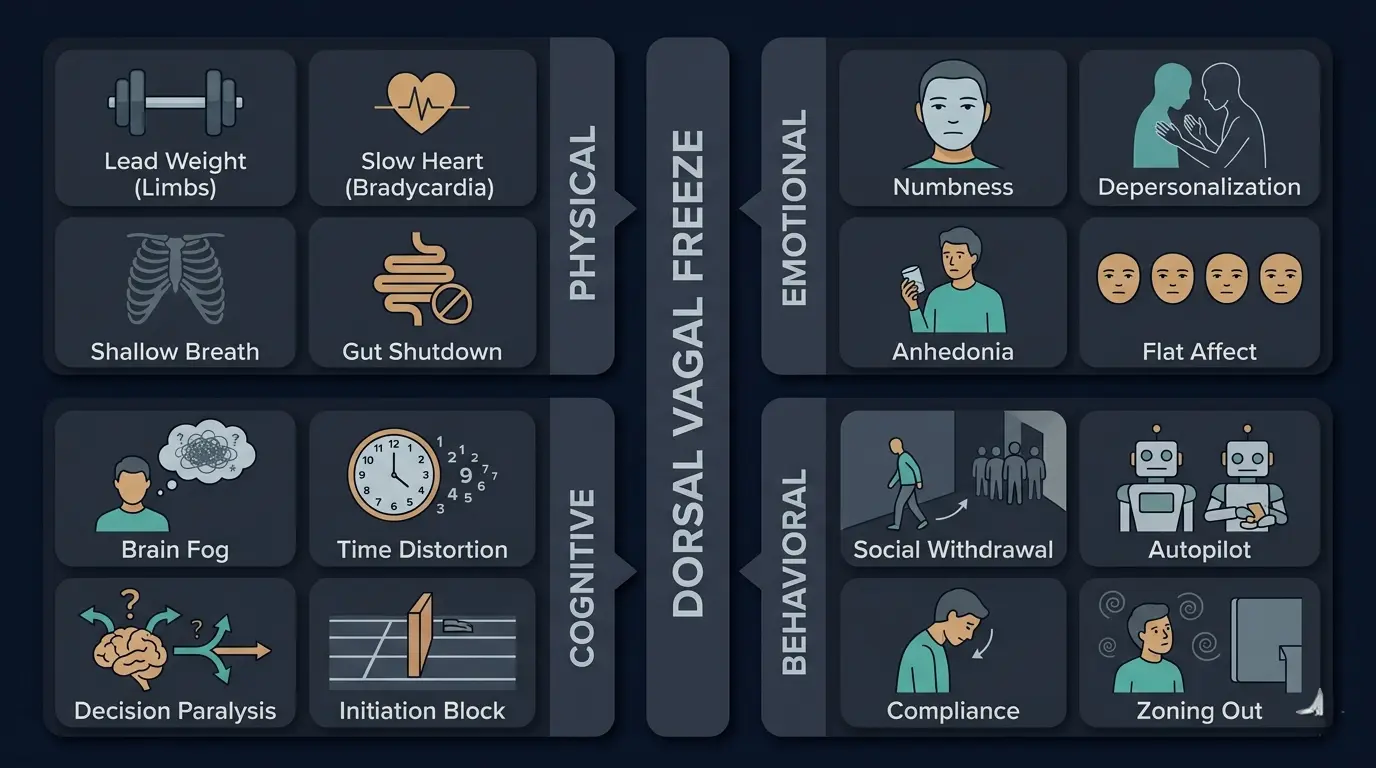
The freeze state has a distinct physical signature. It is not just “feeling tired.” It is a specific cluster of sensations that, taken together, point to dorsal vagal shutdown.
Heaviness in your limbs. Not ordinary tiredness. A deep, leaden weight that makes even small movements feel enormous. Your arms and legs feel like they weigh hundreds of pounds.
You want to move, but your body will not cooperate. This is your dorsal vagal system redirecting blood flow away from muscles to protect vital organs.
Slow heart rate and low blood pressure. Your heart rate may drop below 60 beats per minute. You may feel cold, especially in your hands and feet. This is bradycardia, a measurable physiological response. Your body is conserving energy by slowing everything down.
Shallow breathing or breath-holding. You may notice that you forget to breathe for stretches. Your breath stays high in your chest instead of dropping into your belly.
Sometimes you catch yourself holding your breath without realizing it. This is a hallmark sign of freeze.
Digestive shutdown. Nausea, loss of appetite, or IBS-like symptoms that do not respond to dietary changes. Your gut has slowed or stopped processing because digestion is not a priority when your nervous system is in survival mode.
Exhaustion that sleep does not fix. You sleep eight hours and wake up feeling like you have not slept at all. The fatigue is not a sleep problem. It is a nervous system problem.
Your body is running an emergency conservation program around the clock, and rest does not turn it off.
Feeling physically absent. You may feel like you are not fully in your body. Like you are floating above yourself or watching from a distance. This is depersonalization, a form of dissociation, and it is a common companion to the freeze state.
Dorsal Vagal Freeze Cognitive Symptoms
Freeze not only affects your body. Your thinking changes in specific ways that are often mislabeled as something else.
Brain fog. Not ordinary forgetfulness. A thick, heavy fog that makes it hard to think clearly, concentrate, or make decisions. You may read the same paragraph five times and not absorb it.
You may start a sentence and forget where you were going. This is reduced blood flow to your prefrontal cortex. Your mind is conserving energy.
Time distortion. Hours disappear. Or minutes stretch into what feels like hours. You may lose chunks of time without knowing where they went. This is a measurable disruption in how your brain processes present-moment experience.
Decision paralysis. Even small decisions, such as what to eat, what to wear, and whether to answer a text, feel overwhelming. This is not indecisiveness.
Your prefrontal cortex is running on minimal resources, and decision-making requires more energy than your system has available.
Inability to initiate action. You know what you need to do. You want to do it. But your body will not respond. Your hand will not reach for the phone. Your legs will not carry you to the door.
This is the freeze state, disabling your motor system. It is not laziness. It is a brainstem-level shutdown.
Dorsal Vagal Freeze Emotional Symptoms
The emotional landscape of freeze is distinct from depression, though the two are frequently confused.
Emotional numbness. Not sadness. Not pain. Just nothing. You may sit through events that should make you happy or sad and feel absolutely nothing. You may look at people you love and feel no warmth.
This is your limbic system dampening emotional intensity to prevent overwhelm.
Watching yourself from the outside. You may feel like you are behind glass, watching your own life happen without being able to touch it. You go through the motions. You smile when you are supposed to smile.
But you are not there. This is depersonalization, and it is one of the most disorienting symptoms of freeze.
Inability to feel pleasure. Things that used to bring you joy do not register anymore. Food tastes bland. Music does not move you. Nothing sparks. This is anhedonia, and in the context of freeze, it is a state, not a trait. It is reversible.
Flatness where emotions should be. You may notice that your emotional range has narrowed to almost nothing. You do not get angry. You do not get excited. You do not get sad.
You exist in a narrow band of flatness. This is not who you are. This is what freeze does to your emotional system.
Discover Your Inner Self. Join Our Self-Mastery Program.
Self-Mastery Coaching gives you the space, tools, and guidance to grow, reflect, and discover your values and inner strength.

Dorsal Vagal Freeze Behavioral Symptoms
Freeze shows up in how you move through the world, or more accurately, how you do not.
Social withdrawal. You cancel plans. You stop responding to messages. You avoid people, not because you do not care, but because social engagement feels impossible.
Your nervous system has determined that the connection is not safe right now.
Going through motions without presence. You function. You go to work. You feed yourself. You do what needs to be done. But you are not there. You are on autopilot, moving through your life without inhabiting it.
Compliance without genuine presence. You say yes when you mean no. You agree when you disagree. You comply because it is easier than resisting.
This is not people-pleasing. This is the freeze response, suppressing your authentic reactions to maintain safety.
Zoning out. You lose time. You stare at the walls. You sit on the couch for hours without knowing where the time went. This is not relaxation.
This is your nervous system shutting down non-essential functions, including conscious awareness.

How to Tell If You Are in Freeze Right Now
Check yourself against these signs. The more that resonate, the more likely you are in a dorsal vagal freeze state.
Physical check: Unusual heaviness in limbs. Feeling cold, especially in the hands and feet. Shallow breathing or breath-holding. Digestive issues that do not respond to treatment.
Exhaustion that sleep does not touch. Feeling physically absent or not fully in your body.
Cognitive check: Brain fog that makes thinking difficult. Time distortion. Inability to make decisions. Knowing what you want to do but being unable to initiate the action.
Emotional check: Numbness where you used to feel emotions. Watching yourself from the outside. Inability to feel pleasure. Flatness where there used to be a full range of feeling.
Behavioral check: Social withdrawal. Going through motions without being present. Compliance without genuine agreement. Zoning out or losing time.
If you checked more than half of these, you are likely in a dorsal vagal freeze state. You are not broken. You are not lazy. You are not depressed. You are in a survival state, and survival states can be gently reversed.
How Dorsal Vagal Freeze Differs from Depression
This distinction matters because the treatments are different.
Depression is a mood disorder. It involves persistent sadness, hopelessness, and loss of interest. It responds to antidepressant medication, talk therapy, and lifestyle changes.
The primary experience is emotional: a heaviness of mood.
Dorsal vagal freeze is a nervous system state. It involves physical shutdown, slow heart rate, low blood pressure, gut paralysis, time distortion, and a feeling of watching yourself from outside.
The primary experience is physical and perceptual, a heaviness of body and disconnection from reality.
Here is the key distinction: depression makes you feel sad about your life. Freeze makes you feel nothing about your life, and nothing about the nothing. In depression, you know something is wrong.
In freeze, you may not even have the energy to know that you do not know.
If you have been treated for depression, but the core symptoms- the heaviness, the fog, the paralysis, the sense of watching yourself from outside- have not shifted, it is worth exploring whether dorsal vagal freeze is the primary issue. You may be treating the wrong layer.
Subscribe to Create Higher Vibrations!
Get Inspiration and Practical advice straight to your inbox.
What to Do Next
Recognizing that you are in freeze is itself a healing act. You cannot shift what you cannot see. Now that you can see it, the path forward becomes clearer.
The freeze state is reversible. Your nervous system can learn new patterns. But it requires approaches that work with the body, not just the mind.
Talk therapy alone often cannot reach a nervous system that is below the cortex.
Body-based approaches, somatic experiencing, polyvagal-informed therapy, and gentle nervous system regulation practices are needed to shift the freeze state at the brainstem level.
You are not broken. You are not lazy. You are not depressed. You are in a survival state. And survival states, with the right support, can be gently reversed.
This article is for educational purposes only and is not a substitute for professional medical or psychological advice. If you are in crisis, please reach out to a qualified mental health professional or crisis service.