
The Freeze State: What Happens When Your Nervous System Shuts Down (And How To Come Back Gently)

What if your inability to move, think, or feel is not a flaw but a brilliant biological strategy your body developed to keep you alive?
You have tried pushing through the fog. You have blamed yourself for not leaving sooner, not fighting back, not feeling anything at all. Somewhere between the hypervigilance and the heaviness, you lost access to yourself.
This is not laziness. It is not a weakness. This is your autonomic nervous system doing exactly what a chronic threat trained it to do. Naming this experience is the beginning of changing it.
The freeze response is an involuntary survival state. Your autonomic nervous system shifts into dorsal vagal shutdown when fight-or-flight feels impossible.
Heart rate slows. Emotions go numb. Your body disconnects. Rooted in Stephen Porges’ polyvagal theory, the freeze state is real, biological, and reversible through somatic and spiritual healing.
By the end of this article, you will understand what is happening inside your body. You will see why shame has no place in this conversation. And you will have specific steps to begin thawing, one small sensation at a time.
- The freeze response acts as an involuntary dorsal vagal shutdown rather than a character flaw. Your nervous system chose immobilization because it calculated that fight or flight would put you in greater danger.
- Narcissistic abuse trains your nervous system toward a chronic freeze state through repeated cycles of threat, intermittent reinforcement, and the loss of your agency. Your body performed as best as it could under impossible conditions.
- You recover through gentle somatic techniques like micro movements, temperature shifts, bilateral stimulation, and orienting. You apply the key principle of titration by using small doses of activation that do not overwhelm your system.
- Healing goes beyond physical restoration. The freeze state carries a spiritual dimension where you reclaim your life force through embodied awakening and conscious nervous system repatterning.
What Exactly Is the Freeze Response and Why Does Your Body Choose It?
The freeze response is an involuntary autonomic nervous system reaction. It occurs when your brain determines that neither fighting nor fleeing will keep you safe. Instead of mobilizing energy for action, your body conserves it through immobilization.
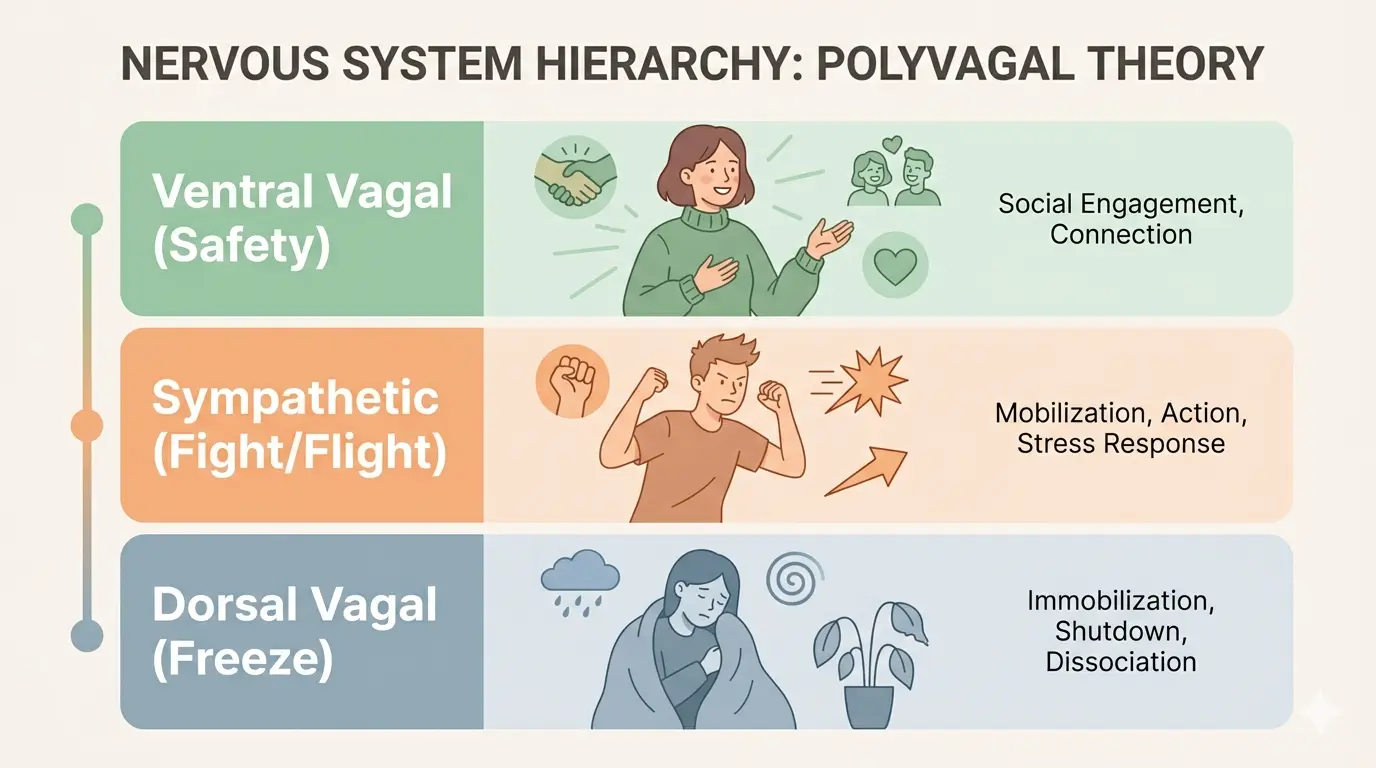
Stephen Porges’ polyvagal theory identifies this as a dorsal vagal shutdown, the oldest survival pathway in your nervous system.
You cannot think your way out of it in the moment. The freeze response is controlled by your autonomic nervous system, which operates below conscious control.
It originates in the dorsal vagal complex, an ancient brainstem pathway shared with reptiles and early mammals. This pathway is older than conscious thought itself.
Your nervous system chooses to freeze when it detects that resistance would increase danger. This calculation is called neuroception, a term Porges coined to describe your nervous system’s unconscious threat scanner.
It happens below conscious awareness. You do not decide to freeze. Your body decides for you.
Freeze is not a failure of courage. It is a survival strategy honed over millions of years of evolution. Your body chose the option it calculated as least likely to get you killed. I used to go silent during confrontations with my abuser.
Years later, I learned that my freeze response had nothing to do with courage. It was my body protecting me. That single reframe changed everything about my healing.
Your body chose to freeze because it was the safest available option, not because you were weak or broken.
| Nervous System State | What It Does | What It Feels Like | What It Looks Like to Others |
|---|---|---|---|
| Ventral Vagal (Safety) | Connects you to others. It supports rest and digestion. | You feel calm, present, and clear-headed. | Others see you as engaged, warm, and responsive. |
| Sympathetic (Fight or Flight) | Mobilizes your energy for action. | You feel anxious, restless, and experience a racing heart. | Others see you as agitated, reactive, and on edge. |
| Dorsal Vagal (Freeze) | Conserves your energy through immobilization. | You feel numb, heavy, foggy, and absent. | Others see you as distant, flat, and checked out. |
Caption: The three polyvagal states and how they show up in your body, your experience, and your behavior.
What Is the Dorsal Vagal State? Understanding Polyvagal Theory in Plain Language
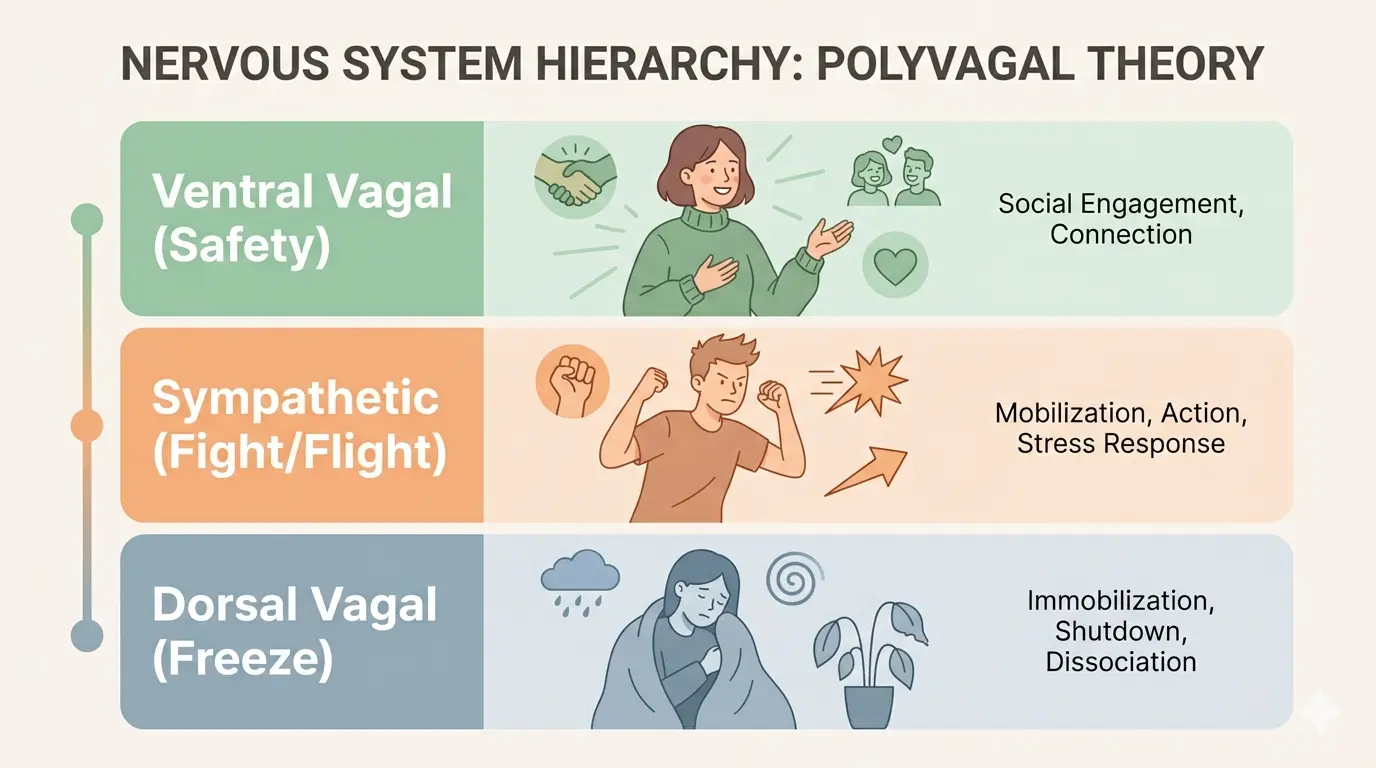
The dorsal vagal state is the deepest branch of your vagus nerve, activating a shutdown response across your body. Stephen Porges’ polyvagal theory describes three neural circuits arranged in a hierarchy.
The ventral vagal state supports social connection. The sympathetic state drives the fight-or-flight response. The dorsal vagal state triggers immobilization and conservation when survival feels impossible.
The ventral vagal complex is your social engagement system. It allows you to feel safe, connected, and present with others. This is the state you want to spend most of your time in.
When it is active, your face is expressive. Your voice has warmth. You can listen and respond without effort.
The sympathetic nervous system activates the fight-or-flight response. It floods your body with adrenaline and cortisol when it detects a threat you believe you can overcome.
Your heart races. Your muscles tense. Your thoughts speed up. This system is designed for short bursts, not chronic activation.
The dorsal vagal complex is the emergency brake. When sympathetic activation fails or feels too dangerous, your system drops into conservation mode.
Everything slows down. Heart rate drops. Breathing shallows. Emotions go offline. This is not a malfunction. It is the bottom rung of your survival hierarchy.
These three states are not choices. They are automatic shifts your nervous system makes based on its constant, unconscious assessment of safety and danger.
In my years teaching nervous system education to abuse survivors, I have watched hundreds of people exhale with relief when they learn about the polyvagal hierarchy. Naming the three states alone begins to reduce shame.
The dorsal vagal state is not a malfunction. It is the bottom rung of your nervous system survival hierarchy, and understanding this hierarchy is essential to recovery.
What Does the Freeze Response Feel Like in Your Body? A Complete Symptom Guide
During a freeze response, your body may feel heavy, numb, or disconnected. Common physical symptoms include bradycardia, which is a slow heart rate.
You may experience muscle stiffness, shallow breathing, and deep fatigue. Emotional symptoms include brain fog, depersonalization, emotional numbness, and a sense of being far away from your own life. Every symptom has a physiological explanation.
Physical heaviness and muscle tension occur because your dorsal vagal system redirects blood flow away from your muscles and toward vital organs. This is the same mechanism that makes prey animals go limp when caught. Your body is trying to protect its core.
Brain fog and cognitive slowing happen because your prefrontal cortex receives less blood and oxygen during freeze. This reduces your ability to think clearly or make decisions. You are not losing your mind. Your mind is conserving energy.
Key insight: Emotional numbness is a protective analgesia. Your nervous system dampens emotional intensity to prevent overwhelm when processing threat feels impossible.
Depersonalization and derealization create a feeling of detachment from your body or your surroundings. These serve a survival function by creating distance from unbearable experiences. You are not going crazy. Your nervous system is doing its job.
Fatigue sets in because dorsal vagal shutdown is metabolically costly over time. Your body is running an emergency conservation program around the clock. Sleep does not fix this kind of exhaustion because the emergency program never fully shuts off.
Shallow breathing or breath-holding occurs because your respiratory system slows alongside everything else. You might notice that you forget to breathe for stretches, or that your breath stays high in your chest. This is a hallmark sign of freeze.
The moment a trauma survivor maps their symptoms to a biological mechanism, the shame lifts. I have seen it happen hundreds of times.
Every symptom of the freeze response, from fog to numbness to exhaustion, is your nervous system trying to protect you. These are not signs of damage. They are signs of a system working exactly as designed under impossible conditions.
Why Do Narcissistic Abuse Survivors Freeze? The Chronic Threat Connection
Narcissistic abuse creates a chronic threat environment in which your nervous system never fully returns to safety. Over time, repeated cycles of tension, explosion, and false calm train your autonomic nervous system to default to the freeze response.
When fight feels dangerous, and flight feels impossible, dorsal vagal shutdown becomes your body’s most accessible survival option.
Coercive control in narcissistic abuse removes your sense of agency. The abuser dictates what you can say, wear, think, or feel.
Over time, your nervous system learns that resistance triggers worse abuse. The fight becomes too dangerous. So your system looks for another option.

Intermittent reinforcement keeps your nervous system in a state of constant threat assessment. The abuser is cruel, then kind, then cruel again.
You never know which version is coming. This unpredictability exhausts your sympathetic nervous system until collapse into freeze, becoming the default resting state.
Walking on eggshells is a form of chronic hypervigilance. It depletes your nervous system resources until there is nothing left. Eventually, your system stops trying to stay alert and starts trying to survive through stillness.
Key insight: Attachment wounds from childhood emotional neglect often prime the freeze response before the abusive relationship even begins. If you grew up with an unpredictable caregiver, your system learned early that freezing was the safest response to an angry or absent parent.
The fawn response, people-pleasing as survival, frequently overlaps with freeze. Both involve suppressing your authentic reactions to maintain safety. In freeze, you go silent and still. In fawn, you go silent and compliant. Many survivors experience a blend of both.
Survivors arrive convinced they are broken because they did not fight back. But their nervous system made the only calculation it could under sustained, inescapable threat. This pattern is one of the most common in narcissistic abuse recovery.
If you froze during narcissistic abuse, your nervous system was not failing you. It was doing the best it could with an impossible situation, and that response deserves compassion, not criticism.
Is It Freeze or Fawn? Understanding the Overlap Between Shutdown and People-Pleasing
The freeze response and the fawn response often look similar from the outside. Both involve suppressing your authentic reactions to survive.
Pete Walker’s 4F trauma model identifies fawn as a distinct response centered on appeasing the threat. Freeze centers on immobilization. In practice, many survivors experience a freeze-fawn blend that shifts depending on context.
Freeze is characterized by shutdown, numbness, and disconnection. You go still. You go quiet. You feel nothing. Your body conserves energy by shutting down non-essential functions. It is the emergency brake.
Discover Your Inner Self. Join Our Self-Mastery Program.
Self-Mastery Coaching gives you the space, tools, and guidance to grow, reflect, and discover your values and inner strength.

Fawn is characterized by hyper-attunement to the abuser’s needs and suppression of your own. You go silent but internally active. You scan for what they want. You shape yourself to be what keeps you safe. It is a social survival strategy.
The freeze-fawn blend looks like going silent while internally scrambling to figure out what the other person wants from you. You are frozen in action but activated in analysis.
Your body is still, but your mind is racing. This is one of the most common patterns in narcissistic abuse survivors.
Both responses share a root in perceived powerlessness. Your nervous system determines that authentic self-expression would increase danger. So it chooses a strategy that minimizes risk. Neither response is a choice. Both are adaptations.
Recognizing which response you default to helps you choose the right recovery tools. Freeze recovery emphasizes gentle body activation. Fawn recovery emphasizes boundary building and self-trust. Most survivors need both.
Most survivors do not fit neatly into one category. Naming your specific blend is more useful than forcing yourself into a single box.
Freeze and fawn are both survival strategies rooted in the same truth: your nervous system determined that being yourself was not safe. Recovery means slowly rebuilding that safety from the inside out.

How Do You Come Out of a Freeze State? Somatic Techniques That Actually Work
Coming out of freeze requires gentle, body-based techniques that signal safety to your nervous system without overwhelming it.
Effective approaches include micro-movements, temperature shifts, bilateral stimulation, humming, and orienting to your environment.
The key principle is titration, small doses of activation that allow your system to discharge survival energy gradually rather than all at once.
Micro-movements are the first step. Slowly turning your head side to side or gently pressing your feet into the floor begins to reactivate your motor system without triggering a threat response.
You are not trying to exercise. You are trying to remind your body that movement is possible.
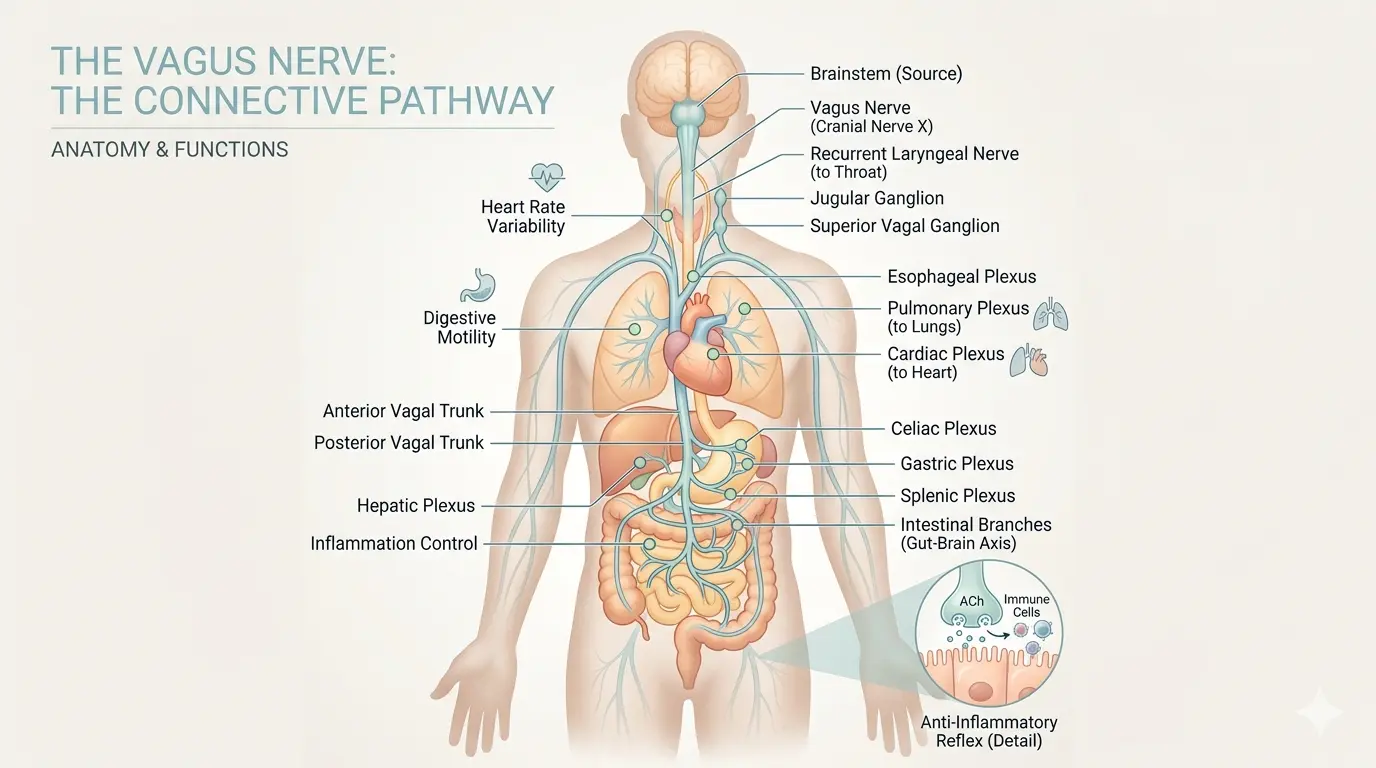
Temperature shifts like holding a cold pack to your chest or splashing cool water on your face stimulate the vagus nerve.
This can help shift your nervous system out of dorsal vagal dominance. Cold activates the dive reflex, which is a direct vagal pathway. It sounds simple because it is.
Bilateral stimulation engages both brain hemispheres. Try alternating gentle taps on your left and right knees or shoulders. This supports the processing of frozen survival energy. It is a core component of EMDR therapy and works on a similar principle.
Humming and singing activate the ventral vagal complex through vibration in the throat. The vagus nerve passes directly through your throat. When you hum, you are giving it gentle input that signals safety. You are safe enough to make sound.

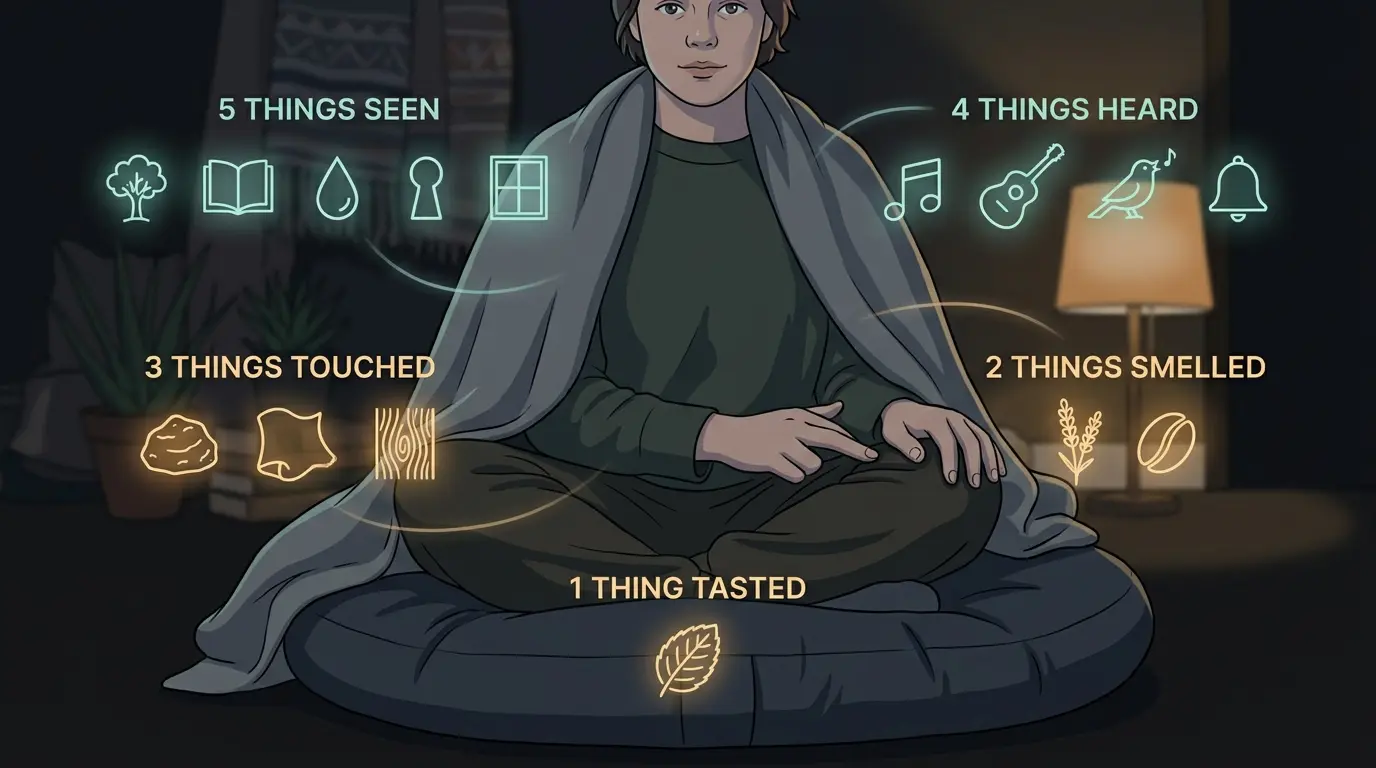
Key insight: The 5-4-3-2-1 grounding technique gently reorients your awareness to the present moment. Name five things you see, four you hear, three you can touch, two you smell, and one you taste. This pulls your attention out of the freeze loop and into your immediate environment.
Orienting means slowly looking around your environment and noticing neutral or pleasant objects. This tells your nervous system that your surroundings are safe enough to take in. It is one of the most direct ways to interrupt a freeze state.
In my experience guiding survivors through somatic exercises, the smallest possible movement is always the best place to start. A single finger wiggle can be the doorway out of a freeze state that has lasted years.
You do not need to force yourself out of freeze. You need to invite your nervous system back to safety, one tiny sensation at a time. Gentle titration is the path.
Can Your Nervous System Actually Heal After Years in Freeze? The Recovery Roadmap
Yes, a nervous system that has been stuck in freeze for years can heal. Neuroplasticity, your brain’s capacity to form new neural pathways throughout life, means your autonomic nervous system can learn new patterns of regulation.
Recovery is not linear, and timelines vary, but the body has a remarkable capacity to retrain its threat responses when given consistent safety signals.
Dan Siegel’s concept of the window of tolerance describes the zone in which you can process experience without becoming overwhelmed. When you are inside the window, you can feel emotions, think clearly, and respond to life.
Recovery means gradually expanding that window through repeated, small experiences of safety.
Co-regulation is one of the most powerful nervous system regulators. Being in the presence of a calm, attuned person helps your nervous system learn safety.
This is why therapeutic relationships and safe communities matter so much. Your nervous system learned to freeze in a relationship. It often heals in relationships, too.
Somatic Experiencing, developed by Peter Levine, specifically targets autonomic nervous system dysregulation. EMDR helps process traumatic memories that keep the nervous system on high alert.
Polyvagal-informed therapy works directly with the three-state hierarchy. These are evidence-supported approaches worth exploring.
Key insight: Regulation before processing is the golden rule. Attempting to process traumatic memories before your nervous system can stay present often leads to re-traumatization. Build your capacity for regulation first. Then approach the harder material with support.
Breathwork, trauma-informed yoga, and consistent somatic practice build vagal tone over time. This makes it easier for your system to access ventral vagal safety. These are not quick fixes. They are daily practices that accumulate.
Healing is not a straight line. You will cycle through states. Progress is measured by how quickly you return to regulation, not by how long you stay there. Some days you will feel alive. Other days, the fog will return. Both are part of the process.
The moments of feeling alive again, even brief ones, are proof that your nervous system is learning. Those moments grow.
Your nervous system can heal. Not overnight, and not in a straight line, but with consistent safety signals and somatic practice, your body can learn that the threat is over and it is safe to come back to life.

The Spiritual Dimension of Freeze: Reclaiming Your Life Force After Trauma
Beyond the biology, the freeze state carries a spiritual weight that many survivors feel but few resources name. Chronic freeze can feel like a dark night of the soul, a contraction of your vital energy that dims your sense of purpose and connection.
Understanding freeze as both a neurological event and an energetic experience opens a deeper pathway to reclaiming your wholeness.
Many survivors describe freeze as a loss of life force. A dimming of the energy that once fueled their creativity, joy, and sense of self. This is not a metaphor.
It is the felt experience of the dorsal vagal conservation mode. Your body has pulled its energy inward to survive. The outer world goes quiet.
The root chakra, associated with safety, grounding, and belonging in many spiritual traditions, maps closely onto the ventral vagal state.
Chronic freeze often correlates with a sense of disconnection from the body and the earth. You may feel unmoored, as if you are floating above your life rather than living it.
Spiritual bypassing, using spiritual concepts to avoid feeling the body’s pain, can keep you stuck. True embodied awakening requires moving through the freeze, not around it. You cannot think your way into presence. You have to feel your way there.
Reclaiming your life force after trauma is a gradual process. It means reintroducing yourself to sensation, pleasure, desire, and creative expression in doses your nervous system can handle. It means learning to tolerate feeling without fleeing back into numbness.
Subscribe to Create Higher Vibrations!
Get Inspiration and Practical advice straight to your inbox.
Conscious nervous system repatterning is where science and spirituality meet. The intentional practice of building new safety pathways through somatic and spiritual practice.
Each time you notice a sensation without shutting down, you are rewiring your system.
Each time you stay present through discomfort, you are expanding your capacity for life.
The freeze state is one of the most profound teachers you will ever encounter. It asks you to find safety not in doing, but in being.
The freeze state is not only a survival response. It is an invitation to discover that your life force cannot be permanently dimmed. It can be reclaimed, slowly and gently, through the body.
Coming Back to Yourself
The freeze state was never a sign that something is wrong with you. It is a sign that something was very wrong in your world, and your nervous system did exactly what it was designed to do.
You survived. And now, slowly, with patience and the right support, your body can learn that the danger has passed.
Healing is not about becoming someone new. It is about coming home to the person your nervous system was protecting all along. You are not broken. You are thawing.
If this resonated with you, explore the fawn response and how people-pleasing becomes a survival strategy. For daily practices that expand your window of tolerance, see our nervous system regulation guide.
This article is for educational purposes only and is not a substitute for professional medical or psychological advice. If you are in crisis, please reach out to a qualified mental health professional or crisis service.