
What Is the Narcissistic Devaluation Phase, and Why Does It Hurt So Much?

You used to know what you wanted for breakfast. Now you cannot decide what to eat, what to wear, or whether you are allowed to have an opinion without checking their face first.
This is what devaluation does. It does not just lower your self-esteem. It removes your internal compass entirely and leaves you running on a threat-detection operating system that mistakes their mood for your reality.
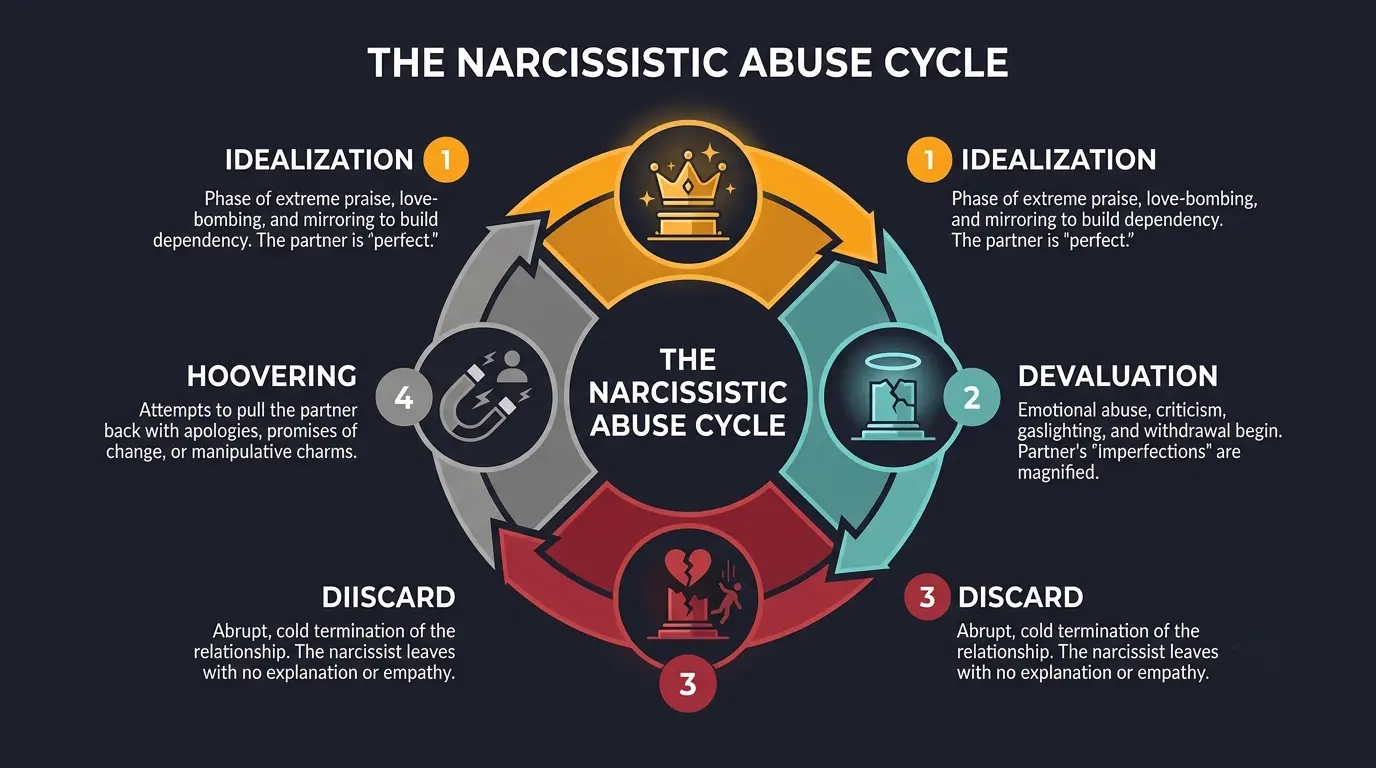
The narcissistic devaluation phase is the systematic withdrawal of idealization, its replacement with criticism, contempt, and calculated emotional manipulation.
It begins after the narcissist has secured your attachment through love bombing, and what follows is not a relationship problem. It is neurological reprogramming.
The trauma bond it creates operates through the same biochemical mechanisms as addiction. And the path out, narcissistic abuse recovery, requires working with your nervous system and body, not just your understanding of what happened.
By the end of this article, you will know exactly why this hurt more than any ordinary loss, why leaving felt pharmacologically impossible, and what somatic healing from narcissistic abuse actually demands of you.
What Is Narcissistic Devaluation, Exactly?
Here is the thing nobody tells you about devaluation: it is not a rough patch. It is not a communication problem you could fix with enough “I-statements” and a couple of therapists who do not understand what they are looking at.
It is a systematic dismantling of your self-trust, your perceptions, and your autonomy.
Designed to make you more controllable. More dependent. More theirs.
During the idealization phase, you felt seen in a way you had never been seen. They remembered small things. They anticipated needs you had not spoken aloud.
They told you that you were unlike anyone they had ever met. And this is the part that fucks with your head later: many narcissists experience that phase as genuinely as you do. It is not entirely performance in the moment.
But it is unsustainable.
It requires them to keep you on a pedestal, and their own pathology guarantees they will eventually perceive you as falling off it. Evolutionarily speaking, their nervous system cannot sustain that level of attunement.
So the mask does not slip because they chose it to. It slips because it was never designed to stay.
Once they feel secure that you are enmeshed, through commitment, cohabitation, pregnancy, financial entanglement, or deep emotional attachment, the need for the exhausting facade lessens.
Their deep-seated shame and inner emptiness remain. And now they attempt to solve it by building themselves up through tearing you down.
As trauma expert Tim Fletcher explains, their unhealed complex trauma becomes the weapon that inflicts complex trauma on you.
Your pain becomes their regulation strategy. It is parasitic. And it is entirely unconscious on their part, which does not make it hurt less.

The devaluation toolkit typically includes:
Why Does Devaluation Feel Like Withdrawal From an Addiction?
Because it is. Literally.
During love bombing, your brain encoded the narcissist as a primary reward. Your mesolimbic pathway, the brain’s reward circuitry, was flooded with dopamine every time they texted, called, or showed up.
Your attachment system released oxytocin in high concentrations during the intense closeness of that phase.
Your nervous system is, in every measurable sense, in a state of positive activation that feels identical to love. It felt like love because the neurochemistry is nearly identical.
Then devaluation begins. Those neurochemicals drop sharply. Your brain experiences this as literal withdrawal, the same mechanism as coming off a substance you have been on for months.
The same tremors. The same desperation. The same irrational behavior in pursuit of one more hit.
This is why leaving feels pharmacologically impossible, not just emotionally difficult. Your body does not care that you “know better.” It has been conditioned. And conditioning does not respond to insight.
The specific mechanism is what behavioral psychology calls a variable ratio reinforcement schedule. The narcissist’s unpredictable alternation between warmth and cruelty is, without exaggeration, the most addictive reward schedule known to research.
It is the same mechanism that makes slot machines profitable. You never know when the next “win”, their approval, their softness, their temporary humanity, will come.
So you keep pulling the lever. Hours become days. Days become years.
See, advice to “just leave” fundamentally misunderstands the target’s nervous system state. You cannot think your way out of a biochemical bond any more than you can think your way out of opioid withdrawal. Knowledge is necessary. It is not sufficient.
Polyvagal theory and nervous system healing explain how the autonomic nervous system gets locked into threat-response patterns during prolonged relational stress.
But understanding why the bond is so hard to break is only half the picture. The other half is understanding what was happening in the narcissist’s mind before you ever felt a single thing shift.
What Happens in the Narcissist’s Mind Before Devaluation Starts?
Before devaluation begins, the narcissist runs a four-step evaluation sequence. It is not always conscious. Sometimes it is pathological intuition shaped by their own unhealed architecture.
But it follows a predictable pattern you will probably recognize, now that you know what to look for.
Step 1 — Boundary testing. How much will you tolerate? They test with small violations. A dismissive comment. A moment of coldness. They watch how you respond. If you accept it without protest, they have data. And data is all they need.
Stage 2 — Remembrance and mourning. This is the stage most people skip, and most therapy rushes past. It requires actually feeling the grief, not analyzing it, not reframing it, not immediately finding the lesson inside it.
You genuinely loved them. That is the part that does not get said enough.
The capacity to feel that love, the vulnerability you allowed yourself, the softness you dropped your guard long enough to show, all of that was real. Yours. It belongs to you. What was not real was their reciprocity.
And you have to grieve both things. The person you thought they were. And the version of yourself who believed it.
Skipping this stage is not a strength. It is avoidance wearing resilience as a costume. The survivors who shortcut the mourning are the ones who describe themselves, two or four years later, as still stuck, a progress bar frozen at 47%, something undigested still sitting in the body.
They know they should be “over it.” They are not over it. Because you cannot think your way through grief that lives somatically, you have to feel it through.
Stage 3 — Reconnection. This is the rebuilding. Not “getting back to normal”, normal was the relational template that made this relationship feel like home in the first place. Reconnection means constructing something new.
It includes reclaiming ambitions that were systematically undermined. Rebuilding the friendships that were quietly isolated.
Returning to the things you used to want before wanting things became dangerous. And doing the deeper attachment work, identifying the wound that made this dynamic feel familiar rather than foreign.
Without that work, the risk is not relapse into the same relationship. The risk is finding the next version of the same dynamic and calling it different because the face changed.
With the work, recovery stops being recovery and becomes something else. It becomes the first time in years you wake up and want something, not because you calculated what would keep them calm, but because you want it.
That is not a small thing. That is your existence reasserting itself beneath the rubble.
It is worth the work, every confusing, non-linear, backsliding minute of it.
Step 4 — Isolation feasibility. Can they separate you from people who would interrupt the pattern? They test this by creating small conflicts with your friends or family.
They position themselves as the only one who “understands” you. They slowly make your world smaller, one withdrawn invitation at a time, one planted doubt at a time.
This evaluation process explains why the love bombing phase felt so safe. They were not falling in love. They were running reconnaissance.
Once they have what they need and once they know you are attached, vulnerable, and sufficiently isolated, the devaluation begins.
Research on narcissistic status pursuit (Grapsas et al., 2020) describes this as evaluating social position and utility before deciding how to interact with a target. The narcissist asks one question: Is it safe to move into stronger forms of control?
Understanding the internal architecture that drives this evaluation process.

What Are the Signs and Stages of Narcissistic Devaluation?
Devaluation does not announce itself. It seeps in like water damage, visible only after the structure is already compromised. It typically progresses through recognizable stages, though the timeline varies by narcissistic subtype and relationship context.
What distinguishes devaluation from normal conflict is the pattern: the criticism escalates, the accountability never lands on the narcissist, and you begin monitoring their face before you speak.
Early Stage: The Subtle Shift
The first signs are easy to dismiss because they are almost invisible. They start dropping hints that you have done something wrong, forgotten something important, or hurt their feelings.
You begin to feel insecure without knowing why. Something is off. You cannot name it.
Watch for:
Middle Stage: The Erosion Accelerates
The criticism becomes more overt. Gaslighting enters the picture. You begin questioning your own memory and judgment. You try harder to please them, which, predictably, feeds the cycle.
The more you try, the less it works. Because the point is not behavior. The point is control.
Watch for:
Late Stage: Contempt Replaces Criticism
By this stage, your value has been significantly reduced in their perception. Basic respect disappears. You are no longer treated as a person.
You may be used, discredited, or openly devalued, sometimes in front of others who do not intervene because they do not understand what they are watching.
Watch for:
Covert Devaluation: The Invisible Pattern
Now here is where it gets genuinely dangerous. Covert (vulnerable) narcissists operate differently. Their devaluation uses ambiguity, therapeutic framing, and victim-positioning.
They do not rage. They sigh. They do not scream. They deliver criticism in the language of concern. From the outside, it looks like a communication problem or a fragile, wounded personality.
This is why therapists, friends, and even the person being devalued cannot name what is happening. The weapon is invisible. Anyone watching sees two people having a hard time, not one person systematically dismantling another.
Covert signs include:
| Overt Devaluation | Covert Devaluation |
|---|---|
| The abuser uses direct criticism and rage. | The abuser uses concern as a weapon and sighs heavily. |
| The abuser humiliates you in public. | The abuser undermines you in private. |
| The abuser shifts between hot and cold behavior obviously. | The abuser withdraws subtly and creates confusion. |
| You identify this behavior easily. | Outsiders remain completely blind to this abuse. |
| The abuser presents a grandiose image. | The abuser presents a victim image. |
Narcissistic projection explains how both types accuse you of what they are doing, and gaslighting tactics map the specific techniques used to erode your reality.
How Does Devaluation Rewire Your Internal Model?
Devaluation installs three specific cognitive distortions that restructure how you relate to yourself. These are not “low self-esteem.”
There are structural changes in how your nervous system processes selfhood. Think of it as someone rewiring your house, but they removed the original wiring first.
Distortion 1 — Worth fused with approval. Your sense of being a good person becomes contingent on their approval. You can only feel good when they say you are good. When they withdraw, you do not just feel sad.
You feel like you do not exist. The part of you that generates self-worth has been outsourced to someone who has a vested interest in keeping it low.
Distortion 2 — Self-monitoring replaces autonomous desire. This is the big one. You stop asking “what do I want?” and start asking “what will keep them calm?”
Your internal compass, the thing that tells you what you like, what you believe, what you want, gets replaced by a threat-detection system.
This is why survivors cannot decide what they want for breakfast. It is not indecisiveness. The mechanism that generates desire has been overwritten by a mechanism that scans for danger.
Distortion 3 — Emotional flashbacks become default. Your nervous system treats every interaction as a threat to survive rather than a moment to live.
Small moments trigger disproportionate responses. As Pete Walker describes in Complex PTSD: From Surviving to Thriving, these flashbacks are not memories. They are your body reliving the past as if it is happening now, same intensity, same physiology, same desperation.
These three distortions explain why survivors cannot “just move on.” The devaluation did not just hurt your feelings. It replaced your internal compass with a threat-detection system.
Recovery is not about “thinking positive.” It is about rebuilding the neural pathways that allow you to trust your own perceptions again. It is construction, not correction.
Signs of nervous system dysregulation map the physical symptoms of this rewiring, and C-PTSD after narcissistic abuse explains the clinical framework.

How Long Does the Narcissistic Devaluation Phase Last?
There is no fixed timeline. Devaluation can last weeks, months, or years, depending on the narcissistic subtype and the relationship context.
Grandiose (overt) narcissists devalue more quickly and visibly. Sometimes, within weeks of idealization ending. Their devaluation is direct: criticism, rage, public humiliation.
It is easier to recognize and often ends faster because the mask slips dramatically. You see the monster sooner.
Covert (vulnerable) narcissists can sustain devaluation for years beneath a surface of normalcy. Their devaluation operates through ambiguity, concern-language, and slow erosion.
It is invisible to outside observers. Therapists may see the target as “anxious” or “depressed” without recognizing the relational mechanism driving it. This is the more dangerous variant, not because it hurts more, but because it hurts longer without being named.
The compression effect: If the relationship restarts after a discard (hoovering), the cycle compresses. The idealization phase shortens. The devaluation arrives faster and more intensely. You do not get the five-month runway. You get weeks. Sometimes days.
But here is what matters more than duration: the cumulative neurological impact. Even brief devaluation within a strong trauma bond can create lasting dysregulation in the nervous system.
A six-month relationship with intense intermittent reinforcement can do more damage than a two-year relationship with mild conflict. It is not about time. It is about intensity and unpredictability.
Recovering from narcissistic abuse addresses the full recovery timeline, and narcissistic relationship idealization explains why the beginning felt so different from what came after.
Discover Your Inner Self. Join Our Self-Mastery Program.
Self-Mastery Coaching gives you the space, tools, and guidance to grow, reflect, and discover your values and inner strength.

Why Can’t I Think My Way Out of This?
Because awareness is a cortical function, and the trauma bond lives in your limbic system. Your prefrontal cortex, the part that just read this article and nodded, can read this, say “I understand,” and feel ready to leave.
Your amygdala does not give a shit about your understanding. It has encoded this person as both the source of safety and the source of threat. It will fire stress signals until your body gets the reward it was conditioned to expect.
Bessel van der Kolk, MD, describes this as the brain’s architecture working against survivors. The amygdala processes threat and encodes emotional memory faster and more durably than the prefrontal cortex can evaluate it.
Your awareness of the pattern lives in the prefrontal cortex. Your attachment to the person lives in the limbic system. These two systems do not communicate efficiently under stress. They speak different languages.
And when the limbic system is screaming, the prefrontal cortex might as well be whispering into a hurricane.
Let me tell you what knowing actually looks like in a body that is still bonded.
I once Googled “Is my partner a narcissist?” at 2 am. They were in the other room. My hands were shaking while I scrolled. Not from cold. From the specific quality of fear that lives in the chest cavity and makes breathing feel like an argument.
I read every sign in that article. I recognized every pattern. I could have written the diagnostic criteria myself at that point.
My body did not believe me yet.
The knowing and the capacity to act on the knowing were separated by months of biochemical conditioning that no amount of information could override. I sat there, reading the science, chest tight, and walked back in the next morning like the article had not existed.
That is not stupidity. That is a nervous system that has been running on a threat-detection operating system so long that it mistakes the threat for home. Intelligence does not protect against operant conditioning.
A functioning, self-aware adult with full access to the same information you have right now can still be held in place by a body that learned to associate danger with safety.
The secondary shame from this is its own wound: “I knew better. Why did I stay? What is wrong with me?” Nothing is wrong with you.
You are a human whose nervous system was reprogrammed by the same mechanism that makes slot machines profitable. If thinking could break the bond, every survivor would be free before they finished their first search result.
Subscribe to Create Higher Vibrations!
Get Inspiration and Practical advice straight to your inbox.
What Does Recovery From Devaluation Actually Require?
Now listen up, because this part matters more than everything above. You can understand the mechanism perfectly. You can name every tactic.
You can recognize the pattern with clinical precision. None of it heals you. Recovery requires working with your nervous system, not just your thoughts.
Judith Herman, MD, articulated a three-stage model of trauma recovery. It remains the most clinically grounded framework for healing from traumatic relationships. And it is exactly as hard as it sounds.
Stage 1 — Safety. Before any processing can happen, the nervous system needs to be out of active threat. This means physical safety and no ongoing contact that produces threat signals. It means a daily structure that provides predictability.
It means beginning somatic practices that communicate safety to the body, not just to the mind. This is where no-contact or low-contact protocols are most essential, not as punishment, but as a physiological necessity.
You cannot heal a nervous system that is still receiving threat signals. You cannot rebuild while the house is still on fire.
Stage 2 — Remembrance and Mourning. This is the stage most people resist, and most therapy accelerates prematurely. It requires actually feeling the grief of what happened. Not the analysis of what happened. The grief. You genuinely loved them.
That love was real, the capacity to feel it, the vulnerability that opened in you, the softness you allowed yourself. All of that was real. And the loss is real. Skipping the mourning is not a strength.
It is avoidance dressed in resilience language. It produces what many survivors describe as a stuck quality years later, the sense of not having fully metabolized something that still has charge. It is a progress bar that has been stuck at 47% for six years.
You have to sit in it. Feel it. Let your body process what your mind has been running from. It sucks. It is necessary.
Stage 3 — Reconnection. This is the rebuilding of identity, relationship, and life, meaning that the cycle had slowly dismantled.
It includes reconnecting with ambitions that had been undermined, rebuilding friendships that were isolated, and doing the attachment work that identifies the relational template that made the narcissistic relationship feel like home.
Without that work, the risk is finding the next version of the cycle. With it, recovery becomes not just healing but transformation.
This is not linear. It does not resolve on a fixed timeline. You will have good days and catastrophic weeks. You will think you are done and then hear a song that puts you on the floor. That is not regression. That is what non-linear healing actually looks like.
And it is worth every confusing, frustrating, non-linear minute of it.
One morning, you will wake up and want something. Not because someone told you to want it. Not because you are trying to figure out what will keep them calm. Because you want it, that is, you coming back.
Existence reasserting itself. Inquiry resuming beneath the rubble of everything you survived.
You stayed alive through a system designed to consume you entirely. And now you are here, rebuilding the internal compass they dismantled. That is not a weakness. That is motherfucker-level resilience.
This article is for educational purposes and is not a diagnostic tool. Narcissistic Personality Disorder can only be diagnosed by qualified mental health professionals. If you are experiencing severe psychological distress, physical danger, or financial dependence, please seek professional support. Your safety comes first.