The 7 Hermetic Principles: What Each One Means and Where They Come From
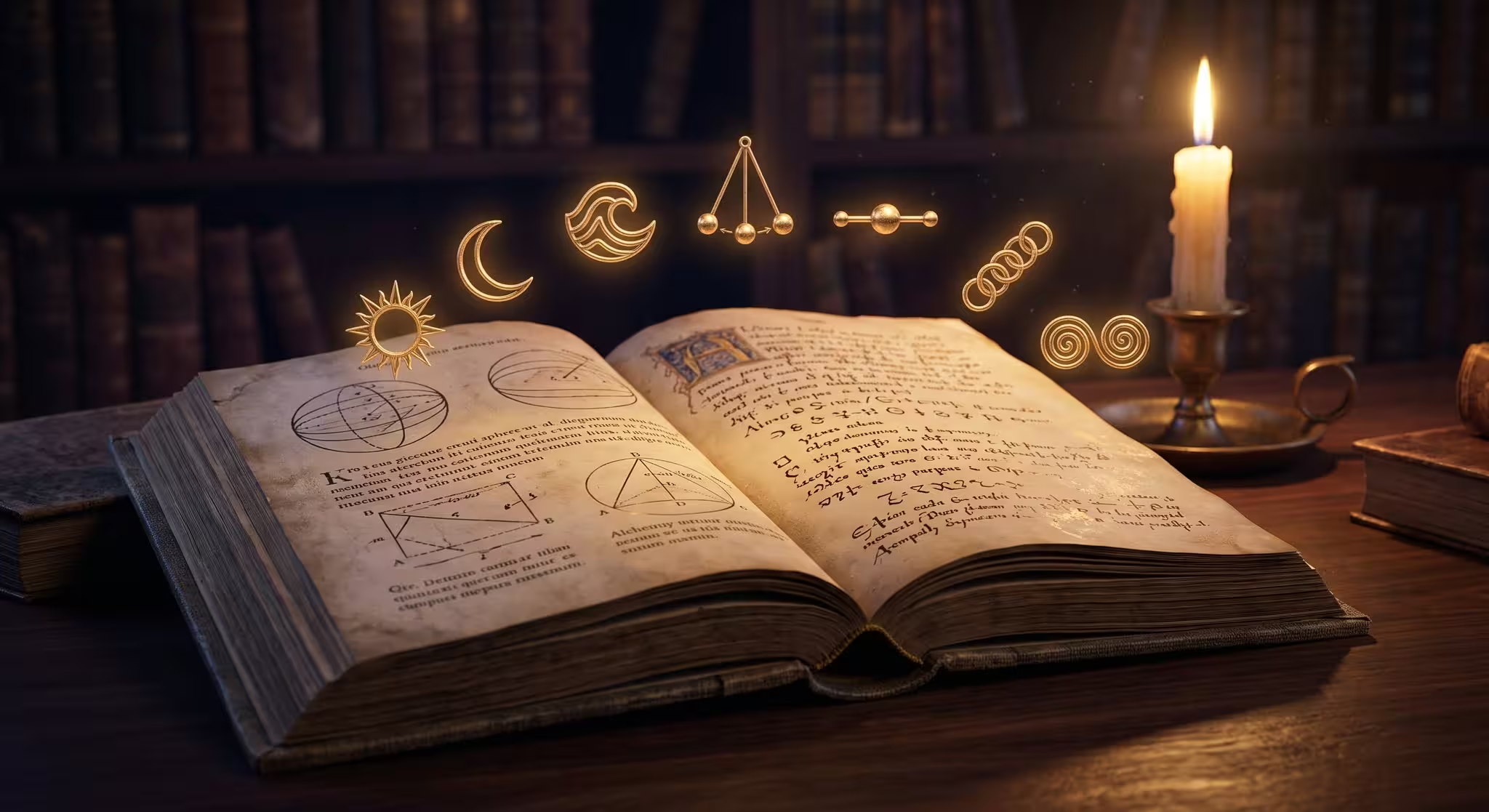
Seven short sentences from a 1908 book became one of the most quoted maps of reality in modern spirituality.
Key Takeaways
The 7 Hermetic principles are the seven laws of reality described in The Kybalion. They teach that the universe is mental and that patterns repeat on every level.
In the same spirit, everything moves. Opposites share one scale. Life runs in cycles, every effect has a cause, and creation needs two complementary forces.
The book makes a bold promise about them.
“The Principles of Truth are Seven; he who knows these, understandingly, possesses the Magic Key before whose touch all the Doors of the Temple fly open.”
Here is what each principle says, where it came from, and how to use the set.

What Are the 7 Hermetic Principles?
The Kybalion lists the principles in a fixed order. You can read the full text free in the Project Gutenberg edition.
1. The principle of mentalism
Axiom: “THE ALL IS MIND; The Universe is Mental.”
Mentalism says the root reality, which the book calls THE ALL, is a living, infinite mind. The visible universe is a creation within that mind. It is the master principle in the book because the other six describe how a mental universe behaves.
2. The principle of correspondence
Axiom: “As above, so below; as below, so above.”
Correspondence says the same laws work on every plane of existence. Study the small, and you learn about the large. Our correspondence guide traces the phrase back to the Emerald Tablet.
3. The principle of vibration
Axiom: “Nothing rests; everything moves; everything vibrates.”
Vibration says the differences between matter, energy, mind, and spirit are differences in rate of motion. Our article on vibration explains the idea in full.
4. The principle of polarity
Axiom: “Everything is Dual; everything has poles; everything has its pair of opposites; like and unlike are the same; opposites are identical in nature, but different in degree; extremes meet; all truths are but half-truths; all paradoxes may be reconciled.”
Polarity says opposites are two ends of one scale, like heat and cold. That makes a mood movable along its own scale. Our polarity guide shows how.
5. The principle of rhythm
Axiom: “Everything flows out and in; everything has its tides; all things rise and fall; the pendulum-swing manifests in everything; the measure of the swing to the right is the measure of the swing to the left; rhythm compensates.”
Rhythm says everything swings like a pendulum between its poles. The book’s key practice is learning not to be carried by the swing. Our rhythm article explains that practice.
6. The principle of cause and effect
Axiom: “Every Cause has its Effect; every Effect has its Cause; everything happens according to Law; Chance is but a name for Law not recognized; there are many planes of causation, but nothing escapes the Law.”
Cause and effect says nothing happens by pure chance. The book’s goal is to become a cause in your own life rather than only an effect of others. The book calls this principle Causation. Our cause and effect guide goes deeper.
7. The principle of gender
Axiom: “Gender is in everything; everything has its Masculine and Feminine Principles; Gender manifests on all planes.”
Gender says every act of creation needs a force that directs and a force that receives. It is about creation, not about sex. Our gender article covers the details.
Where Do the Hermetic Principles Come From?
The principles were first published in The Kybalion: A Study of the Hermetic Philosophy of Ancient Egypt and Greece. The Yogi Publication Society of Chicago released it in 1908. The author signed the book “Three Initiates.”
Most historians credit William Walker Atkinson, a prolific writer in the New Thought movement. Even the title is a puzzle. The word “Kybalion” looks Greek, yet it has no known meaning in Greek.
The book dedicates itself to Hermes Trismegistus, “Hermes the Thrice-Greatest.” He was a legendary sage who blended the Greek god Hermes with the Egyptian god Thoth during the Hellenistic age.
Many modern retellings repeat the claim that these principles are thousands of years old. Yet the book itself is the oldest known source for this list of seven.
Is The Kybalion Actually Hermetic?
Partly. Hermeticism, the older tradition, rests on a group of Greek texts called the Hermetica. Their best-known collection, the Corpus Hermeticum, reached Europe through a Latin translation by Marsilio Ficino, first printed in 1471.
Renaissance readers believed those texts were older than Moses. In 1614, the scholar Isaac Casaubon showed from their language that they dated to roughly 200 to 300 AD.
Researcher Nicholas Chapel compared The Kybalion with the older texts in 2013. He found real overlaps. Mentalism, “as above, so below,” and paired opposites all have Hermetic roots.
He also found clear breaks:
So the fairest description is a modern Hermetic book. It borrows ancient ideas and fits them to the self-improvement language of 1900s America.
How Do the Hermetic Principles Relate to the 12 Universal Laws?
The 12 laws of the universe are a later, longer list. They keep four Kybalion principles: correspondence, vibration, polarity, and causation. They add newer ideas, like attraction and compensation.
The seven Hermetic principles are the older core. The twelve laws are a modern expansion, and the order changes from teacher to teacher.
Both lists sit in our universal laws section.
How Do You Use the 7 Hermetic Principles Together?
The principles are most useful when you turn them into seven questions about one situation. Pick something that is bothering you. A stuck project, a strained friendship, or a low month all work. Then run it through each lens:

Most people find that two or three questions do the real work. The point is not to answer all seven. It is to stop seeing the problem from only one angle.
Are the Hermetic Principles Scientifically True?
Read them in the spirit of philosophy, not physics. The Kybalion often borrows the science of 1908 to support its claims. Some of that science, including its picture of the atom, is long out of date.
The principles still hold up well in practical terms. Patterns do repeat. Moods do swing. Choices do have consequences.
Used for reflection, they can sharpen how you see your life. Used to claim that thoughts alone control events, they promise more than any evidence supports.
Subscribe to Create Higher Vibrations!
Get Inspiration and Practical advice straight to your inbox.
The Key Is in the Word “Understandingly”
Look again at the book’s promise about the seven principles. It does not say whoever memorizes them holds the key. It says whoever knows them “understandingly.”
That is an invitation to practice, not to collect. Take one principle a week for the next seven weeks.
Watch for it in ordinary moments. Then write down one place you saw it. By the end, the list will no longer be seven sentences. It will be seven ways of seeing.