The Kybalion: Who Wrote It, What It Teaches, and How to Read It

A small Chicago book from 1908 that claimed to carry the secrets of ancient Egypt, and still shapes modern spirituality.
Key Takeaways
The Kybalion is a book published in 1908 by the Yogi Publication Society of Chicago under the pen name “Three Initiates.” It claims to pass on the teachings of Hermes Trismegistus through seven “Hermetic principles.”
Its core method is mental transmutation. Most historians credit it to the New Thought writer William Walker Atkinson.
The subtitle reads A Study of the Hermetic Philosophy of Ancient Egypt and Greece.
The book is short. For many readers, it is the first door into Hermeticism, the New Age movement, or the law of attraction.
Who Wrote The Kybalion?
The title page says only “Three Initiates.” No names appear anywhere in the book. Most scholars now credit it to William Walker Atkinson (1862 to 1932), a Chicago lawyer, editor, and New Thought author.

Several clues support the case for Atkinson. The editor Philip Deslippe set them out in his 2011 introduction to the book’s Definitive Edition. The scholar Nicholas E. Chapel summarizes them in a 2013 study.
People have suggested other candidates over the years. Deslippe examined the popular theories and found none convincing. Whether one person or three wrote it, the voice in the book matches Atkinson’s.
When Was The Kybalion Published?
The first edition appeared in Chicago in 1908. A scanned copy of that edition, dated 1908, is held by Brigham Young University’s library and sits on the Internet Archive.
You may see 1912 cited too. The free Project Gutenberg text reproduces a later printing that carries “COPYRIGHT 1912.” Both dates refer to the same book.
The text itself gives a clue to its age. Chapter XIV mentions “the late Thomson J. Hudson,” famous for his 1893 theory of an objective mind and a subjective mind.
Hudson died in 1903. A book that calls him “the late” was written after that.
What Does the Word “Kybalion” Mean?
“Kybalion” looks like a Greek word. It has no meaning in Greek or any other language. The book explains it away, saying “the exact significance and meaning of the term” had been “lost for several centuries.”
Some readers connect the name to the Kabbalah. Others point to the goddess Cybele, Kubelē in Greek. The book mentions neither. Chapel argues the name was chosen to sound ancient.
The book also claims that the original Kybalion was an oral teaching. In its own words, “Its precepts have never been written down, or printed, so far as we know.” Every quoted aphorism in the book is therefore unsourced. No older copy of them has ever been found.
What Does The Kybalion Teach?
The main message is that reality is mental at its root.
If the universe is “held in the Mind of THE ALL,” then a person who understands its laws can change their own mental states. The book calls this skill mental transmutation. Its definition reads “the art of changing and transforming mental states, forms, and conditions, into others.”
The book reads old alchemy in the same light. It claims the “Philosopher’s Stone” was always an allegory. Real Hermetic alchemy, it says, “dealt in the mastery of Mental Forces, rather than Material Elements.”
The book also gives a rule for how the wise should act. A famous passage warns against “the half-wise,” who decide the world is unreal and try to ignore its laws. The wise instead “use Law against laws; the higher against the lower.”
Our guide to the 7 Hermetic principles explains each of the seven laws in turn. The rest of this page is about the book that made them famous.
What Is in Each Chapter of The Kybalion?
The book has an introduction and fifteen chapters. Each chapter opens with a short quotation said to come from the lost original. A commentary follows.
The first seven chapters build the philosophy.
The next six chapters take one principle each.
The last two chapters turn back to practice.
Is The Kybalion Really Hermetic?
The book shares a few real ideas with the ancient Hermetic writings. Its claim to be ancient Hermetic teaching does not hold up.
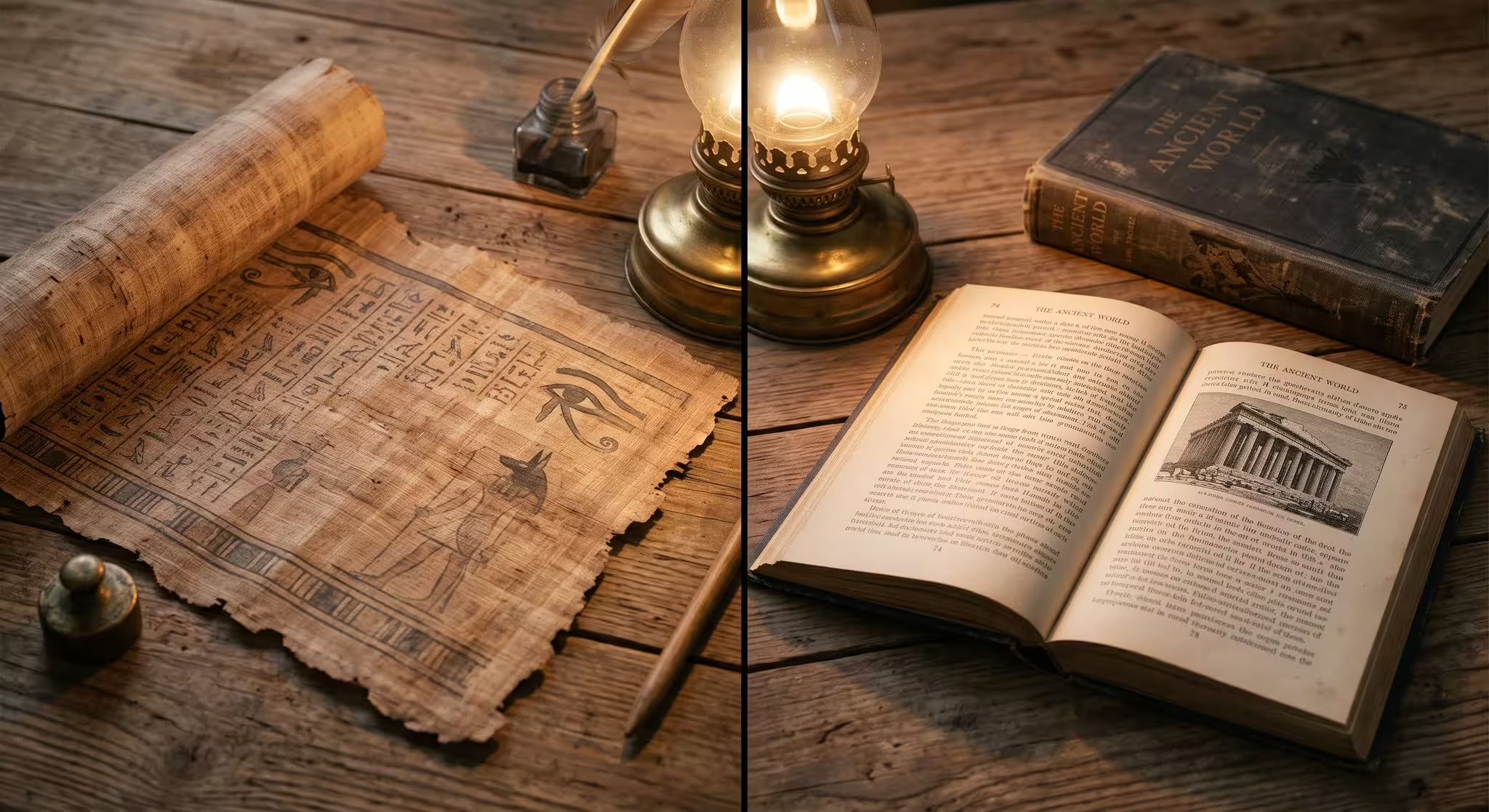
The overlaps exist. The occult writer Mitch Horowitz notes that its first principle, that mind comes first, echoes ideas in the Greek Hermetica. “As above, so below” comes from the Emerald Tablet. The pairing of opposites also has older roots.
Nicholas E. Chapel’s 2013 study, The Kybalion’s New Clothes, lays out the gaps.
Even the book’s admirers grant the point. The esoteric writer Richard Smoley called the aphorisms “very likely a pious fraud.” He still argued that the book stays faithful to the spirit of the tradition. Readers who want the real ancient voice can compare it with the dialogues credited to Hermes Trismegistus.
Is The Kybalion Against Christianity?
The book does not attack Jesus or Christian faith directly. It does take a hard line against church doctrine.
The book separates “Religion” from “Theology.” It defines religion as the “intuitional realization of the existence of THE ALL, and one’s relationship to it.” Theology, in its view, means human theories about God’s will and plans. It also means clergy acting as “middlemen” between God and people.
Chapter I goes further. It claims that Constantine “smothered philosophy with the blanket of theology.” In its account, this cost the Church its original mystical core. Some Christian readers find that framing hostile. Others read the book as philosophy. They set its history aside.
Where Can You Read The Kybalion Free?
The 1908 text is in the public domain in the United States. Several free versions exist online.
Two modern editions add useful context. Philip Deslippe’s Definitive Edition (Tarcher/Penguin, 2011) includes the authorship research. Richard Smoley’s Centenary Edition (Tarcher/Penguin, 2018) adds a commentary.
How Should You Read The Kybalion?
The book rewards a slow reading more than a fast one. A few habits help.
Our Hermeticism pillar covers the full tradition.
Subscribe to Create Higher Vibrations!
Get Inspiration and Practical advice straight to your inbox.
A Book That Asks to Be Used
The last chapter of The Kybalion warns against “Mental Miserliness.” Its authors wanted readers to act on the teaching, not to collect it.
So try the book’s own test. Choose one axiom from Chapter XV. Carry it through a single difficult day and notice where it holds. Then decide for yourself what the little Chicago book from 1908 is worth.