
Who Was Hermes Trismegistus? The Legend Behind the Hermetic Texts
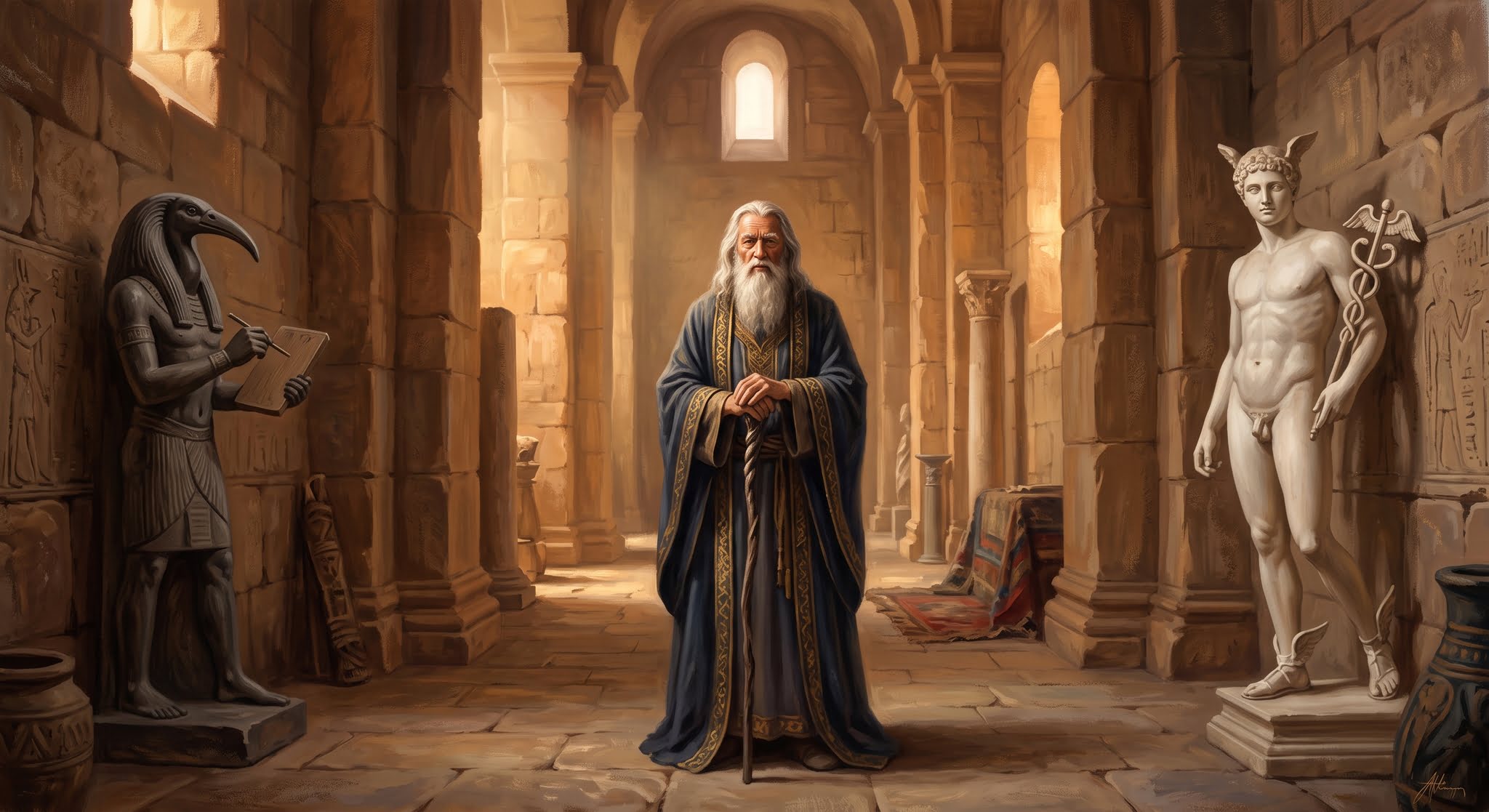
Part Greek god, part Egyptian god, part imagined sage. For fifteen centuries, people believed he was real.
Key Takeaways
Hermes Trismegistus is the legendary author of the Hermetic writings, a figure who combined the Greek god Hermes with the Egyptian god Thoth. His name means “Hermes the Thrice-Great.” Ancient and medieval readers believed in a real sage of immense age. Modern scholars see a blend of two gods, shaped in Greek-speaking Egypt.
He matters because so much was built in his name. Alchemy, astrology, Renaissance magic, and modern Hermeticism all trace their authority back to him.
Did Hermes Trismegistus Actually Exist?
No, not as a single historical person. He is what scholars call a syncretic figure, a blend of two older gods. The writings credited to him were composed by many anonymous authors over several centuries.
That does not make the texts worthless. Real people wrote them, often with deep spiritual seriousness. They placed their work under Hermes’ name, a common practice in the ancient world. Writing under a revered name gave a text authority and placed it in a tradition.
So the honest answer is double. The man is a legend. The writings and the people behind them are real.
How Did Hermes and Thoth Become One?
After Alexander the Great conquered Egypt in 332 BC, Greek kings of the Ptolemaic dynasty ruled the country. Historians call this era Ptolemaic Egypt. Greeks living there looked for their own gods among the Egyptian ones. They matched Hermes with Thoth.
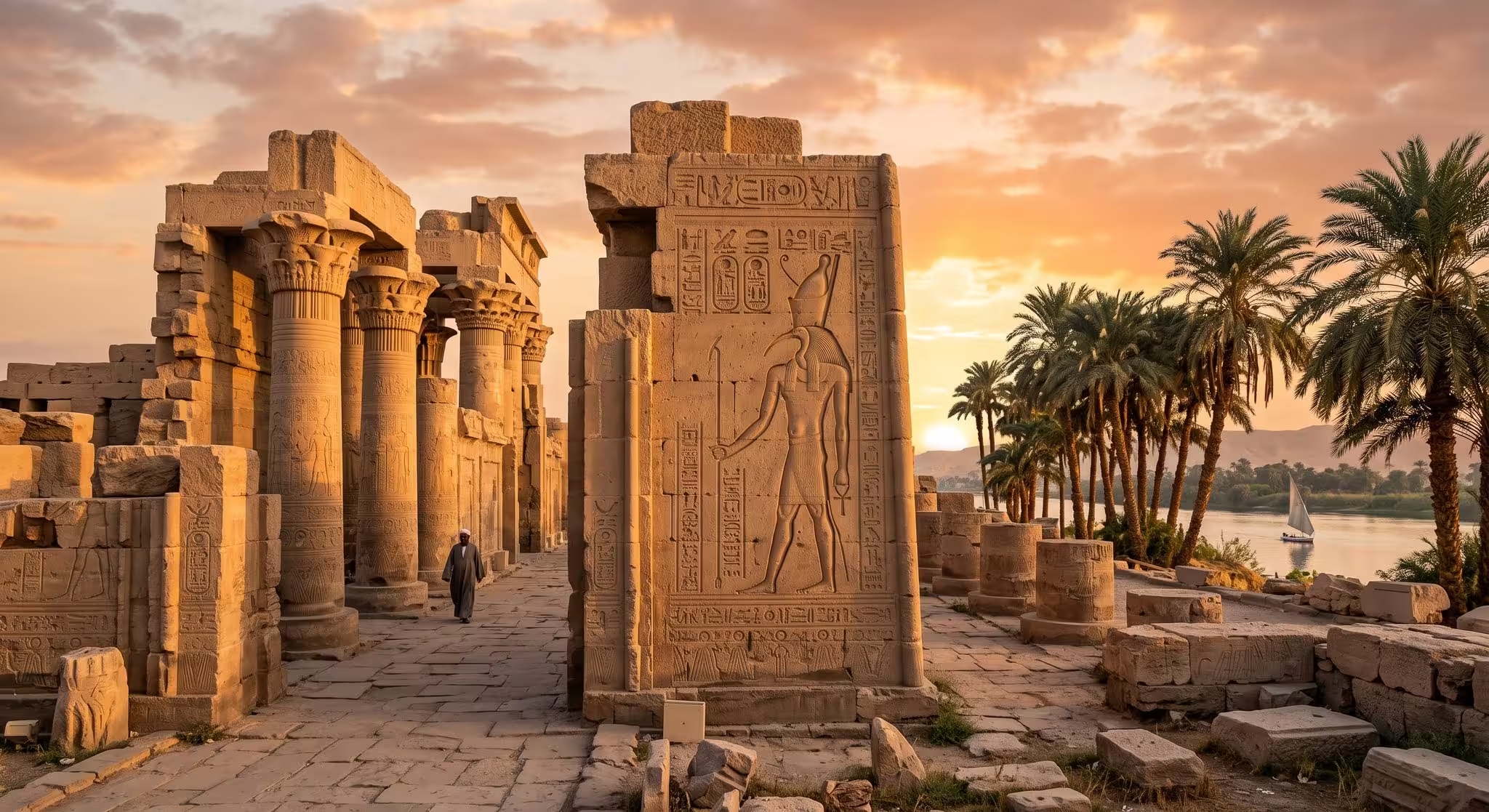
The match made sense. Both were gods of writing, speech, and wisdom. Both had roles in the afterlife. Each stood at the border between life and death.
Hermes carried messages between gods and humans. Thoth served as scribe of the gods. Egyptians credited him with inventing writing and hieroglyphs. He also recorded the judgment of the dead.
Soon the two were worshiped as one. The old temple of Thoth at Khemenu became known by a Greek name, Hermopolis, “the city of Hermes.” Other wise figures joined the cluster. The deified Egyptian architect Imhotep and the scribe Amenhotep, son of Hapu, were honored in shrines to Thoth-Hermes.
The Roman orator Cicero preserves both sides of the merger. He lists several gods named Hermes, or Mercury. One was “the son of the Nile,” an Egyptian god. Another fled Greece for Egypt and gave the Egyptians “their laws and alphabet.”
The Egyptians, Cicero says, called him “Theyt,” that is, Thoth. One list holds two points of view. The first is Egyptian. The second is Greek.
Why Is Hermes Called “Thrice-Great”?
Scholars have traced the title “Trismegistus” to Egyptian religious language. According to the Wikipedia summary of the research, the epithet derives from a title of Thoth found at the Temple of Esna. It reads “Thoth the great, the great, the great.”
The scholar Brian Copenhaver reports that the epithet first appears in the minutes of a meeting of the Ibis cult. The meeting took place near Memphis, Egypt, in 172 BC.
Later writers offered their own explanations:
The Egyptian origin is the best supported. The other explanations show how each culture reshaped Hermes in its own image.
What Did Hermes Trismegistus Write?
The writings credited to Hermes are called the Hermetica. Scholars usually sort them into two groups:
The best-known works include:
Hermes also lent his name to an everyday phrase, one most people use without knowing its origin. Alchemists sealed a glass vessel by melting its neck closed, a method called the “Seal of Hermes.” That is where “hermetically sealed” comes from.
What Did Hermes Trismegistus Teach?
The religious Hermetica share a clear core. God is Mind. The cosmos expresses God. A person can know God by purifying and enlarging their own mind.
The opening vision of the Corpus Hermeticum puts that teaching in the mouth of a being of light. In G. R. S. Mead’s 1906 translation, it tells Hermes, “That Light, He said, am I, thy God, Mind.”
The eleventh treatise adds the most quoted Hermetic teaching.
Mead renders it this way. “If, then, thou dost not make thyself like unto God, thou canst not know Him. For like is knowable to like [alone].” You can read Mead’s translation free on the Internet Archive.
The Emerald Tablet closes with Hermes speaking in his own voice. In Isaac Newton’s translation, he says, “Hence I am called Hermes Trismegistus, having the three parts of the philosophy of the whole world.”
Our article on Hermeticism explains these teachings in depth.
How Did Christians See Hermes Trismegistus?
Many Christian writers took him seriously. Lactantius and Augustine both discussed him in late antiquity. During the Renaissance, Marsilio Ficino, Giovanni Pico della Mirandola, Giordano Bruno, and Tommaso Campanella all studied him.
Many of them called him a wise pagan prophet who glimpsed Christian truths before Christ. They believed in a prisca theologia, a single true theology given to humanity in ancient times. In their view, it passed through a line of sages that included Zoroaster, Hermes, and Plato.
Renaissance scholars accepted that Hermes lived around the time of Moses. Then, in 1614, the scholar Isaac Casaubon analyzed the Greek language of the texts. He showed they were written after the start of Christianity. The belief in an ancient Egyptian Hermes collapsed almost overnight.
Not everyone gave up. In 1678, the English philosopher Ralph Cudworth argued that the texts might still preserve much older oral teaching. Scholars continue to debate how much genuine Egyptian thought lies inside them.
Who Is Hermes Trismegistus in Islam?
Hermes holds an honored place in Islamic tradition, although his name does not appear in the Qur’an. Early Muslim historians identified him with Idris, a prophet named in the Qur’an. Muslims also identified Idris with Enoch from the Book of Genesis.
Islamic scholars preserved and created many Hermetic works. At least twenty Arabic Hermetic texts survive. The eighth-century alchemist Jabir ibn Hayyan quoted an early version of the Emerald Tablet.
Abu Ma’shar’s account of the three Hermeses shows how far the legend traveled:
The Islamicist Pierre Lory called him “a faceless prophet,” with no concrete traits of his own. That blankness helped every culture reshape him.
The Sabians of Harran, a star-worshipping community in what is now Turkey, also traced their teachings back to Hermes. Later, the founder of the Bahá’í Faith also identified Idris with Hermes.
What Are the 7 Laws of Hermes Trismegistus?
This is one of the most searched questions about him. The answer surprises many readers. The famous “7 laws” do not come from any ancient Hermetic text. They come from The Kybalion, a book published in Chicago in 1908.
The Kybalion dedicates itself to the Thrice-Great, whom it calls “Master of Masters.” It then lists seven principles: mentalism, correspondence, vibration, polarity, rhythm, causation, and gender. Some of these ideas have genuine Hermetic roots. Others were added much later.
Our guide to the 7 Hermetic principles explains each one and separates the ancient ideas from the modern additions.
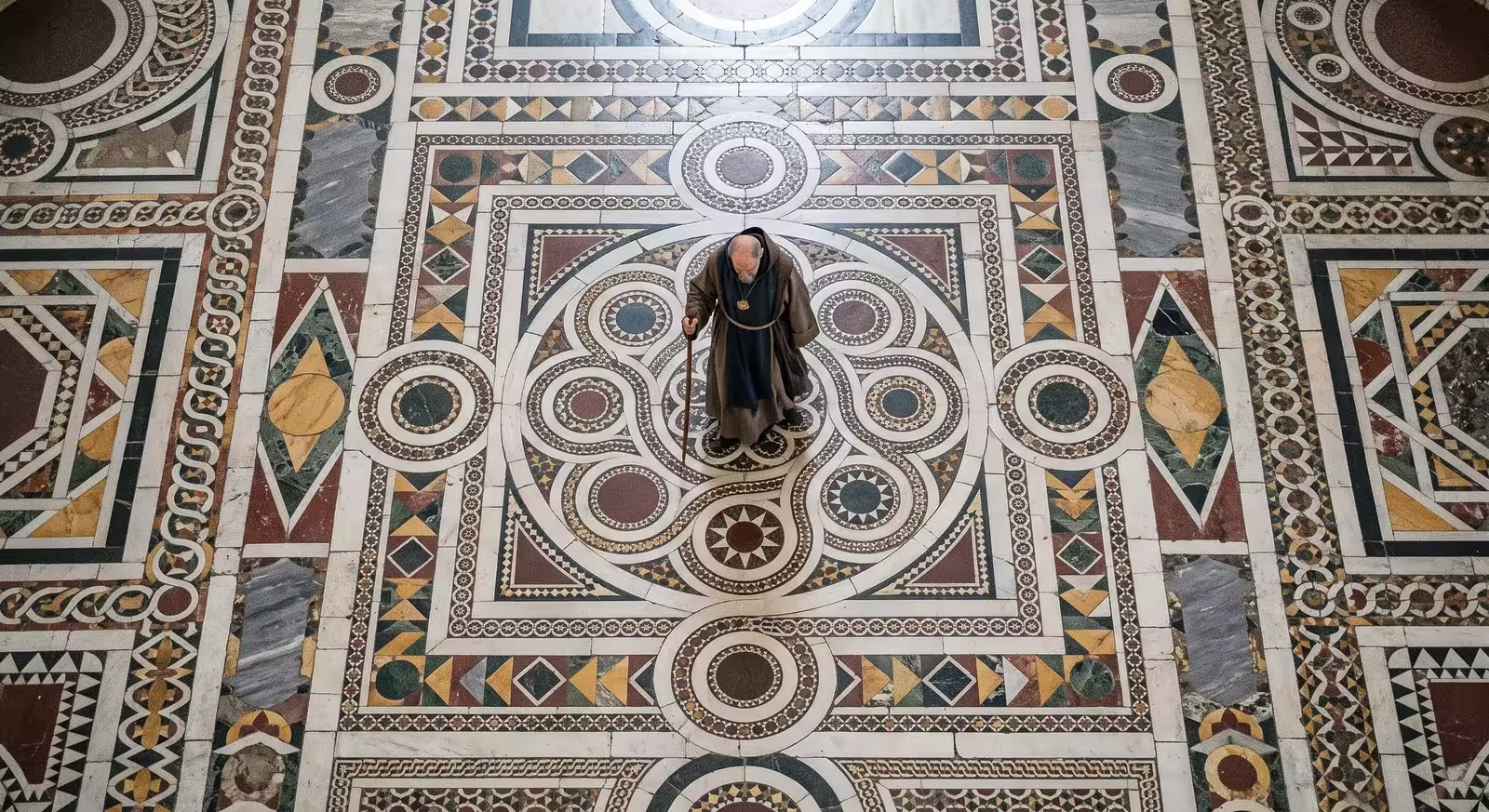
How Was Hermes Trismegistus Pictured?
Renaissance artists usually painted a bearded old sage in long robes. Often he teaches, with a book close at hand. The image fits his role, the teacher of secret wisdom.
The most famous example lies on a cathedral floor.
At the entrance to the nave of Siena Cathedral in Italy, a marble inlay shows the Thrice-Great himself. The sculptor Giovanni di Stefano designed it in 1488.
The Siena Cathedral pavement still draws visitors today. Placing a pagan sage at the door of a cathedral shows how highly Renaissance Christians rated him. Visitors of the time saw him as “the founder of human wisdom.”
The caduceus, the winged staff wrapped by two serpents, often stands for Hermeticism. It was originally the staff of the Greek god Hermes.
Why Does Hermes Trismegistus Still Matter?
Whole fields of thought grew up under his name. The “Hermetic tradition” came to mean alchemy, astrology, and magic. The great Persian astrologer Abu Ma’shar tied Hermes closely to astrology. Medieval and Renaissance alchemists treated the Emerald Tablet like their founding scripture.
The influence reached unexpected places. Isaac Newton copied out the Emerald Tablet in his own hand. Renaissance philosophers read the Hermetic dialogues beside Plato. Modern spirituality met Hermes again through The Kybalion and the New Age movement.
Few imaginary people have shaped real history so much. Every age found its own meaning in him.
Is Hermes Trismegistus the Same as the Greek God Hermes?
Not exactly. The Greek god Hermes is the swift messenger of Olympus, a guide of travelers and souls. Hermes Trismegistus is a later figure, a teacher of secret wisdom who blends Hermes with Thoth.
Think of him like the Greek god reimagined through Egyptian eyes. The messenger became a sage. The bringer of words became the author of sacred books.
You can explore the full tradition in our Hermeticism section.
Subscribe to Create Higher Vibrations!
Get Inspiration and Practical advice straight to your inbox.
A Teacher Who Was Never One Man
The Thrice-Great never lived. Yet for fifteen hundred years, people in Alexandria, Baghdad, and Florence wrote, copied, and argued in his name.
That may be his real lesson. A tradition is not one voice. It is many seekers adding a line, then passing the page on.
If you want to meet him, skip the summaries. Read a single dialogue from the Corpus Hermeticum this month. Then ask what it would mean to become “like unto” the wisdom it describes.