
Generational Trauma: What It Is, How It Passes Down, and Whether It Lives in Your DNA

In 32 Holocaust survivors, one stress gene carried extra chemical tags. In their adult children, the same spot carried fewer.
Key Takeaways
Generational trauma is the passing down of the emotional, psychological, and physical effects of trauma across generations. A grandparent survives a war, a famine, or years of abuse. The next generations then carry fears, habits, and stress responses shaped by events they never saw.
The idea explains a lot of family patterns that seem to have no source. It also gets stretched.
Some people now speak of trauma “stored in your DNA” as settled fact. The real picture is stranger than either the hype or the dismissal. It is also more hopeful.
What Is Generational Trauma?
Generational trauma, also called intergenerational trauma or transgenerational trauma, describes harm that outlives the people it first happened to. The original event might be personal, like violence in the home. It might be collective, like genocide, slavery, forced removal, or war.
The idea started in clinics. In 1966, psychologists in Canada noticed large numbers of children of Holocaust survivors seeking mental health care. The children had not been in the camps. Something had reached them anyway.
Researchers draw one useful line inside the term:

Collective examples are well documented. The descendants of Holocaust survivors, of people held in the Canadian Indian residential school system, of Native American nations forced off their land, and of enslaved African Americans have all been studied for these effects.
How Is Generational Trauma Passed Down?
Generational trauma moves along several routes at once. Most of them need no special biology. They need only a family.
Psychoanalyst Selma Fraiberg gave this pattern a lasting name in 1975. She called it “ghosts in the nursery.” Her point was that old pain from a parent’s childhood can enter the room with a new baby. A parent can repeat the past without remembering it.
What Are the Signs of Generational Trauma?
These signs look like the signs of trauma in general. What sets them apart is the lack of a clear cause in your own life. You react strongly to something that never happened to you.
Many people live with anxiety and depression that seem to come from nowhere. Other patterns reported by therapists include:
None of these signs proves inherited trauma on its own. Each one also has ordinary causes. They point to generational trauma only when they echo something visible in your parents and grandparents.
Can Trauma Change Your DNA?
Trauma does not change your DNA sequence. The letters of your genetic code stay the same. What can change is how genes are read, and that is the field called epigenetics.
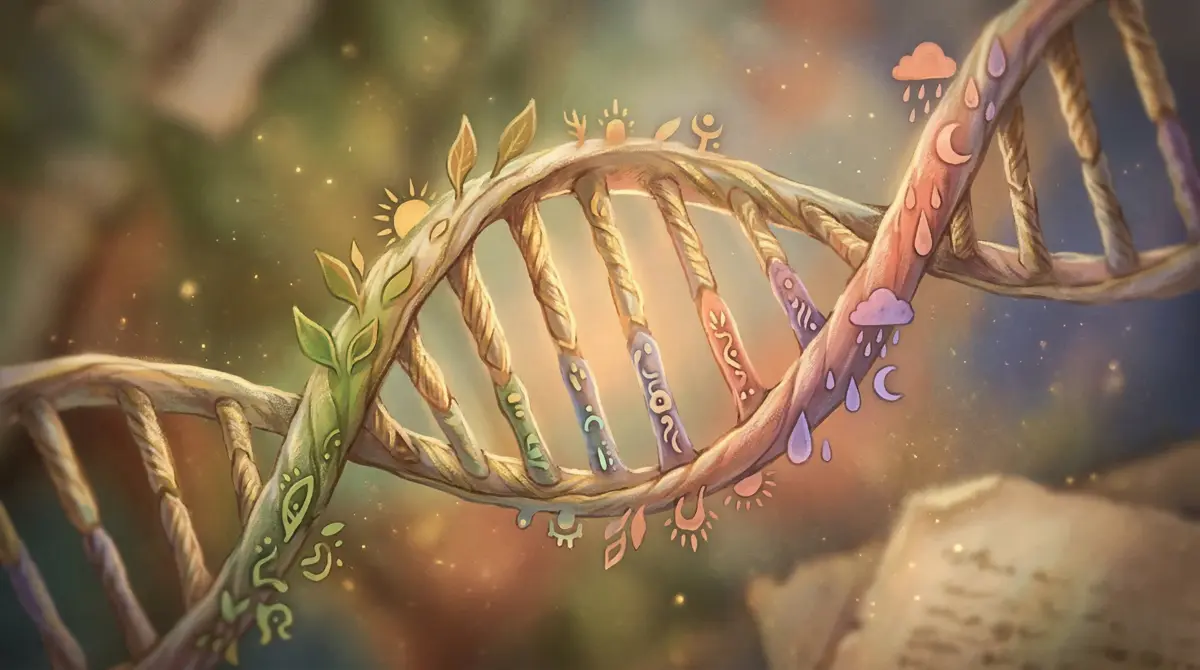
The best-studied mechanism is DNA methylation. Small chemical tags attach to a gene and turn its activity up or down, a little like a dimmer switch. Stress, diet, and toxins can shift these tags. Some of the tags last for decades.
Four studies anchor the human and animal evidence:
The Holocaust finding is the strangest of the four. The children’s biology did not copy their parents’. It moved the other way, like a correction.
How Does Poverty Fit Into Generational Trauma?
Poverty is one of the most common forms of inherited hardship. It brings chronic stress, food insecurity, and danger, often for decades. It also leaves biological traces of its own.
Thomas McDade and colleagues studied 489 young adults in the Philippines. Lower family income in childhood was linked to methylation differences at 2,546 sites across 1,537 genes (McDade et al., 2019). The affected genes clustered around immune function, skeletal growth, and the nervous system.
Poverty also seems to speed up the body’s clock. A 2023 National Institute on Aging study followed 470 adults in Baltimore.
Living below the poverty line was associated with faster biological aging on the DunedinPACE measure. African American participants also aged faster, a pattern the authors tied to adverse social conditions.
A 2017 study of 132 adolescents found a link to the brain. Lower family income predicted rising methylation of the serotonin transporter gene. That change predicted a more reactive amygdala, the brain’s threat detector.
Public health researcher Arline Geronimus gave this wear a name in 1992. She called it “weathering.” Constant hardship ages the body early. The money worries, the hoarding, and the dread of calm periods many people inherit are the human face of these numbers.
Is Generational Trauma Scientifically Proven?
Part of it is proven. The family route is backed by decades of research on parenting, attachment, and adverse childhood experiences. Trauma clearly shapes how people raise children. Children clearly carry the results.
The epigenetic route is not settled. The Holocaust study had 22 offspring. Even the refugee study had only 131 people. Neither can separate biology from parenting with certainty. A child raised by an anxious survivor gets both.
There is also a basic hurdle. Mammals wipe most epigenetic tags from sperm and eggs during early development. Geneticists Edith Heard and Robert Martienssen reviewed the evidence in 2014. They concluded that how far this kind of inheritance happens in humans remains unclear.
So the honest answer is narrow. Epigenetic inheritance of trauma is plausible, supported by animal work, and suggested by small human studies. “Generational trauma is in your DNA” says more than anyone can show today.
How Do You Break the Cycle of Generational Trauma?
Breaking the cycle starts with seeing it. A pattern you can name is a pattern you can choose not to repeat. These steps carry the most support:

The epigenetic side of this is early but encouraging. In a small 2013 pilot, Yehuda’s team gave combat veterans with PTSD prolonged exposure therapy. In the eight who recovered, methylation of the FKBP5 gene fell (Yehuda et al., 2013). The marks moved with healing.
Positive memories matter as much as painful ones. Narayan’s review found that parents’ warm childhood experiences help offset their adverse ones. One loving grandparent, teacher, or neighbor can change what gets passed on.
For related work, our guide to preventing childhood trauma covers the parenting side. Shame often runs through these families, and what shame is and how to heal it explains that thread.
Daily skills for staying steady are in our guide to emotional regulation. For the inner work of rewriting old beliefs, see subconscious reprogramming.
Subscribe to Create Higher Vibrations!
Get Inspiration and Practical advice straight to your inbox.
What Did the Ghosts in the Nursery Teach Fraiberg?
Selma Fraiberg noticed something about the parents she treated. Some had been hurt badly as children yet did not hurt their own. What protected them was memory with feeling. They could recall the pain. They could also feel for the child they once were.
The parents who repeated the harm were different. They had sealed the memory away. Some had sided with the adult who hurt them. The ghost stayed in the nursery because nobody looked at it.
That is the practice. Sit with one memory from your childhood that still carries a charge. Notice what the child in it needed. Write a few lines about it.
Then try a self-reflection practice to keep going. The pattern came down to you without your consent. Feeling it is how you decide what goes forward.
Nobody chooses the history they are born into. Everyone chooses, a little each day, what they hand on.