
Soul Draining: What It Is and How to Free Yourself From It

Burnout researchers say the cause usually sits in your situation. Nearly all the advice you hear asks you to fix yourself.
Key Takeaways
Soul draining is a slow loss of energy, meaning, and selfhood that rest does not fix. Sleep, weekends, and even vacations stop working. The person you used to be starts to feel far away.
It is not a medical diagnosis. People use the phrase for a depletion that goes deeper than the body.
That depth is what makes soul drain easy to miss. You keep functioning. You go to work, answer messages, and show up for people. Underneath, something has gone gray. No amount of coffee brings the color back.
What Does Soul Draining Mean?
Soul draining describes a situation, a person, or a pattern of thought that takes more from you than it gives. Over time it empties the part of you that feels alive. The phrase sits close to three better-studied ideas. Each one covers part of it.
Soul drain overlaps with all three. It adds one more layer. People describe losing contact with themselves, their sense of purpose, and the things that used to make life feel like theirs.

Spiritual traditions have their own language for this state. Some call it spiritual exhaustion. Others describe the heavy, flat stretch that can come during inner change. If your tiredness arrived with a spiritual opening, our piece on fatigue during a spiritual awakening covers that version.
How Is Soul Drain Different From Being Tired?
Tiredness recovers. Soul drain does not.
That is the clearest test I know. In my experience, soul drain makes you feel like you need a lot of sleep. You sleep. The energy in you is still gone. Ordinary fatigue answers to rest. Soul drain only answers to change.
Research on vacations shows why. A 2009 meta-analysis of vacation studies by Jessica de Bloom and colleagues pooled seven studies. Vacations improved health and well-being a little. The gains faded soon after people went back to work.
Rest works on the symptom. When the source is still waiting for you on Monday, the drain resumes. A long weekend can feel wonderful. It still changes nothing.
Two questions help you tell the difference.

What Are the Signs Your Soul Is Being Drained?
Soul drain rarely announces itself. It creeps in through small changes that add up over weeks. Most people notice them in five areas.
These are signals, not character flaws. They mean something in your life is taking more than you have.
If the numbness turns into thoughts of not wanting to be here, reach out today. Anyone in the US can call or text 988 to reach the Suicide and Crisis Lifeline.
What Causes Soul Drain?
Soul drain almost always has a source outside your head. It can still feel like a problem in your thinking. Four sources come up most often.
Work That Conflicts With Who You Are
Maslach and Michael Leiter describe burnout through a framework called Areas of Worklife. It names six areas where a person and a job can clash. These are workload, control, reward, community, fairness, and values. The bigger the mismatch, the more likely burnout becomes.
The values mismatch is the one that feels most like losing your soul. You can survive a heavy workload. Spending your days doing something that violates what you care about empties you in a different way.
Sometimes the mismatch comes from personal growth. You change, and the job stays the same. Work that once fit can start to drain you for that reason alone.

Relationships That Erase You
Some relationships drain your energy. Others drain your identity. I know the second kind from the inside. I was married to a narcissist. That marriage drained my entire self-identity from me.
That kind of loss does not show up as tiredness first. It looks like not knowing what you like, what you think, or who you are without the other person’s reactions to steer by. If that sounds familiar, our guide to exploring your self-identity is a good place to start rebuilding.
Giving Without Anything Coming Back
Caring roles, people-pleasing, and being the strong one in every room all run on the same fuel. When nothing refills it, the tank empties. Compassion fatigue is the clinical name for this in caregivers. The same pattern runs through many families.
Thought Loops That Never Rest
Rumination keeps a draining situation running even after you leave it. The argument replays at 2 a.m. The criticism you heard once becomes the voice you hear daily. Thought loops rarely start the drain. They keep it going.
Why Doesn’t “Set Boundaries and Practice Self-Care” Fix It?
The usual advice misses the point of awareness. It asks you to act before you can see what is happening.
There is a deeper problem too. The standard “set boundaries, practice self-care” advice treats systemic and environmental problems as personal failings. It puts the entire burden of recovery on the exhausted person.

The research agrees. Maslach and Leiter note that most burnout interventions focus on individual strategies, “despite the research evidence for the primary role of situational factors.” A bubble bath cannot fix a job that violates your values. A boundary cannot hold if you cannot yet see the line being crossed.
Awareness is the missing first step. It means seeing three things clearly.
Boundaries and self-care work much better after that. They become targeted changes instead of rituals performed on top of the same draining life. Our piece on what awareness is and how to expand it goes further into this skill.
How Do You Free Your Mind From Soul-Draining Thoughts?
Thoughts do not cause most soul drain. They do decide how long it lasts. Four steps help you stop feeding the loop.
Steps two and four come from acceptance and commitment therapy (ACT), developed by Steven Hayes and colleagues. ACT does not try to win the argument with your mind. It teaches you to hold thoughts lightly and act on your values anyway.
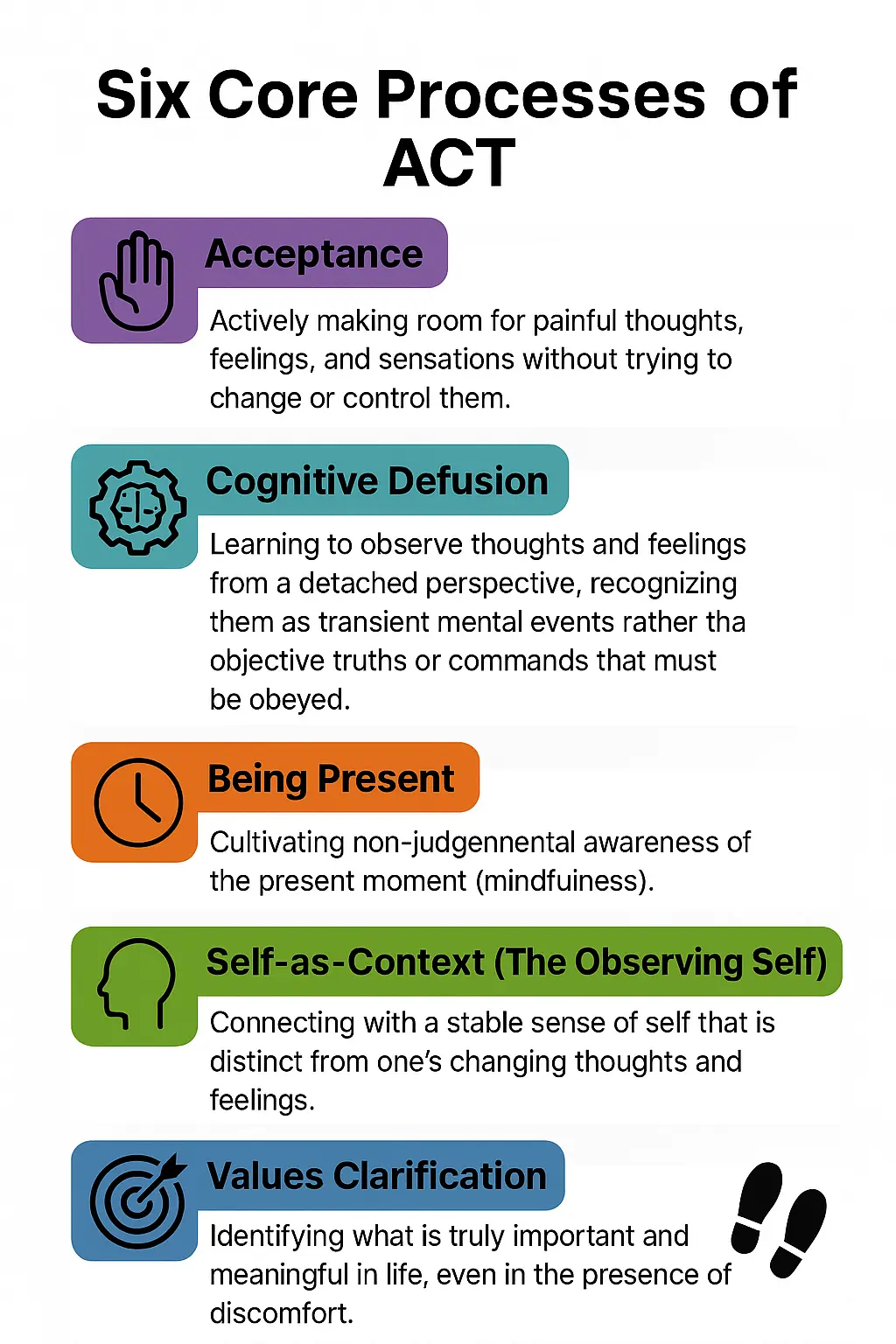
ACT names six core processes. They are acceptance, cognitive defusion, present-moment awareness, self-as-context, values, and committed action. The infographic above shows the first five. Committed action, the sixth, is step four in the list. It means doing what matters even in discomfort.
Mindfulness-based approaches add a related skill. They train you to notice the start of a spiral early. Our guide to mindfulness-based cognitive therapy explains how that works. Our piece on identifying with your thoughts covers the habit of mistaking thoughts for facts.
How Do You Recover From a Soul-Draining Job or Relationship?
Recovery starts with changing a condition, not only your attitude toward it. Start small. One real change beats ten good intentions.

Some drains cannot be fixed from the inside. Any job that requires you to betray your values may need to end. A relationship that erases you may need professional support to leave safely.
A therapist or another mental health professional can help you tell which situation you are in.
Recovery also takes longer than people expect. Your energy returns unevenly. Some days feel like your old self. Others feel like the drain never stopped. Our guide to building emotional resilience can steady you through those swings.
Subscribe to Create Higher Vibrations!
Get Inspiration and Practical advice straight to your inbox.
How Will You Know Your Energy Is Coming Back?
It rarely arrives as a breakthrough. It arrives as small returns.
You wake up once without dread. You catch yourself humming. You disagree with someone out loud. You meant it. You want something again, maybe a trip, a class, or a quiet Saturday that belongs only to you.
Those moments are the proof that the drain was never the real you. They come from the parts of you that were waiting under the fog.
Tonight, write down one thing you loved doing before the drain began. Keep it small and concrete. Then put fifteen minutes of it on your calendar this week. Keep that appointment the way you would keep one for someone you love.

