The Corpus Hermeticum: What the 17 Hermetic Treatises Teach
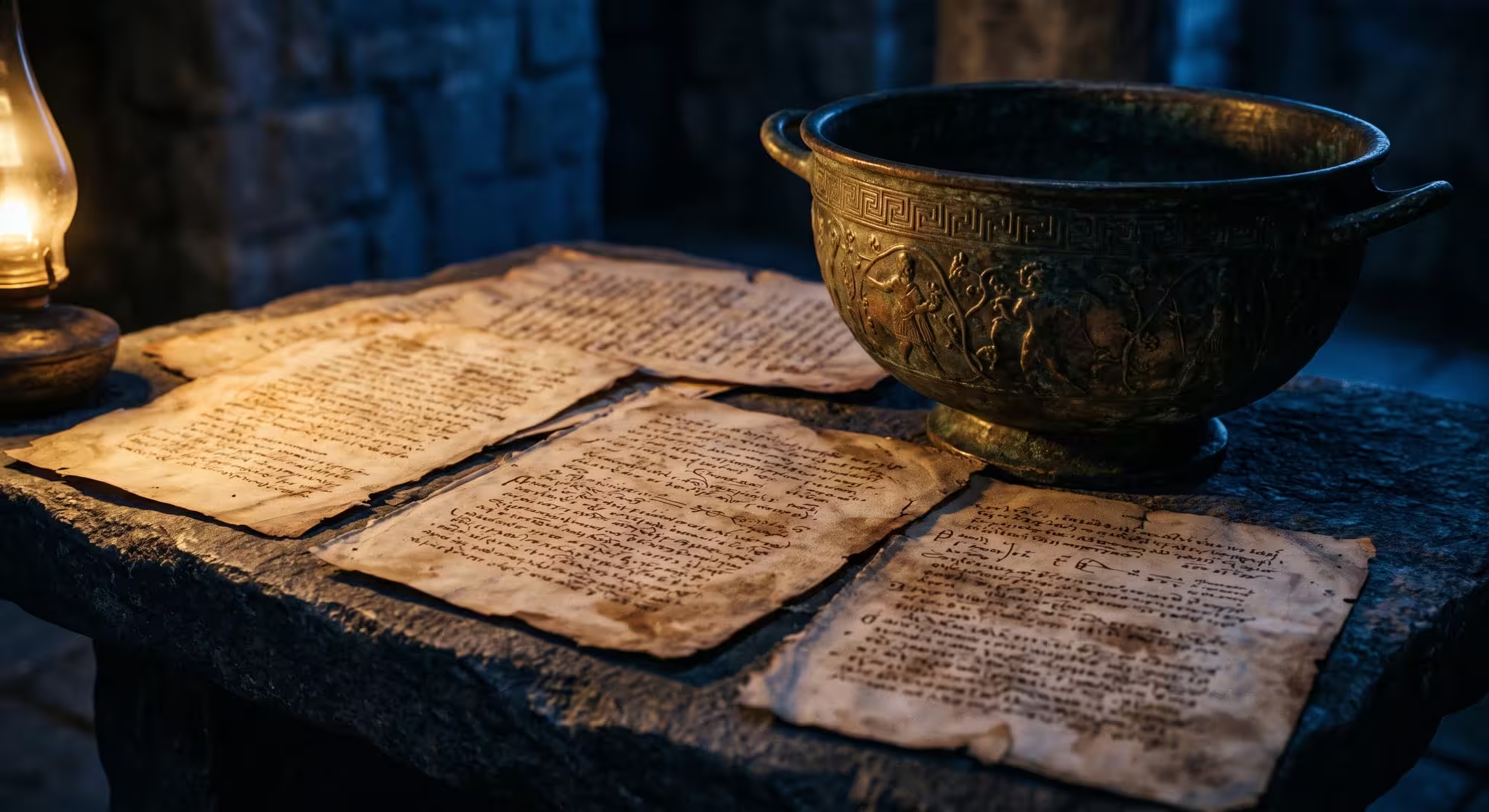
Seventeen short Greek dialogues about God, mind, and rebirth that a Renaissance scholar once ranked above Plato.
Key Takeaways
The Corpus Hermeticum is a collection of 17 Greek writings attributed to Hermes Trismegistus, a legendary blend of the Greek god Hermes and the Egyptian god Thoth. Most are dialogues between Hermes and his students. They were written in Roman Egypt between about 100 and 300 AD.
Their subject is God, the cosmos, the mind, and the soul’s return to its source.
The Corpus is the most important surviving source for ancient Hermetic philosophy. It is short. A patient reader can finish all seventeen treatises in a weekend.
Who Wrote the Corpus Hermeticum, and When?
No single person wrote the Corpus Hermeticum. Many anonymous authors in Greek-speaking Egypt composed its treatises during the second and third centuries AD. They wrote in Koine Greek, the common Greek of the Roman world.
The authors wrote under the name of Hermes Trismegistus. Our guide to Hermes Trismegistus explains who that legendary figure was.
The collection itself is younger than its parts. Church writers quoted single treatises from the second and third centuries on. The grouping we call the Corpus Hermeticum first appears in the writings of the Byzantine scholar Michael Psellos, around the 11th century.
The name “Corpus” can mislead. It sounds like the complete works of Hermes. In fact, it holds only a small share of the surviving Hermetic writings. The Asclepius, the Stobaeus excerpts, and the Nag Hammadi texts sit outside it.
What Is in Each of the 17 Treatises?
The treatises use a standard numbering. The usual list runs I to XIV, then jumps to XVI.
Hermes speaks to several students across the collection:
Here is what each treatise covers:
Why Is There No Treatise XV?
Early printed editions once had a section XV. It held an entry from the Byzantine encyclopedia called the Suda, plus three Hermetic excerpts preserved by the fifth-century anthologist Joannes Stobaeus.
Later editors removed that material. They kept the old numbers for everything else. So the count runs I to XIV, then XVI to XVIII, which makes 17 treatises in all.
What Happens in the Poimandres?
The Poimandres is the opening treatise and the heart of the collection. For centuries, its name stood for the whole collection. Older books spell it Pimander or Pymander.

The story begins with Hermes deep in thought. A vast being appears. It asks what he wants to know. In Mead’s translation, Hermes asks, “Who art thou?” The being answers, “I am Man-Shepherd, Mind of all-masterhood.”
The vision that follows covers creation in stages:
That fall explains the human condition. People carry an immortal mind inside a mortal body.
The treatise closes with the soul’s ascent back through the seven spheres. Hermes then goes out to preach. He calls on people who have given themselves “to drunkenness and sleep and ignorance of God” to “be sober now.”
The name Poimandres probably means “shepherd of men” in Greek. Some scholars have proposed a Coptic source instead, meaning “the knowledge of Re.”
What Are the Core Teachings of the Corpus Hermeticum?
The treatises disagree on details. Some see the world as good. Others treat the body as a prison. Yet a shared core runs through them.
Treatise XI pushes the idea furthest. Mind tells Hermes to “leap forth from every body; transcend all Time; become Eternity; and [thus] shalt thou know God.”
The pairing of inner work with divine knowledge is what makes the Corpus distinct. Our Hermeticism pillar traces how these ideas spread into alchemy, magic, and modern spirituality.
Does the Corpus Hermeticum Teach Belief in God?
Yes. The collection is a deeply religious text. Almost every treatise is about God, or about how to know God.
The Poimandres ends in prayer. In Mead’s translation, Hermes gives thanks with a chant that begins, “Holy art Thou, O God, the universals’ Father.” Treatise V carries a second hymn. Its title alone states its theology: God is unseen, yet the most visible of all.
The God of the Corpus is not a distant judge. God is Mind, the Good, and the Father of all. Treatise VIII even calls the cosmos itself a “second God,” a life that cannot die.
This devotion surprises readers who come from modern Hermeticism. The Corpus asks for reverence, not only techniques.
How Did the Corpus Hermeticum Reach the West?
For most of the Middle Ages, Western Europe could not read the Corpus. Only the Latin Asclepius circulated. The Greek treatises survived in Byzantium.
That changed in 1462. Marsilio Ficino was translating Plato for his patron, Cosimo de’ Medici, in Florence. A manuscript of the Corpus Hermeticum arrived.

Ficino stopped work on Plato to translate Hermes first. The treatises were believed to be far older. That made them more authoritative.
Ficino translated treatises I to XIV into Latin. Lodovico Lazzarelli later translated treatises XVI to XVIII. Ficino’s Latin version was first printed in 1471.
It shaped the whole field of Western esotericism. Thinkers such as Pico della Mirandola, Giordano Bruno, and Robert Fludd read it closely.
In 1614, Isaac Casaubon showed from its Greek that it was written in the Christian era, not in the age of Moses. Our page on Hermes Trismegistus tells that part of the story.
Since 1945, the debate has opened again. Coptic Hermetic texts turned up at Nag Hammadi, including The Discourse on the Eighth and Ninth. The scholar Jean-Pierre Mahé used them to argue for roots in Hellenistic Egyptian writings.
Which Corpus Hermeticum Translation Should You Read?
Four English translations matter most:
Start with The Way of Hermes if you want readability. Choose Copenhaver if you want accuracy. Mead and Everard are the free options.
Where Can You Read the Corpus Hermeticum Free?
Both public-domain translations are online at no cost.
For background on the numbering, the Wikipedia article on the Corpus Hermeticum is a reliable starting point.
A good first reading order is I, then XIII, then X. The Poimandres gives the story. The rebirth dialogue gives the practice. The Key ties it together.
Many readers meet Hermetic ideas first through The Kybalion. Reading the Corpus afterward shows how different the ancient voice is. It is more devotional, more mystical, and far less interested in self-help.
Subscribe to Create Higher Vibrations!
Get Inspiration and Practical advice straight to your inbox.
The Teaching That Ends in Silence
Treatise XIII ends with Tat’s promise to stay silent. Treatise X says the highest knowledge has no words at all.
That makes the Corpus Hermeticum a strange kind of book. It uses thousands of words to point toward something words cannot hold.
So read it with that in mind. After you finish the Key, close the book. Sit for five quiet minutes. Notice what remains when the words stop. Try some simple daily meditation habits if the stillness is new to you.