
Conscious Integration Practices: How To Turn Breakthroughs Into Long‑Term Healing

Breakthroughs fade without daily conscious integration practices. This guide shows you how to turn insights into lasting change. You’ll learn nervous system tools, embodiment practices, and self-mastery frameworks that sustain healing long after therapy, ceremonies, or spiritual experiences.
Integration converts temporary states into permanent traits. Without it, even powerful breakthroughs disappear within weeks or months. Research confirms this pattern across psychedelic therapy, trauma recovery, and emotional healing modalities.
The solution is conscious, consistent practice that rewires your mind and body.
- Integration turns states into traits – Breakthroughs create temporary highs. Daily practice converts those moments into stable patterns that last.
- Nervous system work is the foundation – Somatic practices like grounding, breath regulation, and body awareness signal safety. This creates space for conscious choice instead of automatic reaction.
- Preparation matters as much as the experience – Setting clear intentions and preparing your nervous system before major healing work leads to stronger outcomes. More prep hours equal larger symptom reductions.
- Therapeutic alliance predicts long-term success – The quality of your relationship with a guide or coach strongly influences outcomes 6-12 months later. Safety and trust matter more than techniques alone.
- Small daily rituals compound over time – Morning check-ins, breath breaks, evening reflection, and weekly embodiment sessions build new neural pathways. Consistency beats intensity for lasting change.
What Conscious Integration Really Means For Long‑Term Healing
When we talk about conscious integration, we are talking about the bridge between insight and daily life. It is the ongoing choice to live in alignment with what you know is true, especially when old patterns try to pull you back.
Long-term healing is not one moment of relief, it is the steady rewiring of how you think, feel, and respond. Without integration, even powerful breakthroughs can fade, leaving you discouraged and doubting your capacity to change.
States Versus Traits
Many experiences create temporary high states, such as a ceremony, retreat, or a deep therapy session. Integration is what converts those states into traits, so calm, clarity, and self-respect become part of who you are.
This is why we focus not just on breakthrough, but on how you wake up, relate, and make choices weeks and months later. Healing becomes real when it shows up in your relationships, boundaries, and self-talk.
The Role Of Conscious Choice
Conscious integration practices are not passive. They invite you to notice your default reactions, choose differently, and repeat that choice until your nervous system recognizes it as safe and familiar.
Over time, consistent choice reshapes your identity from someone defined by trauma to someone grounded in truth. That is the heart of long-term healing.

Why Breakthroughs Fade Without Integration Practices
Clinical research shows that longer follow-up times tend to show smaller treatment effects, which means that initial improvements often shrink unless we actively maintain them.
This is not a failure of the experience; it is how the brain and nervous system conserve familiar patterns.
Trauma, conditioning, and chronic stress all wire your system toward survival responses. A single insight does not erase those pathways, but intentional practice can gradually overwrite them.
The Illusion Of “One Big Fix”
Many people hope that one ceremony, one program, or one relationship will finally fix everything. When symptoms return, they feel broken or assume the method did not work, which can deepen hopelessness.
In reality, long-term healing is closer to training than treatment. Just as one intense workout does not keep your body strong for life, one intense healing experience does not hold without ongoing practice.
How Conscious Integration Protects Your Gains
Conscious integration practices give your brain repeated experiences of safety, choice, and self-support. This repetition stabilizes new patterns so they become your new default.
With integration, the energy from a breakthrough turns into new habits, emotional range, and relational honesty. Without integration, that energy dissipates, and familiar cycles quickly reappear.
Integration Timeline: What to Expect and When
Integration follows a natural arc. Your nervous system needs time to stabilize new patterns. This timeline shows what typically happens at each phase.
Progress is not linear. Some days feel transformed. Other days feel ordinary. Both are part of the process.
Days 1-7: Immediate Post-Experience
What’s happening in your system:
Your nervous system is still processing peak experiences. Insights feel fresh and urgent. Emotional range may be wider than usual.
Focus on:
Realistic expectations:
You may feel clarity one moment and confusion the next. Raw emotions might surface without warning. Sleep patterns may shift temporarily.
Weeks 2-4: Early Integration Phase
What’s happening in your system:
The initial glow fades. Old patterns start reasserting themselves. This is when most people panic and think nothing changed.
Focus on:
- Establish one daily grounding practice (5-10 minutes)
- Notice when you default to old behaviors
- Practice one small conscious choice per day
- Connect with integration support (coach, group, trusted friend)
Realistic expectations:
You’ll forget your insights for hours or days. Old triggers still activate you. This is normal, not failure. The work is chosen differently when you remember.
Months 1-3: Stabilization Phase
What’s happening in your system:
New patterns compete with old ones. You catch yourself faster when reverting. Small shifts become visible in relationships and daily choices.
Focus on:
Realistic expectations:
Progress feels unstable. Some weeks you feel solid. Other weeks everything regresses. Your nervous system is testing if new patterns are truly safe.
Months 3-6: Deepening Phase
What’s happening in your system:
New behaviors start feeling natural instead of forced. You notice triggers earlier and respond differently more often. Identity begins shifting from who you were to who you’re becoming.
Focus on:
Realistic expectations:
You’ll have breakthroughs and breakdowns in this phase. Deeper material surfaces once surface patterns stabilize. Old relationships may feel uncomfortable. New ones may emerge.
Months 6-12: Integration Becomes Identity
What’s happening in your system:
Conscious choices become automatic responses. Your baseline emotional state shifts. People notice you’re different. You trust your inner authority more consistently.
Focus on:
Realistic expectations:
Integration is never “complete.” New layers emerge. But you now have tools and trust in your capacity. Setbacks happen, but recovery is faster. Your system knows the way back to center.
Timeline Table
| Phase | Duration | Primary Focus | Common Experience |
|---|---|---|---|
| Immediate | Days 1-7 | Rest and capture insights | High clarity, emotional rawness |
| Early | Weeks 2-4 | Establish one daily practice | Old patterns return, doubt emerges |
| Stabilization | Months 1-3 | Build consistency | Unstable progress, competing patterns |
| Deepening | Months 3-6 | Address core wounds | Identity shifts, deeper material surfaces |
| Embodiment | Months 6-12 | Maintain and refine | New baseline, automatic responses |

When to Consider Another Session
Don’t rush back to intense experiences. Integration takes longer than most people think. Consider these markers before scheduling more work:
Most experts recommend 3-6 months minimum between ceremonies or intensive sessions. Your nervous system needs time to consolidate learning.
Remember: Healing Is Not Linear
You will have days when everything feels lost. You’ll wonder if the experience was real. You’ll default to old behaviors you thought were gone.
This is integration, not failure. Your system cycles through patterns before releasing them fully. Each cycle teaches your body that safety is possible.
Trust the timeline. Do the daily work. Stay connected to support. The changes you seek are building beneath the surface.
Discover Your Inner Self. Join Our Self-Mastery Program.
Self-Mastery Coaching gives you the space, tools, and guidance to grow, reflect and discover your values and inner strength.

Nervous System Awareness: The Foundation Of Conscious Integration
Long-term healing is not just cognitive. Your body and nervous system must also learn that new ways of being are safe, and this happens through direct experience, not just insight.
Somatic approaches like the Community Resiliency Model show that body-based self-care can produce durable improvements in well-being, resilience, and reduced somatic symptoms even a year later.
Simple Daily Somatic Practices
We encourage clients to adopt a few core nervous system practices they can use every day. For example, orienting to your environment, lengthening your exhale, or feeling your feet on the ground when emotions surge.
These small actions signal safety to your body and interrupt automatic fight, flight, or freeze responses. Over time, your system becomes less reactive and more responsive.
Tracking Sensations Rather Than Fixing Feelings
Integration is not about forcing yourself to feel better. It is about learning to notice sensations, emotions, and impulses with curiosity instead of panic or shame.
When you track sensations in real time, you create space for choice. That space is where conscious integration happens.
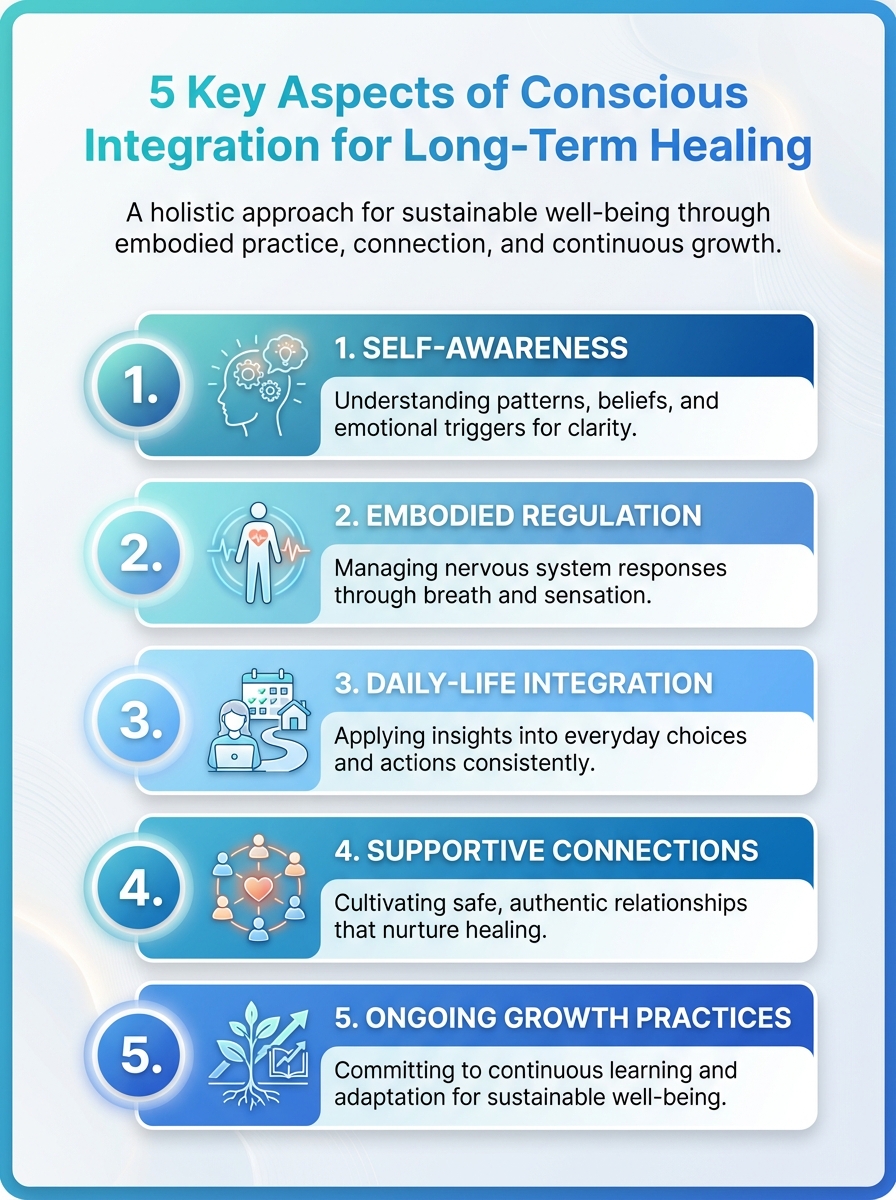
A concise guide to the five key aspects of conscious integration that support long-term healing. See how each aspect contributes to sustained wellbeing.
The Power Of Preparation: Conscious Intention As Integration Before The Experience
Most people associate integration with what happens after a big experience. In practice, integration begins the moment you set a conscious intention and prepare your body and mind.
Research in psychedelic-assisted therapy shows that more preparation therapy hours are associated with larger reductions in depressive symptoms, which means the groundwork you lay matters as much as the peak itself.
Pre-Experience Questions To Clarify Your Path
We invite clients to sit with questions like, “What patterns am I ready to release?” and “How do I want to show up differently in my life six months from now?” These questions focus your system on change that extends beyond the session or ceremony.
Clarity of intention also helps you recognize relevant insights as they emerge, rather than treating the experience as random or purely symbolic.
Practical Preparation Steps
When you prepare consciously, your nervous system feels safer to open. That safety lays a stable foundation for long-term integration.

Embodiment Practices: From Insight In The Mind To Wisdom In The Body
Conscious integration requires embodiment. If an insight only stays in your thoughts, your daily behavior will continue to be driven by old somatic patterns.
An embodiment practice is any intentional activity where you feel and express your inner reality through the body, while staying present and curious.
Examples Of Embodiment For Long-Term Healing
These practices teach your nervous system that it can safely experience and express what was once overwhelming. Over time, this reduces emotional charge around triggers.
Why We Center Embodiment In Our Work
As embodiment coaches, we have seen again and again that people who engage their bodies during integration experience more stable shifts in identity and behavior. They no longer need to mentally manage emotions all the time, because their whole system knows how to process them.
This is especially important for survivors of narcissistic abuse and complex trauma, where the body has often become a place of tension, shutdown, or self-judgment. Embodiment practices reclaim that space as a site of healing.
Subscribe to Create Higher Vibrations!
Get Inspiration and Practical advice straight to your inbox.
Nature-Based Integration: Healing Through Earth Connection
Your nervous system evolved in nature, not behind screens. Natural environments regulate stress responses faster than indoor spaces. This makes nature a powerful integration tool.
Studies show that 20 minutes in nature reduces cortisol significantly, and forest environments lower heart rate and blood pressure. Your body recognizes Earth as home.
Why Nature Accelerates Integration
Nervous system regulation happens automatically
Natural settings activate your parasympathetic system without effort. Your body reads trees, water, and open sky as signals of safety.
Sensory grounding is immediate
You can feel the wind, hear birds, smell the earth, and see movement. These inputs anchor you in the present moment without mental effort.
Perspective shifts naturally
Big landscapes help you hold emotions without drowning in them. Your worries feel smaller when you are near old trees or under a big sky.
Core Nature-Based Practices
Forest bathing (Shinrin-yoku)
Walk slowly through wooded areas for 20-40 minutes. No destination, no phone. Notice colors, textures, and sounds. Let your attention wander. This practice reduces stress hormones and strengthens immune function.
Earthing or grounding
Remove shoes and stand barefoot on grass, soil, or sand for 10-30 minutes. Direct skin contact with the earth transfers electrons that reduce inflammation. This supports nervous system recovery after intense experiences.
Outdoor meditation and breathwork
Sit outside for your regular practice. Fresh air deepens breathing naturally. Morning light regulates circadian rhythm. Temperature variation keeps you present in your body.
Water immersion
Cold water immersion (ocean, lake, cold shower) activates your vagus nerve. This supports emotional regulation and resilience. Start with 30 seconds, build gradually. Warm water (hot springs, bath) soothes when you’re overstimulated.
Nature journaling
Sit in one spot outdoors and write what you notice. Describe sensations, weather, and movement around you. Then write about your inner landscape. The parallel often reveals patterns.

Practical Implementation
Daily micro-doses
Five minutes barefoot on grass before work. Lunch break outside instead of at desk. Evening walk around your block.
Weekly immersion
Two hours in a park, forest, or natural area. No agenda, no hiking goals. Wander, sit, notice.
Integration after major experiences
Spend the first 24-48 hours near nature if possible. Many retreat centers place participants in natural settings for this reason.
Seasonal attunement
Notice how each season affects your energy and emotions. Winter invites rest. Spring supports new growth. Summer energizes action. Fall releases what’s complete.
Nature and Embodiment Work Together
Nature-based practices pair powerfully with embodiment work. Your body moves differently outdoors. Restriction patterns soften. Breath deepens without forcing.
Try your regular somatic practices outside. Notice what shifts. Many clients report faster emotional release and clearer insights when working with nature present.
Urban Integration Options
You don’t need wilderness for nature-based integration. Urban nature works too.
Options:
The key is consistent contact, not perfect wilderness access.
When Nature Feels Overwhelming
Some trauma survivors feel unsafe in isolated natural areas. Honor that response. Start with populated parks. Bring a trusted person. Stay near exits.
Your nervous system will signal when it’s ready for deeper nature immersion. Don’t force it.

Nature as Teacher and Mirror
Natural cycles mirror integration phases. Seeds don’t rush. Trees don’t force growth. Winter rest precedes spring bloom.
When you feel stuck in integration, watch nature. Everything has seasons. Your healing follows similar rhythms.
The Role Of Therapeutic Relationship In Conscious Integration
Long-term healing does not happen in isolation. Research on psilocybin-assisted therapy shows that the strength of the therapeutic alliance predicts outcomes months after the experience, which means that the relationship itself is part of the medicine.
When you feel genuinely seen, respected, and not pathologized, your nervous system can relax enough to explore new ways of being.
What A Supportive Integration Relationship Looks Like
In our one-on-one work, we prioritize this kind of alliance, because we know that techniques alone cannot compensate for a lack of trust. Safety is the container in which integration can unfold.
Choosing The Right Guide For You
It is important to choose someone who understands trauma, power dynamics, and your specific context, such as narcissistic abuse recovery or spiritual crisis. This alignment supports deeper honesty and more relevant guidance.
You are never obligated to continue with a guide who does not feel safe. Conscious integration includes honoring your boundaries in your healing relationships as well.
Self-Mastery As A Framework For Ongoing Integration
Conscious integration practices are most effective when they sit within a clear framework of self-mastery. This means you develop skills to observe yourself, regulate your energy, and align your actions with your deeper values.
Our Self Mastery teachings emphasize seven core steps that guide you from automatic reactivity to conscious choice, day after day.
Core Elements Of Self-Mastery For Long-Term Healing
| Element | How It Supports Integration |
|---|---|
| Self-Awareness | Helps you notice triggers, patterns, and progress without harsh judgment. |
| Emotional Regulation | Gives you tools to stay present with intense feelings instead of shutting down. |
| Embodied Presence | Keeps healing in the body, not just the mind, for deeper rewiring. |
| Aligned Action | Turns insights into concrete changes in behavior and boundaries. |
When you practice these elements consistently, integration becomes part of your lifestyle. You are no longer chasing isolated breakthroughs, you are steadily reorienting your whole system.
Why We Use An 8-Week Container
Our 8-week Self Mastery Program provides a structured period where you can practice these skills with support. Eight weeks is long enough to experience real shifts, yet focused enough to stay engaged.
This container holds you while you experiment with new ways of relating to yourself, others, and your inner world, which is the essence of conscious integration.
Integrating Trauma And Narcissistic Abuse Experiences Consciously
For survivors of narcissistic abuse and relational trauma, conscious integration practices address both emotional wounds and distorted narratives about self-worth. Long-term healing in this context is about reclaiming your internal authority.
Many clients come to us still carrying the belief that their needs are too much or that they must earn basic respect. Integration gently dissolves these beliefs by pairing new experiences with new internal responses.
Key Integration Themes In Narcissistic Abuse Recovery
We use conscious integration practices to help you embody a new story where you are not the problem, you are the person choosing a different life.
Creating Safe Internal And External Environments
Long-term healing requires both inner and outer safety. Internally, you learn to speak to yourself with compassion during triggers rather than blame.
Externally, you gradually reduce contact with harmful dynamics and surround yourself with relationships that reflect your worth. Integration is the daily practice of honoring that worth through your choices.

Practical Daily Integration Rituals You Can Start Now
Conscious integration does not need to be complicated. Simple, consistent rituals can have a profound effect on your long-term healing when practiced over months.
The key is to choose a few practices you can realistically maintain, rather than many that you abandon after a week.
Daily Integration Ritual Ideas
- Morning check-in: Ask, “How do I feel physically, emotionally, mentally, spiritually?” and note one supportive action for the day.
- Two-minute breath breaks: Several times a day, pause to feel your feet and lengthen your exhale.
- Evening reflection: Journal on where you honored yourself and where you defaulted to old patterns, with compassion, not criticism.
- Weekly embodiment session: Set aside 20–30 minutes for movement or stillness dedicated to feeling your inner world.
These rituals keep your healing journey present in your awareness, instead of treating it as something that only happens in appointments or ceremonies.
Integrating Insights In Real Time
Whenever you notice a familiar trigger, pause and ask, “What is one small conscious choice I can make right now that reflects who I am becoming?” Then act on that choice, even if it is tiny.
This is how you build a new identity one decision at a time. Over months, these small decisions add up to profound long-term change.

How Our Programs Support Conscious Integration And Long-Term Healing
At Create Higher Vibrations, we design every offering around conscious integration, not just insight. Our focus is on trauma-informed, practical pathways to sustained self-mastery.
Rather than chasing intensity, we prioritize consistency, safety, and embodiment so your healing becomes part of your everyday life.
8-Week Self Mastery Program
Our 8-Week Self Mastery Program guides you through the foundations of self-healing into deeper self-mastery. Each week builds on the last, with practices you can continue long after the program ends.
You learn conscious integration tools that support long-term emotional regulation, clearer boundaries, and a more stable sense of self.
One-On-One And Embodiment Coaching
For those who want more personalized support, our one-on-one coaching and embodiment coaching sessions tailor integration practices to your nervous system, history, and goals.
We meet you where you are, whether you are healing from narcissistic abuse, integrating spiritual experiences, or rebuilding after burnout, and we walk with you as you apply these practices in real time.
Conclusion
Conscious integration practices are the missing link between powerful healing moments and lasting change. They are how you teach your mind, body, and spirit to live in alignment with the truths you have already glimpsed.
Long-term healing is not reserved for a select few. With consistent practice, supportive relationships, and a clear framework of self-mastery, you can reshape your inner world and your outer life in ways that endure, one conscious choice at a time.