
Brain Fog After Narcissistic Abuse: The Neurological Explanation Nobody Gives You

You left the relationship, but your brain did not come with you. Months later, you still cannot hold a thought, remember simple words, or make a decision without feeling like your mind is wading through wet concrete.
If general brain fog advice has not helped, it is because you have been given recommendations for the wrong problem. Narcissistic abuse does not create generic stress-related fog.
It creates a specific neurological injury pattern that requires a specific recovery approach. This article explains exactly what happened to your brain, why it has not resolved, and what actually reverses it.
Brain fog after narcissistic abuse is a physical state of cognitive dysfunction. It is caused by three specific structural changes in the brain.
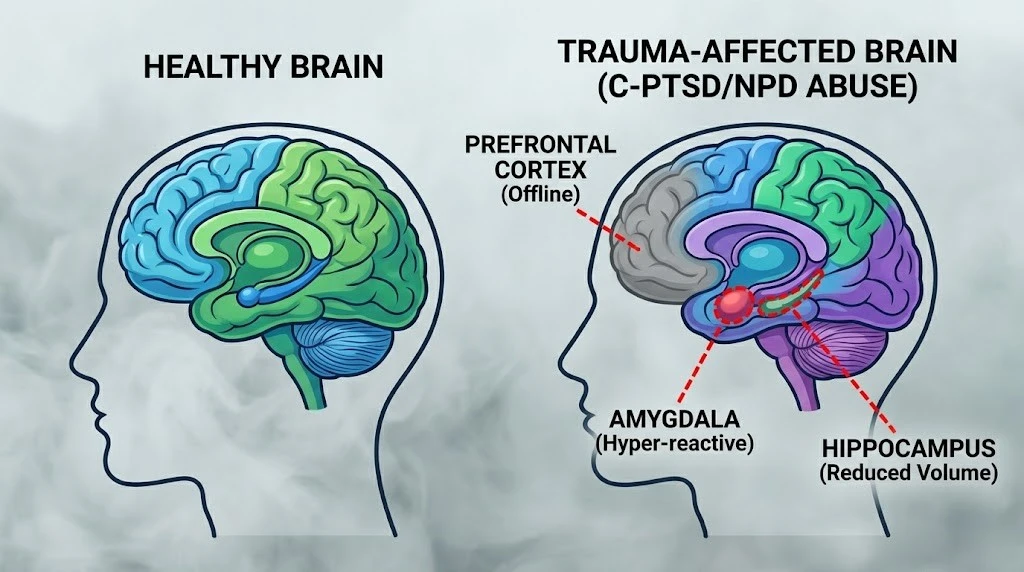
First, an enlarged, hyper-reactive amygdala traps your nervous system in permanent threat detection. Second, a shrunken hippocampus leaves you struggling to form new memories.
Finally, your prefrontal cortex keeps going offline every time your internal alarm system activates.
These are not metaphors. They are physical changes caused by chronic exposure to unpredictable threat. Reversing them requires specific nervous system interventions, not generic self-care.
By the end of this article, you will understand exactly what happened to your brain, why “just rest and it will pass” has not worked, and a clear protocol for getting your cognitive clarity back.
- Neurological Injury. Brain fog from narcissistic abuse expresses C-PTSD. A hyper-reactive amygdala and offline prefrontal cortex drive this condition.
- Standard Advice Fails. Standard lifestyle tips ignore the chronic freeze response. This biological state locks cognitive paralysis in place.
- Hormonal Flush. Cortisol and adrenaline surges cause sudden mental fatigue. Your body requires a 90-second window to clear these chemicals.
- Healing Neurogenesis. Your brain heals through intentional neurogenesis. You build new neural pathways to restore your cognitive volume.
- Recovery Pathway. You reverse the fog systematically. Follow a somatic protocol moving through safety, activation, integration, and clarity.
What Is Brain Fog After Narcissistic Abuse?
Brain fog after narcissistic abuse is a severe form of cognitive dysfunction caused by prolonged, trauma-induced changes to the brain’s structure.
Often a core symptom of trauma-induced C-PTSD (Complex Post-Traumatic Stress Disorder), this specific neurological injury pattern is characterized by:
This is not a character flaw, a sign of weakness, or permanent damage. It is your brain doing exactly what it was wired to do to survive a chronic, unpredictable, and threatening environment.
According to Stephen Porges’ Polyvagal Theory, your autonomic nervous system has three main states. The ventral vagal state supports calm, clear thinking, and social connection. The sympathetic state activates fight-or-flight.
The dorsal vagal state is the freeze response, numbness, dissociation, and profound mental slowing.
After sustaining chronic narcissistic abuse, your nervous system can get stuck in a state of chronic dorsal vagal shutdown. When your brainstem takes over survival operations, higher cognitive functions are literally deprioritized.
If you are experiencing this deep exhaustion and mental paralysis, it helps to understand the full spectrum of dorsal vagal freeze symptoms so you can identify when your system is dropping into lockdown.

The 3 Neurological Mechanisms
Three specific structural shifts create this cognitive paralysis. Each has a known biological trigger, a measurable effect, and a specific recovery pathway. Together, they explain why brain fog from psychological abuse is qualitatively different from generic burnout.
The 90-Second Rule
When you experience a sudden spike in brain fog or a surge of panic, it takes approximately 90 seconds for that surge of cortisol and adrenaline to flush biologically through your bloodstream.
If you can focus on slow, deep breathing through those 90 seconds without mentally fighting the sensation, you stop the amygdala from re-triggering the alarm.
This gives your prefrontal cortex the chemical window it needs to come back online.
Mechanism 1: Amygdala Hyper-Reactivity & Chemical Flooding
Your amygdala is the brain’s smoke detector. In a safe environment, it identifies brief threats and triggers a proportionate response.
In a narcissistic relationship, you lived under constant, unpredictable psychological warfare. This chronic alarm state caused your amygdala to physically grow larger and become hyper-reactive.
Now, it fires continuously, signaling your adrenal glands to pump a non-stop stream of cortisol and adrenaline through your system. You remain in a permanent, exhausting state of high alert, even long after the relationship has ended.
Mechanism 2: Hippocampal Shrinkage and Memory Degradation
Your hippocampus is responsible for consolidating short-term memory, learning, and contextualizing your life timeline. Unfortunately, it is also one of the most cellularly sensitive structures to prolonged stress chemicals.
The relentless influx of toxic cortisol levels physically corrodes and shrinks cellular volume in the hippocampus.
This is why survivors frequently struggle to remember specific details of the abuse, experience a blurred timeline of their past, and find it incredibly difficult to retain new information.
Mechanism 3: Prefrontal Cortex Shutdown
The prefrontal cortex is the seat of human executive function, handling logic, long-term planning, and emotional regulation.
When your amygdala is screaming, and your bloodstream is saturated with adrenaline, the brain routes all energy away from the prefrontal cortex and into the survival centers. It effectively goes offline.
This is why you feel completely incapable of making simple daily decisions, organizing your schedule, or focusing on basic tasks the way you used to.
Why Standard Brain Fog Advice Fails
Generic brain fog advice assumes the cause is lifestyle-related. Sleep more. Exercise. Reduce inflammation. Take supplements. These are not wrong, but they are insufficient. They do not address the three brain changes that keep the fog locked in.
You cannot sleep your way out of an amygdala that has been hyper-reactive for years. You cannot supplement your way out of a shrunken hippocampus. You cannot exercise your way out of a prefrontal cortex that goes offline every time your alarm system activates.
Approaching NPD-related brain fog with generic advice is like putting a bandage on a broken bone. It might help superficially, but it does not address the structural problem.
Recovery requires specific nervous system regulation practices that directly target these three brain structures.
A Recovery Protocol: From Brain Fog to Mental Clarity
Clearing brain fog after narcissistic abuse requires a nervous system approach in four phases. Each phase targets specific brain changes and builds capacity for the next level.
This is not about pushing through the fog. It is about creating the neurological conditions that allow the fog to lift on its own.
| Phase | What It Feels Like | Key Practice | Timeline |
|---|---|---|---|
| Safety | Your nervous system begins to relax. | You use orienting exercises and reduce active triggers in safe environments. | Weeks 1 to 4 |
| Activation | You notice small mental movements returning. | You introduce gentle cognitive challenges like reading short passages and journaling. | Weeks 4 to 10 |
| Integration | You experience good days mixed with foggy days. | You practice pendulation and allow the wave to pass without forcing progress. | Weeks 10 to 20 |
| Clarity | You feel like yourself again. | You deepen your practice and expand your capacity with new challenges. | Months 4 plus |
Caption: The four phases of cognitive recovery after narcissistic abuse. Progress is non-linear.
Phase 1: Safety.
Your nervous system needs to register safety before it can shift out of survival mode. Orienting exercises, reducing contact with triggers, and spending time in safe environments all send the signal that the danger has passed.
Three times daily, pause and slowly look around the room. Name five things you can see. This orienting action tells your brainstem that you are safe enough to take in information.
Phase 2: Activation.
Once your nervous system begins to feel safe, gently invite cognitive activation. Read one short paragraph per day without forcing comprehension. Journal for five minutes without editing. The goal is gentle activation that tells your brain it is safe to think again.
Phase 3: Integration.
You will have good days and foggy days. This is pendulation, the natural rhythm of nervous system healing. Allow the wave without forcing it. Each cycle builds more resilience.
Phase 4: Clarity.
Over time, the fog lifts. The practices that brought you here become part of your life, and your nervous system continues to expand its capacity.

The Trauma Bond Component
One reason the fog persists after leaving is the trauma bond. Narcissistic relationships create an intermittent reinforcement pattern that wires the brain similarly to addiction.
Your brain learned to scan for the abuser’s mood, anticipate their needs, and monitor for the next incident.
After the relationship ends, this scanning pattern persists. Your brain continues monitoring for a threat that is no longer there. This is not a choice or a character flaw. It is a deeply wired survival pattern that requires specific repatterning to release.
The fog will not fully clear until the trauma bond wire is specifically addressed. For help understanding the fawn response that often underlies this pattern, see our detailed guide.
Subscribe to Create Higher Vibrations!
Get Inspiration and Practical advice straight to your inbox.
Addressing the Fear of Permanent Damage
Many survivors panic, fearing that this profound mental fatigue is a sign of irreversible neurological decay or early-onset dementia. It is not.
The human brain possesses an incredible, lifelong capacity for neuroplasticity, the ability to physically restructure and rewire itself based on new, repetitive inputs.
Research published in Physiological Reviews confirms that these structural changes are reversible. When the chronic stressor is completely removed, and the nervous system feels genuinely safe, the brain can systematically shrink a hyper-reactive amygdala.
Even better, it triggers neuroplasticity and neurogenesis, the actual birth of new neurons, to restore healthy cellular volume to the shrunken hippocampus. Your brain is not permanently broken; it adapted beautifully to survive a warzone, and it can readapt to live in peace.
Practices That Actually Work
To move out of survival mode, you must bypass the thinking mind and speak directly to the nervous system using somatic, body-based cues:
If you are ready to start intentionally shifting your body out of survival mode, you can explore our step-by-step nervous system regulation guide for advanced somatic exercises designed to safely melt the freeze response.
Conclusion
The fog is not permanent. It is not evidence that you are broken or that the abuse permanently damaged your brain. It is your nervous system still running a survival program from a relationship that has ended.
With consistent, body-based practice, your nervous system learns that the danger has passed; the amygdala calms. The hippocampus restores. The prefrontal cortex comes back online. The fog lifts.
You are not behind. You are healing in the right order.