
Divine Masculine Energy: What It Is and How to Heal It

The divine masculine has nothing to do with being loud, hard, or in charge. Its strength is the kind other people can lean on.
Key Takeaways
Divine masculine energy is the active, directed and protective side of human nature: the capacity to set a direction, make decisions, keep commitments and stand guard over what matters.
In spiritual teaching, it is one half of a pair, balanced by the receptive divine feminine, and every person holds both.
Divine masculinity, or the sacred masculine, is not the same as being a man. It is a way of using strength. This guide covers what the divine masculine means, where the idea comes from, its healthy and wounded forms, and how to heal it.
What Is Divine Masculine Energy?
At its core, the divine masculine is strength in the service of something larger than yourself. It shows up as clarity, courage, discipline, and the willingness to protect.
The word “divine” matters. It separates this energy from its distorted versions: aggression, domination and control. The divine masculine leads by example rather than by force, and its authority comes from steadiness, not volume.
Spiritual teachers often describe it as yang energy: outward, focused, and structured. It gives shape to things, the way a riverbank gives shape to water.
When people search for spiritual masculinity or the meaning of divine masculine energy, they are usually looking for a better model of strength. They want something between the hardness they were taught and the softness they were told to distrust.
Where Does the Idea of the Divine Masculine Come From?
Masculine images of the sacred appear across the world’s traditions. Shiva in Hinduism, Zeus in Greek myth, and God the Father in Christianity each carry qualities people now group under the divine masculine: authority, protection, and the power to create or destroy.
Shiva and Shakti. In Hindu thought, Shakti is the goddess who personifies the creative power of Shiva. Shiva is pure consciousness, Shakti is energy, and neither acts without the other. When asked “who is the divine masculine in Hinduism?”, most teachers point to Shiva.
The clearest image of this is Ardhanarishvara, a figure of Shiva who is half male and half female. According to Britannica, its symbolic intent is to show “that the male and female principles are inseparable.”
Yin and yang. Chinese philosophy describes the same pairing as yang, the active and bright principle, and yin, the receptive and dark one. Each contains a seed of the other.
Jung’s animus. In psychology, Carl Jung described the anima and animus: the unconscious feminine side of a man and the unconscious masculine side of a woman. Growth, for Jung, meant integrating the side you had neglected.
The four archetypes. In King, Warrior, Magician, Lover (1990), Robert Moore and Douglas Gillette mapped mature masculinity through four archetypes: the King who orders and blesses, the Warrior who acts with discipline, the Magician who understands and transforms, and the Lover who feels and connects. Much modern divine masculine teaching borrows from this map.
Can a Woman Have Divine Masculine Energy?
Yes. Every tradition the idea comes from says each person carries both energies. The divine masculine is a set of capacities, not a gender.
A woman who sets clear boundaries, leads a team through a crisis or protects her children fiercely is expressing divine masculine energy. A man who listens deeply and creates beauty is expressing the divine feminine.
Problems start when either energy is suppressed. Someone taught that assertiveness is unkind may struggle to say no. Someone taught that feeling is weakness may struggle to connect. The law of gender describes this same principle in Hermetic terms.
What Are the Qualities of the Divine Masculine?
The qualities most often named fall into a few clear groups.
These are also the qualities many traditions link to the solar plexus chakra, the energy center of will and personal power.
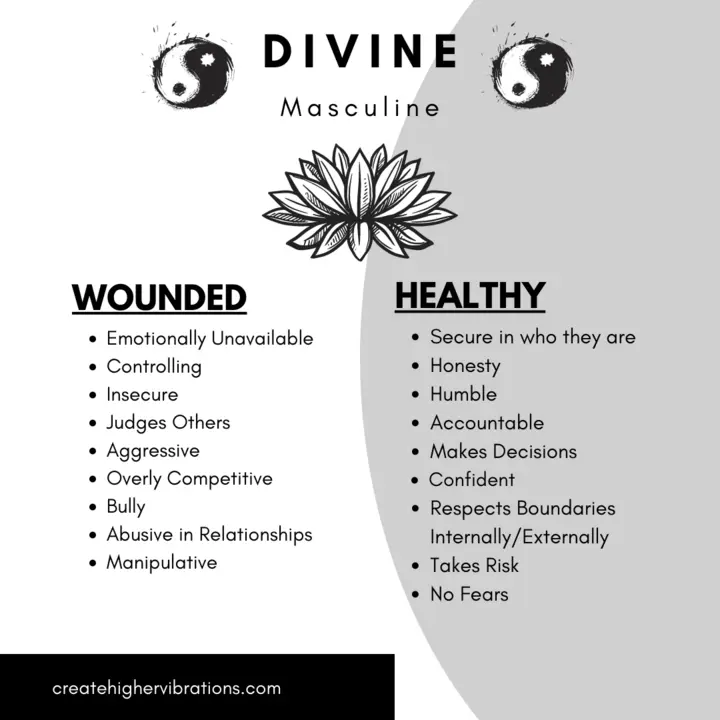
What Does a Wounded Masculine Look Like?
A wounded masculine is masculine energy shaped by fear. It usually forms early, in response to harsh fathers, absent role models, or cultures that punished tenderness.
None of this is a verdict on who someone is. Wounds are learned responses, and they can be unlearned. The darker side of this energy is explored further in the guide to the dark masculine.
What Does a Healthy Masculine Look Like?
A healthy masculine looks calmer than people expect. There is less to prove.
Notice the pattern: every healthy trait involves strength that makes other people safer, not smaller. Our guide to healthy masculinity covers the same ground from a psychology angle.

What Does the Divine Masculine Look Like in Everyday Life?
It rarely looks dramatic. Most of the time, the divine masculine shows up in small, reliable acts.
How Are the Divine Masculine and Divine Feminine Different?
The divine feminine is described as receptive, intuitive, creative and connective. The divine masculine is active, directed, structured and protective. One opens and the other shapes.
They are complementary rather than opposed. Too much masculine energy without the feminine tends toward rigidity, control and burnout. Too much feminine energy without the masculine tends toward drifting, indecision and poor boundaries.
Balance does not mean splitting everything evenly. It means being able to move between the two as a situation requires: listening when listening is needed, acting when action is. The law of polarity makes the same point about opposites belonging to one whole.
How Do You Awaken Your Divine Masculine Energy?
Awakening the divine masculine is less about adding something new than clearing away what blocks it. Four practices help most.
Awakening often follows a disruption, such as a loss, a breakup, or a crisis that forces a person to find their footing. It can also be chosen through steady daily practice.
How Do You Heal the Divine Masculine?
Healing takes longer than awakening, because it involves facing the source of the wound. These five steps come up again and again in the teaching.
1. Understand your wounds. Look closely at the men, fathers, and male figures who shaped you, whether they were supportive, absent, or harmful. Notice what beliefs about strength, anger and tenderness you absorbed from them.
2. Reparent the inner father. The inner father is the part of you that guides, protects, and blesses. If yours was harsh or missing, you can learn to offer yourself what you didn’t receive: encouragement, structure, and approval. Journaling, dialogue exercises, and meditation help.
3. Rewrite your inner programming. Many people carry narrow scripts about masculinity: never show weakness, always win, anger is the only safe emotion. Identify the rules you live by and choose which ones to keep.
4. Meet your inner warrior. In Moore and Gillette’s model, the mature Warrior is disciplined and loyal to a cause larger than himself. The immature Warrior is cruel or cowardly.
Ask which version shows up in you under pressure. Shadow work is one way to bring the hidden version into view.
5. Get support. Healing old wounds is hard to do alone. A good therapist, a men’s group, or a trusted mentor can reflect what you can’t see yourself. If the wounds involve abuse or trauma, a licensed professional is the right starting point.
Subscribe to Create Higher Vibrations!
Get Inspiration and Practical advice straight to your inbox.
What Does the Divine Masculine Mean in Twin Flame Teaching?
In twin flame circles, “divine masculine” often refers to one partner in a twin flame pair, usually the one described as running from the connection. Questions like why the divine masculine runs, or when he comes back, belong to that framework.
That meaning is narrower than the one in this guide, and it is covered in its own article on the divine masculine twin flame. The underlying lesson is the same, though. A partner avoiding intimacy is often a wounded masculine in action, and the healing steps above apply to them too.
Where Do You Start With Your Own Divine Masculine?
Most people learned their ideas about strength from someone who was never taught a better version. That isn’t your fault. What you practice from here is your choice.
Pick one quality from the healthy list that you want more of, and one wound from the other list that you recognize. This week, practice the first in a single small situation: one clear boundary, one decision made and kept, one direct conversation.
Then read the guide to divine feminine energy. Understanding the other half of the pair is often what makes the masculine half make sense.