
The Narcissists False Self: The Answer Will Surprise You

You wake up every morning knowing you are you, with a stable core identity that stays intact despite change, but for those with pathological narcissism, this stability comes from the narcissists false self, not a true self.
There is a core identity. A nucleus that informs you every morning and evening. You are immutable in some fundamental way. There is this thing that experiences everything. A kernel gazing out into the world and arranging perceptions to create continuity.
Continuity and contiguity are the elements of the self.
If you wake up knowing you are you, that is your self speaking. Your self acts as an organizing principle and a hermeneutic, interpretative force. It makes sense of your life. It imbues existence with purpose, direction, and meaning.
The self is a core psychological feature around which everything revolves.
Today we ask: Does the narcissist experience this the same way? Does the narcissist have a self? Does the narcissist have this sense of continuity?
The Answer Will Surprise You
For those with limited attention spans, here is the answer: Yes. The narcissist has this sense of continuity. The narcissist attributes it to a functioning self.
But we know narcissists do not have a true self. We know pathological narcissism compensates for disruption in self-formation.
What Is the Narcissist’s False Self?
So where does this sense of continuity come from?
It comes from the false self.
The narcissist experiences his false self the same way you experience your true self. Because the experience is identical, the narcissist cannot tell the difference.
The narcissist is convinced his false self is the true self. He believes it is authentic, real, factual. Not fantasy. Not counterfactual. Not a concoction or script or elaborate narrative.
The false self, insists the narcissist, is real. It is not false. It is absolutely true and voracious.
This is where confusion starts.
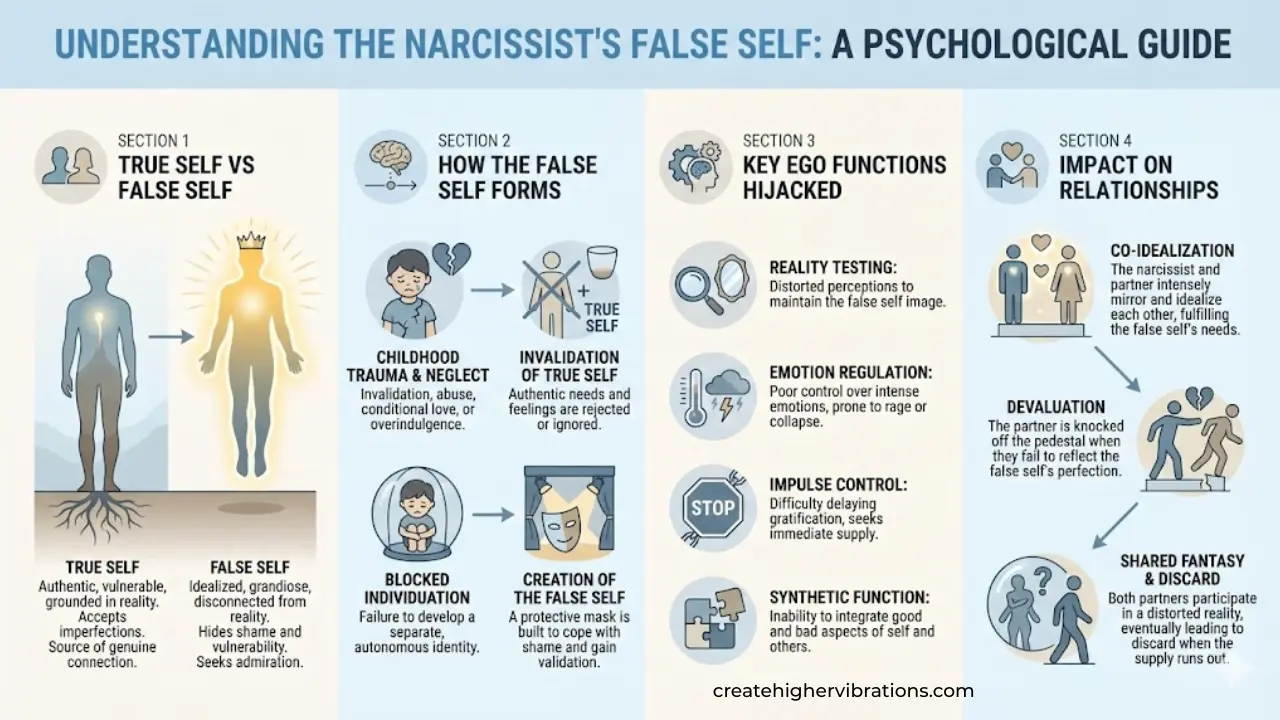
True Self vs False Self: The Critical Difference
Normal, healthy people have a functioning, authentic self. They organize experiences around this self. The narcissist has a false self. A narrative. A piece of fiction.
The narcissist organizes experiences that are fantastic, unreal, grandiose, inflated, and counterfactual. A paracosm is where the narcissist exists in a realm of imagination and storytelling, while healthy individuals remain grounded in reality most of the time.
The reason? The self of normal people is true and grounded in reality. The self of the narcissist is concocted. Invented. An imaginary friend gone rogue. A deity that consumed the narcissist as a child.
Think of the narcissist as a human sacrifice. He sacrificed himself to this new god in a primitive religion: the false self.
A quick note: Half of all narcissists are women. Yes, 50%. When I say “he,” translate it to “he or she.”
Narcissists False Self vs Self-Concept
The narcissist is aware of the false self. Even proud of it. He is emotionally invested in it. But he misidentifies the false self as his only, true, authentic self.
Why? Because the false self provides all the ego functions that a regular self provides. One of these functions is a sense of continuity.
In the narcissist’s case, this sense is false. Because it rests on nonrealistic, counterfactual, fantastic grounds, the narcissist’s continuity is glitchy. Buggy. The narcissist experiences himself as disjointed and dissociative.
But there is still this presumption of continuity. The false self provides it.
This concept is closely associated with the synthetic function, which is a primary role of the ego. It is the crucial ability to organize, unify, and integrate different, often conflicting aspects of personality.
You have thoughts. You have feelings, effects, and emotions. You have experience. They do not always go together. But you spin a narrative on the fly. You reframe everything so it fits cozily into a coherent whole.
This allows you to engage in balanced, efficacious action. It provides a stable sense of self. It is an adaptation to reality.
The synthetic function is absent in pathological narcissism.
The false self provides an ersatz pseudo-synthetic function. It causes the narcissist to experience himself continuously. It allows him to act in ways that seem efficacious. But it is all fake. All intermittent. Disjointed. Dissociated.

The Synthetic Function: Making Sense of Conflict
The synthetic function is the ego’s way of making sense of internal conflicts. You have heard of ambivalence. You love someone and hate them at the same time. Loving and hating the same person is ambivalence.
The ego uses the synthetic function to generate an attitude. A synthesis. A combination of love and hate. This allows you to interact with that individual in ways that yield beneficial outcomes.
The synthetic function handles these key tasks:
The false self provides a fake imitation of this function. Because this is the case, the narcissist experiences the false self as though he were the false self.
There is a coterminous, cospital identity between the narcissist and the false self. The narcissist does not say, “I am a narcissist, and I have a false self. I possess a false self the way I possess a flashy car or trophy wife.”
No. The narcissist says, “I am the false self. There is only the false self. The false self is my true self. There is no other self. Therefore, the false self is an authentic expression of who I am.”
Winnicott’s False Self and Narcissistic Personality Disorder
The false self was first described by Donald Winnicott. He was one of the founders of object relations theory, especially the British school. He built on Helen Deutsch’s concept of “as if” personality.
Winnicott suggested there is a kind of self that develops as a defense against impingements, trauma, and abuse. It adapts to a dysfunctional, hostile environment.
Winnicott contrasted the false self with the true self. The true self develops in an environment that adapts to the infant. It allows the child to discover and express true impulses.
Winnicott was a pediatrician, by the way.
Here is what he found: When a child’s urges, dreams, fears, and explorations are accepted and validated, the child develops a true self.
When a child’s emotions and thoughts are taken seriously, and the child is not neglected, a healthy, true self can form.
On the other hand, when a child is not allowed to become a separate person, problems appear. If you block separation and individuation, the child cannot grow into a separate person.
If you punish emotional expression or critical thinking, or remain so overprotective that exploration feels overly dangerous, the child cannot develop in a healthy way.
If the child is invalidated, that child develops a false self. An imaginary friend that gradually transforms into a deity. This divinity merges with the child and becomes the entitled, grandiose narcissist.
The Self as Internal Object
The true and false selves are internal objects, engaging in what psychoanalytic theory describes as a secondary process. A secondary process is a conscious process. It is rational mental activity under the control of the ego and the reality principle.
This mental process includes these functions:
It enables individuals to meet the external demands of reality and the environment. It meets internal demands of instincts, drives, and urges.
The ego is a mediator. A broker. An arbitrator between reality and your internal drives. It handles urges, wishes, and instincts that threaten to overpower you. What Freud called the id. And it does this in rational, effective ways through secondary process thinking.
Here lies the problem: The narcissist is not possessed of a true, integrated, constellated self. The narcissist identifies with an internal object that is fictitious. Counterfactual. Irrational. Founded on cognitive distortions and biases.
The narcissist is led astray by a godlike entity. This entity comprises omniscience and omnipotence, perfection and brilliance. Because of all this, the narcissist is not grounded in reality. He is divorced from reality. His reality testing is impaired.
Because the narcissist cannot perceive reality appropriately, his actions, decisions, and choices are off the charts.
His cognitions and effects, his emotions, all of them are completely out of control. Deformed. One could even say, in the footsteps of Otto Kernberg, demented. Pseudopsychotic.
Subscribe to Create Higher Vibrations!
Get Inspiration and Practical advice straight to your inbox.
Narcissists Are Selfless
Narcissists have no self. They have no ego.
When people say “ego death,” the irony is that ego death means narcissism. There is no other psychological state without a self. The only exception is pathological narcissism.
Sam Vaknin, a Professor and self proclaimed Narcissists, says: Narcissists are, ironically and sarcastically, selfless. They are not egotists because they do not have an ego.
Ego functions include these capabilities:
None of them persist or operate appropriately in the narcissist’s mind. Not one.
The narcissist’s reality testing is impaired. His impulse control is impaired. His emotion regulation is impaired. He disregulates in reaction to injuries and mortification.
His judgment is completely erroneous. Object relations? Forget about it. Cognitive processes are distorted. Defense mechanisms are rampant, especially primitive ones, infantile ones, like splitting.
The synthetic function is fake. Completely fake.
The narcissist’s ego functions are inoperative because the narcissist does not have anything remotely resembling an ego. He has a pale, distorted, deformed, defective imitation of the self.
It gets everything wrong. It is a caricature of the self. Not a functioning, true, authentic self. A simulacrum.
How Narcissists See Themselves: Internal Objects and Self‑Concept
In narcissism, the false self is the locus of the self-concept. It is also the target of co-idealization.
Let me explain. In normal, healthy people, there is a clear boundary, an impermeable partition between the self and the self-concept. The self is an organic, unitary entity. It organizes everything. Takes care of everything. Interprets and explains everything.
There is a perception, an experience of the self. This is known as self-concept. Self-concept is the way you see yourself. The way you apprehend and perceive yourself. The way you conceive of yourself.
It is as if you and yourself were two entities. You observe yourself. Then you describe yourself. Then you analyze yourself. Put all of these together. You get the self-concept.
This is what happens in healthy people.
In the narcissist, there is no distinction between the false self and the self-concept. Because the false self is false, because it is a narrative, a script, not real, there is no difference between them.
When the narcissist self-observes and introspects, what the narcissist sees is the false self. The self-concept of the narcissist is the false self. They are coextant.
Discover Your Inner Self. Join Our Self-Mastery Program.
Self-Mastery Coaching gives you the space, tools, and guidance to grow, reflect and discover your values and inner strength.

The Internal Object Problem
When the narcissist interacts with other people, whatever the narcissist does to the concept of other people reflects on him.
When a healthy individual interacts with other people, talks to them, walks with them, makes love to them, has dinner with them, any kind of interaction, they distinguish an external object from the internal representation of that object.
Healthy people can tell the difference between themselves and their self‑concept, so they can also tell the difference between real people and their mental images of them.
These healthy people experienced separation from their mothers. By experiencing separation, they learned the difference between inside and outside. External and internal. You and me. Me and the world. Boundaries. They developed healthy self or ego boundaries.
In the narcissist, not having experienced separation, the narcissist cannot tell the difference between self and self-concept. Between false self and himself. Between external objects and internal objects.
The way the narcissist perceives other people as external objects becomes totally internalized. The minute the narcissist starts to interact with someone, that split second, the narcissist internalizes the other person. He continues to interact with that person only internally.
Co-Idealization Example
Imagine the narcissist targets you as a potential intimate partner. A participant in a shared fantasy. The mother figure. The substitute mother figure. He decides you would be a great source of narcissistic supply.
That minute, the narcissist idealizes you.
But because the narcissist cannot perceive you as external to himself, as separate from him, by idealizing you, he is actually idealizing himself. You have become an internal object in his mind.
Now that he is idealizing this internal object, he is idealizing a part of his mind. A portion of his mind. A segment of his mind.
All idealization in narcissism is co-idealization. All devaluation is co-devaluation.
The narcissist cannot differentiate himself from his environment, at least his human environment. They cannot make the distinction between false self and self-concept. They are the same.
The False Self Replaces the True Self
Gradually, over the years, across the lifespan, the false self replaces the narcissist’s true self.
Originally, the false self was an imaginary friend. The false self was everything the child was not. The child was helpless. The false self was all-powerful, omnipotent. The child could not create a theory regarding the minds of adults. These adults were deranged and disturbed. So the false self became omniscient. All knowing.
The child was told he was unworthy, unlovable, and inadequate. The false self is the opposite. It is a perfect being. A godlike entity.
The false self’s initial function was compensatory. It shielded the child from hurt and narcissistic injury. It is attributed to the child’s godlike attributes. Divine attributes. Omnipotence, omniscience, omnipresence.
The narcissist pretends his false self is real. He demands that other people affirm this confabulation. Confirm it. He not only says, “My false self is who I am.” He wants other people to say, “Your false self is who you are, no doubt about it. Your fantasy is not a fantasy; it is completely real.”
The narcissist wants to coerce other people, cajole them, convince them, persuade them, or bribe them. He needs them to confirm his fantasy as the only reality. To confirm his false self as actually who he is.
In this sense, narcissism is a missionary religion, like missionaries who went to Africa and tried to convert natives into Christianity. The narcissist wants to convert you into his primitive, private religion. He is the godhead. You are the worshipper.

Two Main Functions of the False Self
The false self reinterprets information from the world in a way that flatters the narcissist. It attempts to maintain social acceptability, creating an inherent conflict.
On one hand, the main role of the false self is self-aggrandizement. Clinical psychology calls this self-enhancement. But the false self pretends to be an ego. It acts like a real self. A true self.
The false self insists it is acting on the reality principle. It claims to be socially commendable. Socially acceptable. Conforming to reality, social mores, norms, and conventions.
It imitates and emulates normal emotions, cognitions, empathy, normal interactions, and normal reactions. The emphasis on being normal, on emulating a state of normality, is a core feature of the false self.
But it has many other functions. Two of the most important:
1. Decoy
The false self serves as a decoy. It attracts the fire of abuse and trauma. It is a proxy for the true self. A firewall. A protection. A fortress. A moat.
It is tough as nails. It can absorb any amount of pain, hurt, and negative affectivity. Negative emotions.
By inventing it, the child develops immunity and impunity. Immunity to the indifference, manipulation, sadism, smothering, or exploitation. In short, the abuse inflicted on him by parents or other primary objects, caregivers, or peers.
The false self is an invisibility cloak. It protects the child by rendering the child invisible, by taking away the true self. It is as if the child is not there to be abused. Not in situ to be traumatized.
It is very primitive, infantile, magical thinking. Small children, when afraid, cover themselves with a blanket. They believe that when they are under the blanket, they are invisible to the monster in the room.
It is the same with the false self. The false self is this blanket. Indeed, many scholars claim the false self is a transitional object, exactly like a blanket or a teddy bear carried by a child everywhere.
The false self protects the child. Renders the child invisible and omnipotent at the same time.
2. Misrepresentation
The narcissist says the false self is the true self. What the narcissist is saying in effect: “I am not who you think I am. I am invisible to you. I am someone else. I am this self, the false self. I am not my true self. Therefore, because I am the false self, I deserve special treatment. I deserve a better, painless, more considerate life experience.”
This is clinical entitlement.
The false self is a contraption intended to alter other people’s behavior. To modify their behavior. To change people’s attitudes toward the narcissist.
The false self is a Machiavellian device. A manipulative device intended to alter the environment in subtle ways. By miscommunicating. By flooding the zone with misinformation about the narcissist.
This misinformation causes people to react to a moving, fuzzy target. This renders people more vulnerable. Weaker. More amenable to manipulation and goal accomplishment.
This is the antisocial aspect of the false self.
The False Self is a Survival Adaptation
All these roles of the false self are crucial to survival. The false self is a positive adaptation. The child could not have survived his abusive and traumatizing environment without inventing the false self.
The false self was the guardian, custodian, and protector, the angel who kept the child alive.
Throughout the narcissist’s life, they view the false self as essential for survival and proper psychological functioning.
The false self is far more important to the narcissist than his dilapidated, dysfunctional, frozen, ossified, infantile true self.
The Two Selves Are Not on a Spectrum
The false self and the true self are not part of a spectrum. They are not at two ends of a continuum. Some neo-Freudians suggest this, but I strongly disagree.
It is not like the false self is some exaggeration. Some hyperbolic rendition of the true self. The false self and the true self have nothing in common.
The false self is defined by the child as the complete opposite of the true self; it serves as the exact negation of the true self.
The child rejects itself. The false self is about self-loathing. Self-rejection. The false self, in many ways, is a reaction formation.
The false self is a signifier of the child’s mental suicide. The child reinvents or reincarnates as someone completely different.
The false self has nothing to do with the true self.
Healthy people do not have a false self. The false self differs from the true self because it is pathological. There can be no equivalency between something healthy, normal, and functional and something that is thoroughly pathologized.
The true self is about reality. The false self is about fantasy. They do not inhabit the same realms.
Mask and Persona Are Not the False Self
Even healthy people indeed have what is called a mask, the work of Erving Goffman, or persona, the work of Carl Jung. People indeed present an artificial facade. They play-act. They pretend. They present this mask or persona to the world.
That much is true.
But the mask and the persona are not the false self. At any given moment, the individual who presents a mask to the world is fully aware they’re not the mask. They’re not the persona.
The mask and persona are a far cry from the false self. Why?
Because the false self is submerged. Mostly unconscious. The false self depends on outside feedback. It is externally regulated. The false self is compulsive.
There is not a minute or a second in the narcissist’s life where the narcissist is alone with his true self. The false self is present in every microsecond of the narcissist’s life.
Why? Because the narcissist has made a fatal attribution. The misattribution. He has identified himself with the false self.
The False Self Devours the Psyche
The false self is an adaptive reaction to pathological circumstances. But its dynamics make it predominant. The false self devours the narcissist’s psyche.
The false self is a predator. It preys upon the true self and upon the narcissist. It consumes the narcissist. It subsumes and digests the narcissist.
Nothing is left behind except the bleached bones of what the narcissist used to be.
The false self prevents efficient, flexible adaptation and functioning of the personality as a whole. It renders the personality rigid.
That the narcissist possesses a prominent false self and a suppressed, dilapidated true self is now commonly accepted. It is mainstream.
Yet, how intertwined and inseparable are these two? Do they interact? How do they influence each other? What behaviors can be attributed squarely to one or the other of these two protagonists?
Does the false self assume traits and attributes of the true self to deceive the world and to deceive the narcissist?
How the False Self Imitates the True Self
In a full-fledged narcissist, the false self imitates the true self. As I said, it imitates the ego functions. It gives a semblance of continuity. An inner experience of contiguity. An immutability.
These are all fake. All intermittent. Every impingement from the outside world destabilizes this precarious house of cards.
The false self deploys two mechanisms to artfully imitate the true self:
Reinterpretation
The false self causes the narcissist to reinterpret certain emotions and reactions in a flattering, socially acceptable light.
The narcissist may, for instance, interpret fear as compassion. If the narcissist hurts somebody and he is afraid of that somebody, an authority figure, for example, he may feel bad afterwards. He interprets his discomfort as empathy. Regret. Remorse.
To be afraid is humiliating. But to be compassionate and remorseful is commendable. It earns the narcissist social capital. Social commendation and understanding. In short, narcissistic supply.
Reinterpreting the internal states of the narcissist and the narcissist’s interactions with his environment is a major function of the false self.
Pure Imitation
The narcissist possesses an uncanny ability to psychologically penetrate other people. I call it cold empathy.
Often, this gift is abused and put at the service of the narcissist’s control freakery and sadism. The narcissist uses cold empathy liberally to penetrate the defenses of people. To take them over. To manipulate them. To annihilate the natural defenses of his victims by faking, for example, empathy.
This capacity is coupled with the narcissist’s eerie ability to imitate emotions, empathy, and the behaviors attendant on effects.
The narcissist possesses what I call emotional resonance tables. He keeps records. Every action and reaction. Every utterance and every consequence. Every datum provided by other people regarding their state of mind and emotional makeup.
From this gigantic database, the narcissist constructs a set of equations. Formulas. These often result in impeccably accurate renditions of emotional behavior. Affective behavior.
This can be enormously deceiving. That is another major function of the false self.
Final Thoughts
When you interact with the narcissist, you interact with the false self. There is no one else there. There is nobody inside.
It is an absence masquerading as a presence. A falsity pretending to be the truth. A fantasy claiming to be reality.
It is all in the narcissist’s mind, or what passes for his mind. It is a playground. A space that is infested and infected and contaminated by trauma, abuse, and the adaptations to trauma and abuse that only a two-year-old child can come up with.
Adaptations that become, in later life, maladaptations. That afflicts the narcissist and everyone around him. That causes great harm, hurt, pain, heartbreak, and devastation all around.
What is your experience with the false self of narcissists? Have you noticed how convincing their facade can be?