
Manifestation Journaling: How It Works, Methods, and Prompts

A diary records what happened. A manifestation journal writes toward what comes next.
Key Takeaways
Manifestation journaling is the practice of writing your intentions, goals, and desired future in clear, emotionally rich language. Most entries use the present tense, as if the goal is already unfolding. The practice joins the law of attraction with well-studied forms of goal writing.

What Is Manifestation Journaling?
A manifestation journal is a notebook, or an app, kept for one purpose. You write toward the life you want to build. An ordinary diary looks back. A manifestation journal looks forward.
The practice draws on two traditions. The spiritual one is the law of attraction, which holds that focused thought and feeling shape experience. The psychological one is expressive writing research, which studies how putting thoughts on paper changes mood, health, and behavior.
You do not have to choose between them. The spiritual frame gives the practice meaning. The research explains why the habit itself can change how you think and act.
Does Manifestation Journaling Work?
Writing about your future has real, measurable effects. The effects are modest, so it helps to know what the studies show.
The research began with psychologist James Pennebaker. In a 1986 study with Sandra Beall, he asked students to write about traumatic experiences.
Many later studies built on that design. A 2006 meta-analysis of 146 randomized studies found that this kind of writing has a positive but small average effect.
The branch closest to manifestation journaling is “best possible self” writing. In 2001, psychologist Laura King asked students to write about their best possible future self for 20 minutes a day, four days in a row.
Writing about life goals was less upsetting than writing about trauma. It also raised well-being.
A 2011 study took the idea further. Participants spent five minutes a day imagining their best possible self for two weeks. Their optimism rose more than in a group that imagined ordinary daily activities.
So the fair summary is this. Writing toward a hopeful future can lift your mood, optimism, and motivation. It does not move events by itself. You still act on what you write.
Why Does Writing Your Goals Change What You Notice?
Many articles credit the reticular activating system for this. That network in the brainstem mainly controls wakefulness and arousal. It works more like an on/off switch for alertness than a goal filter.
The better explanation is selective attention. Once something matters to you, your mind picks it out of the crowd. That is why you start seeing your new car model everywhere after you buy it.
Writing a goal every day keeps it on your mind. So you notice the job post, the conversation, or the opening that fits it.
This is not a weakness of the practice. It is the practice. A journal trains your attention, and attention shapes what you act on.
Why Should You Write the Process, Not Only the Outcome?
Psychologists Lien Pham and Shelley Taylor ran a study in 1999, just before a midterm exam. One group of students pictured the outcome, a good grade. Another group pictured the process instead. They imagined the good study habits that would earn that grade.
The process group studied more. They also earned better grades. The researchers traced the gain to better planning and lower anxiety.
Researchers call this process simulation. That finding is the single most useful rule in manifestation journaling. Dreaming about the result feels good. Writing the next steps is what moves you.
So pair every outcome sentence with a process sentence. “I am thriving in meaningful work” becomes stronger with “Today I send one application for a role I want.”

What Are the Main Manifestation Journaling Techniques?
Each method works a little differently. Pick one that feels natural, then stick with it for a month.
Some people time their entries to the moon. They write the goal at the new moon and review it a week later at the first quarter moon, when the plan meets its first real resistance.
Our guide to visualization techniques pairs well with any of these.

What Is the 3-6-9 Journaling Method?
The 3-6-9 method has you write one intention three times in the morning, six times in the afternoon, and nine times at night. People often credit the idea to Nikola Tesla’s interest in the numbers 3, 6, and 9.
There is no published study of the 3-6-9 pattern itself. Its likely benefit is simple repetition, which keeps the goal in your attention all day. Our full guide to the 369 method covers how to word your intention.
The 33×3 method works the same way. You write one affirmation 33 times a day for three days. Treat both methods as attention habits, not formulas.
How Do You Start a Manifestation Journal?
Starting is simple. Keep the setup light so the habit survives the first busy week.
Expect the habit to take time. A study by Phillippa Lally and colleagues tracked people building a new daily habit.
The time to reach automaticity ranged from 18 to 254 days. Missing a single day did not derail the process. So keep going after a skipped morning.
Subscribe to Create Higher Vibrations!
Get Inspiration and Practical advice straight to your inbox.
What Should You Write in a Manifestation Journal?
The best manifestation journal prompts are specific, felt, and believable. Each area below has an outcome prompt and a process prompt.
Here is a short sample scripting entry:
“I am writing from a quiet home office I set up with care. My work feels aligned. I hold clear limits in my relationships.
Most of all, I feel calm. The part of me that second-guessed everything is still here. It just no longer runs the show.”
How Is Manifestation Journaling Different From Affirmations?
Affirmations are short statements you repeat, like “I am confident.” They aim to shift self-belief through repetition. They are quick but shallow.
Manifestation journaling is longer and richer. It mixes visualization, feeling, identity, and planning in one session. Where an affirmation states a fact, a journal entry lets you live a scene.
The two work well together. Open with one affirmation. Then write the full scene of the person that affirmation describes.
For example, start with “I am a calm, capable leader.” Then write a few lines about a real meeting next week. Describe how you speak, how you listen, and how the room responds. The affirmation sets the direction. The entry makes it concrete.
Why Does Manifestation Journaling Sometimes Not Work?
When the practice stalls, one of four patterns is usually behind it.
If the same block keeps returning, our guide to limiting beliefs can help you find the story underneath it.
Can Manifestation Journaling Help You Heal?
Manifestation journaling can support emotional healing. It shares its roots with expressive writing, which began as a way to process painful experiences.
A healing entry looks different from a goal entry. Instead of the life you want to have, you write the person you are becoming through what you have lived. “I am someone who can sit with grief without running. Here is what changed in me.”
This approach avoids spiritual bypassing, the habit of using positive thoughts to skip real feelings. Your true emotions are part of the material. They are not obstacles to clear away.
Journaling is a self-development practice. It does not replace therapy. If you are working through trauma, depression, or grief that feels unmanageable, write alongside a qualified therapist.



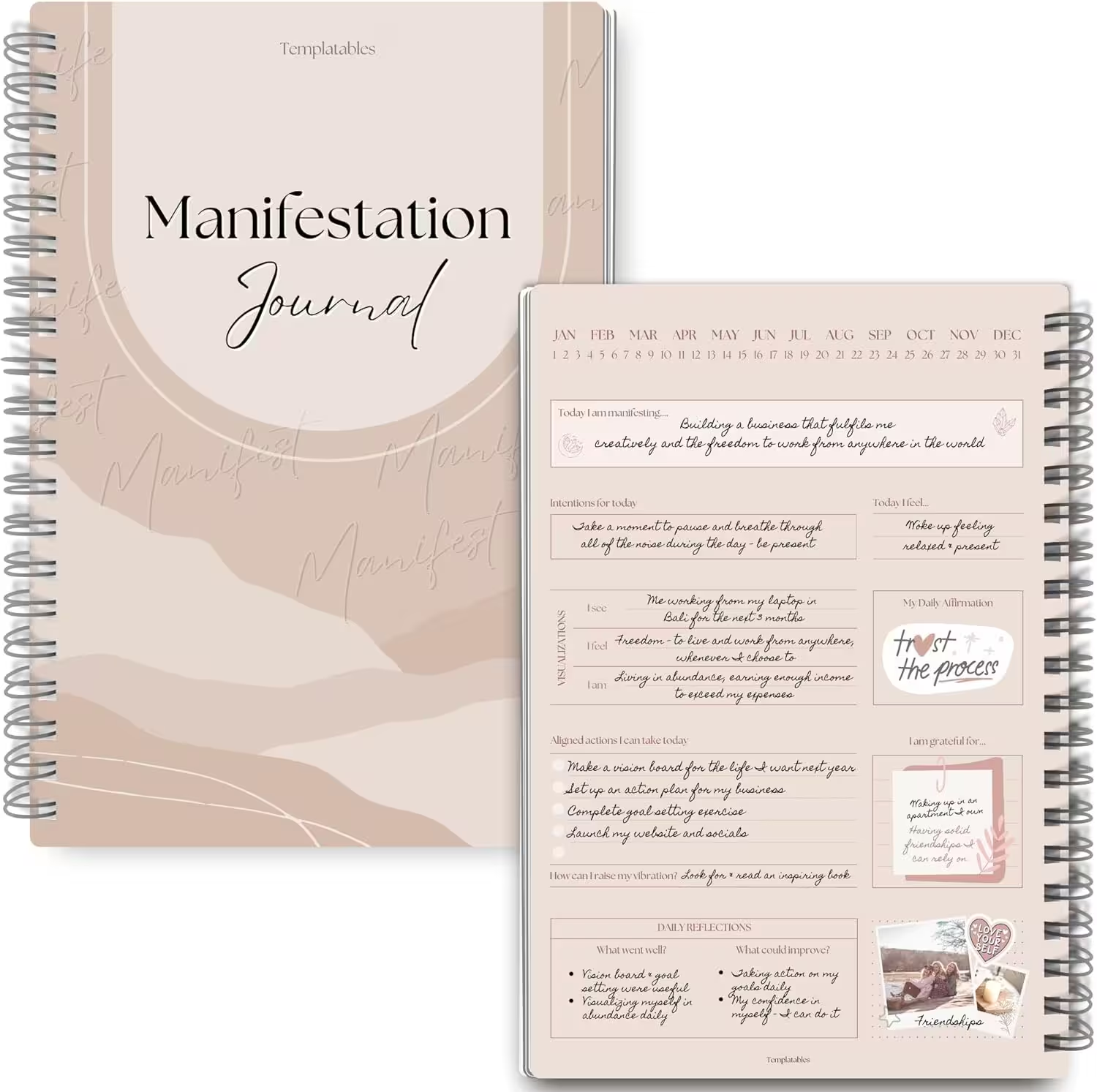
Your First Entry, Line by Line
You can write your first entry in five minutes. Use these four lines.
Write it tomorrow morning. Then write it again the next day. The power is in the return, not in one perfect page. For a daily practice that pairs with this one, read our guide to intention setting, or browse more in the manifestation section.