
What Is Manifestation Journaling? The Science, Techniques, and How to Start

Manifestation journaling is the practice of writing your intentions and goals in deliberate, emotionally engaged language to align your mindset with the outcomes you want to create. It is grounded in real psychology, not wishful thinking.
You might already keep a journal. But there is a difference between writing down what happened and writing toward what you want to become. Manifestation journaling is the second kind.
It is purposeful, forward-facing, and rooted in decades of research on expressive writing and goal visualization.
What if a simple morning writing habit could change what you notice, what you pursue, and how you see yourself? That is not a promise. It is a finding from credible psychological science.
By the end of this article, you will understand exactly why it works. You will know which technique fits your life right now, and feel ready to open a blank page and begin.
- Manifestation journaling relies on proven psychological mechanisms rather than magical thinking. The practice works through neural priming, identity rehearsal, and attention redirection.
- Many people fail when they write what they want without writing how they plan to achieve their goal. Process focused entries produce better results than outcome only scripting.
- You do not need special prompts or an elaborate system. Five minutes of emotionally engaged writing each morning provides enough momentum to begin.
- This practice supports goal achievement and emotional healing. You achieve these results when you write honestly about your current state and your future direction.
What Is Manifestation Journaling, and Is It More Than Magical Thinking?
Manifestation journaling is the practice of writing your intentions, goals, and desired future in a deliberate, emotionally engaged way. Research and cognitive science confirm that it rewires attention, strengthens motivation, and supports goal-directed behavior.
Think of it as the opposite of a regular diary. A diary records what happened. A manifestation journal shapes what happens next. The writing is intentional.
The language is forward-facing, usually in the present tense, as if the desired outcome is already unfolding.
It draws from two traditions that are more compatible than people expect:
Neither tradition has to cancel the other. The spiritual framing gives the practice meaning and emotional depth. The psychological research explains the mechanism.
Both point to the same conclusion: writing about your desired future, done with intention and feeling, changes how your brain filters and responds to the world.
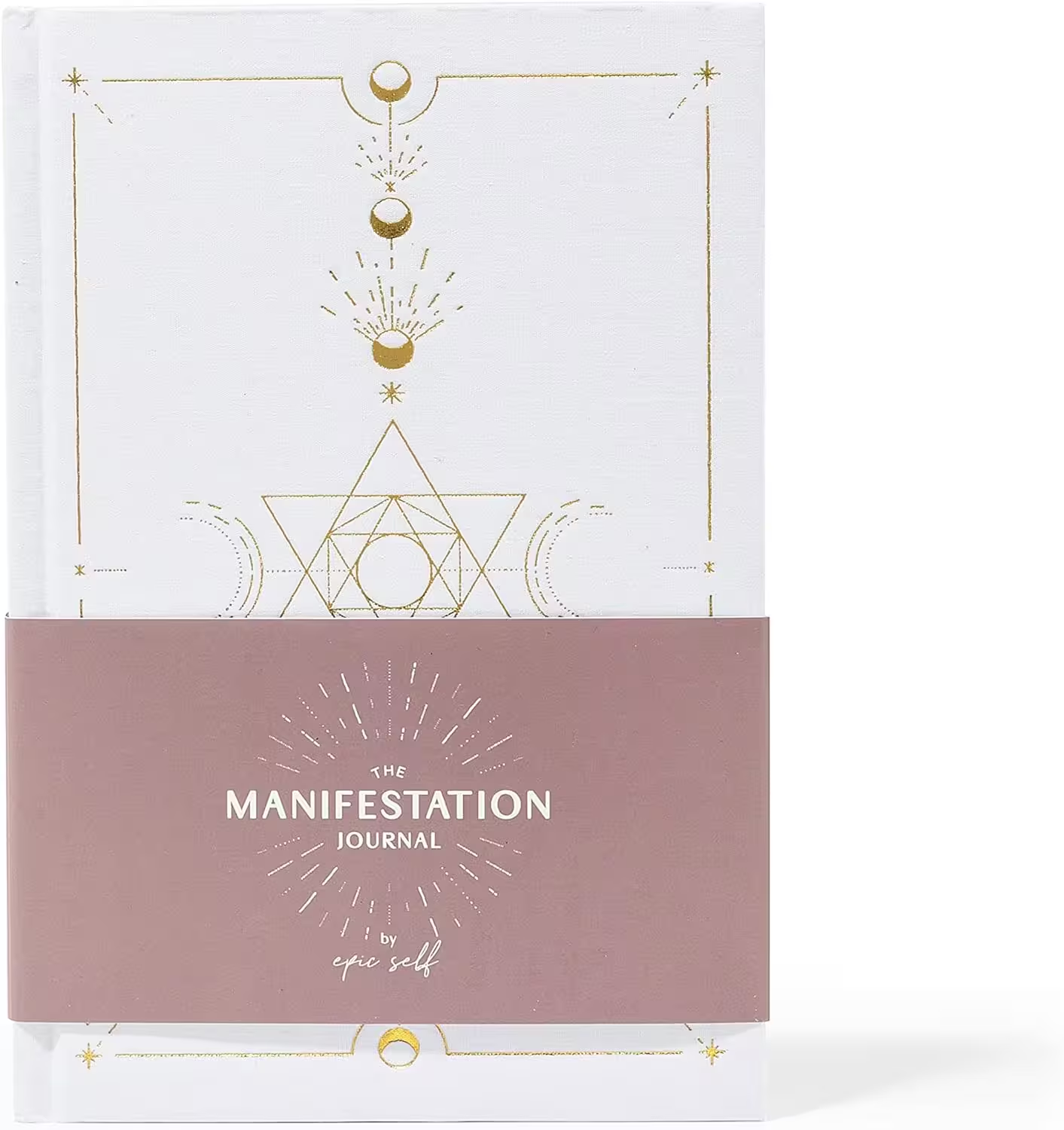
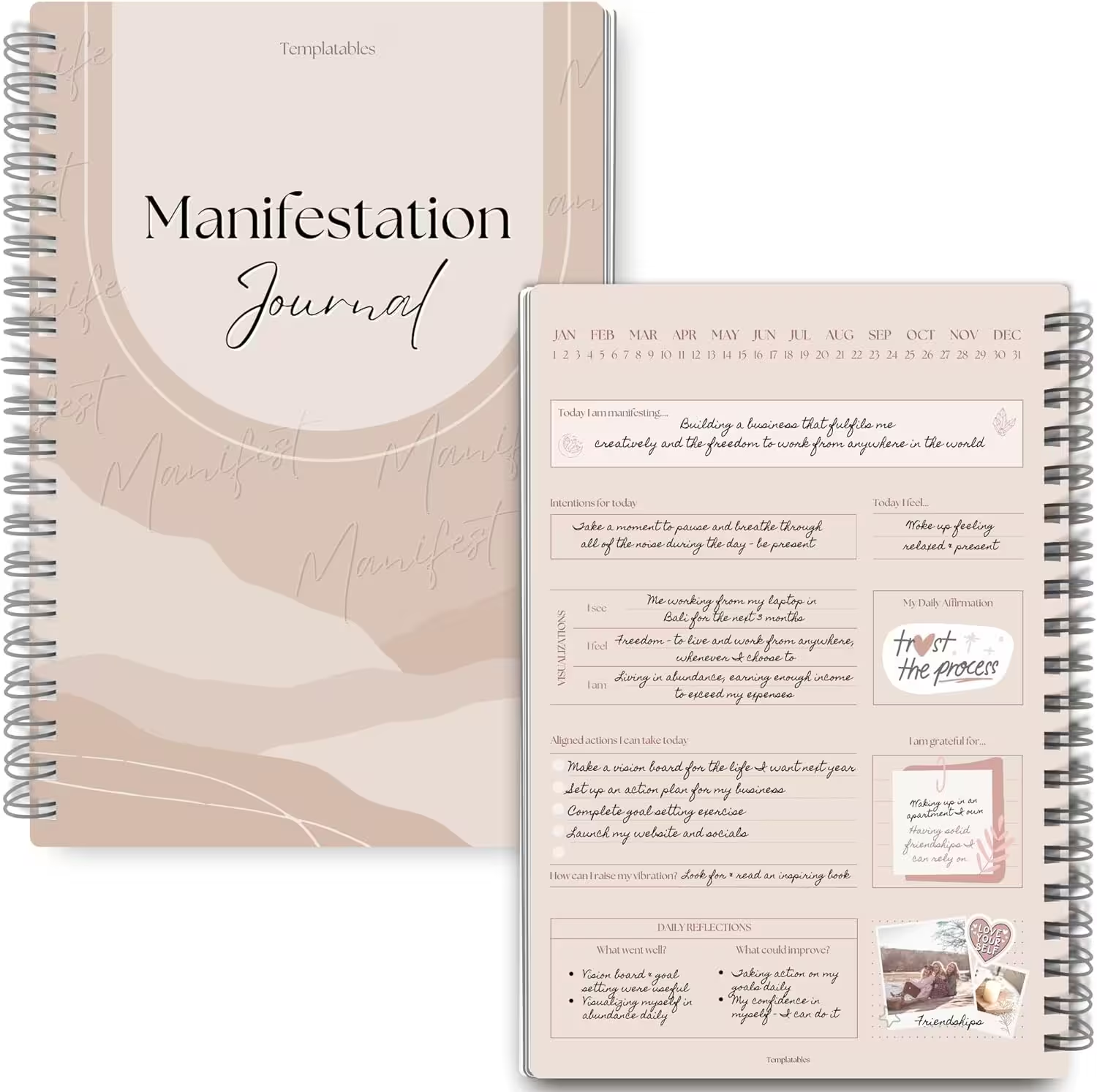
The format itself is flexible—Pen and paper, a digital app, or a structured journal all work. What matters is not the tool. It is the quality of attention you bring to it.
As someone who started this practice believing it was just glorified positive thinking, I was surprised by the shift. Within a few weeks of consistent morning journaling,
I began noticing opportunities and conversations I had been walking past for months. The journal did not create those things. It changed what I was paying attention to.
Manifestation journaling is not about pretending your life is perfect. It is about training your mind to look for what is possible.
Now that we have a working definition, the natural next question is: what does the research actually say?

What Does the Science Say About Writing Down Your Goals?
Research confirms that writing about goals improves motivation, clarity, and follow-through. Dr. James Pennebaker’s expressive writing studies have inspired more than 400 follow-up studies linking structured writing to measurable psychological and physical health benefits.
The science here is stronger than most people expect. It does not live in the self-help section. It lives in peer-reviewed journals, clinical studies, and meta-analyses spanning nearly four decades.
Dr. Pennebaker, a psychologist at the University of Texas, originally studied what happened when people wrote about their deepest thoughts and feelings.
The results changed how researchers think about writing as a tool for change. People who wrote with emotional honesty showed measurable improvements. Not just in mood. In immune markers, clinical visits, and psychological well-being.
Key insight: Over 400 studies have built on Pennebaker and Beall’s foundational expressive writing research, consistently linking structured emotional writing to improvements in mental health, well-being, and physical outcomes.
That is trauma-disclosure writing. Manifestation journaling is not the same thing. But it shares the core mechanism: emotionally engaged writing activates psychological change in ways that passive thought does not.
Key insight: A 2006 meta-analysis found a positive overall effect size across physical, psychological, and functional outcomes from expressive writing interventions, confirming that the practice produces real-world results. (one study)
The branch of research most directly aligned with manifestation journaling is called positive expressive writing. Instead of writing about pain, you write about your best possible future self. Instead of processing the past, you orient toward what you are becoming.
Key insight: A 2025 PMC meta-analysis found positive expressive writing produced the most consistent benefits for well-being and optimism, more so than trauma-disclosure journaling alone. (positive writing benefits)
The table below shows how different types of writing compare, so you can see exactly where manifestation journaling fits within the broader research:
Different types of expressive writing serve different psychological needs. Here is how they compare:
| Writing Type | Core Practice | Primary Benefit | Research Base |
|---|---|---|---|
| Expressive trauma disclosure | Writing about difficult emotions and past experiences. | Stress reduction and emotional processing. | Pennebaker and Beall 1986 with over 400 follow up studies. |
| Positive expressive writing | Writing about desired futures and best possible self. | Improved wellbeing and optimism. | 2025 PMC meta analysis by Hoult and colleagues. |
| Manifestation journaling | Emotionally engaged present tense intention writing. | Goal directed mindset and identity alignment. | Expressive writing and visualization research. |
| Gratitude journaling | Writing what you appreciate in life. | Positive affect and reduced depression. | Positive psychology research including Seligman and the PERMA model. |
Caption: Expressive writing includes several distinct approaches. Manifestation journaling draws most closely from positive expressive writing research.
Manifestation journaling is not a fringe wellness trend dressed up as science. It is a focused application of some of the most replicated findings in behavioral psychology.
Next, we will look at what is actually happening inside your brain when you sit down to write.
How Does Manifestation Journaling Work in Your Brain?
When you write about your goals in vivid, emotionally engaging detail, you activate the brain’s Reticular Activating System (RAS), your brain’s built-in relevance filter. It directs your attention toward opportunities that match what you have written down.

The Reticular Activating System is a network of neurons at the base of the brainstem. Out of the millions of data points your senses pick up each day, the RAS decides what reaches conscious awareness. It prioritizes what you have primed it to notice.
Here is a simple example. You decide you want a red car. Suddenly, you see red cars everywhere. They were always there.
Your RAS just started flagging them as relevant. Written goals work the same way. They train your brain to notice information, openings, and people that align with your intentions.
Key insight: The Reticular Activating System filters sensory information based on what the brain has been primed to find important. Written goals prime the RAS to notice opportunities aligned with them in your everyday environment.
This is attentional priming, not magic. Writing appears to prime the RAS more strongly than mental intention alone. The physical act of forming words encodes the goal more deeply in memory.
There is also a neuroscience finding worth knowing. Brain imaging research has shown that vividly imagining a scenario activates many of the same neural networks as actually experiencing it.
The regions tied to reward, motivation, and planning light up during vivid visualization just as they do during real action. When you write in emotionally rich, present-tense language, you engage those same systems.
Key insight: Writing “I am” statements in the present tense activates identity rehearsal. In this process, the brain begins to accept repeated self-descriptions as part of your actual self-concept over time.
The role of emotion is not incidental here. Emotionally engaged writing deepens the encoding of the goal in memory.
A flat, mechanical entry (“I want to earn more”) activates far less than a felt, specific one: “I feel calm and grateful knowing my work is recognized and well-paid.” The second version engages your brain’s motivational architecture in a way the first does not.
Key insight: Dr. Shelley Taylor’s UCLA research found that students who visualized the process of working toward a goal significantly outperformed those who visualized only the successful outcome, confirming that how you write matters as much as what you write. (process visualization)
As someone who has maintained this practice consistently, I find that RAS activation becomes noticeable within weeks. I wrote that I wanted more creative collaboration in my work.
Within days, I started noticing invitations, conversations, and openings I had been ignoring. The journal did not produce them. It changed what I was paying attention to.
Manifestation journaling activates real neurological mechanisms. Your brain does not sharply distinguish between a vividly written intention and a lived experience. That is the leverage this practice gives you.
Now that you understand why it works, the next question is which technique to use. And the answer depends on what you are trying to create.

What Are the Most Effective Manifestation Journaling Techniques?
The most research-aligned techniques are scripting, process-focused journaling, gratitude-priming, and the 369 method. Each works through a different mechanism: identity rehearsal, process visualization, emotional reframing, or attentional priming through repetition.

Not all manifestation journaling looks the same. Some people write detailed future-self narratives for 15 minutes each morning. Others prefer a single daily intention sentence.
The technique that works best is the one that genuinely engages your imagination and emotion. It is not the most elaborate one.
Here is how the five most effective techniques compare:
| Technique | How It Works | Best For | Time Required |
|---|---|---|---|
| Scripting | Writing a first person narrative in present tense as if your goal has occurred. | Identity rehearsal and emotional engagement. | 10 to 15 minutes |
| Process focused journaling | Writing the steps and behaviors toward a goal rather than focusing only on the outcome. | Goal clarity and action planning. | 5 to 10 minutes |
| The 369 method | Writing an intention three times in the morning six times in the afternoon and nine times before bed. | Daily RAS activation through repetition. | 5 to 10 minutes |
| Gratitude priming | Starting each session with three genuine gratitude statements. | Shifting your emotional baseline before setting intentions. | 2 to 3 minutes |
| Future self letters | Writing a letter from your future self describing how you achieved your goal. | Combining identity work with process focus. | 10 to 20 minutes |
Caption: Each technique works through a different psychological mechanism. Process-focused journaling and scripting have the strongest research support for goal achievement.
Scripting is the most emotionally rich technique. You write in first person, present tense, as if your desired reality has already arrived. “I wake up each morning in my own home.
I feel grounded and proud of what I have built.” This activates identity rehearsal and deepens neural encoding through emotional engagement.
Process-focused journaling is the one most people skip, and the one research supports most strongly. Instead of writing only about the outcome, you write about the steps.
What would you do today if this goal were already on its way? Good visualization techniques always include this process dimension.
The 369 method draws from spirituality but works through psychology. Writing a single intention 18 times a day trains the RAS to flag anything in your environment that aligns with your written goal.
You can find a full breakdown of the 369 method, along with guidance on structuring it for daily practice.
Gratitude-priming takes two to three minutes and shifts your neurological baseline before you write intentions. Starting with genuine appreciation helps your intentions land in a more receptive mindset.
Future-self letters combine process and identity in a single practice. You write from the perspective of your future self, looking back. “I am writing to you from two years ahead.
Here is what changed, and here is how it happened.” This technique is especially useful in healing-oriented journaling.
The technique that activates genuine emotion in you is always the most effective one.
Start with one, commit for 30 days, and let the practice teach you what it needs to be.
How Do You Start a Manifestation Journal Today? (A Simple Step-by-Step)
To start a manifestation journal, choose a dedicated notebook, set a consistent daily time, begin with a gratitude primer, then write your intention in the present tense for 5 to 10 minutes. Consistency matters more than perfection.
The most common reason people stop journaling is that they made the ritual too elaborate at the start. A blank notebook and five honest minutes are enough. The practice does not need to be beautiful. It needs to be repeatable.
Here is a simple six-step structure you can begin today:
- Choose your format. A physical notebook is recommended. Handwriting engages slower, more deliberate motor processing with each word.
Key insight: Physical handwriting may offer deeper memory encoding than typing, because the deliberate pace of forming each word reinforces the neural pathways connected to it. - Set a consistent time. Morning is ideal. Writing before the day’s noise begins primes your RAS when your mind is most open to direction. Five minutes count. More on intention setting and how to structure it is available on this site.
- Begin with a gratitude primer. Write 2 to 3 things you genuinely feel grateful for right now. This shifts your emotional baseline before you set intentions. A mind in a state of appreciation encodes new intentions more deeply.
- Write your core intention in the present tense. Use first person and sensory detail. “I feel calm and energized in my new role. I am doing work that uses my real strengths.” Include at least one emotional word.
- Add one process-focused sentence. What will you do today that moves toward this intention? This is the step that connects subconscious reprogramming to real-world action. Without it, journaling stays inside your head.
- Close with one “I am” identity statement. Keep it a genuine stretch, not a performance. “I am someone who follows through.” “I am building something meaningful, one day at a time.”
Key insight: Habit formation research shows that consistent daily practice for 21 to 66 days is needed before neurological habituation produces reliable, automatic behavior change. The first month of consistency matters far more than the length of each entry.
A Psychology Today guide on getting started confirms that regularity is the most important variable, not technique complexity.
A small, honest daily practice is worth far more than an elaborate one done sporadically.
Once the structure is in place, the natural next question is: what exactly do you write inside it?
What Should You Actually Write? Prompts for Every Situation
The most effective manifestation journal prompts pair emotional resonance with specificity. “I am so grateful that I wake up energized and creative in my work” is more powerful than “I want to be more productive” because it engages identity, emotion, and sensory detail at once.
Think of a vague intention as a faint signal. Your brain can barely register it. A specific, emotionally felt intention is a clear frequency. Your RAS knows exactly what to tune into.
Here are prompts organized by area of life, each with both an outcome-focused and a process-focused version:
Career and purpose
Relationships and love
Health and energy
Abundance and money
Self-worth and identity
Creative life
A short sample scripting entry looks like this:
“I am writing from my home office in a space I designed with care. My work feels aligned, and I hold clear, respected limits in my relationships. I am proud of how far I have come. Most of all, I feel calm. The version of me who second-guessed everything is not gone, but she is no longer in charge.”
You can also try contrast prompts: write briefly about what you no longer want, then rewrite it in the direction you are heading.
This technique draws on cognitive reappraisal, a strategy used in therapy to shift how you interpret an experience consciously. It helps move stuck emotional energy before you set an intention.
Your journal does not need to sound beautiful. It needs to feel true.
The most powerful entry is the one you wrote honestly, not the one you performed for an imagined audience.
How Is Manifestation Journaling Different from Just Writing Affirmations?
Affirmations are short, repeated statements designed to shift self-belief. Manifestation journaling combines visualization, identity rehearsal, and process planning in extended, emotionally engaged writing. Journaling elicits greater cognitive depth than repeating affirmations alone.
This is one of the most common questions people bring to both practices. The short answer: these are not competing tools. They are different layers of the same work.
Affirmations are brief and declarative. “I am confident.” “I attract abundance.” They work through a gradual shift in self-perception. Repeated often enough, the brain begins to accept a statement as part of its internal self-model.
Research on the law of attraction and positive self-talk supports their role in shifting baseline belief. But they are surface-level by design.
Manifestation journaling goes deeper. It is extended, narrative, and emotionally rich. Where an affirmation tells the brain a fact, journaling takes the brain on an experience.
It engages visualization, emotion, process planning, and identity rehearsal simultaneously. This multi-layered engagement produces stronger neural encoding than repetition alone.
The table below shows how to understand each practice and when to use them together:
| Practice | Format | Mechanism | Best Used For |
|---|---|---|---|
| Affirmations | Short, declarative, and repeated daily. | Gradual self perception shift. | Building a foundation of daily self belief. |
| Manifestation journaling | Extended narrative writing with deep emotional engagement. | Identity rehearsal, visualization, and emotional encoding. | Shifting self concept and aligning goals. |
| Combined practice | Affirmations open the session and journaling deepens the process. | Dual layer neural and motivational activation. | Maximum depth and consistency. |
Caption: Affirmations and manifestation journaling work best when layered together, not treated as alternatives to each other.
The most effective approach is to use both. Begin a session with one or two affirmations. Let them orient your mind. Then open your journal and write the full felt experience of the identity those affirmations are pointing toward.
The affirmation feels like a door. Journaling is walking through it.
Key insight: Positive self-affirmation has mixed research evidence when used alone. Positive expressive writing, which manifestation journaling most closely resembles, has more consistent research support for changes in well-being and self-concept.
Affirmations plant a seed. Manifestation journaling provides space for it to take root.
For a deeper look at how this process shapes your inner architecture, the article on self-identity exploration is worth reading alongside this one.
Subscribe to Create Higher Vibrations!
Get Inspiration and Practical advice straight to your inbox.
Why Does My Manifestation Journal Sometimes Feel Like It’s Not Working?
Manifestation journaling is often ineffective for three reasons: writing outcomes without process, inconsistent practice, or writing without emotional engagement. The practice must feel real to activate the psychological mechanisms it relies on.
This deserves a direct, honest answer. Feeling like it is not working does not mean you are doing it wrong. It usually means one of three specific things needs to shift.
Mistake 1: Outcome-only writing. If every entry is a list of desired outcomes, without any writing about how you will move toward them, you are missing the core mechanism. Process-focused entries are what bridge intention to behavior. Write what you want, then write what you will do today.
Mistake 2: Inconsistency. A practice done three times a week when inspiration strikes does not build the neural pathways that daily repetition does. Occasional journaling can feel good. Only consistent journaling changes default settings.
Key insight: Research on habit formation confirms that 21 to 66 days of consistent daily practice are needed before behavior change becomes neurologically embedded.
Mistake 3: Emotional detachment. Writing flat, mechanical entries because you feel you “should” journal is less effective than writing nothing. Bypassing your actual emotional state to maintain a positive outlook is a form of toxic positivity.
It actually reduces effectiveness. Your real emotions are not obstacles to the practice. They are the material.
There is also what you might call the belief threshold problem. Writing goals that feel completely impossible creates cognitive dissonance rather than engagement. Your brain recognizes a gap too wide to bridge and quietly disengages.
The fix is a belief ladder. Start with intentions that are a genuine stretch beyond where you are now, but not so far that they trigger dismissal. “I am financially free and abundant” may create resistance if your current reality feels very far from it.
“I am making smarter, steadier decisions that are building my security” may actually land. Over time, as one rung of the ladder becomes believable, you climb. That is how real identity shifts happen: in steps, not leaps.
If you find yourself genuinely stuck, working through limiting beliefs as a companion practice often clears the path.
The journal is not failing you. One of these three patterns is the culprit, and all three are fixable.
Understanding what goes wrong is useful. But the deepest reason people return to this practice is not to achieve goals. It is healing.
Can Manifestation Journaling Support Emotional Healing, Not Just Goals?
Yes. Manifestation journaling can support emotional healing by processing unresolved emotions, shifting self-concept, and rehearsing an identity beyond past pain. It shares core mechanisms with therapeutic expressive writing used in trauma-informed care.

This dimension of the practice is the one most goal-focused content skips entirely. It may be the most powerful one.
When someone uses manifestation journaling purely as a goal-achievement tool, they often write from a place of urgency. The underlying message is: I am not enough yet, but I want to be.
That tension can quietly undermine the practice. When journaling is approached as a form of healing, the orientation shifts. You write: “I am in the middle of becoming.” And that is exactly where I am supposed to be.
Research on journaling and mental health outcomes confirms that structured writing interventions produce measurable improvements in anxiety, PTSD, and depression scores compared to control groups, with anxiety showing the strongest response.
The overlap with Dr. Pennebaker’s therapeutic expressive writing tradition is meaningful here. Both practices work through the same core mechanism: taking something that lives in the body as an unprocessed feeling and giving it language, form, and direction. Writing does not erase the feeling. It metabolizes it.
There is a healing technique called scripting that is worth knowing. Instead of scripting the life you want to have, you script the version of yourself you are becoming through the process of healing.
Not a bypassed, pain-free future self. A wiser, more grounded version of you who has done the real work. This approach sidesteps what psychologists call spiritual bypassing, the habit of using positive thinking to avoid real emotional processing.
You might write: “I am someone who has learned to sit with discomfort without running. I have moved through the grief of __. I no longer carry it the same way. Here is what changed in me.”
Writing “I am worthy of love” every day can slowly reshape self-concept. This is especially true when it is paired with honest reflection about where that worthiness feels blocked.
Identity rehearsal builds a new internal narrative, one honest sentence at a time. This connects directly to the deeper work of healing your inner child and to the daily practice of self-love.
One important note: manifestation journaling is a self-development practice. It is not a replacement for professional mental health support. If you are navigating trauma, grief, or a diagnosed mental health condition, please work alongside a qualified therapist.
This practice can hold both the goal and the grief. That is what makes it worth returning to.
Your Next Step Is a Single Blank Page
Manifestation journaling works because it changes what you pay attention to, how you see yourself, and which actions feel natural. It is not a magic system. It is a daily practice of honest, emotionally engaged writing toward the life and identity you are building.
You do not need the right notebook, the perfect morning routine, or a complete understanding of neuroscience. You need five minutes, a pen, and something true you want to write toward.
If you are ready to go deeper, the articles on visualization techniques and intention setting on this site will give you a strong foundation to build on. And if the healing dimension of this practice resonates with you, the work on self-love and inner child healing is a natural next step.
Start simple. Start today. The practice will grow with you.