
Conscious Relationships: A Guide to Transcending Patterns and Deepening Love

Conscious relationships are romantic unions entered into with a specific intention: to use the partnership as a vehicle for psychological and spiritual growth. Unlike traditional relationships, which often prioritize comfort or happiness, a conscious partnership prioritizes awareness.
Research from the Gottman Institute reveals that 69% of relationship conflicts are “perpetual problems” based on personality differences. This means you cannot solve them; you can only manage them.
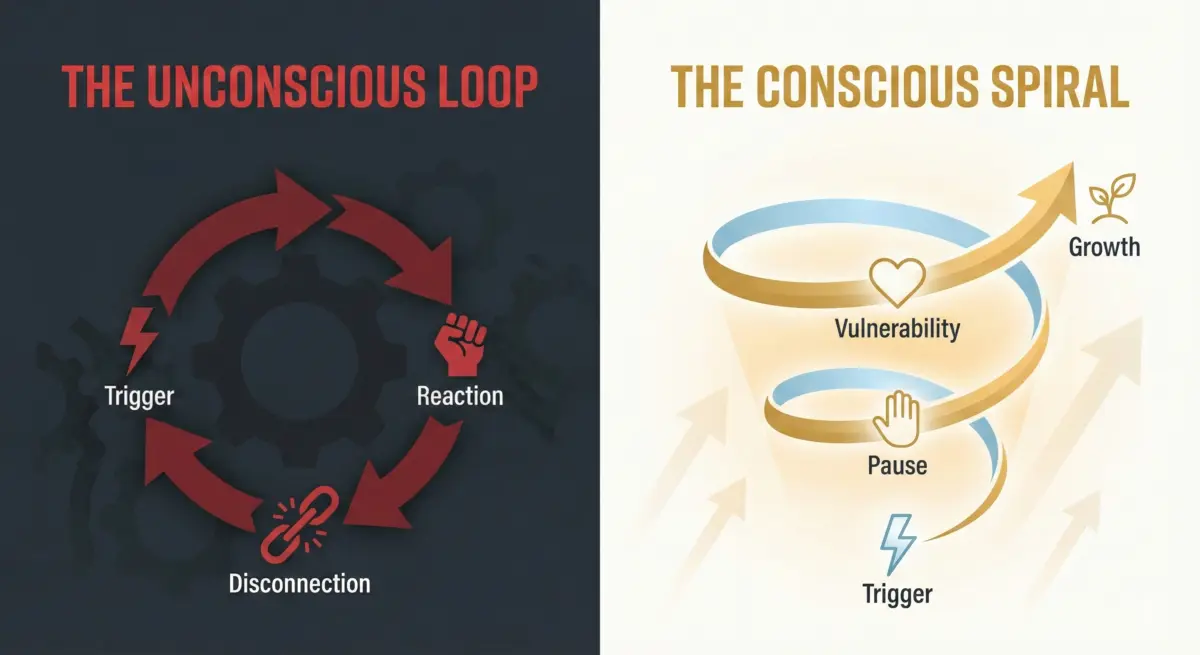
A conscious relationship accepts this reality. It shifts the focus from “fixing” your partner to regulating your own nervous system and taking radical responsibility for your reactions.
When you commit to this path, you stop fighting against your partner and start fighting for the integrity of your connection. You learn that the “spark” is not something you find.
It is something you cultivate through deep listening, somatic awareness, and the courage to integrate your shadow.
- Growth Over Comfort
The primary goal is not just to feel good, but to evolve individually and together. - Radical Responsibility
You own 100% of your emotional reactions instead of blaming your partner for your triggers. - The “Third Entity”
You treat the relationship as a separate living being that needs nourishment and protection. - Conflict as a Mirror
Arguments are viewed as opportunities to uncover hidden wounds and unmet needs. - Somatic Regulation
You prioritize calming the body (nervous system) before trying to resolve issues with the mind.
1. The Neuroscience of Safety: Why Love Goes Offline
To understand why conscious relationships are difficult, you must understand your biology. Your nervous system prioritizes survival above connection. It constantly scans your environment for threats in a process called neuroception.
When your partner raises their voice or withdraws into silence, your body often registers this as a danger signal. Your amygdala activates. Your prefrontal cortex, the part of your brain responsible for empathy and logic, goes offline.
You enter a state of sympathetic activation (fight or flight) or dorsal vagal shutdown (freeze).
In these states, you are physiologically incapable of connection. You cannot listen. You cannot be curious. You are preparing for war. A conscious relationship prioritizes co-regulation, which is the ability of one partner’s calm nervous system to soothe the other.
The Vagal Brake
Your ability to connect socially is directly linked to your heart rate. The “Vagal Brake” is a biological mechanism that slows your heart down to keep you calm.
The Vagal Brake
2. The Four Pillars of Conscious Connection
You do not build a conscious relationship by hoping for the best. You build it on a foundation of specific agreements and practices.
Pillar 1: Radical Truth-Telling
Most of us hide our true feelings to keep the peace. We say “I’m fine” when we are hurt. In a conscious relationship, you commit to revealing your inner world, even when it is uncomfortable.
This is not about being brutal. It is about being vulnerable. You share your fears, your desires, and your shame. This transparency builds a level of trust that “nice” behavior never can.
Subscribe to Create Higher Vibrations!
Get Inspiration and Practical advice straight to your inbox.
Pillar 2: The “Third Entity”
Conscious couples recognize that there are three parties in the relationship: You, Your Partner, and The Relationship itself.
Think of the relationship as a separate living being, or a “Third Entity.” Every interaction you have either nourishes this being or poisons it. When you attack your partner to win an argument, you might feel a temporary sense of victory, but you have damaged the
Third Entity. Conscious partners constantly ask: “Does this action serve the relationship?”
Pillar 3: Holding Space
Holding space means being present for your partner’s emotions without trying to fix them or make them about you. It requires you to suspend your own judgment and simply listen.
This is difficult because our partner’s pain often triggers our own anxiety. We want to make it go away so we can feel better. Conscious partners learn to sit in the fire of discomfort together.
Pillar 4: Sacred Sexuality
In a conscious relationship, intimacy is not a performance. It is a form of communication. You move beyond goal-oriented sex and explore sexuality as a way to deepen your energetic connection.
You use eye contact, breath, and slow touch to synchronize your nervous systems.
Intimacy & Physical Health
3. Turning Conflict into Gold
You cannot avoid conflict. You use it.
In a conscious partnership, you understand the 90/10 Rule. This rule states that 10% of the conflict is about the current situation (the dishes, the money, the schedule).
The other 90% is about your past history. The dirty dishes are rarely just about dishes. They are about a time in your childhood when you felt ignored or unimportant.
When you argue, you are often negotiating a trauma response rather than a logistical problem.

Identifying the Four Horsemen
Dr. John Gottman identified four behaviors that predict divorce with high accuracy: Criticism, Defensiveness, Contempt, and Stonewalling.
Conscious couples learn to spot these “Horsemen” instantly. They stop the conversation and repair the rupture before it deepens.
Predicting Divorce Accuracy
4. Step-by-Step Guide to Conscious Connection
This is your practical workflow for building a conscious container.
Step 1: Establish Your Agreements
Safety is the foundation of growth. Sit down when you are calm and write out your “Rules of Engagement.”
Discover Your Inner Self. Join Our Self-Mastery Program.
Self-Mastery Coaching gives you the space, tools, and guidance to grow, reflect and discover your values and inner strength.
Step 2: The Weekly Check-In
Schedule a 30-minute meeting once a week to discuss the state of the union. Use this simple script:
Step 3: Somatic Awareness
Before you speak, scan your body. Is your jaw tight? Is your chest constricted? If so, stop. Take five deep breaths. You are manually overriding your fight-or-flight response. Do not try to communicate complex ideas when your body is in threat mode.
Step 4: Repairing the Rupture
You will make mistakes. The difference in a conscious relationship is the speed of repair. Do not wait for an apology. Offer one. A conscious apology looks like this: “I realized I snapped at you. I was feeling overwhelmed, but that is not an excuse. I am sorry I raised my voice.”
The Magic Relationship Ratio
5. Common Pitfalls on the Path
Spiritual Bypassing
Do not use spiritual language to avoid human emotions. Saying “I am just protecting my energy” can be a form of stonewalling. Real intimacy is gritty. It requires you to feel anger, sadness, and grief without rushing to “transcend” them.
The “Therapist” Trap
You are a partner, not a clinician. Do not diagnose your partner. Saying “You are just reacting from your anxious attachment” is condescending. Use your knowledge to have compassion, not to win arguments.
Expecting Perfection
Consciousness is a practice. It is not a destination. You will still have bad days. The goal is not to eliminate conflict but to shorten the lag time between the rupture and the repair.
Conclusion
A conscious relationship is the hardest work you will ever do. It asks you to take full responsibility for your own happiness. It forces you to look at the parts of yourself you have spent a lifetime hiding.
But it is also the most rewarding work. You stop looking for a partner to save you and start becoming the partner you are looking for. Remember the Thermostat Effect: if you regulate your own nervous system, you change the temperature of the entire relationship.
Do not just read this article. Act on it. Tonight, ask your partner: "What is one thing I do that makes you feel most loved?" Then listen to the answer.