
Ancestral Wealth Epigenetics: How Poverty Leaves Marks on Your DNA

Ancestral wealth epigenetics is the science of how financial conditions across generations, including poverty, food scarcity, and chronic stress, leave chemical marks on DNA that alter how genes work.
These marks do not change the genetic sequence itself, but they can switch genes on or off, and they can pass from parent to child. Your biology, in very real terms, carries your family’s financial history.
That might sound unsettling at first. But understanding this connection is one of the most freeing things you can do.
Think about it: if you have ever wondered why generational poverty feels so sticky, why so many families seem to cycle through the same financial struggles and health problems across decades, epigenetics may be part of the answer.
Not because your fate is written in stone, but because your body has been quietly responding to everything your family lived through. And bodies can change.
- Poverty affects your wallet. Chemical marks appear on your DNA. These marks influence your health for decades.
- Epigenetic changes pass from parents to children. Generational poverty has a biological dimension.
- Financial stress rewires your brain. This stress changes gene expression linked to anxiety and depression.
- Epigenetic marks are temporary. Gene expression shifts under specific conditions. Change happens at every level.
What Is Epigenetics and Why Does It Matter for Poverty?
Epigenetics is the study of changes in how genes are expressed, not changes to the DNA sequence itself.
Environmental conditions like stress, poor nutrition, and chronic financial hardship can attach chemical “tags” to genes that switch them on or off. These tags can form early in life and, in some cases, pass to the next generation.
Picture your DNA as a piano. Every person has roughly the same keys. But epigenetics determines which keys get played, and how loudly.
Growing up in poverty does not rewrite the piano, but it does place a hand over certain keys, muting them or pressing others down harder. That shift in the music can last a lifetime.
The central mechanism here is called DNA methylation: a process where a small chemical group attaches to a section of a gene and changes how actively that gene works. Think of it as a dimmer switch.
Poverty and the chronic stress that comes with it have been shown to add or remove these dimmer switches in patterns that affect immune function, brain chemistry, and the rate at which your body ages.
This is what makes epigenetics so significant for understanding poverty. It sits exactly at the intersection of nature and nurture, where lived experience gets written into biology.
It is not about blaming your genes. It is about understanding that the body keeps score, in the most literal, molecular sense.
As someone who first encountered this research while trying to understand why health disparities seemed to follow family financial lines so precisely, I can tell you: the science does not catastrophize. It clarifies. And clarity is where real change begins.
Epigenetics bridges the gap between social conditions and physical health. Your environment does not just shape your choices; it shapes your cells.

How Does Growing Up in Poverty Change Your DNA?
Research on epigenomics and poverty has found that poverty leaves chemical marks on nearly 10% of the genes in the human genome.
These marks show up as altered DNA methylation at thousands of specific sites across more than 1,500 genes, affecting immune response, neurological development, and skeletal growth.
The changes are measurable in adulthood, even when childhood poverty ended years earlier.
That figure is worth sitting with. Nearly one in ten of your genes may carry a record of the financial conditions you were raised in.
Researchers have mapped these changes to specific areas on the genome called CpG sites, the precise locations where methylation tags attach. The genes affected are not random.
They cluster around systems your body uses to manage inflammation, regulate stress hormones like cortisol, and control neurological development in early childhood, all of which are exactly the systems most taxed by living in financial hardship.
A study on poverty and DNA methylation patterns found that methylation differences between men who grew up wealthy versus poor appeared at nearly one-third of active gene promoter sites. That is not a small statistical footnote.
There is a wide biological gap between two people who may look identical on the outside.
What makes this even more striking is that these marks persist. Adults who grew up poor but later achieved financial stability still showed the epigenetic signatures of early poverty. The body remembers what the bank account has long since moved past.
It is also worth noting that the impact is not identical across all groups. A 2024 peer-reviewed study found that poverty at birth predicted accelerated epigenetic aging in male children by age 15, but the same pattern was not observed in female children, suggesting that the biological toll of early financial hardship may differ meaningfully by sex.
Poverty written into DNA is not a metaphor. It is a measurable biological reality.
What Is the Link Between Ancestral Wealth and Epigenetic Health?
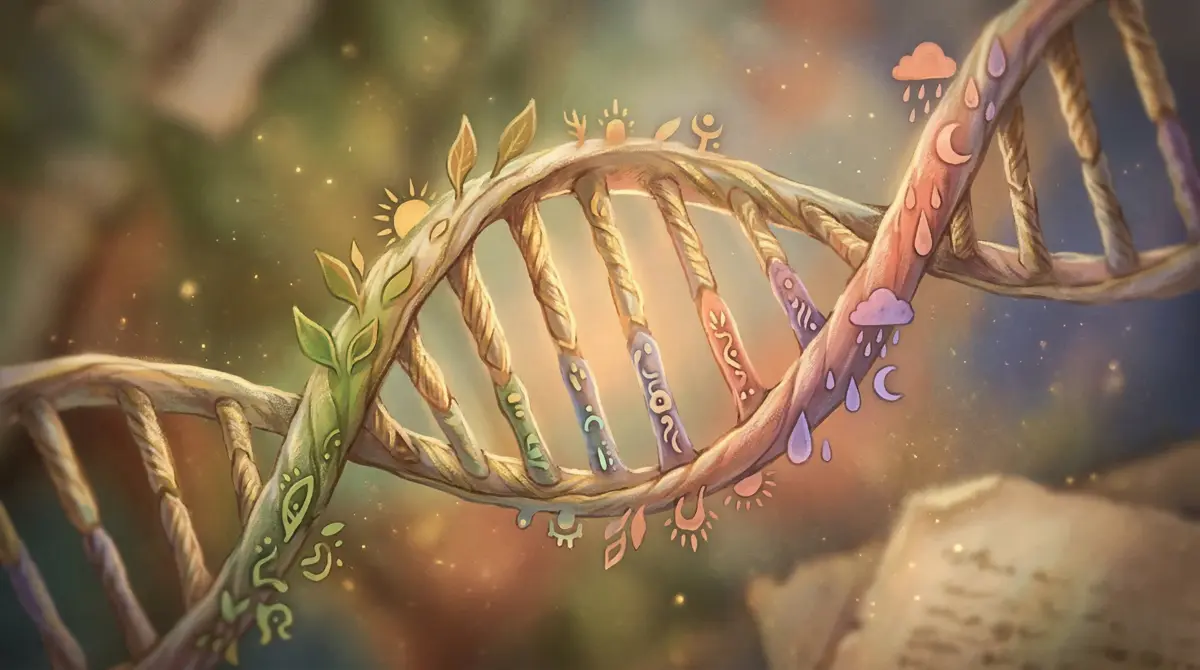
Ancestral wealth, or the lack of it, shapes the epigenetic environment a child is born into. Parents and grandparents who experienced financial stress, food scarcity, or chronic adversity can pass altered gene expression patterns to their offspring.
This means the health consequences of poverty may stretch across multiple generations, even after material conditions improve.
This is the part that surprises most people. We tend to think of inheritance in terms of money, land, or maybe a genetic predisposition to high cholesterol.
But inheritance also includes the epigenetic programming laid down by how safely and abundantly our ancestors were able to live.
The mechanism is called transgenerational epigenetic inheritance: the process by which stress-related gene modifications travel through sperm, eggs, and the in-utero environment to affect the next generation.
A 2025 study published in Nature examined three generations of Syrian refugee families and found epigenetic signatures of violence and trauma present in grandchildren who never directly experienced the original events. The biology crossed a generation gap that the memory could not.
Similar patterns have been observed in historical food scarcity research. The Överkalix studies from northern Sweden tracked generations of families through detailed harvest records.
When a grandfather experienced food scarcity just before puberty, his grandchildren showed measurably different rates of cardiovascular disease and diabetes. No direct environmental exposure could account for it. The effect traveled down the paternal line.
What “ancestral wealth” really means here is not just money. It means access to consistent nutrition, physical safety, low chronic stress, and education. These are the inputs that create a healthier epigenetic baseline.
When those inputs are absent across multiple generations, the body adapts in ways that can outlast the original conditions by decades.
As I have sat with this research over the years, I keep coming back to one thought: the families we come from gave us more than stories. They gave us a biological starting point shaped by everything they survived.
The epigenetic legacy of ancestral poverty is real. Understanding it is not about blame; it is about context.

Does Poverty Speed Up Biological Aging at the DNA Level?
Poverty is associated with faster biological aging as measured by epigenetic clocks. A 2023 JAMA Network Open study found that households below the poverty line had significantly higher DunedinPACE scores, meaning their biology aged faster than their actual chronological age. This gap widens further along racial and economic lines.
Epigenetic clocks like DunedinPACE and PhenoAge are tools researchers use to measure biological age from DNA methylation patterns.
They are essentially a way of asking: how old is your body, really, regardless of what your birth certificate says? For people living in poverty, the answer is consistently older than expected.
The biological “middleman” here is allostatic load, the cumulative wear and tear on the body from prolonged stress. When you are living with chronic financial pressure, your body activates its stress response systems repeatedly and over long periods.
Cortisol, the primary stress hormone, stays elevated. Inflammation runs higher. The cellular machinery that normally repairs DNA damage gets less attention. All of this accelerates the pace at which your cells age.
A 2024 study reinforced this picture, showing that poverty at birth predicted measurably accelerated epigenetic aging in male adolescents by age 15. That is not aging in the distant future. That is a teenager whose body is already running older than it should be.
This connects directly to why people from low-income communities often carry higher rates of heart disease, metabolic disorders, and cognitive decline at earlier ages.
It is not just about access to healthcare, though that matters enormously. It is about what prolonged financial stress does to the biology underneath.
Poverty does not just drain your bank account. It accelerates the clock inside your cells.
Can Poverty Rewire the Brain Through Epigenetics?
Chronic financial stress during adolescence is linked to epigenetic changes in the serotonin transporter gene (SLC6A4), which raises the brain’s sensitivity to threat.
This NIH-published longitudinal research found these changes amplify amygdala reactivity and raise long-term risk for depression, making emotional regulation harder, particularly for people who grew up without economic security.
The SLC6A4 gene controls how efficiently serotonin, a chemical central to mood regulation and emotional stability, moves through the brain. When methylation increases on this gene, the system becomes less efficient.
The brain’s threat-detection center, the amygdala, becomes more reactive. Small stressors feel bigger. Risk feels more dangerous. Trust feels harder to extend.
Now imagine growing up in a household where money was consistently scarce. The stress of that environment, over time, can literally tune the brain toward vigilance. That is not a character flaw. That is biology adapting to a genuinely uncertain environment.
The same research tracked young people over two years and found that lower socioeconomic status during adolescence predicted an increase in SLC6A4 methylation across that period, suggesting this is not a one-time event but a progressive biological response to ongoing financial stress.
As someone who has spoken with many people navigating the aftermath of financially unstable childhoods.
I have heard this rewiring described in lived terms: the feeling that abundance is temporary and must not be trusted, the impulse to spend money quickly before it disappears, the deep discomfort of financial calm.
These are not irrational responses. They are the behavioral surface of epigenetic changes that were, at the time, adaptive.
This does not mean you are trapped in that wiring. It means you can understand where it came from.
Poverty can reshape the brain’s baseline. Knowing that is the first step toward reshaping it.
Is Generational Poverty Written Into DNA, Or Can It Be Changed?
Epigenetic marks from poverty are not permanent. Unlike genetic mutations, epigenetic tags are, in principle, reversible.
Research from the Borgen Project’s overview of epigenetics and poverty suggests that nutrition, stress reduction, safe social environments, and consistent access to resources can shift gene expression patterns over time. Generational poverty has a biological dimension, but biology is not destiny.
This is the part of the science that gets quietly left out of a lot of conversations about poverty. The same plasticity that allowed poverty to imprint itself on the genome is the same plasticity that allows those imprints to change.
Some of the most well-supported inputs for positive epigenetic change include:
It is also worth naming something clearly: individual habits can shift gene expression, but the most powerful levers are structural.
Reducing poverty, improving food access, building safe housing, and funding early childhood programs are not just social policies. They are, in a biological sense, epigenetic interventions.
This does not mean personal effort is meaningless. It means that both things are true. You can take real steps toward changing your epigenetic environment, and those steps are made meaningfully easier or harder by the systems around you.
I have seen this play out. People who stabilized their living conditions, built consistent routines, and reduced chronic stressors often described something they could not quite name at first: a quieting.
A baseline that felt different. Less braced. That is not just a mindset shift. It is biology responding to a changed environment.
Epigenetic plasticity means that the marks left by poverty are real, and so is your capacity to move them.

What Does This Mean for Racial Wealth Gaps and Health Disparities?
The same research that maps poverty onto DNA also consistently finds that race amplifies epigenetic risk.
A 2023 JAMA Network Open study showed that Black and Latino individuals living in poverty experience the fastest rates of biological aging, reflecting the compounded impact of racial inequity and financial hardship.
This is not a biological given. It is a measurable consequence of systemic inequity, encoded at the cellular level.
Arline Geronimus, a researcher at the University of Michigan, introduced the concept of weathering to describe how chronic social stress accelerates biological aging in marginalized communities.
The idea is that the persistent, low-grade physical demand of navigating racial and economic inequality wears the body down faster, in ways that show up in epigenetic data.
The 2024 PMC study found that Black and Latino children were disproportionately represented among those born into poverty and showed correspondingly greater epigenetic aging by adolescence.
This is not a story about the genetic difference between racial groups. It is a story about what compounded historical and current disadvantages do to the body across generations.
This matters for how we interpret health disparities. When Black communities show higher rates of early-onset heart disease, or when Latino families carry elevated chronic illness rates despite cultural dietary strengths, the explanation is not located in biology alone.
It is located in the intersection of biology and a long history of systematically denied ancestral wealth, safety, and stability.
Seeing this through an epigenetic lens validates the lived experience of communities who have long known that inequality is not just a social wound. It is a physical one.
Structural change is not just a moral position. It is, from a biological standpoint, a health intervention.
Discover Your Inner Self. Join Our Self-Mastery Program.
Self-Mastery Coaching gives you the space, tools, and guidance to grow, reflect, and discover your values and inner strength.

Key Facts About Ancestral Wealth and Epigenetics
Subscribe to Create Higher Vibrations!
Get Inspiration and Practical advice straight to your inbox.
Your DNA Is a Starting Point, Not a Sentence
The science of ancestral wealth epigenetics does not tell us that poverty is fate. It tells us that poverty is written into the body, and that bodies can change.
Understanding the biological dimension of generational financial hardship removes blame from the picture and opens the door to something more useful: a clear-eyed, compassionate path forward.
Your cells carry your family's history. That is real. And the same biological system that recorded that history is also capable of writing something new, with the right conditions, the right support, and time.
If this has stirred something in you, a recognition, a grief, or a quiet sense of possibility, you might find it worthwhile to explore how generational trauma healing connects to physical wellbeing, or to look more closely at the everyday practices that support stress and gene expression habits over time.
The science points in one direction: change is possible, at every level.